
Morning Note: Market News and Updates from Visa, Unilever, and Heineken.
Market News
Asian equities rallied sharply overnight, led by a 6.6% surge in South Korea’s Kospi after SK Hynix reported a sevenfold jump in quarterly profit and announced a $45bn shareholder return programme, reigniting the AI trade. OpenAI is also reportedly in discussions to purchase Google TPU chips, adding another layer to the AI infrastructure narrative. Elsewhere in Asia, equity markets were also firm: Nikkei 225 (+1.1%); Hang Seng (+0.3%); Shanghai Composite (+0.9%).
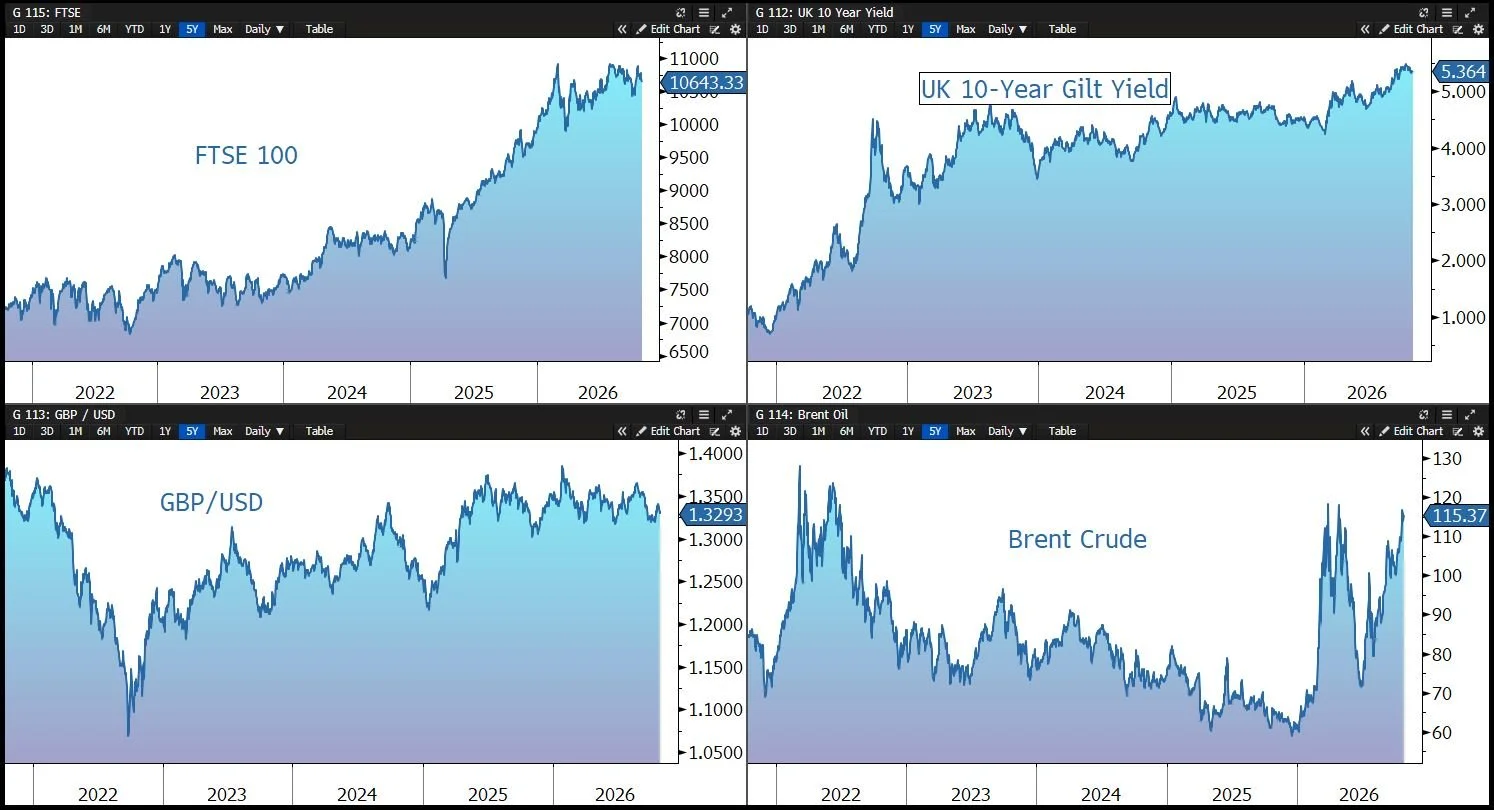
In the US, the S&P 500 is expected to open slightly higher this afternoon, with the market focused on the FOMC interest rate decision. The 10-year Treasury yield has edged above 5%, with markets pricing a 91% probability of a Fed hold. The focus will be squarely on Chair Kevin Warsh’s tone, specifically whether he signals a December hike is live given persistently elevated inflation. After yesterday’s rise, gold trades at $4,050 an ounce.
Brent crude has risen to $115 a barrel, on a report the US may resume military strikes on Iran after next week’s mid-term elections.
Chancellor John Healey’s inaugural budget kicks off at 12:30pm. Markets are braced for higher taxes on UK banks. The budget is expected to be modest in scope, prioritising household relief, but any fiscal surprise — in either direction — could move gilts and sterling sharply. Sterling currently trades at $1.3295 and €1.1950.
The FTSE 100 is currently 0.3% lower at 10,659. In Consumer Staples, Unilever (see below) beat on Q3 sales and raised volume guidance, while Heineken (see below) also beat on volumes, with Asia Pacific a standout. Healthcare company GSK is down 4% following its results. It is a heavy earnings day for the banking sector. BNP Paribas is trading higher on strong equities trading and a new buyback. Standard Chartered delivered a broad-based beat with low-to-mid single-digit EPS upgrades expected. UBS was broadly in line.
Source: Bloomberg
Company News
Yesterday evening, Visa released results for the three months to 30 September 2026, the final quarter of its FY2026 financial year, that were slightly better than market expectations and included a generous 16% dividend hike. Revenue was driven by resilient consumer spending and continued strength in consumer payments, commercial and money movement solutions, and value-added services. The company also initiated guidance for FY2027, targetting earnings growth in the low-double-digits to low-teens, a touch below market expectations. As a result, the shares, which are trading close to an all-time high, were marked down 2% after hours.
Visa is the world’s largest electronic payments network. It connects nearly 14,500 financial institutions, 175m merchant locations, and around 12bn cards, bank accounts, and digital wallets. Visa is not a bank; it doesn’t lend or take on credit risk. It doesn’t issue cards or place the terminals at the merchant locations. Instead, the company earns a small fee from 281bn transactions processed on its network to generate annual revenue of $46bn. The company is increasingly evolving into ‘Visa-as-a-Service’ which involves unbundling Visa’s product set to support more customers in more ways across its service stack. Revenue outside of traditional Consumer Payments (i.e. Commercial & Money Movement Solutions and Value Added Services) now account for more than 30% of revenue.
Outside of the US, Visa is still benefiting from the ongoing shift from cash and cheques to electronic means of payment, and the growth of online retail, contactless, and mobile payment systems. In emerging markets, a lack of physical communication infrastructure traditionally provided a barrier to payments growth, but that has been removed by the emergence of mobile phone technology and a government focus on digitalising cash to reduce the black economy. Earlier in the month, Visa announced approval of its Application to Prepare from the People’s Bank of China, which allows the company to begin formal preparations to establish a domestic bank card clearing institution in China. This marks an important milestone toward the company serving China’s domestic payments market.
There is a huge opportunity for Visa’s trusted network in agentic commerce where autonomous AI agents act on behalf of consumers to discover, compare, and purchase products or services. Visa has launched Visa Intelligent Commerce, a tool that creates ‘Agentic Tokens’ (rather than credit cards) that allow AI (like Claude) to pay on behalf of the consumer without ever seeing an actual card number. Visa’s value is trust and settlement – when a consumer hands over purchasing power to an AI agent, Visa wants to ensure its ‘rails’ are the default, trusted payment mechanism embedded in the software. We note recent research which highlights that Visa is the most trusted brand for AI-powered payments, with 61% of respondents saying they would trust Visa to handle agentic transactions. On the operational side, Visa has leveraged AI to help with faster product innovation, whilst cutting 7% of the tech workforce. In addition, Visa’s Stablecoin initiatives continue to grow.
In Consumer Payments, Visa estimates a total market of $41tn worldwide, with 56% ($23tn) still available to be served, including $11tn cash and cheques. The company has six areas of focus including: ‘tap to everything’, token technology, cross-border, affluent consumers, A2A (account to account) payments, and credit. Since 2020, the number of Visa tokens has increased from 1bn to 17.5bn, with adoption led by ecosystem benefits including 5% higher authorisation rates and 30%+ lower fraud.
Growth in Commercial & Money Movement Solutions (CMS, formerly known as ‘New Flows’) is expected to outpace the Consumer Payments business over the long term. The company believes the total addressable market of the opportunity is massive – $145tn in B2B payments and $55tn in disbursements/payouts/P2P. Even though yields for these new flows are lower on average than Consumer Payments (as they tend to be high-volume, low-complexity B2B transfers), they utilise Visa’s existing infrastructure and take advantage of the company’s massive scale and fixed operating costs, resulting in high margins.
The group’s third growth engine is Value Added Services that help clients and partners optimise their performance, differentiate their offerings, and create better experiences for their customers. The company estimates the total addressable market at more than $500bn, meaning only 2% has been penetrated so far. Many of Visa’s largest clients now use more than 20 value-added services, such as cybersecurity, fraud prevention, advisory services, identity solutions, data analytics, tokenisation, and AI, all of which enhance the group’s competitive advantage.
During the three months to 30 September 2026, against a backdrop of heightened geopolitical tensions, consumer spending remained resilient, and the group’s strategy continues to deliver strong performance across all three divisions. The company continued to enhance its Visa as a Service stack, including with agentic and stablecoin capabilities, to further strengthen its position as the leading hyperscaler of payments globally.
Trends were strong across key metrics: payments volume (+9% in constant currency, with debit and credit up 10% and 9%, respectively), processed transactions (+10% to 74.2bn), and cross-border volume growth (which includes a lot of e-commerce as well as travel, +14%), boosted by the FIFA World Cup.
Net revenue grew by 13% on a constant currency basis in the quarter to $12.1bn, in line with the market forecast and the company guidance for growth at the high end of low double-digit. For the full year, revenue grew by 14% to a record $45.9bn.
Q4 revenue was made up of service revenue (based on prior-quarters payment volume, +14% to $5.3bn); data processing (+16% to $6.2bn); international transaction revenue (+8% to $4.1bn); and other revenue (+40% to $1.6bn). Client incentives, a contra-revenue item, were up 21% to $5.1bn.
On the call, the company highlighted that Commercial & Money Movement Solutions grew by 19% in the year and Value Added Services revenue rose by 30% (helped in part by the acquisition of Prisma). Together they amounted to 40% of revenue. Visa Direct transactions grew 20% to 15bn.
Operating expenses were up 11% in constant currency in the quarter, in line with the expectation for low double-digit growth but below the 17% growth seen in the previous quarter. The company is cutting 7% of its workforce, primarily across technology and product teams, with the savings expected to be reinvested in the business.
Adjusted EPS was up 17% on a constant currency basis, to $3.48, above the market expectation of $3.43 and the company guidance for growth in the low end of mid-teens. This was helped in part by a lower tax rate. Full-year EPS rose by 16% to $13.27, versus the market forecast of $13.22, and better than the company guidance for growth in the low end of mid-teens
During the quarter, Visa generated $6.9bn of free cash flow. The group’s balance sheet remains strong, with cash, cash equivalents, and available-for-sale investment securities of $14.2bn at the end of September. The main capital allocation priority is to invest to grow the business, both organically and via acquisition – agentic commerce and stablecoins are current areas of investment focus.
Visa also has an ongoing commitment to return excess cash to shareholders. The group has a record of strong dividend growth, with the latest quarterly payout raised by 16% to $0.78. During the latest quarter, the company also bought back $4.0bn of its stock, leaving $24.4bn remaining of its authorised multi-year programme.
Visa has a long-term track record of coping with regulatory challenges and has flexibility in its cost base to mitigate any bottom-line impact. Earlier in the year, President Trump called for a one-year, 10% cap on credit card interest rates, significantly lower than the current market average of over 20%. This will require a legislative change, with Trump formally asking Congress to codify the cap. We believe the 10% cap is a volume risk rather than a margin risk for Visa. It threatens the ‘network effect’ by potentially shrinking the pool of active spenders, but it reinforces the strategic importance of Visa’s expansion into New Flows and Value Added Services.
Another ongoing threat is the Credit Card Competition Act (CCCA) which, if passed, would force major issuing banks to provide merchants with at least one alternative network (such as Discover or independent routing networks like Star or Pulse) to process credit transactions. This would break the Visa-Mastercard duopoly on credit routing, introducing direct price competition that could lower overall transaction revenues and squeeze swipe fees. While the banking lobby continues to fight the measure aggressively – citing recent judicial antitrust settlements as sufficient merchant relief – strong bipartisan sponsorship and explicit endorsement from the White House give the Act greater momentum than in previous congressional cycles
Overall, we believe the long-term growth prospects for Visa remain attractive, more so given the acceleration in recent years in the shift to e-commerce, tap-to-pay, and new digital payments, and in the number of acceptance points at SMEs (particularly tap-to-phone). In addition, the broad application of digital payments by businesses and government agencies provides a huge market opportunity. The long-term revenue growth framework is: Consumer Payments at 5%-7% and Commercial & Money Movement Solutions/Value Added Services at 16-18%, with the latter moving from a third to a half of revenue over time. This implies total net revenue growth of 9%-12%.
The company issued new guidance for the financial year to 30 September 2027: low-double-digit revenue growth. This includes growth in Value Added Services in the low to mid-20s. EPS growth in the low-double-digit to low-teens is expected on a constant dollar basis, slightly behind mid-teens market expectation.
For the current quarter as a whole, the company expects to generate revenue growth in the low double-digits, operating expenses growth in the low- double-digits, and EPS growth in the low-end of mid-teens.
While some short-term economic uncertainty persists, the group remains confident in its ability to execute its strategy and expand Visa’s role at the ‘centre of money movement’. We believe the company has the ability to compound revenue in the low double digits over the medium-term. That said, a slowdown in overall consumer spending could be a drag on volumes, although spending across the network is very diversified, be it credit vs. debit, domestic vs. overseas, discretionary vs. non-discretionary spend, and low vs. high ticket spend. However, the company has previously said that if the economy does go into a recession, Visa is now stronger in debit – the card of choice in tougher times – than it was in the 2008/09 financial crisis. The group also highlights that if there is a downturn, they have plenty of flexibility on costs and client incentives. Note also that half of the group marketing spend is variable.
Source: Bloomberg
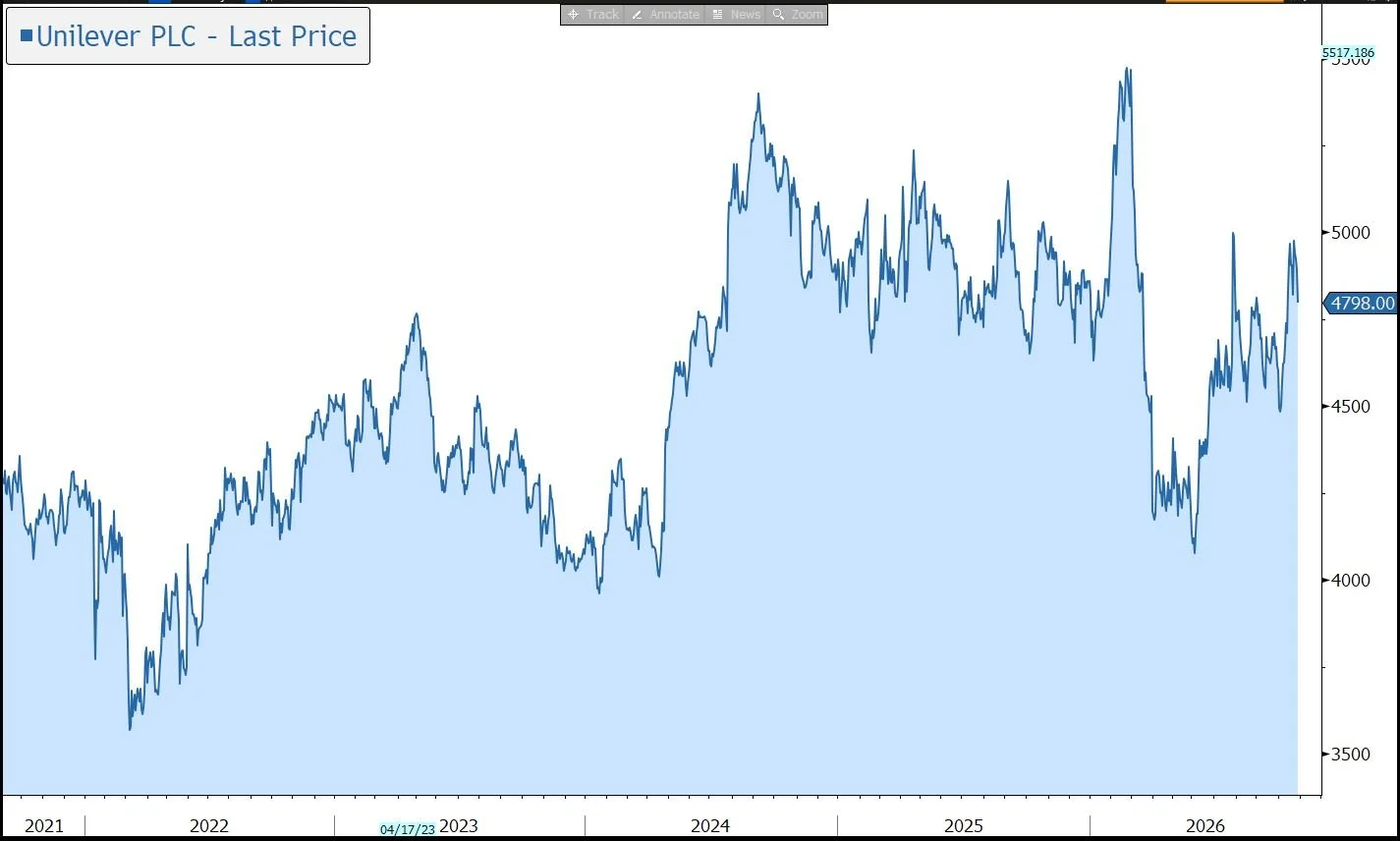
Unilever has today released Q3 results which were better than market expectations. The company delivered underlying sales growth of almost 5% driven by emerging markets. In response, Unilever has nudged up its guidance for the full year, highlighting confidence it will now deliver at least 3% volume growth. However, there were some negatives: the decline in North America was a surprise but, on the call, management said this was a one-off and is confident of a return to growth in Q4. In response, the shares have been marked down by 3% in early trading. The focus will now shift to next week’s Capital Markets Day at which the group may launch a new productivity programme and a potential medium-term margin ambition.
Unilever is one of the world’s leading suppliers of consumer goods, with annual sales of more than €50bn. Its products are low-ticket, repeatable purchases, with 3.4bn people using a Unilever brand every day. With unique routes to market, the company has an unrivalled emerging market presence and generates 60% of its sales from those parts of the world expected to experience strong long-term growth in demand. In particular, the group’s 62% holding in India-listed Hindustan Unilever Limited provides exposure to the largest consumer goods company in India.
Following last year’s demerger of its Ice Cream unit Magnum, in which Unilever has retained a 19.9% stake, the company recently announced a $44.8bn combination of its Foods division with US flavours company McCormick. The new company will house leading, iconic brands including McCormick, Knorr and Hellmann’s, and brands with high growth potential including Cholula, Maille, and Frank’s, as part of a global portfolio with revenue of $20bn. Work is already underway to support the delivery of $600m of annual run-rate cost synergies net of growth reinvestments, and incremental cost and revenue synergies of $100m. Unilever expects €400m-€500m of stranded costs following the separation, which will be offset with savings over 2027 to 2029, incurring one-off restructuring costs of €500m over that period. Overall, although the valuation of the deal was reasonable, the structure was poorly received. The negative sentiment has been driven by the complexity of the deal, particularly the fact that Unilever shareholders will own a direct stake in a US-listed company, the lack of a Unilever shareholder vote, and the reduction in operational scale of the remaining business (and the resulting credit outlook downgrade). The deal isn’t expected to close until mid-2027 and is subject to McCormick shareholder approval and the receipt of required regulatory and other approvals. In the summer, McCormick announced the planned operating model and executive team of the combined company, along with a secondary listing location in London. The transaction is currently “on track”.
Following the separation of its Foods division, Unilever will become a leading pure-play Home and Personal Care (HPC) business spanning Beauty, Wellbeing, Personal Care, and Home Care. The focus will be on categories with strong structural growth and the highest returns. 25 Power Brands will account for 78% of revenue. The pro-forma portfolio generated revenue of €39bn in 2025 and delivered a compound annual growth rate of 5.4% underlying sales growth in the last three years, alongside a gross margin of 48% and an underlying operating margin of 19%.
The main focus will be to generate more sales in the US, India, the beauty sector, premium markets, and the e-commerce channel. The remaining 100+ smaller markets will be run on a ‘One Unilever’ basis to benefit from scale and simplicity, further enhancing the group’s focus.
Overall, over the medium term, Unilever is still aiming to deliver mid-single digit underlying sales growth, underpinned by at least 2% underlying volume growth and continued modest improvement in operating margin fuelled by gross margin expansion.
Back to today’s results. In the quarter to 30 September, turnover rose by 6.7% to €13.3bn. Underlying sales growth (USG) – adjusted for the impact of currency (+0.6%) and M&A (+0.8%) – was 5.2%, ahead of both the first half (+4.8%) and the market forecasts (+4.7%).
Growth was driven by good volume growth of 2.9%. Underlying price growth was 2.3%, put in place to offset the impact of higher commodity costs. This was faster than the first half which was held back by three temporary factors
Growth was led by the Power Brands, which grew underlying sales by 5.8%, with 3.3% volume growth.
In emerging markets, USG was 9.5%, led by double-digit growth in India (+15%), Turkey, Vietnam, and Pakistan. China delivered low single-digit growth.
Developed markets fell by 0.9%, reflecting tougher prior-year comparators and softer performance in Foods. North America declined by 0.7% while continuing to gain volume share, as strong growth in Personal Care and Beauty was offset by declines in Wellbeing and Foods. On the call, the company blamed this outlier on tough comps and is confident of a return to growth in Q4. Europe fell by 1.7% in a soft market environment
By Business Group:
· Beauty & Wellbeing (+5.7% USG to €3.5bn) – led by strong performance from Power Brands and the prestige portfolio. This included double-digit growth in Dove, Vaseline, Sunsilk, Clear and K18. Wellbeing declined, partly due to shipment timings for Amazon Prime Day, but is expected to get progressively.
· Personal Care (+6.3% to €3.6bn) - driven by broad-based growth across geographies, with high-single digit growth in emerging markets and mid-single digit growth in the US.
· Home Care (+9.1% to €3.1bn) - Fabric cleaning grew double-digit and home & hygiene and fabric enhancers grew mid-single digit.
· Foods (+0.1% to €3.1bn) – emerging market and Unilever Food Solutions growth was offset by softness in developed market retail.
As this was only a sales update, other than the commentary on the productivity programme there is no detail in the statement on profitability or the group’s financial position.
As a reminder, in the first half the gross margin fell by 70 basis points to 46.8%, reflecting the benefits of volume leverage and productivity, offset by commodity inflation and calibrated pricing. The group completed its €800m productivity programme six months ahead of schedule, which helped to generate an improvement in underlying operating margin in the first half, up 10 basis points to 20.3%.
Net debt ended the first half at €26.0bn, 2.3x EBITDA, with the company is still guiding for ‘around 2x’ for the full year. The company’s capital allocation framework is prioritising disciplined investment behind organic growth and €1.5bn a year on bolt-on acquisitions.
Capital returns include a dividend payout ratio of approximately 60%, alongside €6bn of share buy‑backs expected to run between 2026 and 2029. The latest quarterly dividend has been increased by 3% to €0.4664, although in Sterling terms it is down 0.5% at 39.07p. In June, the company completed its €1.5bn share buyback programme, an acceleration reflecting management’s clear view that the current stock valuation materially understates operational performance.
Looking ahead to the full-year, the company still expects underlying sales growth to be within its multi-year guidance range of 4% to 6%. The company is now confident it will deliver at least 3% volume growth for the full year, versus the previous expectation of ‘around 3%’, and underlying sales growth in the second half of around 5%, versus 4%-5% previously. The company continues to anticipate a modest improvement in underlying operating margin for the full year versus 20.0% in 2025.
Source: Bloomberg
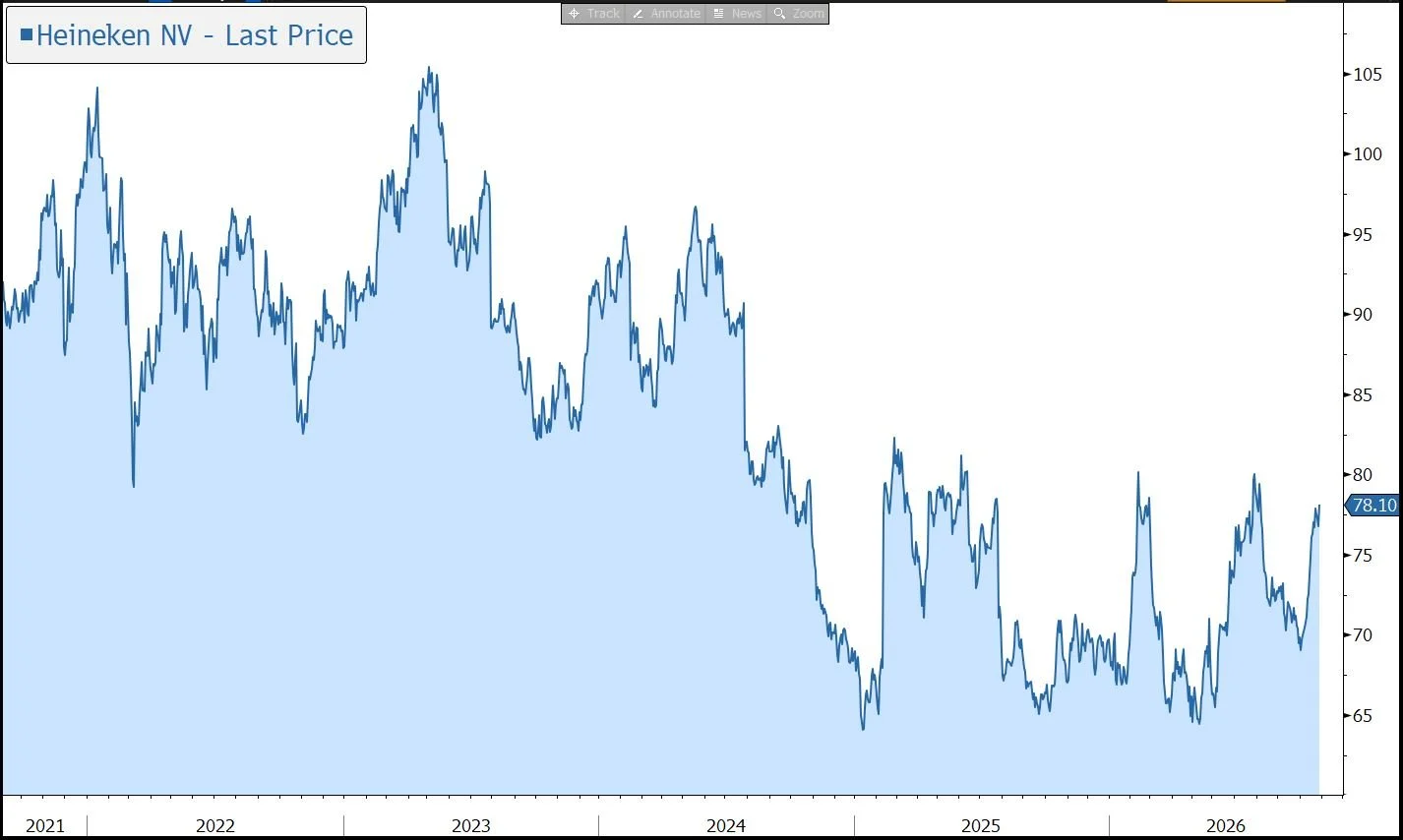
Heineken has this morning released its Q3 results which were better than market expectations, driven by good volume growth. The group’s balance sheet remains robust and the second tranche of its share buyback programme is ongoing. Based on a prudent assessment of the current macroeconomic environment, the company has reiterated its guidance for operating profit to grow in the 2% to 6% range. Ahead of the analysts’ meeting, the shares are trading up 2%.
Heineken is the world’s second largest brewer, generating net revenue of €29bn from a portfolio of iconic brands, many of which have been quenching the thirst of consumers for decades. In addition to the core Heineken brand, the company owns several well-known beers and ciders, including Sol, Tiger, Amstel, Murphy’s, and Strongbow, as well as around 200 local brews. Heineken is benefiting from the growth of low and no-alcohol products, where it is the global leader, and has gone ‘beyond beer’ with the launch of seltzers and ready-to-drink products. Finally, the company also owns around 2,400 pubs in the UK, runs a wholesaling operation in Europe, and has a strong global distribution capability.
Over time, the group has expanded and developed its global footprint through investment in new breweries, partnerships, and acquisitions. It has also exited several businesses to refine the portfolio, most recently the company exited its business in the Democratic Republic of Congo to an asset-light licensing model.
We believe the company is well placed to benefit from long-term growth opportunities in emerging markets (which generate 55% of revenue), where young and growing populations, low per-capita beer consumption, and increasing wealth are expected to drive growth. The company believes the biggest opportunity lies in India, with strong prospects also in Mexico, Brazil, China, Vietnam, and South Africa. Most recently, the group strengthened its position in Central America through the $3.2bn acquisition of the multi-category beverage portfolio and retail business of FIFCO, a deal that was immediately accretive to earnings.
The group generates more than 40% of its revenue from premium brands, where volume is growing faster than mainstream beer because consumers turn to better brands as they grow older and wealthier. Premium brands tend to have greater pricing power.
We believe the shareholding structure, supported by family ownership, ensures the company is run for the long term and in the best interests of all shareholders.
In the near term, however, the global industry environment is challenging, with headwinds from the impact of weight-loss drugs on alcohol consumption, health warnings, Gen-Z moderation, and cannabis cannibalisation. In particular, we note a recently-leaked internal Heineken presentation which revealed concerns that GLP-1 weight-loss drugs are curbing alcohol cravings and accelerating shifts toward smaller servings. However, this dynamic underscores the strategic foresight of Heineken’s pivot towards low- and no-alcohol products, providing a natural hedge as consumer habits shift.
Although there are challenges, we believe there is also a cyclical overlay with macroeconomic issues impacting overall consumer spending.
Against that backdrop, the company has embedded a stronger productivity culture, with improved resilience, enabling more consistent cash generation and shareholder returns. The EverGreen 2030 Strategy is targeting 18 priority markets and fewer, bigger brands (five global and 25 local). This involves a transition from a federation of local units – a legacy of multiple acquisitions over the years – to a more centralised, data-driven organisation. By using Freddy.ai, the company’s in-house digital marketing agency, Heineken expects to significantly improve marketing efficiency, pricing agility, and speed-to-market of new products across its global footprint.
The aim is to grow ahead of the Beer category’s 1% volume CAGR, which combined with pricing above input cost inflation, as well as positive mix, underpins the mid-single-digit revenue growth target. Productivity savings of €400m-€500m p.a. are expected to underpin organic profit growth ahead of sales growth, with EPS growth expected to outpace operating profit growth and cash conversion expected to be 90%.
Heineken’s new CEO Rafa Oliveira started at the beginning of October and has been tasked with accelerating the execution of the company’s existing strategy. As the company’s first-ever true outsider – he is the ex-CEO of JDE Peet’s, the world’s largest pure-play coffee and tea company, and President of International Markets at Kraft Heinz – the hope is that Oliveira will bring a fresh pair of eyes to the business. With today’s results, Oliveira highlights that there is “more to do to sharpen execution, increase pace, and build a stronger performance culture, with greater accountability across the business”. He plans to share “more … perspective with the full-year results" in February.
In the third quarter of the year, net revenue grew by 4.6% on an organic basis to €8.1bn. Although the result was aided by relatively easy year-on-year comparative, the growth rate was above the market forecast of +3.5%.
Growth was driven total volume up 4.8%, made up of consolidated volume up 3.9% and licensed volume up 19.5%. Net revenue per hectolitre only grew by 0.7%. Price-mix on a constant geographic basis increased 1.8%.
We note that if you include the growth from the China associate and contract brewing business in India – neither of which appear in the revenue line – growth would currently be higher.
Once again, the company gained or held share in more than two thirds of its markets.
Beer category dynamics varied meaningfully across the group’s markets, with the revenue performance as follows:
- Asia Pacific (volume up 17.3%; net revenue up 15.1%) remains the key growth engine, with particularly strong momentum in Vietnam, China, and India.
- Africa & Middle East (+4.3%, +6.8%) delivered resilient volume growth
- Americas (+2.1%, +3.1%), returned to growth in the quarter, including Mexico and Brazil.
- Europe (+0.6%, +1.3%) grew modestly, supported by strong customer activation, notably in the off-trade, and favourable weather.
The group continues to see an ongoing shift towards product premiumisation, with volume up 11.5% organically. The Heineken brand itself was also up 9.7% in Q3, with double-digit growth in 22 markets. Note, mainstream volume grew by 2.4%.
In the low & no-alcohol category, the company consolidated its market leadership, with volume up double-digits, led by Heineken 0.0 also up double-digits. The beyond beer segment grew by mid-teens, led by Desperados. During the quarter, the company agreed to acquire a majority shareholding in the fast-growing ready-to-drink brand Stëlz.
As is usual at this stage, there is no other update on the group’s profitability or financial position. As a reminder, during the first half, the company accelerated its EverGreen 2030 strategy and is on track to deliver gross savings of €500m in 2026.
Heineken has a strong balance sheet and generated free cash flow of €1,381m in the first half driven by better working capital and lower capex At the end of June, financial gearing was 2.6x net debt to EBITDA, progressing towards the mid-term target to be below 2.5x.
The priority for capital allocation remains organic investment, the dividend, and bolt-on M&A. The company has said it is beyond peak capex and has more to do in terms of working capital improvements. As a result, strong free cash flow generation is seen as sustainable.
The company’s dividend policy is to pay out 30%-50% of full-year net profit – at the time of the first-half results, the company has declared an interim dividend of €0.76 per share, up 2.7%. Significant deleveraging has left the company well positioned to return additional capital to shareholders – the second €750m tranche of the €1.5bn share buyback programme is ongoing, with €654m repurchased to date.
Guidance for 2026 has been reiterated: 2%-6% operating profit growth. This reflects the company’s current assessment of beer market conditions, inflation, and other macroeconomic conditions, as well as the investments and changes required to accelerate the EverGreen 2030 strategy. Gross savings are expected to be €500m. The company expects some inflationary pressures from the conflict next year.
Source: Bloomberg
