
Morning Note: Market News, The Budget, and Updates from Alphabet (Google) and Shell
Market News
Global equities are under pressure this morning after Alphabet’s post-market revenue miss (see below) reignited fears over AI spending returns, sending Nasdaq and S&P 500 futures down 1.1% and 0.3%, respectively. Microsoft’s (+4%) contrasting beat provides a partial offset, but the divergence sharpens scrutiny on today’s Amazon Q3 print after the US close.
The Federal Reserve held rates steady at 3.75%–4.00% on Wednesday in a 10-2 vote – Governors Cook and Hammack dissented in favour of a hike – with Chair Warsh signalling a data-dependent pause ahead of a likely December move. The 10-year US Treasury yield eased to 5.0% in Asian trade as markets digested the Fed decision. Data today includes Q3 GDP, Core PCE, Personal Income and Spending, and Initial Jobless Claims. Gold slipped to $4,030 an ounce.
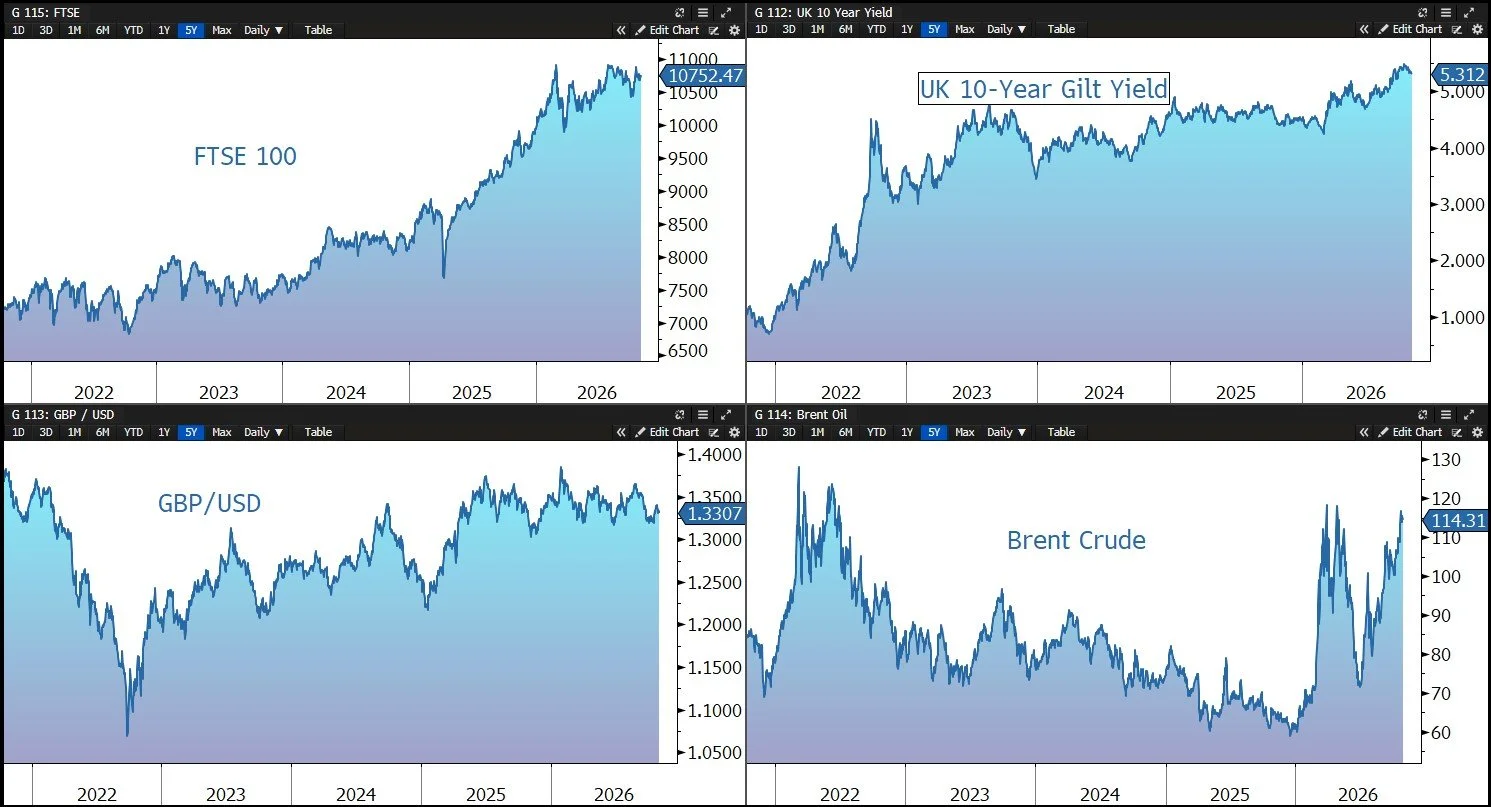
Brent crude pulled back to $114 a barrel, after VP Vance reportedly reached out to Iran's security chief in a bid to revive peace negotiations. Oil major Shell released knock-out results (see below) and increased the pace of its share buyback programme.
The ECB rate decision — widely expected to leave the deposit rate at 2.50% — is the key European event today, with the euro trading in a narrow range ahead of the announcement. Higher European bond yields are having an impact on the property market. After the market close last night, German residential property company Vonovia lowered its guidance for 2026, 2027, and 2028. This is driven by higher financing costs, lower-than-expected contributions from Recurring Sales and Development amid a limited transaction-market recovery, and slower organic rent growth momentum. Vonovia has become more cautious about the near-term trajectory of asset values and expects a broadly flat portfolio valuation for the full-year 2026. In response, the company is implementing a focused action plan to protect cash flow, preserve balance-sheet strength and direct capital toward the most attractive risk-adjusted opportunities. The shares are down 4% this morning.
The FTSE 100 is currently up 0.5% at 10,752. Companies trading ex-dividend this morning include Balfour Beatty (0.55% price impact), JD Sports Fashion (0.43%), and Whitbread (1.33%). In the aftermath of yesterday’s budget (see below), Sterling trades at $1.3310 and €1.1955, while the 10-year Gilt yields 5.31%.
Lloyds beat Q3 pretax profit estimates at £2.33bn, supported by structural hedge income and lending volume growth. The UK Budget spared banks from worse tax treatment, providing a near-term relief catalyst for the sector. The shares are down 3% in early trading.
Source: Bloomberg
The Budget 2026
Breathing space for Britain's savers and investors?
Yesterday's Budget offered Britain's savers and investors a degree of welcome stability, but beneath the headline announcements lies a continuing squeeze on private wealth.
Against a backdrop of persistent inflation, elevated borrowing costs and limited fiscal flexibility, the Chancellor opted for targeted tax increases and support for British business rather than sweeping reform. For investors, the message is clear: the importance of effective tax planning and disciplined investment management continues to grow.
Cash ISAs – a welcome reprieve
The decision to retain the £20,000 annual Cash ISA allowance, rather than reduce it to £12,000, is good news for savers. However, while cash offers security, inflation continues to erode purchasing power over time. For longer-term capital, diversified investments remain an important consideration.
Savings and property income – the quiet tax squeeze
From April 2027, savings and rental income will face higher rates of taxation, with proposed rates of 24%, 44% and 49% across the respective tax bands. This will particularly affect investors holding substantial deposits outside tax-efficient wrappers and landlords relying on rental income. Increasingly, it is not what your investments earn, but what you retain after tax and inflation, that matters.
Pensions and inheritance – time to revisit the strategy
The previously announced inclusion of most unused pension funds within estates for Inheritance Tax purposes from April 2027 remains a major consideration for wealthier families. Retirement income planning, pension withdrawals and intergenerational wealth transfers should be reviewed together rather than in isolation.
British business – encouraging investment
The Chancellor announced £20.4 billion of additional financial capacity for the National Wealth Fund and British Business Bank. New incentives for qualifying business founders are encouraging, although reductions to existing disposal reliefs will affect some entrepreneurs. For equity investors, opportunities remain, but valuations and underlying business fundamentals must continue to drive decisions.
Gilts and investment markets – the bigger picture
With planned gilt issuance of approximately £250.6 billion for 2026–27, the Government's borrowing requirements remain substantial. The bond market's response will be important for interest rates and broader asset valuations. Selected gilts continue to offer potentially attractive income, predictable maturity values and, in certain circumstances, favourable Capital Gains Tax treatment.
Our view.
This was not a Budget that fundamentally reshaped the investment landscape. Nevertheless, the cumulative impact of higher taxes, frozen allowances and changing inheritance rules makes thoughtful financial planning more valuable than ever.
Over almost three decades in investment management, I have learned that successful wealth creation rarely comes from reacting to political announcements. It comes from disciplined investing, sensible diversification, tax efficiency and patience.
Ultimately, successful investing is not about predicting the next Budget. It is about ensuring your financial future does not depend upon it.
For my full analysis of the Budget, including the implications for savings, investment portfolios, pensions and inheritance planning, please read my article on the Patronus Partners website: https://www.patronuspartners.com/investingandmarkets/the-budget-2026 - The Budget 2026: The Chancellor offers breathing space. But what about Britain's savers and investors?
Company News
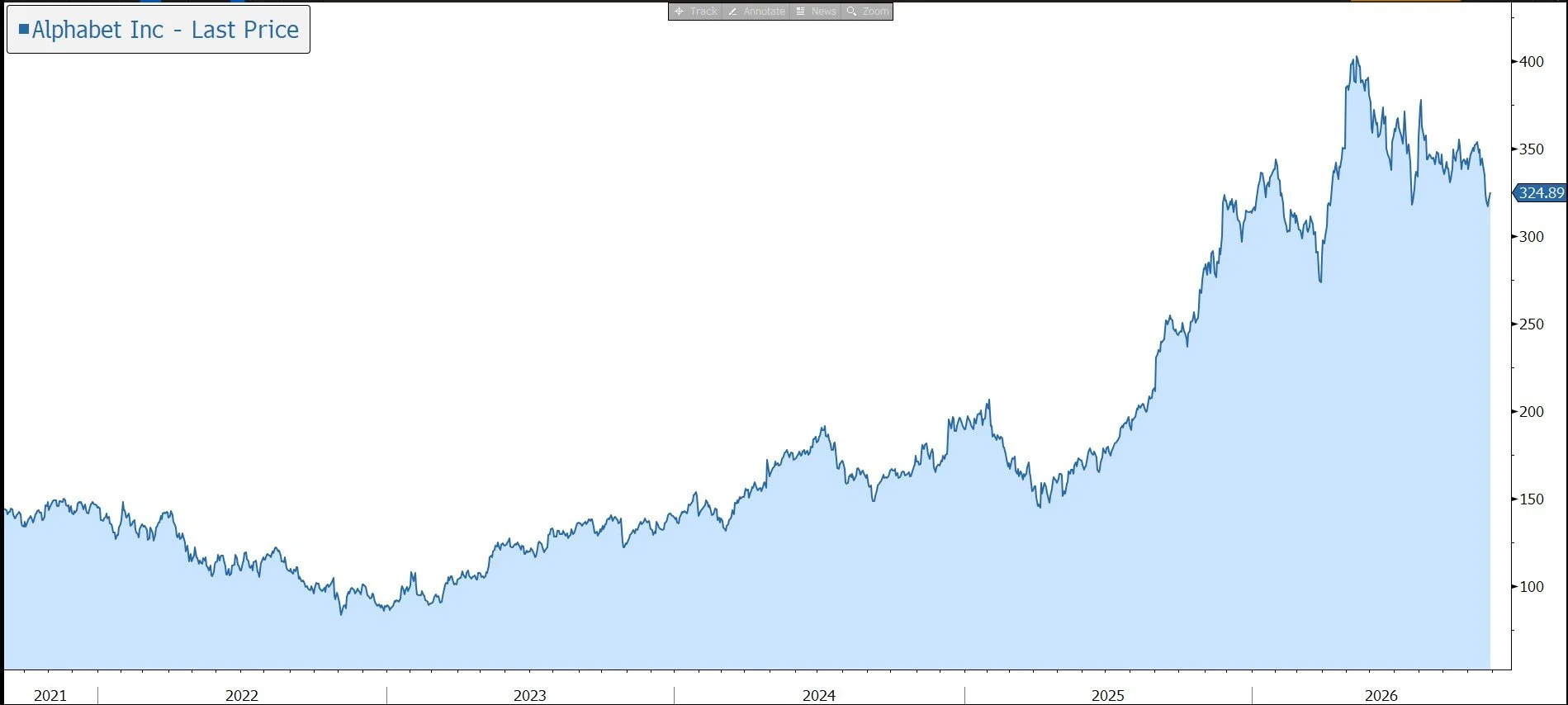
Last night, Alphabet released Q3 results which were below market expectations, driven by a slowdown in Search revenue growth and higher depreciation. As expected, there was a rapid step-up in capital investment which led to a free cash outflow for the second quarter in a row. On a positive note, Cloud revenue more than doubled and the group reported another jump in the order backlog to $561bn, of which more than 55% will convert to revenue over the next 24 months. In after-hours trading, the shares were marked down by 10%.
Alphabet is the public holding company for Google, one of the world’s most recognised and widely used brands. In addition to the core search engine, the group owns digital video platform YouTube, Google Cloud, web browser Chrome, mobile operating system Android, Gmail, Google Maps, AI personal assistant Gemini, Fitbit, autonomous driving company Waymo, and drone delivery company Wing.
The group has a strong track record of innovation, leaving it well placed to capitalise on multiple technological themes, such as AI, digital media, e-commerce, video advertising, cloud computing, and driverless cars.
The company has seven products with more than two billion users each and another eight with more than 500m users, most of which we believe are far from being fully monetised. The group’s structure allows it to own a portfolio of businesses with different time horizons, while its broad offering provides customer stickiness and a competitive edge. Cash is allocated between capital expenditure, internal R&D, bolt-on M&A, and shareholder returns.
We believe Alphabet is very well placed for the world of AI – the company has been incorporating AI functionality into its search capabilities and other products for years. As a result of its vertically integrated ecosystem and immense financial strength, the company now holds several competitive advantages:
· Google develops its large language models (LLMs) on its own semiconductors (Trillium) which are far more cost effective than comparable Nvidia models, providing it with a substantial cost advantage versus other AI players. Overall, the company reduced Gemini’s serving units costs by 78% in 2025. Looking forward, the company has also embarked on TPU-as-a-service. It was recently reported that OpenAI plans to buy Google’s AI chips.
· Google’s position in cloud services – it is one of the big three public providers, currently generating an annual revenue run rate of more than $120bn – leaving it well placed to provide the infrastructure and computing power needed for AI.
· Google owns the world’s largest and most robust personalised data and user histories from its scaled applications: YouTube, Maps, Gmail, Chrome, and traditional Search.
The recent rollout of the Gemini 4 generation—headlined by Gemini 4 Argon and Carbon —marks Google’s next leap in frontier intelligence. Designed natively for complex, long-horizon reasoning across code, video, and multi-document analysis, Gemini 4 features an industry-leading output token window of up to 1 million tokens for single-pass tasks. Gemini models power experiences across Google’s core ecosystem, including AI Mode in Search, while a multi-year deal estimated at $1bn annually licenses Gemini to power the next generation of Siri and Apple Intelligence. With Gemini 4 Argon setting top benchmarks across software engineering, legal, and finance benchmarks, enterprise API token volumes continue to compound rapidly as consumer adoption across Google AI Pro and Ultra subscriptions expands.
Following a period of investor concern regarding the threat to the company’s competitive position, we believe Google has the infrastructure and application vehicles to fully monetise AI. The main concern is the huge ramp-up in the level of capital investment to support AI growth (see below).
Political and regulatory headwinds remain a focus, but remedies issued in the Google search monopoly case were less destructive than feared. The judge avoided structural breakups (such as a forced sale of Chrome or Android). However, the court explicitly banned exclusive default distribution agreements (meaning Apple distribution deals must transition away from strict exclusivity) and mandated select ‘click-and-query’ data sharing with competitors.
Back to last night’s results. In the three months to 30 September 2026, revenue grew by 25% on a constant currency basis to $127.6bn, pretty much in line with the consensus forecast of $128.0bn, reflecting strong performance in the cloud the business. This compares to the 23% growth rate in the previous quarter.
The group reports its results across three segments: Google Services, Google Cloud, and Other Bets. Google Services is the largest division (75% of revenue), generating revenue primarily from digital advertising and the sale of apps, digital content products, hardware, and YouTube subscription fees. During Q3, Google Services revenue grew by 11% to $96.3bn, slightly below the +13% market expectations.
Google Search (which accounts for 77% of ad revenue) increased by 12%, versus the 17% last quarter, as the business faced tough year-on-year comparatives. The consensus expectation was for growth of 15%. That said, the year-over-year Search query growth rate was the highest it has been in the last five years.
Advertising from Google Network Members’ websites (9% of ad revenue) rose by 1%. The group separates out YouTube, which accounted for 14% of ad revenue in the quarter and grew by 9%. According to ratings firm Nielsen, YouTube accounts for more than an eighth of all television usage in the US and there are currently more than 200bn daily views on YouTube Shorts.
Other sales within the Services division (known as Google Subscriptions, Platforms, and Devices) include Play, content products, hardware, service, licensing fees, Nest, and YouTube’s non-advertising revenue (which now accounts for a third of YT revenue). Revenue grew by 11% in Q3 to $14.3bn.
Traffic acquisition costs (TAC) are the fees Google pays to other companies (such as Apple) to carry its search service and adverts (i.e., cost of sales). During Q3 they grew by 10% and currently account for 20% of advertising revenue.
Google Cloud includes Google’s infrastructure and data analytics platforms, collaboration tools, and other services for enterprise customers. Earlier this year, Google completed the acquisition of cybersecurity firm Wiz and the platform is being heavily integrated into Google Cloud Next initiatives. In Q2, the division grew by stellar 103% to $30.7bn, above the market forecast of $29.1bn and the previous quarter (82%). Performance was led by strong growth in Google Cloud Platform (GCP) across enterprise AI infrastructure and enterprise AI solutions, as well as core GCP services. TPU systems sales were also a ‘meaningful contributor’ to revenue growth. The way in which TPU sales are recognised and the cycle of cash flow generation is very different from the core Cloud business given the upfront inventory build-up.
The supply-demand balance remains tight – the backlog is $561bn (vs. $514bn in the previous quarter) – and the group continues to invest to grow the business. Cloud quarterly profit grew from $3.6bn to $11.1bn, with a margin of 36.2%. The company expects margin headwinds in the near term as the company starts to use third-party cloud capacity to help meet demand.
The group’s Other Bets division (less than 1% of revenue), which is effectively an incubator fund for new products and technologies, made a quarterly loss of $2.0bn. The group continues to wind down non-priority projects and focus investment on viable businesses like Waymo, the autonomous driving technology company, which has a potentially huge total addressable market – earlier in the year, Waymo raised $16bn at a $126bn valuation.
Alphabet continues to ‘durably engineer’ its cost base to support its investment in long-term growth opportunities, most importantly AI. The number of employees rose by only 7.7% in Q3 to 205k, while actions are being taken to optimise global office space and use AI to increase business productivity and efficiency. The group has previously highlighted that 25% of new code is being written by AI. The company reiterated its warning that the ramp up in capital investment (see below) is now feeding through to higher depreciation, which rose by 49% in Q3.
In the latest quarter, operational gearing and continued efforts to improve efficiency drove a gain in the margin from 30.5% to 31.8%. EPS fell from $2.87 to $2.12, albeit this included a $8.7bn (or $0.55) negative ‘other income’, primarily the result of net unrealised loss on equity securities, most notably Alphabet’s holding in SpaceX. In underlying terms, EPS rose from $1.82 to $2.67 but was below the market forecast of $3.02 due to the lower than expected Search revenue and higher than expected depreciation.
As expected, capital expenditure rose sharply as the company continued to pour money into infrastructure for AI products – up 114% to $51.4bn in the quarter, on track to hit the full-year guidance of $195bn-$205bn, which has been reiterated. Another significant step-up is still expected in 2027 – consensus is $300bn – with the company providing guidance with the Q4 results in February.
The company has justified the spend by the current monetisation of previous investment across the business and the huge order backlog which has increased by another $47bn to $561bn, of which 50% will convert to revenue over the next 24 months. The company has previously said that 95% of the top 20 SaaS companies now use Gemini, and the models are processing over 32bn tokens per minute. The company also said that 40% of the spend is in longer duration assets like physical land and power infrastructure.
Although the increase in spend comes from a position of financial strength (see below), it equates to 1.5x consensus 2026 profit. The concern is the shift toward a more capital-intensive, asset-heavy model and the potential risk of technological obsolescence and return on investment. However, for now demand continues to exceed supply, justifying the continued ramp-up in investment. We also note the group has a strong track record for generating return on investment – together, Cloud and YouTube exited 2025 at an annual revenue run rate of $160bn.
The increase in capex led to a free cash outflow of $9.1bn in the quarter. The group’s large cash pile (including marketable securities and long-term debt) stands at $140bn. In February, the company raised $32bn in a heavily oversubscribed debt issue, including a 100-year Century Bond in Sterling. In June, Alphabet announced an upsized $85bn equity raise, consisting of $35bn of public offerings, a $40bn at-the-market (ATM) programme, and a $10bn private placement to Berkshire Hathaway, with the latter we believe providing a strong validation of Alphabet’s strategy. We also note that $30bn of the $40bn ATM programme is designated for employee stock-tax settlement rather than net-new share creation, minimising dilutive impact of the raise.
The company pays a quarterly cash dividend, putting the company on an equal footing with Microsoft and Apple in the minds of investors looking for yield.
Source: Bloomberg
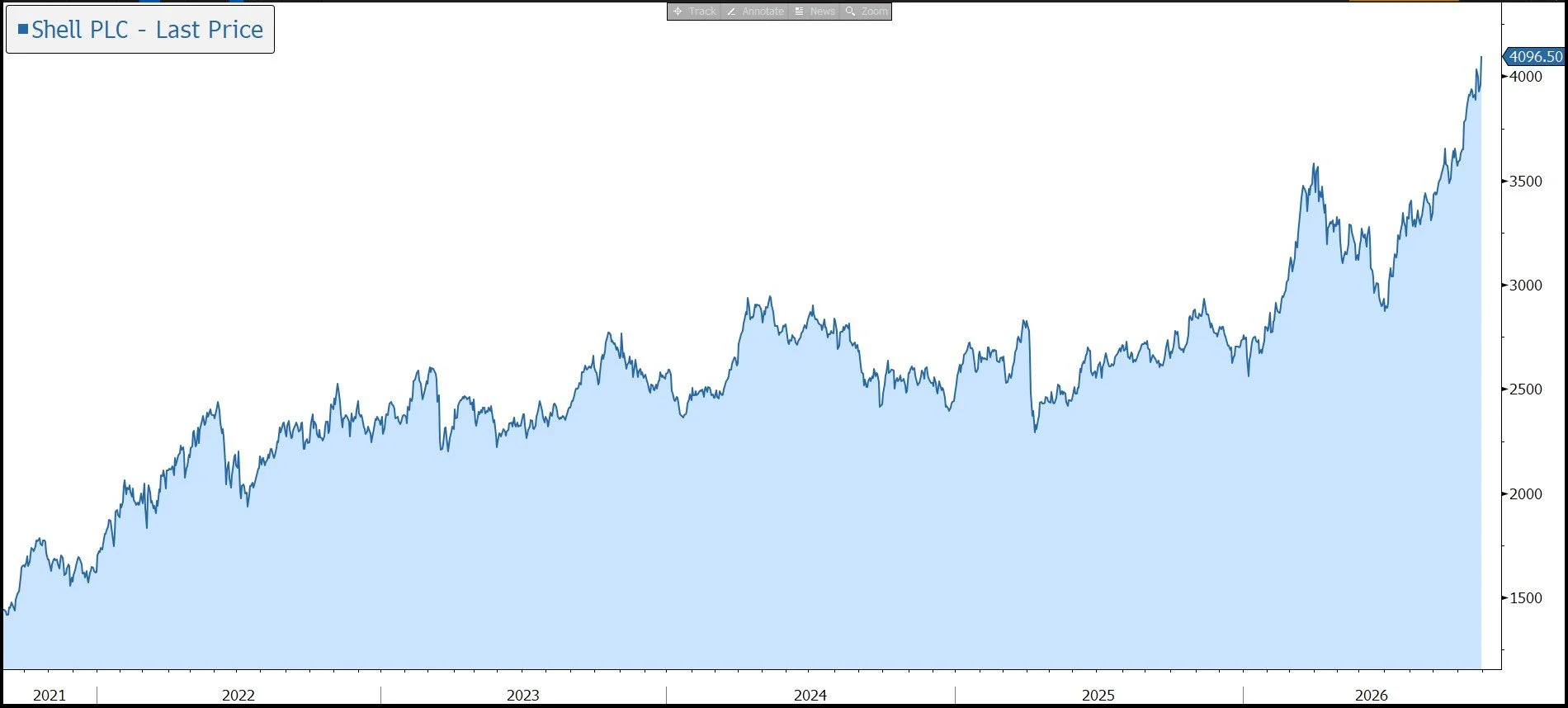
Shell has released third-quarter results which were better than market expectations. The results reflect strong operational performance in a continued volatile and elevated commodity price environment with record refining margins. The company has raised its dividend by 9% and, given the strong operating performance, announced a $5bn share buyback, a step up from the recent $3.5bn programmes. The shares are 3% higher in early trading.
Shell is a global integrated energy company with expertise in the exploration, production, refining, and marketing of oil and natural gas, and the manufacturing and marketing of chemicals. The group is also allocating capital to low and zero carbon products and services including wind, solar, advanced biofuels, EV charging, hydrogen, and carbon capture & storage. According to Brand Finance Global 500, Shell is the most valuable brand in the industry, valued at around $50bn.
The business is divided into five segments:
· Upstream (i.e. E&P) explores for and extracts crude oil, natural gas and natural gas liquids. Shell has best-in-class deepwater assets complemented by resilient conventional assets in the Gulf of Mexico, Brazil, Nigeria, UK, Kazakhstan, Oman, Brunei, and Malaysia.
· Integrated Gas includes liquefied natural gas (LNG), conversion of natural gas into gas-to-liquids (GTL) fuels, and other products. Shell is the global leader in LNG (achieved through the 2016 acquisition of BG), a critical fuel for the energy transition, with a business that spans upstream, liquefaction, shipping, marketing, optimising, and trading. We believe the level of commercial control derived from its global reach is difficult to replicate.
· Chemicals & Products is made up of a focused set of assets – there are currently five energy and chemicals parks (i.e. integrated refining and chemicals sites) and seven chemicals-only sites.
· Marketing includes mobility, lubricants, and decarbonisation. In addition to the service stations with their EV charging footprint, Shell is the global number one lubricants supplier and operator of assets in renewable natural gas, sugar cane ethanol, and biofuels.
· Renewables & Energy Solutions includes Shell’s production and marketing of hydrogen, integrated power activities (solar and wind), carbon capture & storage, and nature-based projects. The assets are helping to reduce the carbon intensity of the group’s hydrocarbon product sites. The group is however stepping back from new offshore wind investments – it is returning a 3GW offshore wind lease back to the UK government – and is splitting its power division following an extensive review of the business.
To deliver more value with less emissions Shell will aim to:
reinforce its leadership position in LNG by growing sales by 4%-5% per year through to 2030.
grow production across the combined Upstream and Integrated Gas business by 1% p.a. to 2030, sustaining 1.4m barrels per day of liquids production to 2030 with increasingly lower carbon intensity.
drive cash flow resilience and higher returns in the Downstream and Renewables & Energy Solutions businesses where around 20% of the company’s capital employed currently generates a negative return. This will be achieved through focused growth in the high-return Mobility and Lubricants businesses, directing up to 10% of capital employed by 2030 across lower carbon platforms, and through unlocking more value from the portfolio of Chemicals assets by exploring strategic and partnership opportunities in the US, and both high-grading and selective closures in Europe.
The company has set out several operational and financial targets including:
· structural cost reduction of $5bn-$7bn by the end of 2028, compared to 2022. In 2025, the company generated $2.0bn of savings, with the cumulative total standing at $5.1bn. Around 60% of the savings are coming from non-portfolio actions (i.e. not as a result of disposals). The company is actively exploring and harnessing AI to transform workflows and enhance business outcomes.
· invest for growth while maintaining capital discipline: disciplined cash capex of $24bn–$26bn for 2026 – which includes $4bn allocated toward the ARC Resources acquisition (see below) and asset integration – while maintaining an unchanged baseline guidance of $20bn–$22bn p.a. for 2027–2028. The company continues to divest non-core assets and step back from projects with low returns.
· grow free cash flow per share by more than 10% p.a. through to 2030 (at $70 Brent) and generate a return of more than 10% across all business segments.
· shareholder distributions of 40%-50% of cash flow from operations (CFFO) through the cycle, continuing to prioritise share buybacks, while maintaining a 4% p.a. progressive dividend policy.
The company has disclosed the impact of the conflict in the Middle East on its activities:
Pearl GTL is the world’s largest gas-to-liquids plant developed by Shell and QatarEnergy, in which Shell has a 30% stake. The company currently expects no damage to Train One and an initial assessment of around one year for full repair of Train Two.
LNG - Shell has a 30% interest in QatarEnergy LNG N(4) equating to 2.4 MTPA of equity production. QatarEnergy shut in production on 2 March across all LNG facilities and subsequently declared force majeure. The complex was not impacted during the attacks on 18 March but has been largely idle since then because the closure of the Strait of Hormuz has trapped specialised LNG carriers in the Gulf.
Now, back to the results. In the three months to 30 September 2026, adjusted earnings doubled to $10.81bn and were well above the market forecast of $10.33bn. The results reflect strong operational performance in a continued volatile and elevated commodity price environment with record refining margins
Compared to the strong previous quarter, earnings increased by 10%, reflecting higher refining margins, higher realised LNG prices and higher integrated gas volumes. These were partly offset by lower crude and oil products trading and optimisation, higher well write-offs, and lower realised liquids prices.
Oil and gas production fell by 9% to 2,574k barrels a day, as expected impacted by higher maintenance across the portfolio. The underlying indicative refining margin rose from $24/barrel to $42/barrel, while the indicative chemicals margin fell from $270/tonne to $208/tonne.
By division, Q3 adjusted earnings were Upstream (+77% year on year), Integrated Gas (+42%), Marketing (-12%), Chemicals & Products (up from $550m to $3.9bn), while Renewables made a $289m gain.
Management acknowledged cost inflation, particularly for deepwater rigs, of around 5%-6%, but noted that advanced contracting and scale advantages should offset those pressures.
Shell recently acquired Canadian energy company ARC Resources for $16.5bn. The deal adds complementary oil and gas assets in a shift back toward stable, democratic jurisdictions for long-term supply. It also helps address the group’s shrinking reserve life and is expected to be free cash flow accretive from 2027. With 75% of the transaction cost funded from the issue of new Shell shares, the company retains cash reserves for dividends and share buybacks. We would highlight potential integration risk given the difference in operating models.
The balance sheet is very strong, both in absolute terms and relative to the peer group, and the company targets AA credit metrics through the cycle. This provides resilience regardless of the industry or operational backdrop. In Q3, Shell spent $7.9bn on capital expenditure (including the ARC outlay), versus underlying guidance of $20bn-$22bn for the full-year. The group generated $16.3bn of free cash flow to leave net debt down $1.5bn at $39.7bn, despite the acquisition of ARC, with gearing at a comfortable 16.6%.
As highlighted above, Shell’s current policy is to return 40%-50% of cash flow from operations (CFFO) to shareholders through the cycle via a combination of dividends and share buybacks. The group’s dividend breakeven is around $40 a barrel (vs. $115 currently) and the group is targetting 4% growth annually. Even as low as $50 a barrel, share buybacks will be undertaken as a priority to debt reduction and capital investment as management believes the shares are undervalued.
With these results, a Q3 dividend of 39.06c a share was declared, 9.1% above the same quarter last year, to give a total yield expectation for 2026 of 3%. During the quarter, the company bought back $3.2bn of its own shares, which included $1.232bn that was not repurchased in connection with the ARC acquisition. With today’s results, a new $5.0bn buyback has been announced, a step-up from the recent $3.5bn programmes, to be completed by the end of January 2027.
We believe decarbonisation can’t happen at the flick of a switch – oil and gas will remain part of the global energy mix for decades, with demand driven by population growth and higher incomes, particularly in developing countries where the desire for energy intensive goods and services like cars, international travel, and air conditioning is rising. We also believe the production of the materials needed to transition to net zero can’t happen without hydrocarbons. At the same time, reduced investment in new production, partly because of environmental concerns, and natural decline rates, are increasingly leading to constrained supply.
The shares remain on an undemanding valuation, both in absolute terms and relative to its US peers, which fails to discount the potential for free cash flow generation and shareholder returns. We believe they also provide something of a hedge against inflation.
Source: Bloomberg
