
Morning Note: Market News and Updates from Assa Abloy and Reckitt Benckiser.
Market News
Global equities advanced overnight, led by a tech-driven rally in Asia after Anthropic filed IPO paperwork that could value the AI startup at between $1.5–$2.0 trillion, reigniting enthusiasm for the AI trade following last week’s selloff. The Kospi surged 3.1%, led by Samsung Electronics (+4.2%) and SK Hynix (+5.2%), while Japan's Nikkei rebounded +2.1%.
However, those gains are fading, with the Nasdaq futures indicating a 0.3% decline at the open this afternoon. The FTSE 100 is currently down 0.9% at 10,663.
The yield on the 10-year US Treasury sits at 4.98%, with markets pricing an 89.5% probability of a Fed hold on Wednesday. Chair Powell’s press conference tone on December and the inflation trajectory will drive market sentiment. Gold has slipped back below $4,000 an ounce.
Brent crude moved back above $116 a barrel, hovering at the highest since June 2022, as investors weighed renewed diplomatic efforts in the Middle East to prevent a wider escalation of the US-Iran conflict. Reports said senior officials from Saudi Arabia, Pakistan, and Turkey met with top Iranian officials on Monday to ease tensions and revive negotiations aimed at avoiding another wave of US-Israeli strikes against Iran.
The BRC Shop Price Index rose 2.1% year-on-year in October, versus 1.6% forecast, highlighting that inflation at the retail level is re-accelerating above expectations. Sterling trades at $1.3320 and €1.1940, while the 10-year Gilt yields 5.34%.
Meta Platforms is seeking to raise up to $97.5bn through a combination of common and preferred stock offerings — one of the largest equity raises in history — to fund AI infrastructure investment. Nvidia, AMD, and Broadcom are reportedly set to participate in the offering.
HSBC is down 7% following the release of Q3 results. Revenue came in below estimates, in part due to slower growth at its wealth business.
In the North American gas sectors, EQT agreed to acquire Range Resources in an all-stock deal worth nearly $13bn, creating a US natural gas giant focused in the Appalachian Basin. EQT will issue 0.987 shares per Range share, a ~21% premium to Friday’s close.

Source: Bloomberg
Company News
Assa Abloy has today announced its Q3 2026 results which once again highlighted the benefit of a decentralised operating model against the backdrop of ongoing global geopolitical tensions and macroeconomic uncertainty. The results came in ahead of market expectation driven by record margins. Importantly, the group’s North America Residential segment improved and had good sales growth. The company announced it will launch its 11th Manufacturing Footprint Programme during the fourth quarter. In response, the shares are little changed in early trading.
Assa Abloy is the global leader in access solutions to physical and digital places, with a portfolio of well-known global and local brands, such as Yale, Union, HID, and Lockwood. Products include doors, sensors, locks, alarms, fencing, gates, and identity systems. Products are either offered on a standalone basis or combined to form a complete, full-service access offering.
The key long-term drivers of the $100bn industry are:
· increased demand for safety and security
· movement of people and demographic change
· increased wealth in emerging markets
· the shift to digital and electronic technologies which have grown at 4-5x the rate of mechanical products over the last 10 years
· the development of sustainable buildings to meet climate change objectives
· the shift towards touchless (hygienic) activation points, automated doors, and location services
· constantly changing local market regulations which make it difficult for smaller operators to compete. In Europe, for example, although the NIS2 Directive is an IT/cybersecurity mandate, its operational scope extends directly into physical access control, positioning Assa Abloy to capture structural, high-margin growth.
As the brand leader in most markets, with a large installed base, robust pricing power, and strong distribution channels, we believe Assa Abloy is well placed to take advantage of these trends. The strategy is to actively upgrade the installed base, increase service penetration, generate more recurring revenue, and expand exposure to emerging markets. The group’s broad offering is also well suited to address the fast-growing data centre market.
Assa Abloy has a strong track record of innovation and continuously enhances its offering with new products, solutions, and technologies. The aim is to generate a quarter of sales from products launched in the last three years.
The company has a decentralised operating model and a strong track record of cost control. The latest Manufacturing Footprint Programme (MFP), the group’s tenth, was launched last year, and is proceeding to plan. It is expected to generate annual savings of about SEK 1bn (c.60 basis points of margin) from 10 factory closures and 1,300 headcount reductions. The company has today announced it will launch its 11th MFP during the fourth quarter.
Overall, the long-term financial target is to generate annual sales growth of 10%, half organically and half from acquisitions. We expected the 5% organic growth to be driven by structural tailwinds from the transition to electromechanical locks, increased recurring and service revenue, data centre growth (collectively 60% of the business) and pricing. An operating margin of 16%-17% is the target over the business cycle, although the aim is to be towards the upper end of the range in the coming years. Management has previously said it needs to generate organic top-line growth of 3% to offset inflation and drive the margin forward. The group is on track to exceed its target to generate SEK 25bn of profit from SEK 150bn of sales in 2026, while the 2030 target is SEK 41bn of profit from SEK 250bn of sales.
Assa Abloy is a textbook example of late-cycle business – locks are one of the last things in a building and are changed after you have moved. The current macroeconomic environment is mixed, especially in the residential market that accounts for a third of sales. However, strong exposure to the aftermarket and operational agility continue to be a great advantage.
During the three months to 30 September 2026, ongoing global geopolitical tensions and macroeconomic uncertainty have impacted many customer segments and geographies. In this environment, the company has once again shown resilience and strong execution.
Net sales rose by 7% to SEK 40.8bn, versus the market forecast of SEK 40.6bn. In organic terms, which strips out the impact of acquisitions & disposals (+2%) and currency movements (+1%), sales rose by 4%, versus the forecast of 3.8% and in line with the previous quarter. Growth was made up of 2% volume and 2% price growth.
The group continues to actively upgrade the installed base by shifting customers from mechanical to electromechanical and digital solutions. Organic sales in the regional divisions in this category grew by 9% in the quarter, driven by demographic changes – a digitally-native younger generation and an ageing population in need of care, are accelerating the need for more convenient, reliable, and efficient electromechanical and digital solutions.
The company is organised into three regional units and two global divisions.
· The Americas reported organic sales growth of 6%, driven by continued strong growth in the non-residential segment and Latin America. Crucially, the North America Residential segment improved and had good sales growth.
· The EMEIA region delivered organic sales growth of 5%, driven by very strong sales growth in Central Europe, while the other regions had good or stable sales growth developments.
· Global Technologies (a separate global division) reported organic sales growth of 4% with strong sales growth in HID, while Global Solutions’ growth was low single-digit due to temporarily lower deliveries in the retail business unit.
· Entrance Systems (also a separate global division) achieved 3% growth driven by Pedestrian and Perimeter Security.
· Asia Pacific declined by 1%, due to the weak sales in Greater China.
Operating income rose by 11% to SEK 7.1bn, versus the market forecast of SEK 6.96bn. The operating margin rose from 16.8% to a record high 17.4%, driven by excellent operating leverage of 47%, a step-up from 32% in Q2, due to price realisation and costs efficiencies. Underlying EPS grew by 14% to SEK 4.24.
Operating cash flow rose by 6% to SEK 7.4bn, resulting in strong cash conversion of 117%. The group’s financial position remains robust, with net debt to EBITDA falling to 2.0x. Looking forward, gearing is expected to fall rapidly thanks to strong free cash flow generation. There was no dividend announcement today. For 2025, the company declared a payout of SEK 6.40, up 8.5%, equating to a yield of 2%.
M&A will continue to be a core driver of growth, with over 900 potential acquisition targets identified globally. The focus is on acquiring new customers in the core business, extending the core offering, accessing new technologies to deepen the group’s competitive position, and increasing service capacity. Elsewhere, M&A activity remained buoyant with 23 deals in 2025 and 11 in the first nine months of 2026. This included the acquisition of Gunnebo Entrance Control, an international provider of entrance control solutions, including speed gates, mass transit gates and security revolving doors.
The pipeline remains strong, and the group still plans to make its usual 15-20 acquisitions per year.
However, there is some concern that recent M&A has been skewed towards lower value-added segments (e.g. DIY, window and door hardware components, fencing products, gates, padlocks, cylinders, etc). Although these acquisitions fit the purpose of growing earnings at lower multiples than the group average, they also dilute the group’s exposure to the fast-growing and structurally more attractive electromechanical and mobile segments, potentially posing a risk to the long-term valuation multiple.
A strategic review of the non-core plumbing business of the group’s $4.3bn HHI acquisition is being undertaken which could potentially fetch $1bn. After the quarter end, the company signed an agreement to sell HID’s public key infrastructure business.
Assa Abloy doesn’t usually provide annual guidance but highlights that it remains confident in the company’s ability to navigate varying market conditions. The company is confident it can pass through any raw material cost increases through higher pricing – full-year price is still expected to be north of 2%. A continued focus on innovation, operational excellence, cost discipline, margin expansion, and strategic acquisitions, combined with a strong financial position, provides a solid foundation for continued profitable long-term growth and value creation.
The risk to this optimism is driven by a combination of rising interest rates, labour shortages, and tariffs. Management is dedicated to mitigating any impact from potentially negative changes in demand, through local agility and focus on cost-control. Assa has previously said that during both the global financial crisis in 2008/09 and the Covid-19 pandemic, its decentralised operational model and agile cost base provided flexibility. In addition, the group’s large exposure to after-market service and its structural pricing power leaves the business better positioned to navigate through uncertain times.
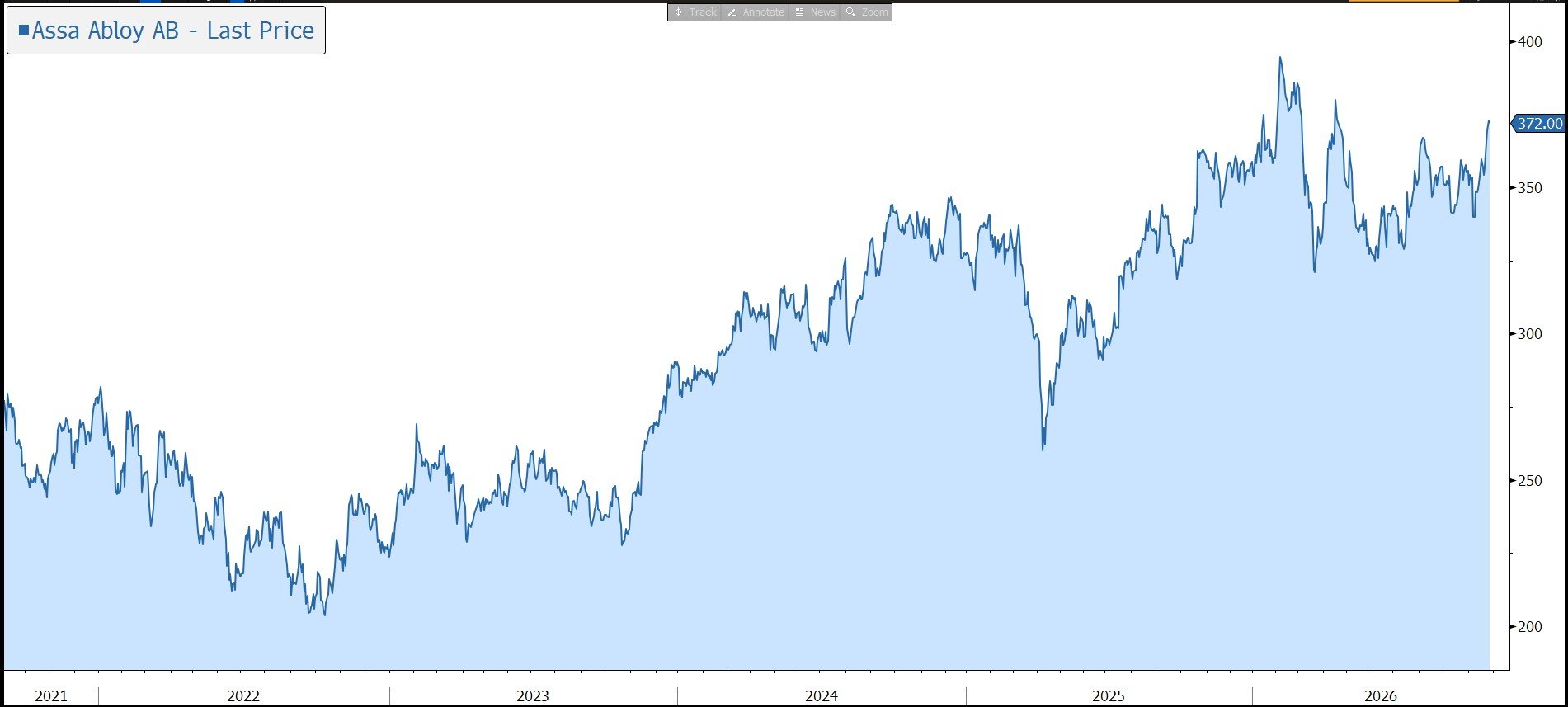
Source: Bloomberg
Reckitt Benckiser has today released Q3 results which were slightly below market expectations due to a temporary manufacturing issues in North America. As a result, revenue guidance for the full year has been trimmed, although the margin target remains intact. The £500m share buyback programme is ongoing. Following a strong run in the last few weeks, the shares have been marked down by 6% in early trading this morning.
Reckitt is a global leader in health, hygiene, and nutrition. Trusted brands, such as Dettol and Lysol, continue to benefit from the shift to healthier and more hygienic lifestyles, particularly in emerging markets. To help ease the pressure on state-funded healthcare systems, we are seeing a transition to self-care and growth of over-the-counter (OTC) brands owned by Reckitt. A focus on immunity, mental health, and overall well-being is expected to drive growth of the group’s preventative treatments, such as vitamins, minerals, and supplements (VMS).
Reckitt is currently refocusing its portfolio and simplifying its organisation to drive accelerated growth and value creation. Core Reckitt includes a portfolio of 11 market-leading (No.1 or No.2), high margin Powerbrands across four categories of Self-Care, Germ Protection, Household Care, and Intimate Wellness. Brands include Mucinex, Strepsils, Gaviscon, Nurofen, Lysol, Dettol, Harpic, Finish, Vanish, Durex, and Veet. Over the last three years this portfolio has delivered 5% revenue CAGR and in 2025 generated a gross margin above 60%. With such an attractive stable of brands, the company could be involved in an industry consolidation.
In its core business, Reckitt operates across three geographies: North America, Europe, and Emerging Markets, with the latter expected to grow in the high-single digits. In July, the company sold its Russian Hygiene business, a unit which accounted for 1% revenue, and which will result in a post-tax loss of £175m in 2026, with £125m recognised in the first half.
The company now believes it has the portfolio, geographic footprint, innovation pipeline and execution capabilities for Core Reckitt to consistently deliver 4%-5% like-for-like (LFL) net revenue growth, while consistently delivering annual EPS growth and creating value for shareholders.
At the end of 2025, the company sold its Essential Home business (now called Vestacy), a portfolio of non-core brands such as Air Wick, Mortein, Calgon, and Cillit Bang. The $4.8bn transaction was fairly complex – it included up to $1.3bn of contingent and deferred consideration, and Reckitt retained 30% of the business. As part of the deal, shareholders received a $2.2bn (£1.6bn or 235p a share) special dividend and the shares underwent a 24-for-25 consolidation.
The company’s third leg is Mead Johnson Nutrition (MJN) which includes infant formula brands Enfamil and Nutramigen. The company continues to evaluate all strategic options for the business, noting that a carve-out will be more straight-forward than it was for Essential Home. There have been persistent market rumours that French food giant Danone is considering a bid to improve its infant nutrition footprint in North America. However, any deal will likely require Reckitt to ringfence and retain its historical US litigation liabilities (see below) or offer massive structural indemnities to shield Danone from future losses. In the meantime, the business is cash generative.
The company is undertaking a fixed cost optimisation initiative to unlock efficiencies and deliver at least a three percentage points reduction in fixed costs by the end of 2027. In H1 2026, fixed costs as a percentage of Core Reckitt + MJN net revenue was 20.1%, broadly in line with H1 2025, despite absorption of stranded costs following the Essential Home divestment. The programme remains on track to deliver fixed costs below 19% of net revenue as the group exits 2027.
Back to today’s results. In the three months to 30 September 2026, reported revenue fell by 6.9% to £3,362m. Stripping out the impact of currency and disposals, LFL growth was 3.2%, slightly below the market forecast.
Core Reckitt grew revenue by 3.3% in LFL terms to £3,239m, an acceleration from the 2.7% generated in the first half, but below the market forecast. Growth was driven by a 3.2% increase in price/mix and a disappointing 0.1% volume increase. Excluding Russia Hygiene, Core Reckitt grew 3.9%.
The results were led by Emerging Markets, which grew by 8.0% LFL despite a tough comparison with the same quarter last year. Growth was broad-based, with several smaller, high-potential markets delivering double-digit growth. In China, VMS growth moderated with headwinds in the cross-border VMS category driven by false claims by smaller local competitors impacting consumer perception.
In Developed Markets, growth in Europe continued (+0.8%), with a +4.0% price/mix improvement offset by continued volume decline (-3.2%). North America (-1.3%) came in below management expectations. While consumer demand for Lysol remains strong, temporary manufacturing constraints limited the company’s ability to fully meet demand.
In the Core product segments, LFL growth at Germ Protection (6.0%), Self-Care (2.2%), and Intimate Wellness (6.4%) were partly offset by Household Care (-1.5%), reflecting continued impacts of the Russian business. Innovation continues to support long-term growth with launches across each category – the pipeline is meaningfully bigger than two years ago. The company expects to deliver 1–2 big wins per year, with recent examples including Lysol air sanitizer and Mucinex 12-hour.
In the smaller, non-core division Mead Johnson Nutrition, net revenue rose by 2.7% on a LFL basis, versus consensus of +1.6%. Performance reflected increasingly normalised operating conditions in North America following the disruption caused by the Mount Vernon tornado in 2024
As expected at this stage, the group hasn’t provided an update on profitability or its financial position. As a reminder, financial gearing at the half-year stage was 2.5x net debt to adjusted EBITDA.
The dividend policy is to deliver sustainable growth in future years – the 2025 payout and the 2026 half-year payment were both raised by 5%. In response to the weak share price and to reflect the board’s confidence in the continued strong free cashflow generation of the business, Reckitt has been buying back its shares – it is currently undertaking a £500m to be completed by next summer, with £90 undertaken so far.
Looking to the full year:
· Guidance for Core Reckitt LFL revenue growth has been trimmed from 4.0%-5.0% to 3.5% to 4.5%. This reflects the Lysol disruption and category slowdown in China VMS in Q3 and positive demand for seasonal cold & flu brands in early Q4. Given the 9-month growth rate of 3.3%, there is still much to do.
· Mead Johnson Nutrition - low-single-digit LFL net revenue growth.
· Further down the P&L, forecasting is more difficult given the complexity stemming from the deconsolidation of Essential Home. However, the company has maintained its expectation for adjusted operating profit margin for 2026 (24.9%-25.6%), with the delivery of this weighted to H2. Where the margin ultimately lands will be a function of mix (seasonal OTC) and opportunities to reinvest (i.e. Brand Equity Investments). In H2, group adjusted operating profit margin will be much stronger than H2 2025, driven by more favourable mix across Categories and Areas, actions to offset commodity price inflation, as well as continued stranded cost mitigation.
The company reiterated its ambition to deliver long-term, sustainable EPS growth, acknowledging in 2026 headwinds from Essential Home dilution.
Legal Appendix …
The legal case against the company (and industry peer Abbott) relating to its cow’s milk-based infant formula is ongoing. Reckitt continues to vigorously defend these claims and believes the lawsuit’s claims are not supported by scientific evidence. In May, a US District Judge rejected Mead Johnson’s motion for summary judgment in the Inman case. Crucially, this is the only first-wave federal case to survive summary judgment after the judge dismissed the prior three test cases on expert evidence grounds. The bellwether trial in the US federal multidistrict litigation (MDL) started in August. This is the first ‘test case’ inside the massive federal MDL infrastructure, which currently holds nearly 800 pending lawsuits. Crucially, the litigation landscape shifted dramatically in June and July 2026 with consecutive defence victories. First, an Illinois appeals court completely reversed the headline-grabbing $60m state court verdict against Mead Johnson from 2024, ordering a new trial due to improper jury instructions regarding corporate wealth and the duty to warn. Weeks later, a St. Louis jury delivered a watershed victory for the company by completely rejecting a plaintiff's claims that Enfamil formula was responsible for causing NEC. Most recently, in October, a Missouri State Court denied the plaintiff motion for new trial in Collins vs Mead Johnson. This followed MJ being cleared in July of claims it knew its products caused NEC. While more than 800 cases remain pending in the federal litigation, these successive defence wins break the plaintiffs’ legal momentum, significantly improve Reckitt's leverage for an eventual global settlement, and improve the long-term prospects for the sale of the Nutrition business. However, the threat of sizeable damages continues to hang over the share price and prevents the company from offloading its Nutrition division. The court has encouraged the parties to explore settlement ahead of trial and this would be optimal as Reckitt seeks to sell its Mead Johnson business.
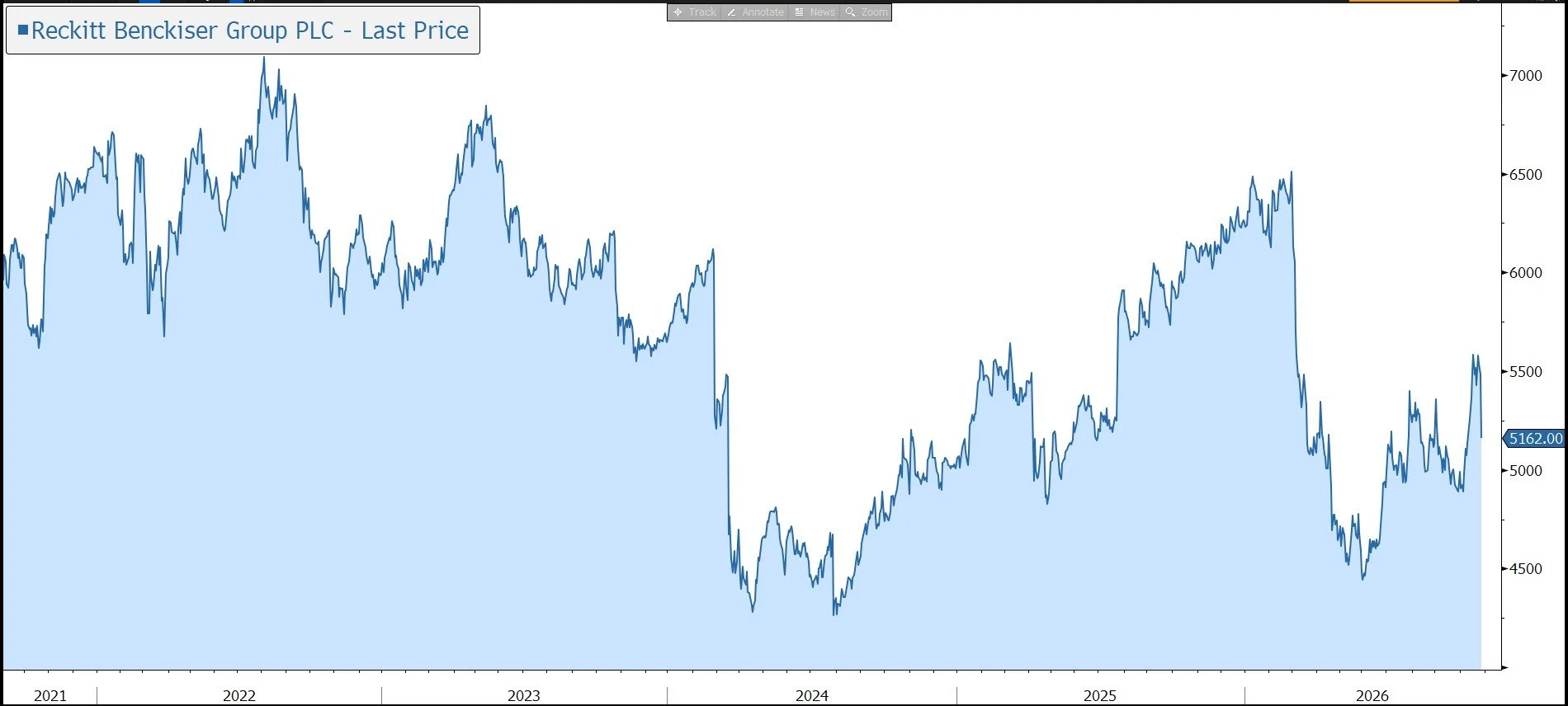
Source: Bloomberg
