
Morning Note: Market News and Updates from Glencore and Heineken.
Market News
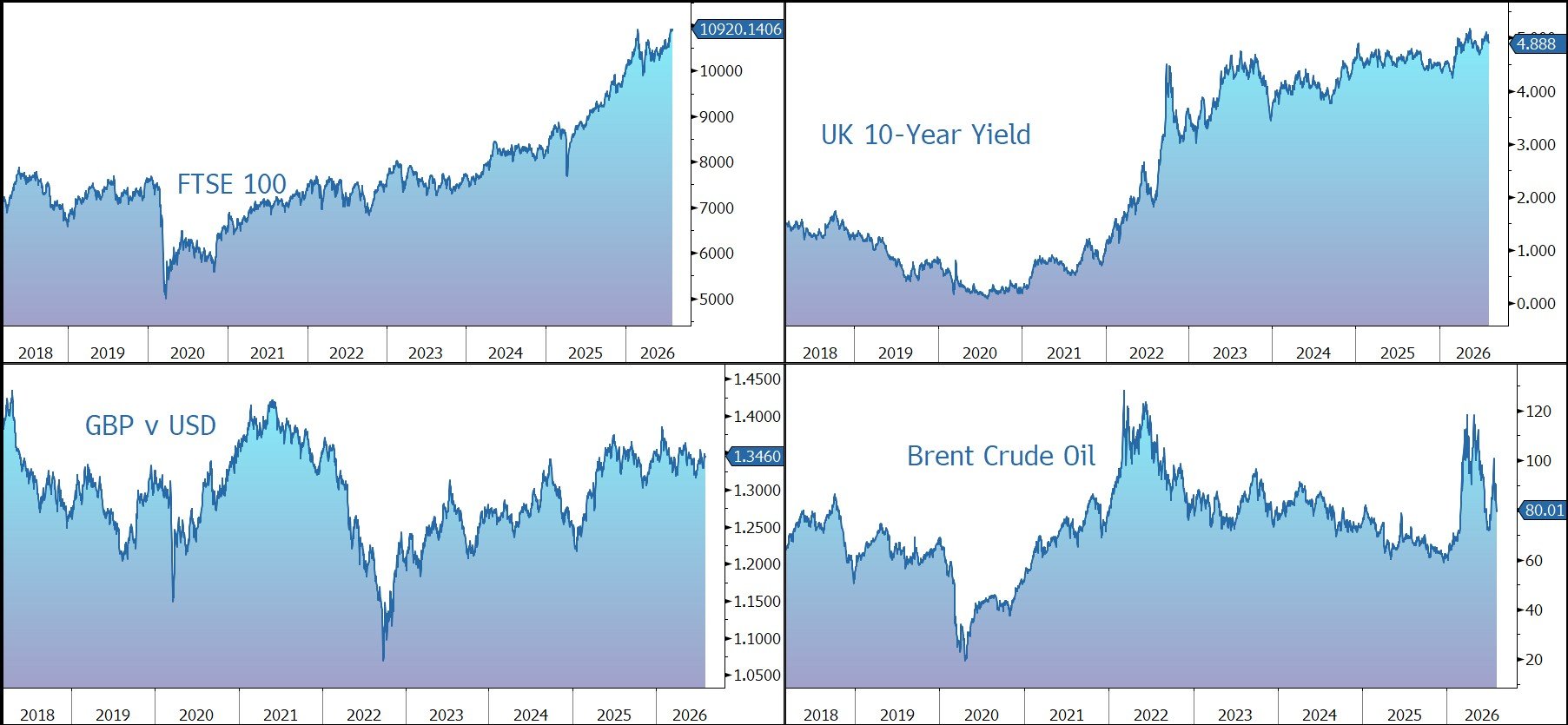
The US is closing in on a 60-day interim deal to re-open the Strait of Hormuz without tolls and is aiming for an announcement as soon as today, Axios reported. Brent crude currently trading at $80 a barrel.
Gold has moved up to $4,170 an ounce on hopes that peace in the Middle East could ease inflation concerns and lower the likelihood of near-term Federal Reserve interest rate hikes. The yield on the US 10-year Treasury is 4.61%.
US equities rose last night – S&P 500 (+1.8%); Nasdaq (+2.6%) – driven by strength in semiconductor stocks. SpaceX and AMD fell short of lofty investor expectations. Asian equities shrugged off disappointing AI results overnight, with chip stocks leading gains this morning: Nikkei 225 (+3.7%); Hang Seng (+0.2%); Shanghai Composite (+1.5%); Kospi (+3.8%).
The FTSE 100 is currently 0.4% higher at 10,920. Glencore (see below) and Next posted strong results. Sterling trades at $1.3460 and €1.1670, while the 10-year Gilt yield slipped to 4.88%.
Source: Bloomberg
Company News
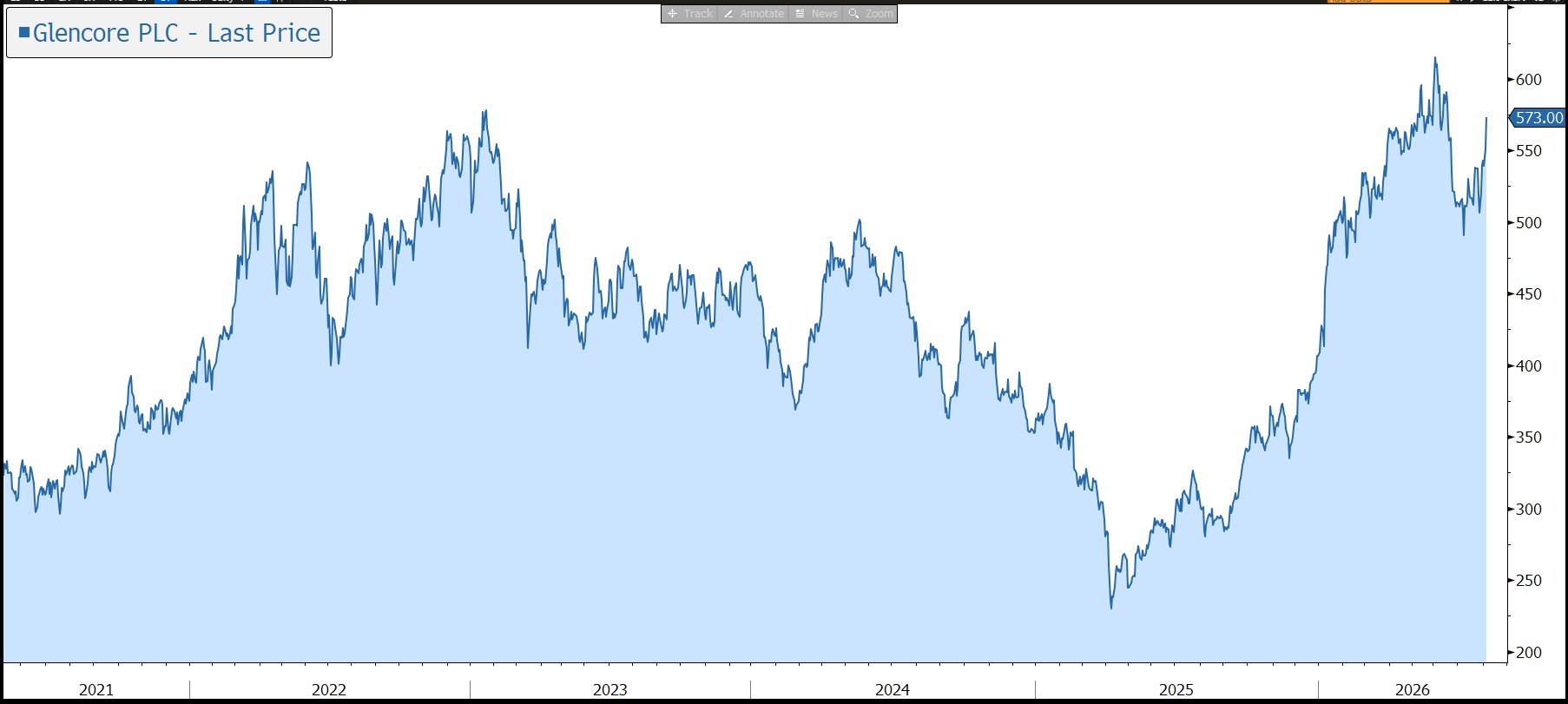
Glencore has this morning released its H1 2026 results which were better than market expectations, with strong commodity prices offsetting increased input costs resulting from the Middle East conflict. The Marketing segment’s first-half profit was at the top end of its annual guidance range. With net debt at the target level, the company has announced a top-up special cash distribution of $1bn, alongside a new $500m share buyback. The company has also announced plans for a secondary share listing in Australia. The shares have been very strong over the last year, driven by the (now withdrawn) bid from Rio Tinto and the ongoing strength in commodity prices. As a standalone company, we believe Glencore is well placed, with a strong position in copper, a cash generative coal unit, and unique marketing business. In response to this morning’s update, the shares have been marked up 4% in early trading.
Glencore is a vertically integrated commodities business, with a strong position in the production of copper, coal, nickel, zinc, cobalt, and precious metals, and a unique marketing business which markets and distributes commodities sourced from internal production and third-party producers to industrial consumers. The group’s strategy is to own large-scale, long-life, low-cost Tier 1 assets.
Following a period of portfolio simplification, the company has sold or shut 35 assets since 2021. In the meantime, it has undertaken selective M&A in key/core commodities, including copper/alumina/bauxite and high-quality steelmaking coal. As part of this process, Glencore has uncovered opportunities to streamline its operating structure and identified at least $1bn of cost savings (against a 2024 baseline). These are expected to be fully delivered by the end of 2026, with more than half generated in 2025.
Glencore is a leading producer of critical minerals that are used in low-carbon and carbon-neutral technologies, such as electric vehicles and renewable energy, the outlook for which is underpinned by robust demand and persistent long-term supply challenges. Most notably, this includes copper. Last December, the company set out plans to expand its copper production from 0.85mt in 2025 to 1mt by 2028 and 1.6mt by 2035, making it one of the largest producers in the world. Growth will be driven by new mines, the expansion of existing mines, and the restart of dormant mines. Glencore’s position in Copper was one of the main motivations for the interest from Rio Tinto earlier in the year.
Given the company’s somewhat mixed production record in recent years, investors are looking for signs of improved operational performance – recent updates provide some encouragement. It is also helpful that the copper expansion plans are derisked to some extent as the production targets are not dependent on one mine or process and are often a bolt-on to existing infrastructure. The major greenfield project is El Pachón in Argentina, one of the world’s largest undeveloped resources which the company hopes will underpin its long-term growth.
Earlier in the year, the company announced the sale of a 40% stake in their Congolese copper and cobalt assets (Mutanda and KCC) to a US-backed consortium (Orion CMC) at an implied enterprise value of $9bn. Through this partnership, Glencore will be able to support the ambitions of the US government and private sector with the supply of two critical minerals, while derisking the political volatility associated with its African operations. The cash injection – estimated at over $3bn for Glencore’s interest – also provides headroom for organic growth investment and shareholder returns. The company also finalised the KCC land access package with Gécamines, unlocking life of mine extension, productivity and cost improvements, and a pathway to c.300kt pa of copper production.
Glencore is also the world’s leading seaborne energy (thermal) coal business, a top-tier steelmaking (coking) coal producer, and has a rapidly growing LNG, power, gas, and carbon business. As a result, the company will play a strategic role in supporting the world’s energy needs of today and tomorrow. Glencore believes global population growth, increased urbanisation, a growing middle class, AI infrastructure growth, and the energy transition will all continue to drive long-term demand for thermal coal. More recently, the Middle East conflict has driven a jump in the thermal coal price on the back of the surging gas price and the prospect of increased gas-to-coal switching. Over the medium term, the company is balancing immediate energy security needs with a commitment to a net-zero trajectory by undertaking the responsible decline of its thermal coal operations.
Glencore’s 77% interest in Teck’s steelmaking coal business (EVR) complements existing production in Australia, Colombia, and South Africa. Following consultation with its shareholders, Glencore is retaining its coal and carbon steel materials business. The company believes the cash generative capacity of the business significantly enhances the quality of the overall portfolio, by commodity and geography, and broadens the company’s ability to fund the growth of its copper portfolio as well as accelerate shareholder returns. Management sees potential upside through synergies as the EVR assets are integrated into the portfolio.
The first half of 2026 was characterised by the significant repricing of energy and closely related markets and risks, following escalation of the Middle East conflict. What began the year as a relatively well-supplied energy complex, quickly shifted towards a focus on security of supply and access to physical commodities. Constraints across oil, refined products, LNG and freight capacity, drove heightened volatility across global energy and other markets.
Against that backdrop, adjusted profit (EBITDA) rose by 86% to $10.1bn, ahead of the market forecast of $9.5bn.
The group’s cost and efficiency drive has identified $1bn of cost saving opportunities across more than 300 initiatives. A significant portion was realised in 2025 and the company remains on track to fully deliver on these by the end of 2026.
The Industrial assets’ EBITDA rose by 72% to $6.5bn, reflecting the significantly stronger commodity price environment and solid operational performance across the portfolio. These benefits were partially offset by a generally weaker US dollar and higher operating costs, exacerbated by the Middle East conflict supply-chain disruptions.
As reported at last week’s trading update, the group’s key assets largely performed in line with expectations and previously communicated guidance:
- Copper: own-sourced production rose 15% to 397kt, reflecting various higher contributions across the portfolio. Guidance for 2026 is 810-870kt.
- Zinc: own-sourced production fell 21% to 365.6kt, primarily reflecting Lady Loretta’s end of mine life in late 2025 and lower zinc grades at Antamina. The decrease also reflects the disposal of the Kidd mine.
- Cobalt: Production fell by 46% to 10.2kt, mainly due to the DRC government’s ongoing cobalt export quota regime.
- Nickel: own-sourced production fell by 2% to 35.8kt,
- Steelmaking Coal: production of 13.5mt was 14% lower primarily reflecting lower throughput and yields, which are expected to normalise in the second half.
- Energy Coal: production was down 2% to 47.4mt, due to voluntary production curtailment in response to market conditions.
Average prices for the group’s key commodities were strong during the first half: copper (+39%), Zinc (+22%), nickel (+15%), gold (+52%), silver (+136%), steelmaking coal (+28%), and energy coal (+24%).
Glencore’s Marketing business exploits arbitrage opportunities that continuously emerge as a result of different prices for the same commodities in different locations or time periods. The target is to earn through-the-cycle long-term adjusted EBIT in the range of $2.3bn-$3.5bn p.a. It provides a good hedge against commodity price volatility and finances the $1bn base dividend (see below), although clearly there is always a risk of potential losses because of that volatility.
In the first half, the business generated adjusted EBIT up 142% to a near record $3.3bn. The unit benefitted from the dislocations across global commodity markets, particularly within energy. For the full-year, the unit is in a position to comfortably exceed the top end of the target range. As a guide, during the energy crisis of 2022, the division reported record EBIT of $6.4bn.
Funds from operations rose by 158% to $8.1bn. Net borrowing fell from $11.2bn (including $1.0bn of marketing lease liabilities) to $10.2bn. This was driven by funding $4.0bn of capex, $1.1bn of shareholder returns, and a $1.9bn increase in non-Readily marketable inventories (RMI) working capital. This leaves gearing at a very comfortable 0.56x net debt to EBITDA, providing significant financial headroom.
Looking forward, the company is looking to strike the “right balance” between its growth ambitions and returns to shareholders. Excluding the various copper growth projects, capex will average $6.5bn p.a. from 2026-2028. Depending on the level of additional capex for new developments, aggregate investment could be $23.7bn. However, the company has said that although its plans can be self-funded, it will look at opportunities to reduce financial and operational risk via passive or active minority stakes or a strategic partner.
The dividend policy is to pay a fixed $1bn base distribution from the Marketing business, reflecting the resilience, predictability, and stability of the unit’s cash flows, plus a minimum payout of 25% of the Industrial free cash flow. Following the decision to retain the coal and carbon steel materials business, the group’s net debt ceiling which shapes its shareholder returns framework is $10bn. When net debt falls below this level (after the base distribution), cash will be periodically returned to shareholders via special cash distributions and/or share buybacks.
Following a merger with its Viterra business, Glencore owns 16.4% of Bunge, the diversified global agribusiness solutions company. The stake is worth $3.3bn at the current share price and is recognised as surplus capital, being warehoused for appropriate monetisation for Glencore shareholders at some point in the future. The lock-up ended earlier this month. Underpinned by the value of these shares, the company is paying a top-up cash distribution of 7c/share (c.$0.8bn), taking the aggregate cash distribution to 17c/share (c.$2bn), to be paid in two equal instalments in June (already paid) and September. Given the position of the balance sheet, the company has today announced a further top-up special cash distribution of 8.5c/share (c.$1bn), alongside a new $500m share buyback to be completed by February 2027. This brings total 2026 announced shareholder returns to c.$3.5bn
The company has announced that, in order to broaden its investor base and enhance trading liquidity, its intends to apply for a secondary listing on the ASX, targeting admission in October 2026. A listing in Australia would provide access to a highly sophisticated investor base with deep expertise in the global resources sector.
Overall, while geopolitical uncertainty continues in the near term, Glencore remains of the view that in certain commodities, the scale and pace of global mine project development will struggle to meet demand for the materials needed in the future. Glencore believes it is well placed to participate in bridging this gap through the flexibility embedded in both its Marketing and Industrial businesses to respond to global needs.
We believe commodities and resource stocks are inexpensive when compared to financial assets and are relatively under-owned in investor portfolios. We also believe they provide something of a hedge against inflation.
Furthermore, the mining sector has a long history of M&A. Looking forward, further industry consolidation would open the sector to generalist investors at a scale that would make it easier to bring on large and complex projects needed for new supply. Although the transaction between Glencore and Rio Tinto fell apart earlier this year, we expect a deal will be revisited at some point. Since that time, Glencore’s share price has outperformed Rio’s due to a coal price rally and iron ore price decline, giving Glencore a stronger hand if talks were to resume now the 6-month cool-off period is over.
Source: Bloomberg
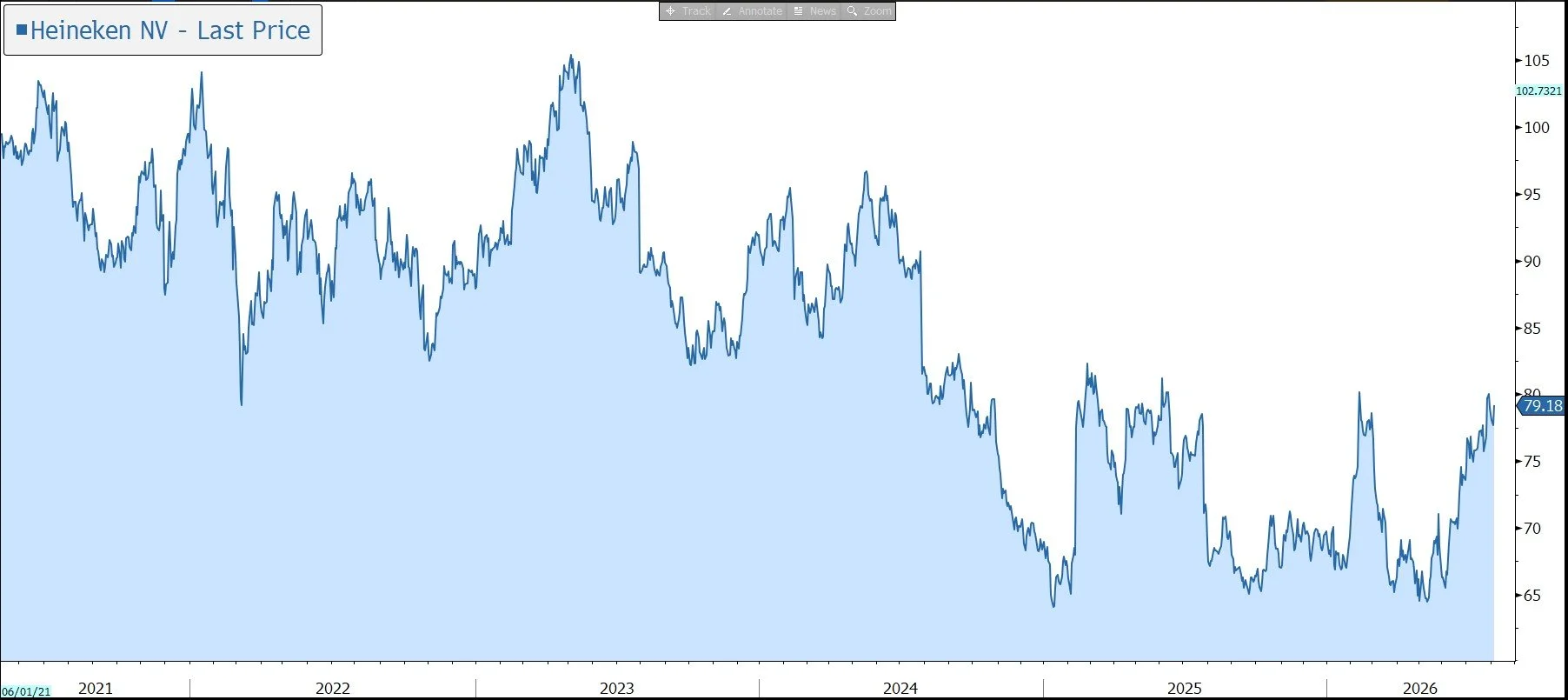
Heineken has this morning released its first-half results which were better than market expectations, driven by strong demand in Asia and Africa. The group’s balance sheet remains robust and the second tranche of its share buyback programme is ongoing. Based on a prudent assessment of the current macroeconomic environment, the company has reiterated its guidance for operating profit to grow in the 2% to 6% range. Ahead of the analysts’ meeting, the shares are up 2%.
Heineken is the world’s second largest brewer, generating net revenue of €29bn from a portfolio of iconic brands, many of which have been quenching the thirst of consumers for decades. In addition to the core Heineken brand, the company owns several well-known beers and ciders, including Sol, Tiger, Amstel, Murphy’s, and Strongbow, as well as more than 300 or so local brews. The company also owns around 2,400 pubs in the UK, runs a wholesaling operation in Europe, and has a strong global distribution capability. Over time, the group has expanded and developed its global footprint through investment in new breweries, partnerships, and acquisitions. It has also exited several businesses to refine the portfolio, most recently the company exited its business in the Democratic Republic of Congo to an asset-light licensing model.
We believe the company is well placed to benefit from long-term growth opportunities in emerging markets (which generate 55% of revenue), where young and growing populations, low per-capita beer consumption, and increasing wealth are expected to drive growth. The company believes the biggest opportunity is in India, with strong prospects in Mexico, Brazil, China, Vietnam, and South Africa. Most recently, the group strengthened its position in Central America through the $3.2bn acquisition of the multi-category beverage portfolio and retail business of FIFCO, a deal that is expected to be immediately accretive to EPS.
The group generates more than 40% of its revenue from premium brands, where volume is growing faster than mainstream beer because consumers turn to better brands as they grow older and wealthier. Premium brands tend to have greater pricing power. Finally, the group is benefiting from the growth of low and no-alcohol products, where it is the global leader, and products ‘beyond beer’ such as seltzers and ready-to-drink products.
We believe the shareholding structure, supported by family ownership, ensures the company is run for the long term and in the best interests of all shareholders.
In the near-term, however, the global industry environment is challenging, with headwinds from the impact of weight-loss drugs on alcohol consumption, warnings from health authorities, Gen-Z moderation, and cannabis cannibalisation. However, there is also a cyclical overlay with macroeconomic issues impacting overall consumer spending.
Against that backdrop, the company has embedded a stronger productivity culture, improved resilience and enabling more consistent cash generation and shareholder returns.
The EverGreen 2030 Strategy is targeting 18 priority markets and fewer, bigger brands (five global and 25 local). This also involves a transition from a federation of local units – a legacy of multiple acquisitions over the years – to a more centralised, data-driven machine. By using Freddy.ai, the company's in-house digital marketing agency, Heineken expects to significantly improve marketing efficiency, pricing agility, and speed-to-market across its global footprint.
The aim is to grow ahead of the Beer category’s +1% volume CAGR, which combined with pricing above input cost inflation, as well as positive mix, underpins the mid-single-digit revenue guidance. Productivity savings of €400m-€500m p.a. are expected to underpin organic profit growth ahead of sales growth. EPS growth is expected to outpace EBIT growth, while the cash conversion target is 90%.
After a long search, Heineken announced its new CEO will be an external appointment: Rafa Oliveira, the CEO of JDE Peet’s N.V., the world’s largest pure-play coffee and tea company, and formerly President International Markets of Kraft Heinz. Oliveira’s 4-year term will commence on 1 October, and he has been tasked with accelerating the execution of the company’s existing EverGreen 2030 strategy. As the company’s first-ever true outsider, the hope is that Oliveira will bring a ‘fresh pair of eyes’ to the business.
In the first half of the year, net revenue grew by 2.7% on an organic basis to €14.8bn. Growth was driven by a 2.3% increase in net revenue per hectolitre. Total volume grew by 1.6%, better than the flat expectation. Within that, total consolidated volume rose by 0.4%. Price-mix on a constant geographic basis increased 2.8%, led by pricing and positive portfolio mix. The company intentionally did not raise prices in line with inflation to increase affordability. Licensed volume grew 23.2%.
The company gained or held share in over two thirds of its markets.
Beer category dynamics varied meaningfully across the group’s markets, with the revenue performance as follows:
- Asia Pacific (+10.5%) remains the key growth engine, driven by volume growth of 11.6%. Vietnam grew in the high 20s.
- Africa & Middle East (+8.2%) was driven by volume growth of 2.9% and price/mix of 5.4%. Growth in Nigeria was broad-based and Ethiopia was strong.
- Americas (flat), with weakness in Mexico, Brazil, and the US. Volume was down 3.4%, while price/mix rose 3.4%.
- Europe (+0.1%) saw volume down 0.6% and flat price/mix. Heatwaves caused some higher costs.
The group continues to see an ongoing shift towards product premiumisation, with volume up 6% organically. The Heineken brand itself was also up 5.3% in the first half. Tiger returned to volume growth. In the low & no-alcohol category, the company consolidated its market leadership, with volume up 12% with Heineken 0.0 up 7.2%. The beyond beer segment grew by 8%, led by Desperados
During the first half, the company accelerated its EverGreen 2030 strategy and is on track to deliver gross savings at the top-end of the €400m-€500m range in 2026. The company is looking to cut 5,500-6,000 of headcount, with c. 3,000 laid off in the first half.
Group operating profit rose by 6.7% in organic terms to €2,170m, well above the market forecast for growth of 3.5%. Pricing, improved portfolio mix, and productivity savings more than offset inflationary pressures in the cost base and incremental brand investments. The company has already received €10m in US tariff refunds and expected more than three times that amount to come. The margin expanded by 55 basis points to 14.6%.
Heineken has a strong balance sheet and generated free cash flow of €1,381m, with cash conversion of 97%. At the end of June, financial gearing was 2.6x net debt to EBITDA, progressing towards the long-term target to be below 2.5x.
The priority for capital allocation remains organic investment, the dividend, and bolt-on M&A. The company has said it is beyond peak capex and has more to do in terms of working capital improvements.
The company’s dividend policy is to pay out 30%-50% of full-year net profit – today the company has declared an interim dividend of €0.76 per share, up 2.7%.
Significant deleveraging has left the company well positioned to return additional capital to shareholders – the second €750m tranche of the €1.5bn share buyback programme is ongoing.
Guidance for 2026 has been reiterated: 2%-6% operating profit growth. This reflects the company’s current assessment of beer market conditions, inflation, and other macroeconomic conditions, as well as the investments and changes required to accelerate the EverGreen 2030 strategy. Gross savings are expected to be at the upper end of the medium-term guidance of €400m-€500m. The company expects some inflationary pressures from the conflict next year.
Source: Bloomberg
