
Morning Note: Market News and an Update from Vonovia.
Market News
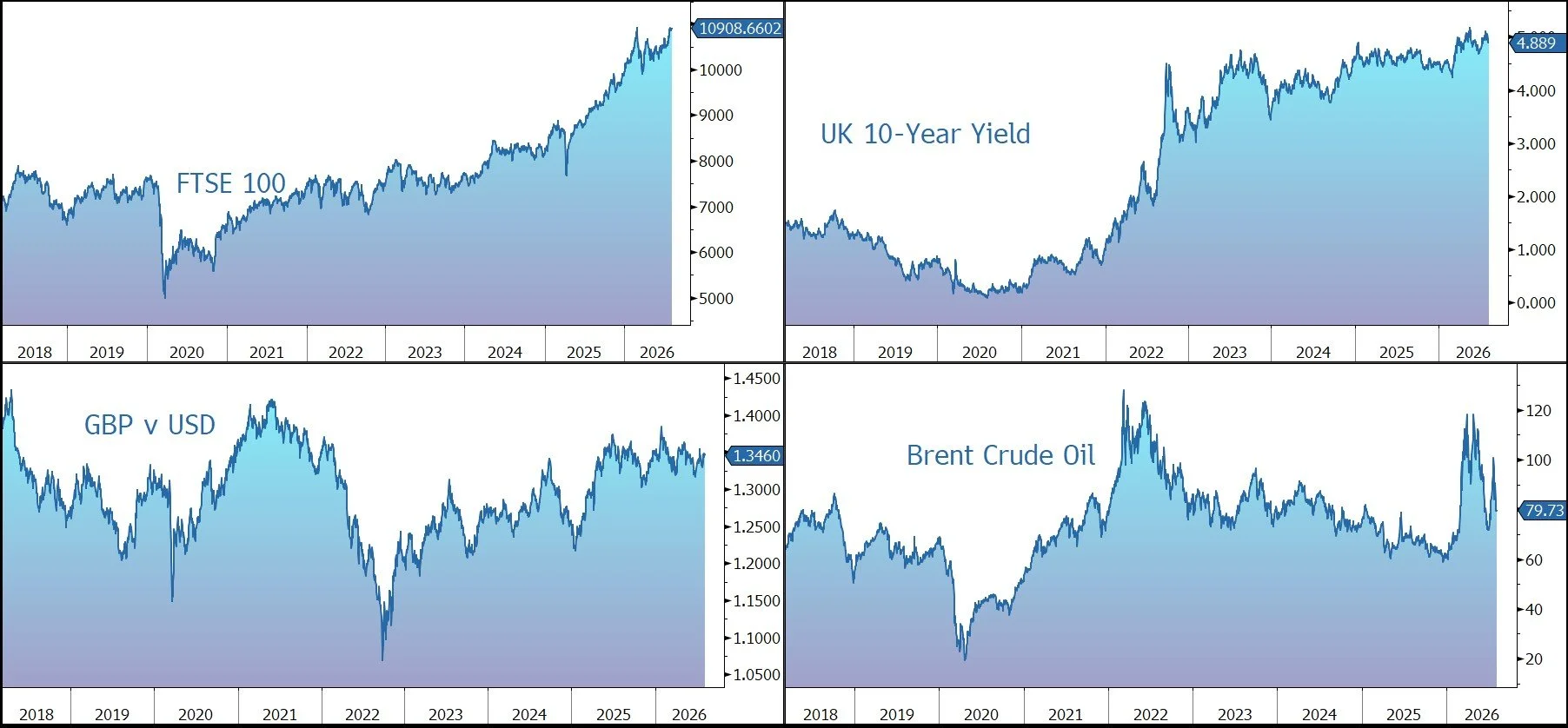
Iran is still deciding whether to move to second stage talks with the US, even as it said talks with Oman over a temporary shipping route through Hormuz are nearing completion. Tehran said the passage may remain in place for two to four months. Brent crude currently trades around $80 a barrel.
ADP data showed the US economy added only 44,000 private-sector jobs in July, the weakest reading since January and well below forecasts for 70,000. Markets scaled back expectations for Federal Reserve interest rate hikes this year, now pricing in just one increase by year-end, compared with two as recently as last week. However, Fed Governor Lisa Cook reiterated that she remains prepared to raise rates if inflation fails to cool, warning that the central bank may not have the luxury of waiting before bringing inflation back to its 2% target, while Minneapolis Fed President Neel Kashkari said it is time for the Fed to start slowly raising rates. Traders are awaiting tomorrow’s US jobs data, which could materially influence policy expectations.
Gold rose to its highest level since June, with demand backed by strong central bank buying. It currently trades at $4,255 an ounce. The yield on the US 10-year Treasury is 4.62%.
Global stocks slipped from record highs amid weakness in chipmakers following earnings disappointments from SanDisk and Western Digital. Losses in the US – S&P 500 (-0.2%); Nasdaq (-0.8%) – continued across Asia this morning: Nikkei 225 (-0.9%); Hang Seng (-1.8%); Kospi (-4.8%).
The FTSE 100 is currently 0.2% higher at 10,909, while Sterling trades at $1.3460 and €1.1655. Companies trading ex-dividend today include BT Group (2.92%), RELX (0.77%), AstraZeneca (0.66%), Unilever (0.83%), Barclays (1.12%), Standard Chartered (0.68%), Reckitt Benckiser Group (1.66%), Rolls-Royce (0.38%), and Lloyds Banking Group (1.35%).
In Europe, Siemens boosted its full-year earnings outlook for a second time, while Deutsche Telekom raised its 2026 share buyback program by as much as €3bn.
Source: Bloomberg
Property News
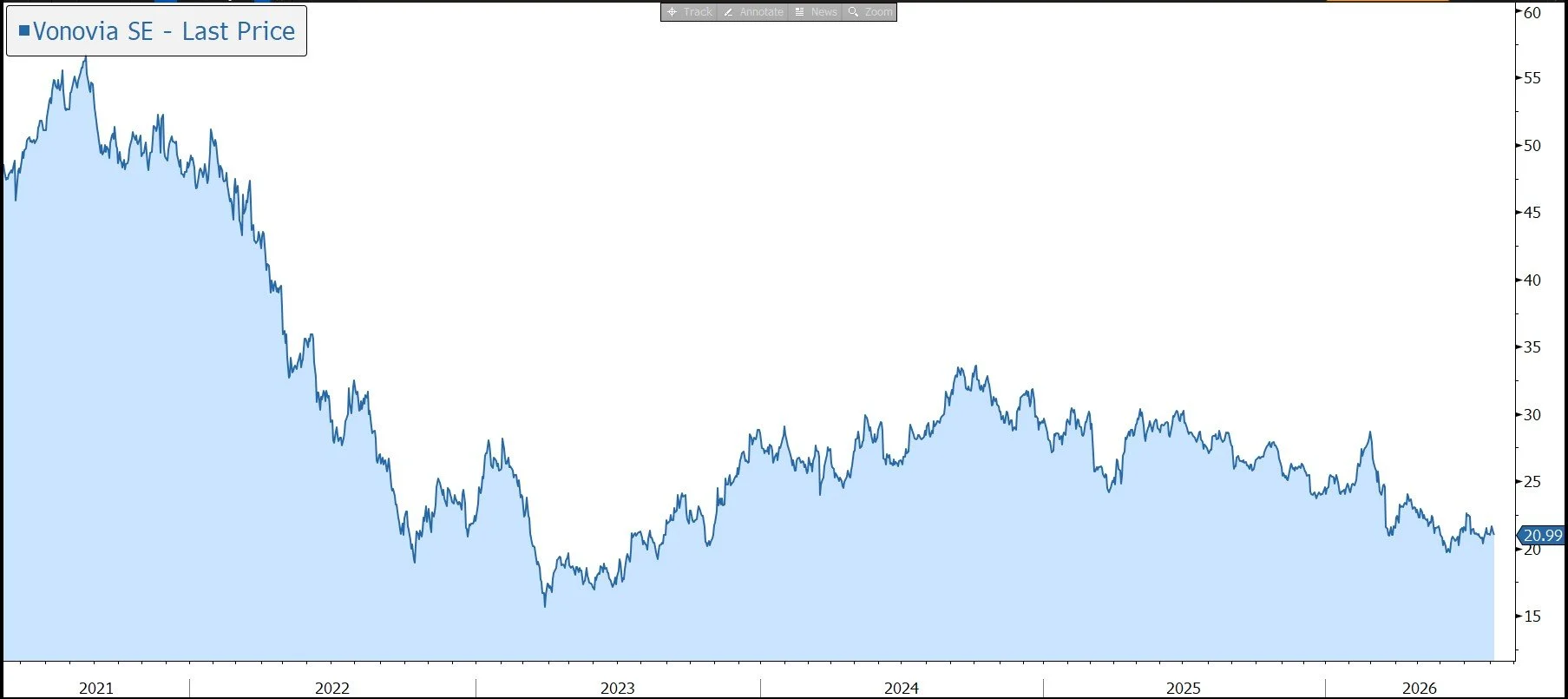
Yesterday Vonovia released its first-half 2026 results which highlighted attractive growth in the rental and value-add segments. However, in a still challenging market environment for disposal activities, the two sales-related segments progressed more slowly. Full-year guidance for 2026 and 2028 has been reiterated, albeit management noted that without market improvement, hitting the upper half of the forecast range is unlikely. The shares have been weak this year, tracking the upward move in Bund yields, driven by inflation concerns arising from the conflict in the Middle East and higher financing costs. The shares ended the day down 2%, leaving them on a 54% discount to NAV.
Vonovia is Europe’s largest residential real estate investment company with a market cap of around €18bn. The group owns around 528k units worth around €86bn across Germany (c. 85%), Sweden, and Austria. The company also manages a further 75k units owned by others. Despite its size, in Germany Vonovia still only owns 2% of a highly fragmented market. The focus is on multi-family housing for low- and medium-income tenants in metropolitan areas. The aim is to benefit from residential megatrends such as urbanisation, energy efficiency, and demographic change.
Following a number of acquisitions, Vonovia enjoys the benefits of scale – over the last 12 years, its adjusted EBITDA operating margin has risen by 20 percentage points to 80% and its cost per unit has fallen by two thirds.
Following the appointment of a new CEO earlier in the year, the company amended its strategic priorities including tighter leverage targets, enhanced disclosure, improved transparency, and an adjusted dividend policy.
In the first half of 2026, adjusted EBITDA rose by 2.4% to €1,457m, leaving the company well on track to achieve its target for 2026. Adjusted earnings before tax (EBT) – the group’s preferred profit metric – fell by 2.6% to €962.3m, primarily due to an 11% increase in financing costs. Operating free cash flow (OFCF) – the key figure for internal financing and thus liquidity management – was down 45% to €607.5m, primarily due to temporary working capital effects and dividend-related outflows while operating earnings remained resilient.
The most recent market data for the German residential sector suggests a phase of cautious stabilisation, characterised by strong rental demand but restrained transaction volumes. Housing completions in Germany remain severely depressed due to high construction and borrowing costs, driving an expanding structural deficit in urban housing. Total transaction volumes remain well below 10-year averages, largely due to a dearth of mega-portfolio deals. At the smaller and medium-sized end of the market, public-sector housing companies, municipal buyers, and private investors/family offices have become much more active purchasers.
Vonovia’s core rental segment continued to benefit from a positive market environment with strong demand for affordable housing. Earnings grew by 3.5% to €1,269m, despite having 5,000 fewer homes. The vacancy rate remains very low (2.3%) and highlights the ongoing mismatch between supply and demand. The trend towards higher rents continued, while the collection rate was 99.6%. This includes all ancillary and energy costs, which management see as a strong sign of affordability.
The organic increase in rent was 3.6%, with new construction accounting for 0.3%. Like-for-like rental growth of 3.3% was driven by market-related factors (+2.1%) and investment in existing buildings (+1.2%). The monthly rent per square metre increased by 3.5% to €8.51. Going forward, under the regulatory system, rent growth is expected to follow inflation higher over time albeit with a lag. In the near term however, the company has trimmed its expectation for rental growth in 2026 from 4.2% to 4.0% primarily due to the decision to defer the implementation of the full Berlin Mietspiegel. Further out, the expectation is ‘around 5%’ driven by an additional investment in modernisation.
Profitability in the three non-rental segments was: development (-65% to €20.1m), recurring sales (+1.6% to €39.3m), and value-added services (+27.6% to €128.5m). Looking forward, the company is targeting multiple organic growth initiatives to develop non-rental activities and estimates a contribution of 20%-25% of adjusted EBITDA in 2028, versus 13% currently.
Vonovia continued to sell properties of inferior quality or in non-core regions, though the market environment remained challenging. The volume of recurring sales was 39% lower in the period (at 687), albeit with the fair value step-up at 43.8%, much higher than last year. Around 2,900 non-core units were also sold. Much of the group’s sales activities will be more back-end loaded in 2026.
Capital is being partly reallocated toward the construction of new properties and the improvement of the existing portfolio to comply with environmental regulations which can drive higher rents. In H1 2026 the group spent €933m (+9.0%), made up of maintenance (+6.5%), modernisation (+19.8%), and new construction (-14.7%).
The company’s balance sheet remains stretched – loan-to-value (LTV) increased slightly from 45.4% to 46.0% and is still above the current 40%-45% target range. Given the higher interest rate environment, the company is targeting more prudent leverage metrics in 2028 for net debt/EBITDA (<12x vs 14.0x currently) and LTV (c. 40%). Deleveraging will occur via disposals, with the company currently reviewing minority positions in non-strategic assets both in Germany and abroad. Disposal execution continues to be broadly in line with the 2028 deleveraging plan.
At present, the group’s long-term and well-balanced debt maturity profile provides a hedge against increasing financing costs: weighted average maturity (6.3 years); average cost of debt (2.1%); fixed/hedged (96%). The strategy is to roll over secured debt and repay unsecured bonds with disposal proceeds. After a promising start to the year, the war in the Middle East has led to increased volatility and slightly higher financing costs.
Replacing incredibly cheap capital locked-in during the era of negative interest rates with new debt at current market rates is the primary headwind facing the company. Before accounting for early debt buybacks and active liquidity management, Vonovia’s baseline debt maturity schedule for the next three years is €13.8bn. The true risk for Vonovia isn't a default or an inability to access capital markets – the company retains solid investment-grade credit ratings (BBB+ stable from S&P and Fitch). The issue is the interest expense step-up. The vast majority of maturing debt carries an average legacy coupon of roughly 1.2% to 1.5%. Refinancing this debt into new Eurobonds at current market yields of roughly 4.5% introduces an interest rate jump of three times, potentially a €400m drag by 2028.
As highlighted above, the company is responding by lowering leverage targets, selling assets, and diversifying new debt by currency. In the year to date, €4.4bn has been refinanced with an 8-year average tenure and 3.2% euro coupon. In May, the company successfully issued two single-tranche bonds in the UK (£400m, 12 years) and Australia (A$300m, 7 years) with a weighted average interest rate of 4.4% in euro terms, hedged against currency risks. In June, the company announced an upsized €850m convertible bond placement with no periodic interest and a conversion premium of 35% to 40% above the reference share price. The recent €1.5bn liability management addressed a significant portion of the 2027 and 2028 bond maturities.
For the dividend, the company is pursuing a progressive policy, targeting a payout ratio of between 50% and 60% of adjusted EBT. In May, the 2025 dividend €1.25 per share was paid to shareholders, 2.5% higher than last year and equal to a yield of 6%.
The like-for-like market value of the portfolio rose by 1.1% (or 1.8% including investments) to €81.8bn in the first half, with an initial gross yield of 4.3%. This follows a 3% increase in 2025, supporting management’s view that the market has now bottomed out. The net asset value (known as EPRA NTA), which is the real estate value excluding debt, was little changed at €46.22.
Guidance for 2026 has been reiterated: EBT of €1.9bn-€2.0bn and adjusted EBITDA of €2.95bn-€3.05bn. The company has also reiterated its target for EBITDA in 2028 of €3.2bn-€3.5bn.
Greater visibility over the outlook for interest rates and property market valuations will be required for the shares to move higher. Clearly, the government’s plan to ease its fiscal rules is unhelpful, with Bund yields rising in anticipation of an increase in government debt, a trend that has been exacerbated by the inflation concerns as a result of the Middle East conflict. Not only does this increase the group’s borrowing costs (and reduce free cash flow) but it also has a negative impact on property values and makes bond proxies such as real estate relatively less attractive. In the meantime, however, we are comforted by the outlook for rental growth, the improved transaction market, and the ongoing substantial mismatch between Vonovia’s equity value (implied at €2,412 per sqm for the German portfolio), the median purchase price for existing condos in the direct real estate market (€3,600), and the median purchase price for newly constructed properties (€5,700).
Source: Bloomberg
