
Morning Note: Market News and an Update from BP.
Market News
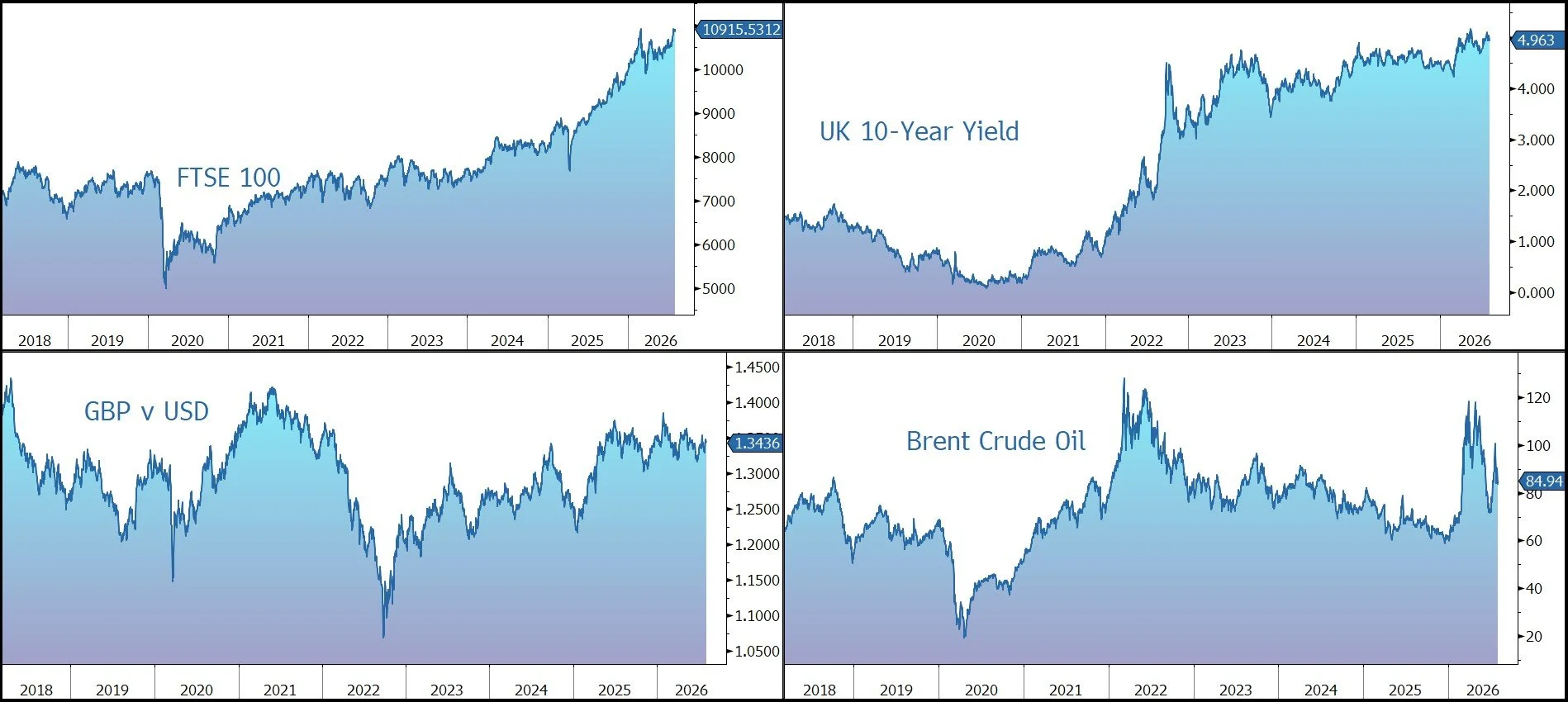
Donald Trump called his latest offer of talks a “last chance” for Iran. Tehran denied negotiating with the US, but said discussions with Oman to restore shipping through the Strait of Hormuz were making progress. The UK Navy said a cargo vessel off Oman was hit by an unknown projectile. Brent crude trades at $85 a barrel, while gold ticked up to $4,065 an ounce.
US equities moved higher last night – S&P 500 (+1.5%); Nasdaq (+2.1%) – after a tech-driven rally. In Asia this morning: Nikkei 225 (+0.3%); Hang Seng (-0.7%); Shanghai Composite (+0.3%); Kospi (+1.6%). Trading in leveraged ETFs tied to SK Hynix and Samsung shrank sharply after South Korea took measures to cool demand following market volatility.
Japan’s joint intervention with the US is shifting market focus to whether the yen can strengthen beyond 155 per dollar, according to strategists. The unprecedented currency cooperation may give Washington additional leverage in a range of US interests such as trade and rates. The yen slipped to 157.75.
The FTSE 100 is currently 0.6% higher at 10,916, while Sterling trades at $1.3435 and €1.1670. BP (see below) posted its strongest quarterly profit in more than four years, topping estimates, as refining and trading boomed during the Iran war. HSBC’s second-quarter profit beat estimates, driven by $2.6bn in “notable items” as well as growth in banking and wealth income. The bank also announced a fresh stock buyback of up to $1bn. The shares are trading 1% lower.
The Rhine’s water levels fell to the lowest in nearly 150 years as hot, dry weather gripped Europe, threatening to disrupt shipments of coal, fuel and industrial commodities.
Source: Bloomberg
Company News
BP has today released Q2 results which were well above market expectations. Good progress has been made simplifying the portfolio and strengthening the balance sheet – today the company has announced its intention to sell Archaea, its biogas business in the US. However, operational performance was mixed. The quarterly dividend was raised by 4% and as expected the share buyback programme remains on hold. The new CEO has laid out five priorities to deliver a step change in performance and grow shareholder value, with further detail expected on the call later today. The shares are 2% higher in early trading.
BP is a global integrated energy company undertaking a strategic reset involving a reduction of capital expenditure, a reallocation of spend away from low carbon activities, and a significant cost reduction programme, all of which will drive improved cash flow and returns to support a stronger balance sheet and, in time, growth investment and increased shareholder distributions.
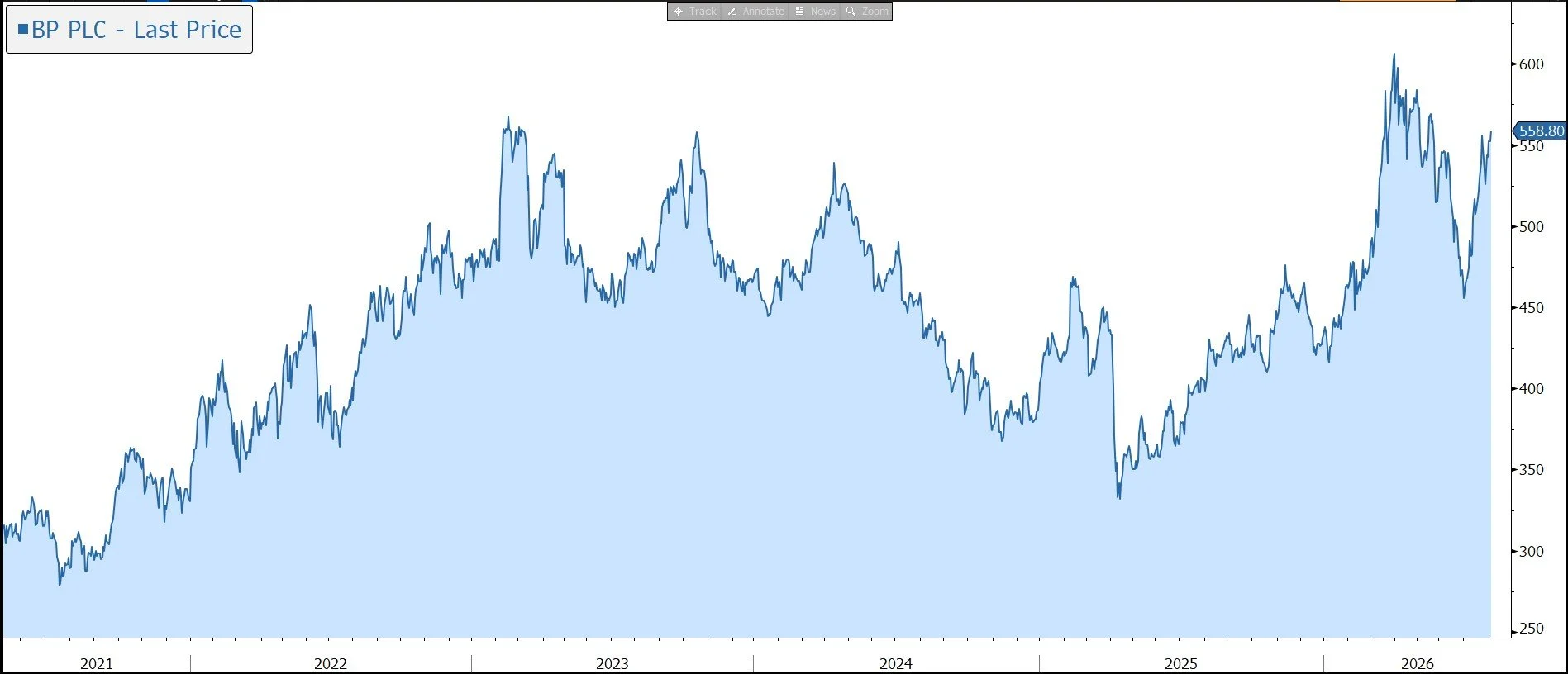
The share price has been fairly volatile of late as a result of the conflict in the Middle East, and its impact on the oil and gas price, and issues related to the Chairman.
In May, BP abruptly dismissed its Chairman Albert Manifold over serious governance and conduct concerns, the second major executive conduct exit in three years following CEO Bernard Looney’s 2023 departure. Manifold fiercely disputes the decision, leaving the company exposed to a high-profile legal battle. Despite the chaos, new CEO Meg O’Neill – the first outsider to lead BP – is continuing the strategic reset, reorganising the group into simpler upstream and downstream units to drive efficiency. For now, however, the governance uncertainty continues to suppress BP’s valuation, leaving it potentially vulnerable to a hostile takeover.
With today’s results, the CEO has laid out five priorities to deliver a step change in performance and grow shareholder value:
· Strengthen the balance sheet to provide the financial resilience needed to generate greater flexibility to invest to grow through the cycle and reward shareholders.
· Simplify the portfolio based on value, not sentiment nor history. The group will focus on the assets with the strongest potential to deliver competitive returns and long-term value.
· Invest with greater discipline to ensure every dollar of capital competes. The company will use balanced investment criteria to make decisions rooted in profitability, cash generation, and market realities. The company will compete in the weight class it is in.
· Drive operational excellence. Although the company has made progress on reducing structural costs, it has not improved enough where it matters most: the bottom line. The company will move faster and has the opportunity and technology to do so.
· Hardwire high-performance and accountability into bp - make better, faster decisions, reduce complexity, and sharpen accountability.
There has already been strategic progress on the portfolio: an agreement was reached to sell the Austrian retail business; terms were agreed to bring partners into Kirkuk; the sale of Gelsenkirchen refinery was completed, and processes were launched to market the group’s North Sea business and Archaea Energy, the group’s US biogas business. Since the quarter end, BP has announced the sale of its 37.2% stake in the Bay du Nord offshore oil project in Canada. Last week, it was reported that BP is close to a deal to sell its solar business Lightsource BP to a Kuwait-backed group. Given the pool of potential organic growth opportunities, there are no plans for major acquisitions.
Back to today’s results which have clearly been impacted by the conflict in the Middle East and the current market conditions. Heightened volatility in crude oil, natural gas, and refined products prices have impacted financial results, including trading results and working capital movements.
In the three months to 30 June 2026, underlying replacement cost profit – the key measure of the group’s performance – rose from $2.4bn to $5.7bn, well above the market forecast of $5.0bn.
Compared with the previous quarter, underlying profit rose by 79%, and mainly reflects higher liquids and gas realisations including the impact of price lags, stronger realised refining margins and stronger customers result, partly offset by higher exploration write-offs.
The commodity price backdrop was mixed: Brent crude averaged $103.85/barrel (up from $81.13/barrel in the previous quarter); US gas Henry Hub averaged $2.90/mmBtu (vs. $5.05/mmBtu); and the refining margin averaged $29.6/barrel (vs. $16.9/barrel). The environment has been volatile as a result of ongoing geopolitical uncertainty and the company believes that even when the conflict ends it will take months for the oil and gas supply/demand balance to normalise.
As a rule of thumb, the company has disclosed that: a $1 movement in Brent has a $340m profit impact, a $0.1 movement in Henry Hub has a $40m profit impact, and a $1 movement in the refining margin has a $450m profit impact.
The Q2 results include post-tax adjusting items relating to asset impairments of $1.1bn. These charges are primarily attributable to transition businesses in the gas & low carbon energy segment and are excluded from underlying replacement cost profit.
By division, the results for the quarter for underlying operating profit were: gas & low carbon energy (+45% vs. Q2 2025); oil production & operations (+58%); and customers & products (+223%).
Reported upstream production in the second quarter fell from 2,300 mboe/d to 2,201 mboe/d due to seasonal maintenance predominantly in the Gulf of Mexico and the effects of disruption in the Middle East. Q3 is expected to be between 2,100 mboe/d and 2,250 mboe/d.
Cost discipline was strong, with overall unit production costs down 3% year on year. However, operational performance was mixed – in the second quarter, upstream plant reliability fell from 95.7% in Q1 to 92.4% in Q2, while refining availability fell from 96.3% to 94.7%. This was driven, in part, by planned maintenance and the conflict in the Middle East but is also a reminder that the company has more to do to deliver consistent operational performance.
Despite higher oil prices, investment discipline remains a key priority. Capital expenditure was $3.1bn in Q2 and the company has nudged up its full-year guidance to $13.5bn-$14.0bn, reflecting the decision to delay asset farm downs and capture better value.
Operating cash flow rose from $6.3bn to a stellar $10.9bn, reflecting higher earnings and a lower $1.0bn working capital build.
H1 disposal proceeds were $857m. In 2026, proceeds of $8bn-$9bn are expected (down from $9bn-$10bn, previously) including $6bn from the announced Castrol transaction, all significantly weighted to the second half.
The company’s first capital allocation priority is a resilient dividend, which is expected to increase by at least 4% per ordinary share a year. Today, the group has declared a quarterly dividend of 8.66 US cents, 4% higher than last year, implying a full-year yield of 4.9%.
BP remains committed to maintaining a strong investment grade credit rating and a reduction in net debt to $14bn–$18bn by the end of 2026 (vs. $22.3bn as at Q2 2026) – a year earlier than expected. We note, however, the net debt figure doesn’t include other financial obligations and instruments such as lease liabilities ($13.3bn), Gulf of Mexico oil spill payables ($5.0bn), and hybrid bonds (£13bn). Treating hybrids as 50/50 equity/debt, the gearing measure rises to nearer 40%, rather than the 22.6% disclosed at the Q2 stage.
In the second quarter, net debt fell from $25.3bn to $22.3bn. This reduction is after the payment of $2.9bn to redeem the €2.5bn perpetual hybrid bonds in June in line with plans to reduce hybrids by $4.3bn by end 2027. Overall financial obligations and instruments fell by 11% to $53.6bn.
In a nod to these ‘other’ financial obligations, the company is currently not buying back its shares and is fully allocating excess cash to accelerate the strengthening of its balance sheet, a process that has accelerated with higher commodity prices. We believe this is the right decision – it saves $3bn a year and will create a strong platform to invest with discipline into the group’s ‘distinctive’ deep hopper of oil and gas opportunities.
We believe decarbonisation can’t happen at the flick of a switch – oil and gas will remain part of the global energy mix for decades, with demand driven by population growth and higher incomes, particularly in developing countries where the desire for energy intensive goods and services like cars, international travel, and air conditioning is rising. We also believe the production of the materials needed to transition to net zero can’t happen without hydrocarbons. At the same time, reduced investment in new production, partly because of environmental concerns, and natural decline rates, are increasingly leading to constrained supply.
Against this backdrop, investor disillusion with BP’s tilt towards low carbon energy, particularly in terms of capital discipline and returns (as evidenced by $18bn of impairments since 2023), and its mixed governance track record, has had a negative impact on the share price over the medium term relative to the peer group. However, the recent arrival of a new CEO, combined with operational high-grading, reduced financial gearing, and ongoing M&A speculation suggests that the valuation gap between BP and its peers should narrow.
Source: Bloomberg
