
Market News
A Democratic sweep of both chambers of the US Congress in Tuesday’s midterm elections is the dominant overnight theme, sending S&P 500 futures down as much as 1.4% before dip buyers pared losses to leave a 0.3% gain by early London hours. In Asia this morning, markets recovered ground towards the end of the session: Nikkei 225 (-1.4%); Hang Seng (+1.7%); Shanghai Composite (+2.2%); Kospi (+0.6%).
Markets interpreted the results as potentially increasing the likelihood of political gridlock in Washington and limiting prospects for further fiscal expansion. The dollar weakened against all G10 peers, while the Swiss franc and yen led safe-haven gains. The yield on the 10-year US Treasury slipped to 4.93%, while gold climbed more than 2% to reclaim the $4,000 an ounce level. The key question for today is whether the Treasury’s quarterly refunding announcement — due at 13:30 GMT — validates or challenges the bond rally. Any upside surprise in issuance size could reverse the overnight Treasury bid and push yields back toward 5%.
At the stock level, investors will assess whether the Democratic Congress materially threatens the AI capex cycle or whether, as some analysts argue, the regulatory risk is overstated and fundamentals reassert. Defence stocks weakened, while renewable energy stock gained.
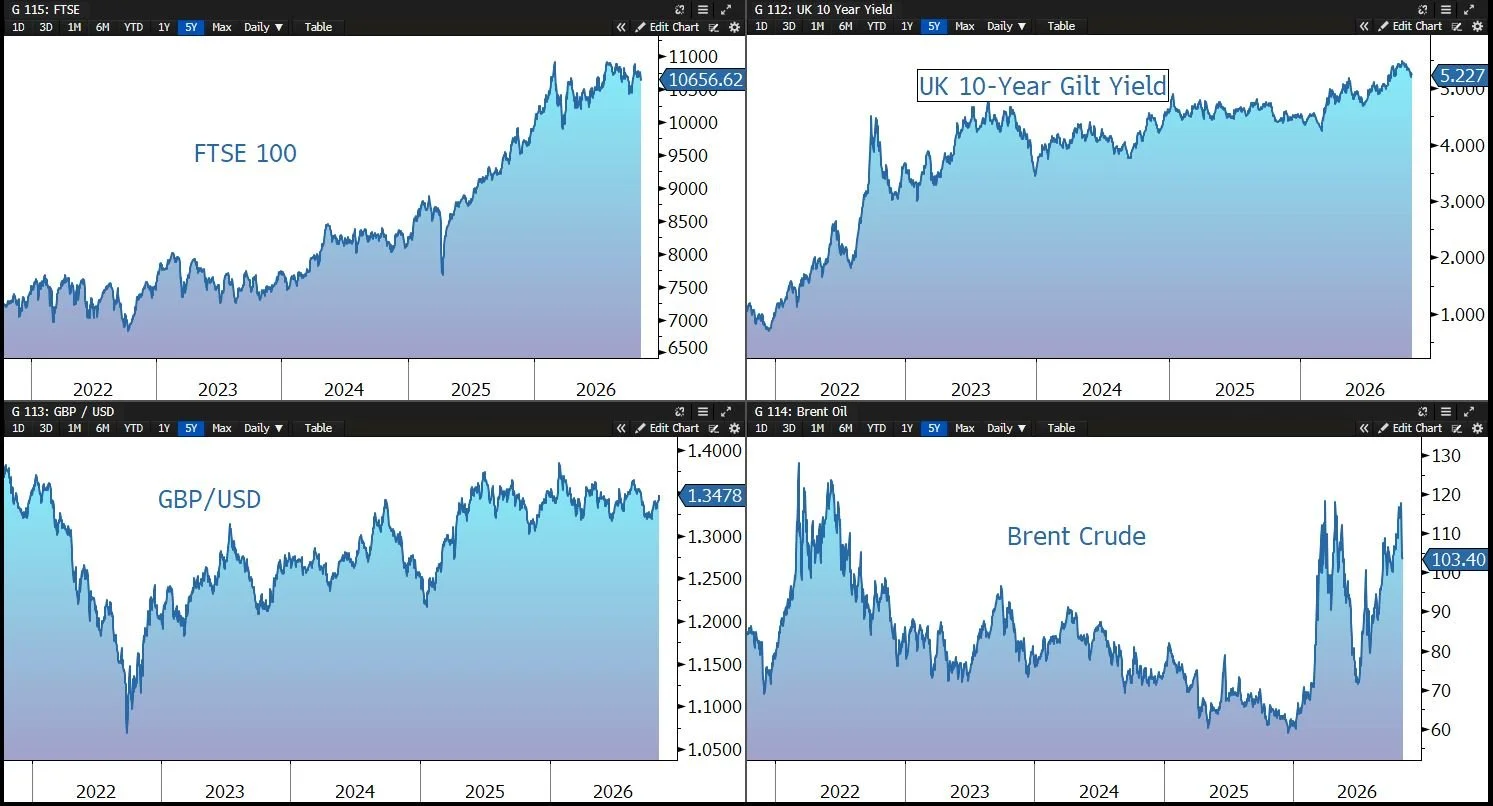
The crucial question for energy stocks is how the election results alter the outlook for a peace deal in Iran, and ultimately commodity prices. For now, however, Brent Crude remains firm at $104 a barrel, amid heightened uncertainty surrounding the outcome of ongoing peace negotiations between the US and Iran. Qatar’s Foreign Ministry spokesperson stated that both countries are evaluating new proposals put forward by mediators to bridge their differences. However, Iran’s national security chief indicated in a social media post that Washington’s response remains unsatisfactory.
The FTSE 100 is currently 0.2% higher at 10,656, while Sterling trades at $1.3485 and €1.1985. Smith & Nephew is trading 2% lower following a cut to its full-year revenue growth outlook from 4% to 3% and trading profit target to $1.25bn, citing weaker US hip and knee implant demand. The company also confirmed acquisition talks with J&J have ended.
Source: Bloomberg
Property News
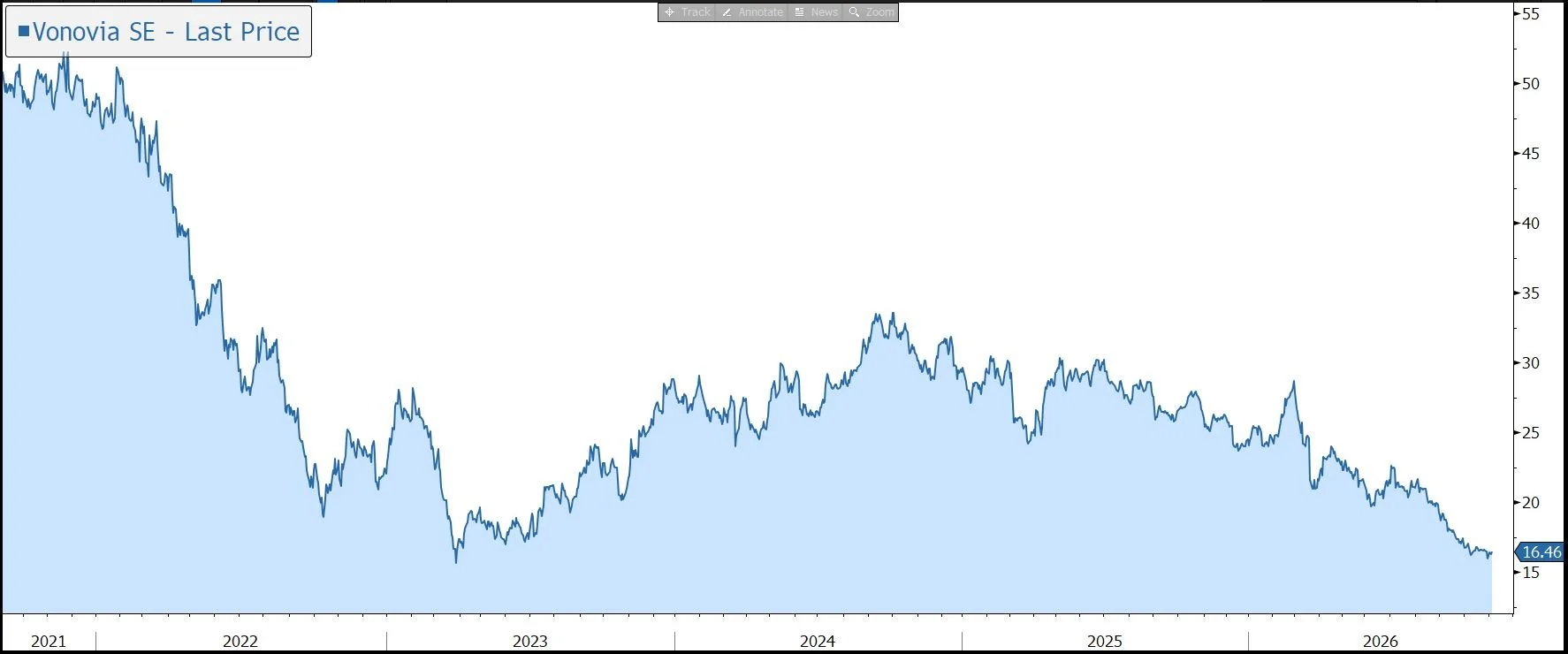
This morning Vonovia released the full detail of its Q3 results. This follows an announcement last week in which the company highlighted that higher interest rates and weaker financing conditions are constraining transaction activity and its market-sensitive, sales-related businesses. At the time, the company also lowered its guidance and objectives. The core rental business remains resilient, driven by strong demand. The shares have been very weak this year, tracking the upward move in Bund yields, driven by inflation concerns arising from the conflict in the Middle East. The company now expects a broadly flat portfolio valuation for the full-year 2026. Ahead of this afternoon’s meeting, the shares are trading slightly higher, leaving them on a 65% discount to NAV.
Vonovia is Europe’s largest residential real estate investment company with a market cap of around €14bn. The group owns around 527k units worth around €85.8bn across Germany (c. 85%), Sweden, and Austria. The company also manages a further 75k units owned by others. Despite its size, in Germany Vonovia still only owns 2% of a highly fragmented market. The focus is on multi-family housing for low- and medium-income tenants in metropolitan areas. The aim is to benefit from residential megatrends such as urbanisation, energy efficiency, and demographic change.
Following the appointment of a new CEO earlier in the year, the company amended its strategic priorities including tighter leverage targets, enhanced disclosure, improved transparency, and an adjusted dividend policy.
The company’s core rental business remains solid, value-add is performing ahead of expectations, and B2B and other asset-light, service-driven models continue to offer further growth potential. However, in response to an increasingly challenging market backdrop, driven by higher rates and weaker financing conditions, the company has undertaken a strategic review of its Development activities, reduced its Development-to-Hold investments, initiated stricter capital allocation, and suspended new Manage-to-Green investments to protect cash flow and balance-sheet strength. Deleveraging remains a top priority, supported by (hopefully vanilla) disposals, disciplined capital allocation, and cash-flow preservation.
The company has trimmed its full-year 2026 guidance, while the 2027 guidance and 2028 objectives now reflect higher financing costs, lower contributions from recurring sales and development, and a slower ramp-up in organic rent growth.
In the first nine months of 2026, adjusted EBITDA rose by 3.3% to €2,187m, despite having 5,000 fewer homes in the portfolio. Adjusted earnings before tax (EBT) – the group’s preferred profit metric – fell by 3.5% to €1,408m, primarily due to an increase in financing costs. Operating free cash flow (OFCF) – the key figure for internal financing and thus liquidity management – was down 34.1% to €932.5m, affected, among other factors, by changes in net working capital, a lower recurring sales volume and higher distributions to minority shareholders.
Vonovia’s core Rental segment continued to benefit from a positive market environment with strong demand for affordable housing. Earnings grew by 3.5% to €1,912m, despite having 5,000 fewer homes. The vacancy rate remains very low (2.3%) and highlights the ongoing mismatch between supply and demand. The trend towards higher rents continued, while the collection rate was 99.6%. This includes all ancillary and energy costs, which management see as a strong sign of affordability. The division continues to benefit from efficiency gains, in particular AI-driven productivity initiatives are expected to generate an annual run-rate profit benefit of €50m by 2030.
The organic increase in rent was 3.8%, with new construction accounting for 0.3%. Like-for-like rental growth of 3.5% was driven by market-related factors (+2.3%) and investment in existing buildings (+1.2%). The monthly rent per square metre increased by 3.5% to €8.57. Going forward, under the regulatory system, rent growth is expected to follow inflation higher over time albeit with a lag. In the near term, however, the company has once again trimmed its expectation for rental growth in 2026 from 4.0% to 3.8%, primarily due to a slower ramp-up of its investment programme and slightly softer-than-anticipated rent increases from local rent indices. Looking forward, the company has also trimmed its expectation for 2027 (+4.0%) and 2028 (+4.5%, versus ‘around 5%’ previously).
Profitability in the three non-rental segments was: development (-56.4% to €28.1m due to weak demand for medium- to higher-priced projects), recurring sales (-11.8% to €49.9m), and value-added services (+31.4% to €197.2m, driven mainly by the craftsmen organisation and the energy business).
Vonovia continued to sell properties of inferior quality or in non-core regions, though the market environment remains challenging as financing constraints continue to limit transaction volumes. The volume of recurring sales was 38% lower in the period (at 965), albeit the average fair value step-up remained high (42.2%), confirming the pricing quality of completed transactions. Around 3,543 non-core units were also sold.
Capital is being partly reallocated toward the construction of new properties and the improvement of the existing portfolio to comply with environmental regulations which can drive higher rents. However, as highlighted above, the development segment will undergo a comprehensive strategic review with an update at the time of the full-year results next March.
The company’s balance sheet remains stretched – loan-to-value (LTV) increased slightly from 45.4% to 46.1% and is still above the current 40%-45% target range. Given the higher interest rate environment, the company is still targeting more prudent leverage metrics in 2028 for net debt/EBITDA (below 12x vs 13.9x currently) and LTV (c. 40%, albeit this is more challenging given the outlook for asset values). Deleveraging will be front-end loaded and will occur via a disposal programme that has three main components: a non-core portfolio in Germany of €1.8bn including €0.3bn of nursing homes; a further €0.3bn of commercial property; and a non-core element of the Swedish portfolio totalling €0.8bn.
At present, the group’s long-term and well-balanced debt maturity profile provides a hedge against increasing financing costs: weighted average maturity (6.4 years); average cost of debt (2.1% in H1); fixed/hedged (96%). The strategy is to roll over secured debt and repay unsecured bonds with disposal proceeds. After a promising start to the year, the war in the Middle East has led to increased volatility and higher financing costs, particularly since the latest ECB rate hike decision in early September.
Replacing incredibly cheap capital locked-in during the era of negative interest rates with new debt at current market rates is the primary headwind facing the company. The re-offer yield of Vonovia’s eight-year unsecured corporate bonds has increased by 140 basis points since the beginning of the Iran war, raising the cost of capital and constraining transactions and investment activity.
Vonovia has no further material funding requirements for the rest of 2026. Before accounting for early debt buybacks and active liquidity management, Vonovia’s baseline debt maturity schedule is ‘relatively’ quiet in 2027 (€3.1bn to be refinanced) as opposed to €5.2bn in 2028, €3.9bn in 2029 and €5.5bn in 2030.
The true risk for Vonovia isn't a default or an inability to access capital markets – the company retains solid investment-grade credit ratings (BBB+ stable from S&P and Fitch). The issue is the interest expense step-up. Vonovia’s own bonds with 6.3 years to maturity are currently yielding 4.6% and so the market will be looking to see how this repricing will affect the bottom line. €42bn of debt at 4.6% vs. 2.1% implies an incremental financial burden of nearly €1bn p.a., although clearly this is a moving feast given the current volatility of bond yields.
As highlighted above, the company is responding by lowering leverage targets, selling assets, and diversifying new debt by currency. In the year to date, including the convertible bond, €4.7bn has been refinanced with a 7.5-year average tenure and 3.3% euro coupon. €1.5bn of corporate bonds with 2027 and 2028 maturities were also partially or fully redeemed.
For now, the progressive dividend policy, targeting a payout ratio of between 50% and 60% of adjusted EBT, remains intact, although there are investor calls for retaining the cash (€1bn p.a.) to mitigate higher debt costs.
The net asset value (known as EPRA NTA), which is the real estate value excluding debt, increased by 0.1% to €39.3bn, or €46.31 per share. As expected, there was no precise update to net asset value at this stage – the next comprehensive revaluation of the portfolio will be carried out as of year-end 2026. However, given the interest rate rise in recent months, Vonovia has become more cautious about the near-term trajectory of asset values. After four consecutive half-year periods of valuation gains, the company expects a broadly flat portfolio valuation for the full year 2026 versus year-end 2025. As a result, rent growth is unlikely to translate into organic value growth in the near term to the extent previously assumed.
Last week, the company adjusted its guidance and objectives. Guidance for 2026 is now: EBT (around the low-end of the €1.9bn-€2.0bn range) and adjusted EBITDA (bottom half of the €2.95bn-€3.05bn range). OFCF before changes in net working capital is now expected to be moderately below the 2025 level, versus flat previously. Most metrics are expected to grow slightly in 2027, although the target for EBITDA in 2028 is now at the lower end of the previous €3.2bn-€3.5bn range.
Further deleveraging and greater visibility over the outlook for interest rates and property market valuations will be required for the shares to move higher. Clearly, the government’s plan to ease its fiscal rules is unhelpful, with Bund yields rising in anticipation of an increase in government debt, a trend that has been exacerbated by the inflation concerns as a result of the Middle East conflict. Not only does this increase the group’s borrowing costs (and reduce free cash flow) but it also has a negative impact on property values and makes bond proxies such as real estate relatively less attractive. In the meantime, however, there remains an substantial mismatch between Vonovia’s equity value (implied at €1650 per sqm for the German portfolio), the implied fair value (€2,372), the median purchase price for existing condos in the direct real estate market (€3,600), and market construction costs (€5,800).
Source: Bloomberg
