
Market News
A Democratic sweep of both chambers of Congress in Tuesday’s US midterm elections continues to drive the dominant cross-asset theme. Treasuries extended gains for a second session — 10-year yields fell to 4.85%, the lowest since 10 September — on expectations that Trump’s fiscal agenda will face legislative resistance, reducing bond supply risk.
The dollar extended its decline, while gold continued its recent recovery and currently trades at $4,130 an ounce. Investors are now turning their attention to tomorrow’s key US employment report, which could influence expectations for the Federal Reserve’s monetary policy. Traders currently see a 79% probability of a rate hike in December.
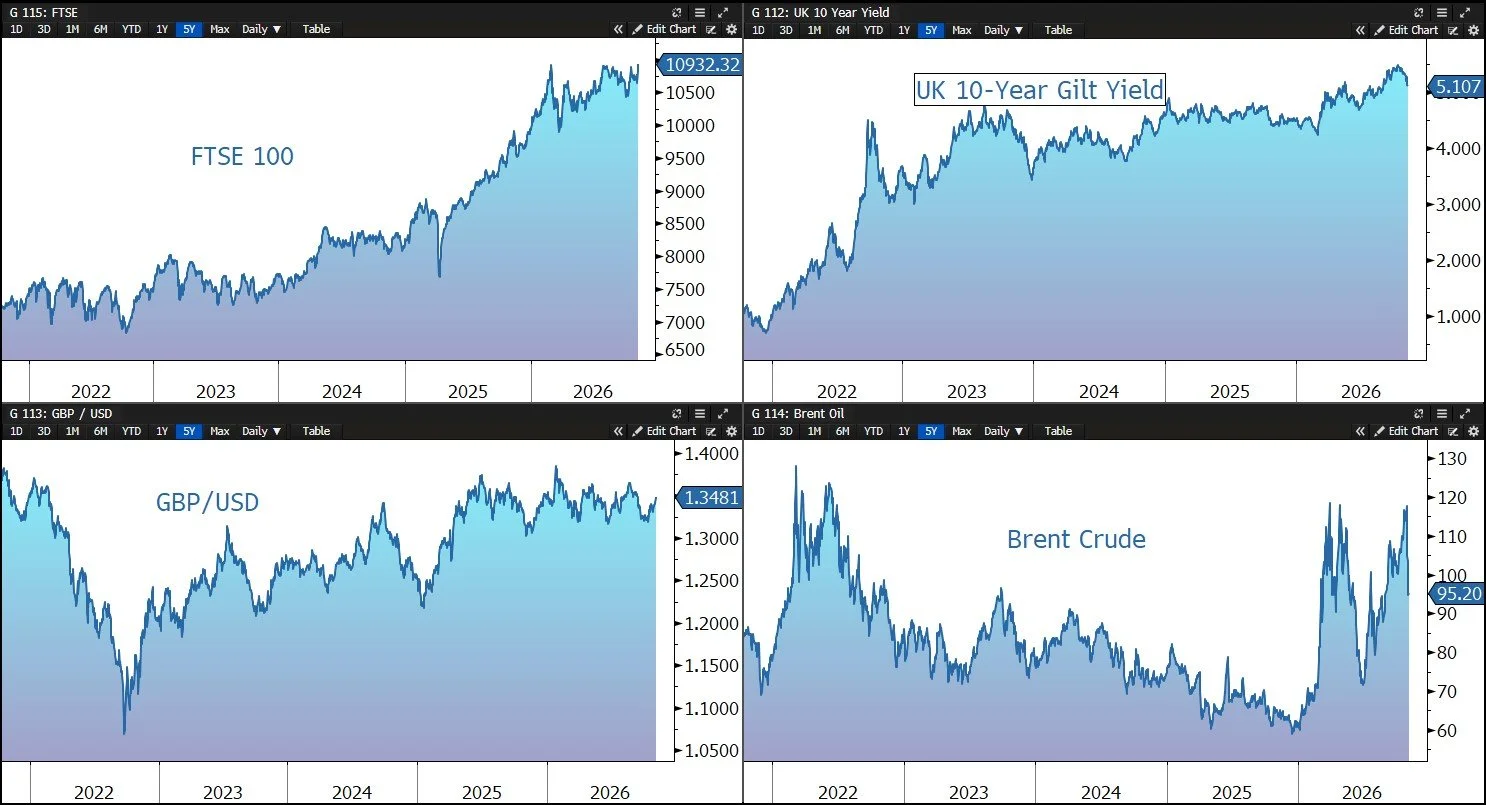
Brent crude is trading at around $95 a barrel following a decline of nearly 9% in the previous session that pushed prices to a two-month low.
US equities moved higher last night: S&P 500 (+1.6%); Nasdaq (+1.4%). The AI trade was split, as investors favoured cash-rich hyperscalers (Amazon, Alphabet) and shares of data centre operators fell, after Democrats made gains in key data-centre states including Texas and Georgia, where public opposition to the industry’s rapid expansion has been growing.
Asian equities also diverged sharply this morning: Hong Kong’s Hang Seng Tech Index surged 6% on a rotation into Chinese internet names, while South Korean chipmakers Samsung and SK Hynix tumbled more than 7% on fears of tighter data-centre regulation.
The FTSE 100 is currently trading 1.0% higher at 10,932. Companies trading ex-dividend this morning include HSBC (0.56% price impact), Tritax Big Box REIT (1.34%), and Ashmore (5.28%). Diageo released a reassuring update (see below).
The UK 10-year gilt yield has fallen to 5.14%, the lowest in two months, tracking a decline in US Treasury yields. Investors are positioning for an expected return to monetary tightening by the Bank of England later today, with markets widely anticipating the first interest rate hike since 2023. A 7-2 vote split is the consensus expectation. Sterling trades at $1.3475 and €1.1985.
Source: Bloomberg
Company News
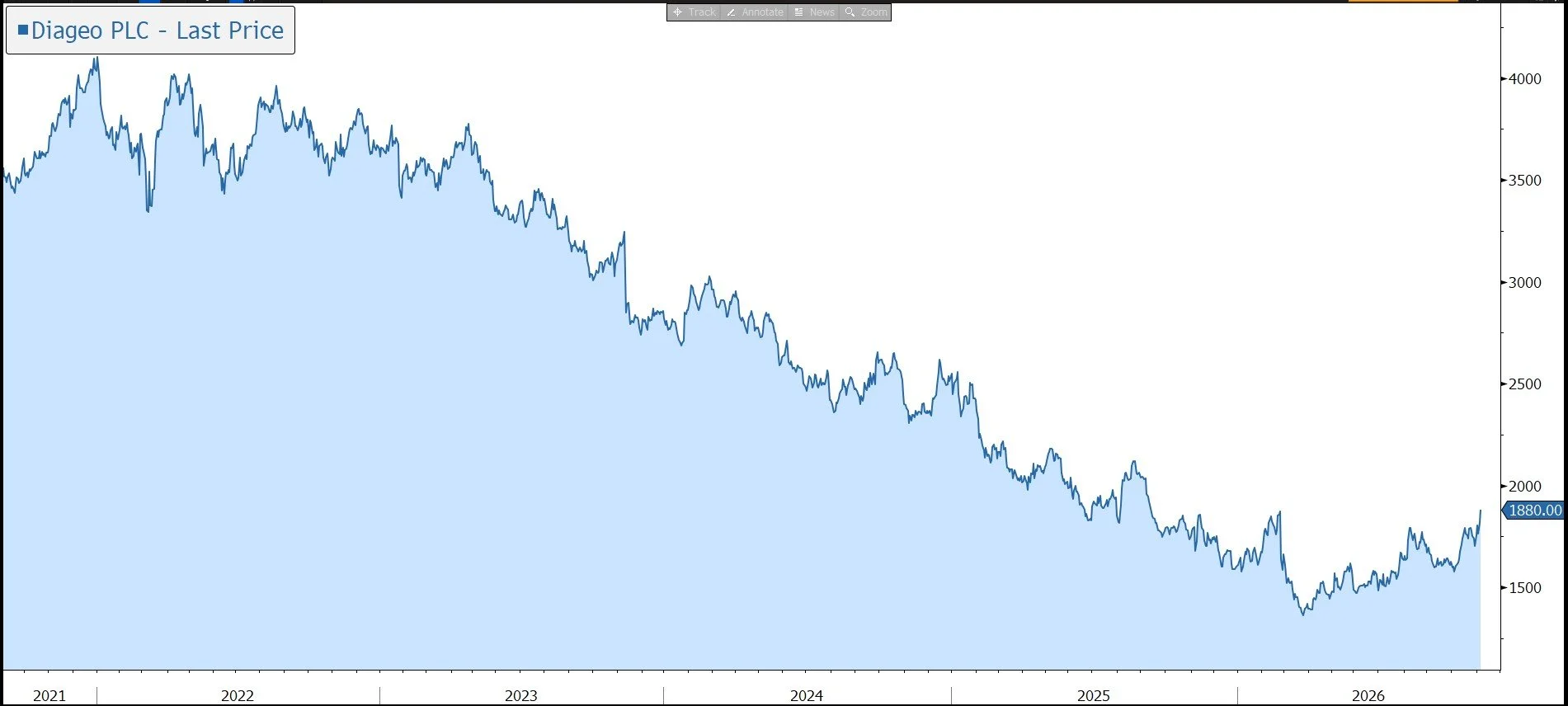
Diageo has released a trading statement for the three months to 30 September 2026, the first quarter of its financial year to 30 June 2027. Despite the challenging backdrop, trading was in line with management expectations, albeit slightly better than the market expectation. Guidance for the full year has been reiterated. Ahead of the analysts’ call, the shares have been marked up by 4%.
Diageo is a leading global drinks company, with a portfolio of iconic brands including Johnnie Walker, Smirnoff, Captain Morgan, Baileys, Tanqueray, and Guinness. The company owns 13 billion-dollar brands across a broad range of categories. The group is an integrated operator, producing and supplying drinks at a variety of price points across strong global distribution routes. The company has been positioned to benefit from the trend towards premiumisation – including its 34% stake in Moet Hennessy, the group generates more than 60% of its sales from high margin, premium brands. Diageo also has a strong presence in under-penetrated emerging markets, where the number of people of legal purchasing age is set to increase by over 600m by 2030. Wealth is also increasing in these regions, with the middle class expanding, and consumers shifting from local products to higher-margin international brands.
In the near-term, however, the global industry environment has been challenging, with headwinds from the impact of weight-loss drugs on alcohol consumption, warnings from health authorities, Gen-Z moderation, and cannabis cannibalisation. However, the data the company is currently seeing shows penetration and frequency of spirits consumption as broadly stable, including among younger cohorts, with the more meaningful change being a reduction in servings per occasion rather than outright disengagement from the category. This implies that the biggest consumption headwind may be cyclical, not structural, and that an upturn in consumer confidence, particularly in western markets, could be an inflection point for the sector.
The company is undertaking a broad strategic reset driven by new CEO Dave Lewis – ex Tesco and Unilever. There are three priorities – relevant brands in all categories, improved customer focus, and a more agile and competitive operating framework – which lay the foundation for the new strategy.
The revised operating framework is being rolled out across Diageo, with the organisation being vastly simplified, with less duplication and improved benefits of scale, and a focus on improved supply chain capability. The company has stressed that this is an organic turnaround, with no need for M&A.
There are two strategic ‘battlegrounds’:
· Spirits and RTDs (ready to drink) – the company will manage both within each brand. It will retain its focus on premiumisation but will also broaden its reach to serve more customers on more occasions. Some brands are being positioned at lower price points to broaden the customer base, so the portfolio is ‘fit’ for all stages of the economic cycle. The investment will not just be in price but also format size and other competitive initiatives.
· Brewing through Guinness - the company remains excited about the growth potential in Guinness, with accelerated investment to leverage this opportunity more fully.
Diageo has already implemented 90% of the new structure, leaving only parts of Europe to complete. It will then operate through 23 country and country-cluster organisations, reporting into five regional divisions (North America, Latin America & Caribbean, EMEA, Asia Pacific, and India). As a result, SG&A/overheads are expected to drop to 10.5% of sales.
In total, Diageo expects to generate $1bn in savings over the next three years from the operating framework ($850m) and further work on its supply chain ($150m). Restructuring costs related to both programmes will total $1.2bn; $1.1bn for the operating framework, of which $752m was incurred in FY2026, and $100m for the supply chain savings expected to be incurred in FY2027. These savings provide the firepower to invest in marketing and US distribution without the need to reduce operating profit.
In addition to guidance for FY2027 (see below), the company has introduced guidance for the medium term through to FY2029.
· low-single-digit organic net sales CAGR, accelerating over the period as Diageo stabilises and grows share in North America.
· Sales CAGR by region of North America (-2% to 0%), Latin America & Caribbean (4%-6%), EMEA (2%-4%), Asia Pacific (0% to +2%, held back by China), and India (4%-6%). Guinness is expected to grow faster than the premium beer average of 1%-3%.
· mid-single-digit organic operating profit CAGR, reflecting the benefit of savings and more favourable mix over the period.
· EPS CAGR ahead of operating profit growth, on a currency neutral basis.
· Capital investment is being raised to $1.25bn for the next three years.
· Cumulative free cash flow of $8bn over the three years after $850m of exceptional cash costs, mainly relating to the operating framework changes.
The target is to exit FY2029 at 2.5%-3.0% sales growth. Importantly, there has been no margin reset. Instead, the focus is on growing gross profit dollars. The gross margin is expected to remain above 60%, as negative mix and tactical price repositioning are offset by operating leverage and productivity/supply chain savings. Advertising & promotion spend is expected to rise to 16% of sales and operating margins are expected to expand as operating expenses fall.
There are risks, in particular the difficulty in turning around the North America business and the potentially disruptive implementation of the restructuring plan.
On the senior management front, last month the company announced that Joanne Wilson, currently CFO of WPP, will join Diageo as CFO in 2027, succeeding Nik Jhangiani. Wilson previously worked under CEO Dave Lewis as part of the transformation team at Tesco. The move is not a complete surprise given that Jhangiani was overlooked for the position of CEO.
Back to today’s update. The company has highlighted that whilst the market remains challenging, and volatility continues given the geopolitical uncertainty and impact of the ongoing conflict in the Middle East on energy, supply, and distribution, results in the three months to 30 September 2026 are in line with management expectations and ”represent a small step in the right direction.”
Reported net sales rose by 1.2% to $4,931m, with organic net sales growth (which excludes M&A and currency movements) of 1.4%.
Excluding the impact of East African Breweries (EABL), which is in the process of being sold, organic sales rose by 0.6%, driven by flat organic volume (-0.1%) and a small 0.7% increase in price/mix. This was slightly better than the market expectation.
In North America, the group’s largest market (43% of profit), organic net sales declined by 3.6%, helped by a small phasing benefit, and made up of volume down 3.7% and price/mix up 0.1%. The result reflected continued market softness, particularly Don Julio, Casamigos, and Crown Royal which fell by double-digits. The company continues to focus on making its offer more competitive, and whilst this remains the biggest challenge, clear actions are underway.
Elsewhere, the company was pleased with the growth. Latin America and Caribbean (LAC, +4.8%) and Asia Pacific (+4.1%) delivered mid-single-digit growth. India (+3.4%) and Europe, Middle East and Africa (EMEA, +2.4%) were up low-single-digit.
By category, the company enjoyed growth in whisky, Guinness, and Smirnoff RTD.
As expected, this update only covers sales, so there is less detail on profitability or the group’s financial position. At the last balance sheet date (30 June 2026), financial gearing was 3.1x net debt to adjusted EBITDA. The company remains committed to returning to its target range of 2.5x-3.0x ‘no later than’ FY2027, with the help of disposals. The sale of the company’s stake in East African Breweries for $2.3bn remains on track to complete by the end of December. The disposal of Royal Challengers Bengaluru cricket team by United Spirits Limited (56% owned by Diageo) is progressing as planned. Diageo is expected to receive a special dividend from USL for its share of the after-tax proceeds.
In the meantime, and in order to create more financial flexibility, Diageo has rebased its dividend – a saving of $1.2bn. The company is committed to growing shareholder distributions over time and is targeting a 30%-50% payout policy going forward, with a minimum floor set for the dividend of 50c p.a., down 52% versus FY2025. For FY2026, a dividend of 50 cents was declared, equal to a yield of 2%. Looking forward, the company will review the gearing target range annually with an eye on whether to initiate increased shareholder returns.
Guidance for the financial year to June 2027 has been reiterated:
· Organic sales growth is expected to be broadly flat, with North America down mid-single-digit. This assumes that the overall North America market is down 3% and Diageo improves share performance compared to FY2026.
· Organic operating profit growth in the low-to-mid single digits. This includes 40% of the $850m cost savings from the operating framework changes and 25% of the $150m supply chain savings.
· Free cash flow of $2bn after $800m of exceptional cash costs related to the operating framework changes and $50m exceptional cash costs related to the supply chain savings programme.
Source: Bloomberg
