
Morning Note: Market News and an Update from Unilever.
Market News
A global sell-off in semiconductor stocks deepened on worries over the sustainability of AI spending. South Korea’s Kospi slid more than 10%, sparking a 20-minute trading halt. Slumps in Samsung and SK Hynix pointed to cracks in the memory-chip boom. Other equity markets in Asia were also down this morning: Nikkei 225 (-4.0%); Shanghai Composite (-1.0%). Nasdaq futures currently point to a 1% decline at the open this afternoon.
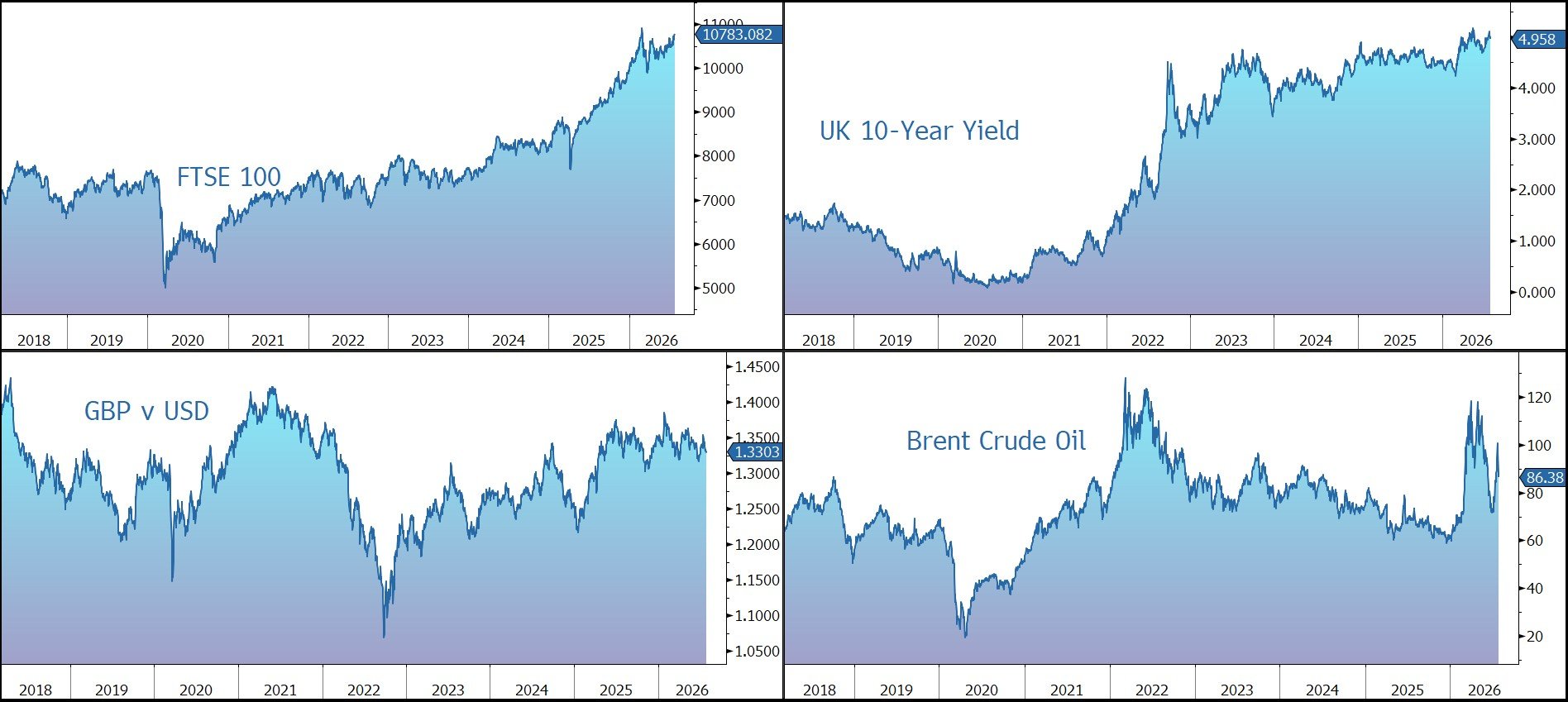
Oil extended a steep decline as Donald Trump said there’s a “good chance” of a deal with Iran. He also warned fighting may flare up again if negotiations fail. Iran and Oman negotiators are trying to reach an agreement to restart shipping through the Strait of Hormuz, people familiar said. Brent crude is $85 a barrel.
Gold has drifted down to $4,050 an ounce, while the yield on the US 10-year Treasury is 4.62%. The yen remains weak, currently 163.75 versus the dollar. Heatwaves and drought conditions have reduced crop-yield prospects in Europe, with the French maize yield forecast cut by 13%, MARS said.
The FTSE 100 is currently little changed at 10,783. Unilever (see below) delivered strong first-half results, sending the shares up 6%. Barclays’ investment banking revenue rose 20% in the second quarter, beating estimates, as stronger equities trading and IB fees offset softer-than-expected FICC revenue. However, the shares are down 4% in early trading.
Food prices are rising at their slowest rate in nearly two years, as the cost of some staples such as margarine and sugar have gone down. Sterling trades at $1.3305 and €1.1695, while the 10-year Gilt yield has fallen back to 4.95%.
Source: Bloomberg
Company News
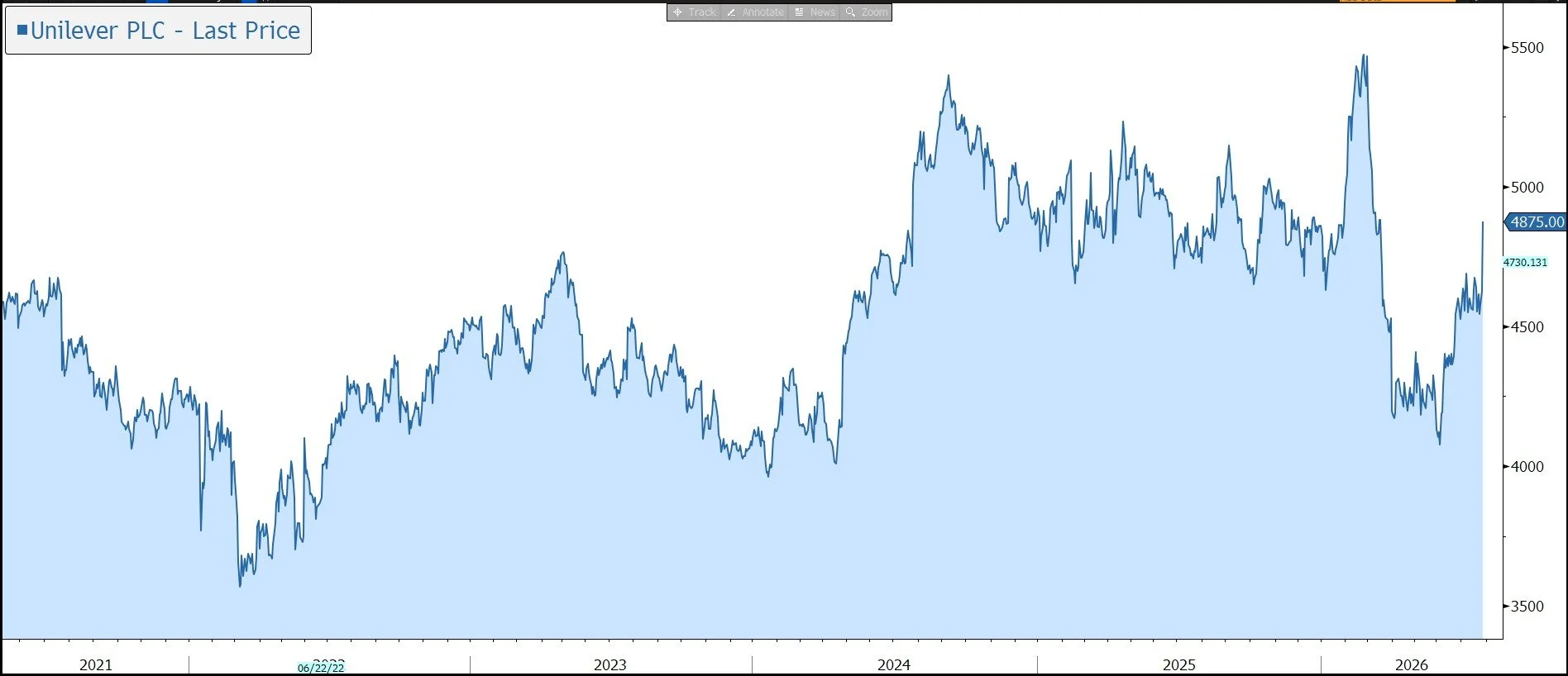
Unilever has today released first-half results which were ahead of market expectations. The company delivered a strong volume-led performance, with a significant step-up in the second quarter – the best volume quarter at Unilever in over a decade. The company has upgraded its full-year revenue guidance, driven by an improved volume outlook. In response, the shares are up 6% in early trading.
Unilever is one of the world’s leading suppliers of consumer goods, with annual sales of more than €50bn. Its products are low-ticket, repeatable purchases, with 3.4bn people using a Unilever brand every day. With unique routes to market, the company has an unrivalled emerging market presence and generates 60% of its sales from those parts of the world expected to experience strong long-term growth in demand. In particular, the group’s 62% holding in India-listed Hindustan Unilever Limited provides exposure to the largest consumer goods company in India.
Following last year’s demerger of its Ice Cream unit Magnum, in which Unilever has retained a 19.9% stake, the company recently announced a $44.8bn combination of its Foods division with US flavours company McCormick. The new company will house leading, iconic brands including McCormick, Knorr and Hellmann’s, and brands with high growth potential including Cholula, Maille, and Frank’s, as part of a global portfolio with revenue of $20bn. Work is already underway to support the delivery of $600m of annual run-rate cost synergies net of growth reinvestments, and incremental cost and revenue synergies of $100m. Unilever expects €400m-€500m of stranded costs following the separation, which will be offset with savings over 2027 to 2029, incurring one-off restructuring costs of €500m over that period. Overall, although the valuation of the deal was reasonable, the structure was poorly received. The negative sentiment has been driven by the complexity of the deal, particularly that Unilever shareholders will own a direct stake in a US-listed company, the lack of a Unilever shareholder vote, and the reduction in operational scale of the remaining business (and the resulting credit outlook downgrade). The deal isn’t expected to close until mid-2027 and is subject to McCormick shareholder approval and the receipt of required regulatory and other approvals. Last week, McCormick announced the planned operating model and executive team of the combined company, along with a secondary listing location in London.
Following the separation of its Foods division, Unilever will become a leading pure-play Home and Personal Care (HPC) business spanning Beauty, Wellbeing, Personal Care, and Home Care. The focus will be on categories with strong structural growth and the highest returns. 25 Power Brands will account for 78% of revenue. The pro-forma portfolio generated revenue of €39bn in 2025 and delivered a compound annual growth rate of 5.4% underlying sales growth in the last three years, alongside a gross margin of 48% and an underlying operating margin of 19%.
The main focus will be to generate more sales in the US, India, the beauty sector, premium markets, and the e-commerce channel. The remaining 100+ smaller markets will be run on a ‘One Unilever’ basis to benefit from scale and simplicity, further enhancing the group’s focus.
Overall, over the medium term, Unilever is still aiming to deliver mid-single digit underlying sales growth, underpinned by at least 2% underlying volume growth and continued modest improvement in operating margin fuelled by gross margin expansion.
Back to today’s results. Against a backdrop of heightened macroeconomic and geopolitical uncertainty, the company has made a good start to the year.
In the first half, turnover rose by 0.5% to €25.6bn, just above the market forecast. Underlying sales growth (USG) – adjusted for the impact of currency headwinds (-4.9%) and M&A (+0.7%) – was 4.8%. Q2 (+5.8%) was expected to accelerate versus Q1 (+3.8%) due to an uplift from the World Cup, however, the pace of improvement was well above the +4.3% market forecast.
First half growth was driven by volume which rose 4.2%, with Q2 (+5.5%) the best volume quarter at Unilever in over a decade. Underlying price growth adding 0.6% – a disappointment as the 0.9% generated in Q1 was meant to be the trough. However, this was put down to three temporary factors and price is expected to accelerate in the second half as commodity-driven pricing continues to land in market.
Growth was led by the Power Brands, which grew underlying sales by 6.0%, with 5.4% volume growth. Non-Power Brands returned to growth in the second quarter.
In emerging markets, USG was 7.0%, led by broad-based strength across key markets: India (+8.0%), Indonesia (+7.0%), and Latin America (+7.6%). Even China delivered mid-single digit growth driven by strong premium innovation, and digital and e-commerce execution.
Developed markets grew by 1.5%, led by North America (+2.7%) where the group continued to outperform the market on volume. Europe remained subdued (-0.9%), driven by soft markets and price in Foods.
All Business Groups delivered volume growth:
· Beauty & Wellbeing (+5.9% USG to €6.5bn) – led by double-digit growth in the largest Power Brands Dove, Sunsilk and Vaseline.
· Personal Care (+4.8% to €6.8bn) - driven by strong performance from Dove’s premium innovations.
· Home Care (+7.6% to €6.0bn) - reflecting strong growth in the largest markets of India and Brazil.
· Foods (+1.2% to €6.3bn) - led by increased competition in US condiments.
The gross margin fell by 70 basis points to 46.8%, reflecting the benefits of volume leverage and productivity, offset by commodity inflation and calibrated pricing. The company expects the gross margin in the second half to be broadly similar to the first half in absolute terms, as price growth accelerates.
The group has completed its €800m productivity programme six months ahead of schedule. This fuelled brand and marketing investment, down 10 basis points to 16.1% of sales. The group generated an improvement in underlying operating margin in the first half, up 10 basis points to 20.3%. Underlying operating profit rose by 0.9% to €5.2bn, just above the market forecast. Underlying EPS rose by 2.4% to €1.61.
Free cash flow rose from €1.1bn to €1.5bn, reflecting slightly higher operating profit and an improvement in working capital. Net debt rose from €23.1bn to €26.0bn, 2.3x EBITDA, but the company is still guiding to ‘around 2x’ for the full year.
The company’s capital allocation framework is prioritising disciplined investment behind organic growth and €1.5bn a year on bolt-on acquisitions.
Capital returns include a dividend payout ratio of approximately 60%, alongside €6bn of share buy‑backs expected to run between 2026 and 2029. The latest quarterly dividend has been increased by 3% to €0.4664, although in Sterling terms it is up 1.7% at 39.82p. In June, the company completed its €1.5bn share buyback programme, an acceleration reflecting management’s clear view that the current stock valuation materially understates operational performance.
Looking ahead to the full-year, the company still expects underlying sales growth to be within its multi-year guidance range of 4% to 6%, albeit no longer at the bottom end of the range. Underlying volume growth is now expected to be ‘around 3%’ versus the previous expectation of ‘at least 2%’. Underlying sales growth in the second half is expected to be 4%-5%, led by pricing. The company continues to anticipate a modest improvement in underlying operating margin for the full year versus 20.0% in 2025.
Source: Bloomberg
