
Morning Note: Market News and Updates from Visa, Reckitt Benckiser, and EssilorLuxottica.
Market News
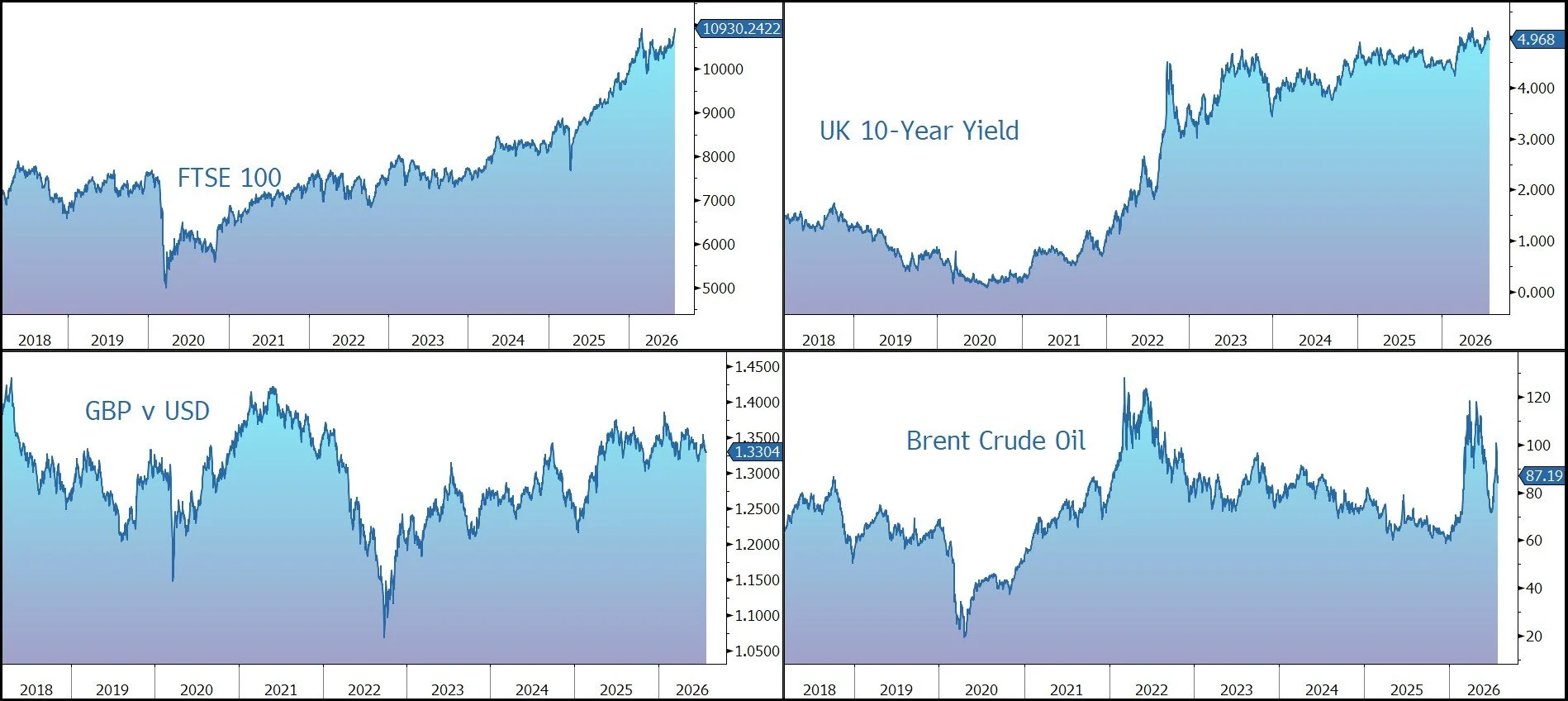
Brent surged back up to $87 a barrel as the pause in the Middle East conflict came to an end. The US said it intercepted an Iranian ‘surprise attack’ on its troops. The US and Saudi Arabia responded by striking Tehran-backed militants in Iraq.
Open interest in the federal funds futures surged to a record ahead of today’s Fed rate decision, reflecting uncertainty over the outcome. The central bank is expected to hold, but traders still see about a 30% chance of a quarter-point hike. The yield on the US 10-year Treasury is 4.61%, while gold trades at $4,040 an ounce.
US equities were little changed last night – S&P 500 (+0.2%); Nasdaq (-0.2%). This evening, Microsoft is expected to report strong growth at Azure, the main driver of its AI-related sales, while Meta investors will watch for updates on plans to build a cloud business that may help monetise its AI investments.
In Asia this morning, trading on the Kospi (-6%) was halted again. The South Korean index was dragged down by SK Hynix, which saw quarterly profit miss sky-high expectations. Other indices were mixed: Nikkei 225 (-1.5%); Hang Seng (+1.7%); Shanghai Composite (+0.4%).
The FTSE 100 is currently 0.5% higher at 10,930, helped by the oil majors. Glencore is up 4% following a strong half-year performance from its marketing segment, while Standard Chartered is up 5% following the announcement of a large buyback. Sterling trades at $1.3310 and €1.1670.
Source: Bloomberg
Company News
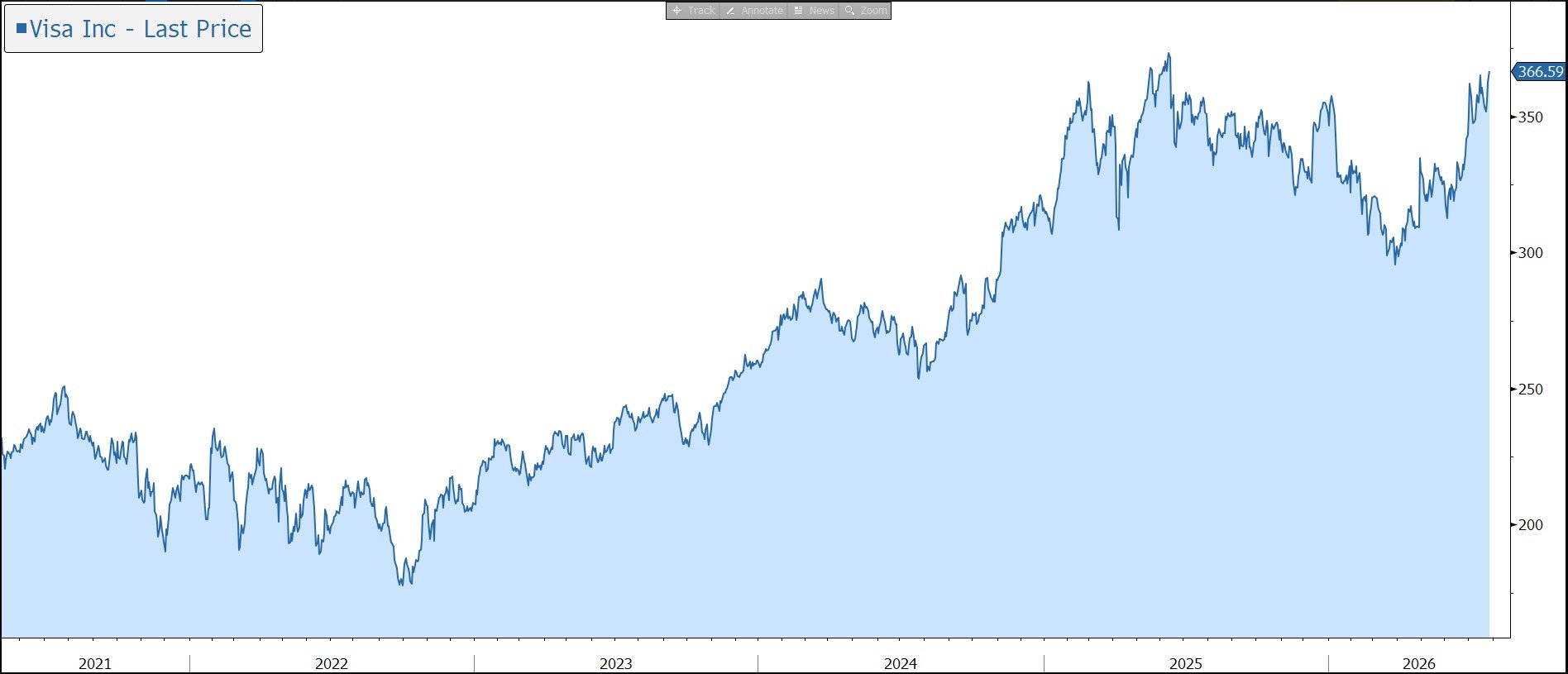
Yesterday evening, Visa released results for the three months to 30 June 2026, the third quarter of its FY2026 financial year, that were better than market expectations. Revenue growth of 13% was driven by resilient consumer spending and continued strength in consumer payments, commercial and money movement solutions, and value-added services. Guidance for the full year was raised for both revenue and EPS. The shares have been firm of late but were marked down 1% after hours, probably due to a case of ‘travel and arrive’.
Visa is the world’s largest electronic payments network. It connects nearly 14,500 financial institutions, 175m merchant locations, and around 12bn cards, bank accounts, and digital wallets. Visa is not a bank; it doesn’t lend or take on credit risk. It doesn’t issue cards or place the terminals at the merchant locations. Instead, the company earns a small fee from 258bn transactions processed on its network to generate annual revenue of $40bn. The company is increasingly evolving into ‘Visa-as-a-Service’ which involves unbundling Visa’s product set to support more customers in more ways across its service stack. Revenue outside of traditional Consumer Payments (i.e. Commercial & Money Movement Solutions and Value Added Services now account for more than 30% of revenue).
Outside of the US, Visa is still benefiting from the ongoing shift from cash and cheques to electronic means of payment, and the growth of online retail, contactless, and mobile payment systems. In emerging markets, a lack of physical communication infrastructure traditionally provided a barrier to payments growth, but that has been removed by the emergence of mobile phone technology and a government focus on digitalising cash to reduce the black economy. There is also an opportunity for Visa’s trusted network in agentic commerce where autonomous AI agents act on behalf of consumers to discover, compare, and purchase products or services. Visa has launched Visa Intelligent Commerce, a tool that creates ‘Agentic Tokens’ (rather than credit cards) that allow AI (like Claude) to pay on your behalf without ever seeing your actual card number. Visa’s value is trust and settlement – when a consumer hands over purchasing power to AI agents, Visa wants to ensure its ‘rails’ are the default, trusted payment mechanism embedded in the software. Finally, Stablecoin initiatives are continuing to grow.
In Consumer Payments, Visa estimates a total market of $41tn worldwide, with 56% ($23tn) still available to be served, including $11tn cash and cheques. The company has six areas of focus including: ‘tap to everything’, token technology, cross-border, affluent consumers, A2A (account to account payments), and credit. Since 2020, the number of Visa tokens has increased from 1bn to 17.5bn, with adoption led by ecosystem benefits including 5% higher authorisation rates and 30%+ lower fraud.
Growth in Commercial & Money Movement Solutions (CMS, formerly known as ‘New Flows’) is expected to outpace the Consumer Payments business over the long term. The company believes the total addressable market of the opportunity is massive – $145tn in B2B payments and $55tn in disbursements/payouts/P2P. Even though yields for these new flows are lower on average than Consumer Payments (as they tend to be high-volume, low-complexity B2B transfers), they utilise Visa’s existing infrastructure and take advantage of the company’s massive scale and fixed operating costs, resulting in high margins.
The group’s third growth engine is Value Added Services that help clients and partners optimise their performance, differentiate their offerings, and create better experiences for their customers. The company estimates the total addressable market at $520bn, meaning only 2% has been penetrated so far. Many of Visa’s largest clients now use more than 20 value-added services, such as cybersecurity, fraud prevention, advisory services, identity solutions, data analytics, tokenisation, and AI, all of which enhance the group’s competitive advantage.
During the three months to 30 June 2026, against a backdrop of heightened geopolitical tensions, consumer spending remained resilient, and the group’s strategy continues to deliver strong performance across all three divisions. The company continued to enhance its Visa as a Service stack, including with agentic and stablecoin capabilities, to further strengthen its position as the leading hyperscaler of payments globally.
Trends were strong across key metrics: payments volume (+10% in constant currency, with debit and credit both up 10%), processed transactions (+10% to 71.7bn), and cross-border volume growth (which includes a lot of e-commerce as well as travel, +13%), boosted by the FIFA World Cup.
Net revenue grew by 13% on a constant currency basis in the quarter to $11.6bn, ahead of both the market forecast of $11.37bn and the company guidance for growth in the low double-digits.
Revenue was made up of service revenue (based on prior-quarters payment volume, +14% to $4.9bn); data processing (+17% to $6.0bn); international transaction revenue (+6% to $3.9bn); and other revenue (+45% to $1.5bn). Client incentives, a contra-revenue item, were up 18% to $4.7bn, four percentage points higher than the previous quarter due, in part, to lapping an easy quarter.
On the call, the company highlighted that Commercial & Money Movement Solutions grew by 17%, Value Added Services revenue rose by 34% to $3.8bn (including the acquisition of Prisma), and Visa Direct transactions increased by 21% to 4bn.
Operating expenses were up 17% in the quarter, heavily boosted by marketing campaigns around the FIFA World Cup. The company is planning to cut 7% of its workforce, primarily across technology and product teams, with the savings expected to be reinvested in the business. Adjusted EPS was up 11% on a constant currency basis, to $3.32, above the market expectation of $3.22 and the company guidance for growth of mid to high single-digit.
During the quarter, Visa generated $6.1bn of free cash flow. The group’s balance sheet remains strong, with cash, cash equivalents, and available-for-sale investment securities of $13.9bn at the end of June. The main capital allocation priority is to invest to grow the business, both organically and via acquisition – agentic commerce and stablecoins are current areas of investment focus.
Visa also has an ongoing commitment to return excess cash to shareholders. The group has a record of strong dividend growth, with the latest quarterly payout raised by 14% to $0.67. During the latest quarter, the company also bought back $4.9bn of its stock, leaving $28.4bn remaining of its authorised multi-year programme.
Visa has a long-term track record of coping with regulatory challenges and has flexibility in its cost base to mitigate any bottom-line impact. Earlier in the year, President Trump called for a one-year, 10% cap on credit card interest rates, significantly lower than the current market average of over 20%. This will require a legislative change, with Trump formally asking Congress to codify the cap. We believe the 10% cap is a volume risk rather than a margin risk for Visa. It threatens the ‘network effect’ by potentially shrinking the pool of active spenders, but it reinforces the strategic importance of Visa’s expansion into New Flows and Value Added Services.
Another ongoing threat is the Credit Card Competition Act (CCCA) which, if passed, would force major issuing banks to provide merchants with at least one alternative network (such as Discover or independent routing networks like Star or Pulse) to process credit transactions. This would break the Visa-Mastercard duopoly on credit routing, introducing direct price competition that could lower overall transaction revenues and squeeze swipe fees. While the banking lobby continues to fight the measure aggressively – citing recent judicial antitrust settlements as sufficient merchant relief – strong bipartisan sponsorship and explicit endorsement from the White House give the Act greater momentum than in previous congressional cycles
Overall, we believe the long-term growth prospects for Visa remain attractive, more so given the acceleration in recent years in the shift to e-commerce, tap-to-pay, and new digital payments, and in the number of acceptance points at SMEs (particularly tap-to-phone). In addition, the broad application of digital payments by businesses and government agencies provides a huge market opportunity. The long-term revenue growth framework is: Consumer Payments at 5%-7% and Commercial & Money Movement Solutions/Value Added Services at 16-18%, with the latter moving from a third to a half of revenue over time. This implies total net revenue growth of 9%-12%.
The company raised its guidance for the financial year to 30 September 2026 on a constant dollar basis. Revenue growth is now expected to be in the low end of low-teens (vs. low-double-digit to low-teens previously). EPS growth is now expected to be in the low end of mid-teens (vs. in the low teens, previously).
On the call, the company outlined that performance in the first three weeks was slower in US payments but stronger in cross-border volume. For the current quarter as a whole, the company expects to generate revenue growth in the high end of low double-digit. Expenses are expected to increase in the low double-digits and EPS is expected to grow in the low end of mid-teens.
While some short-term economic uncertainty persists, the group remains confident in its ability to execute its strategy and expand Visa’s role at the ‘centre of money movement’. That said, a slowdown in overall consumer spending could be a drag on volumes, although spending across the network is very diversified, be it credit vs. debit, domestic vs. overseas, discretionary vs. non-discretionary spend, and low vs. high ticket spend. However, the company has previously said that if the economy does go into a recession, Visa is now stronger in debit – the card of choice in tougher times – than it was in the 2008/09 financial crisis. The group also highlights that if there is a downturn, they have plenty of flexibility on costs and client incentives. Note also that half of the group marketing spend is variable.
Source: Bloomberg
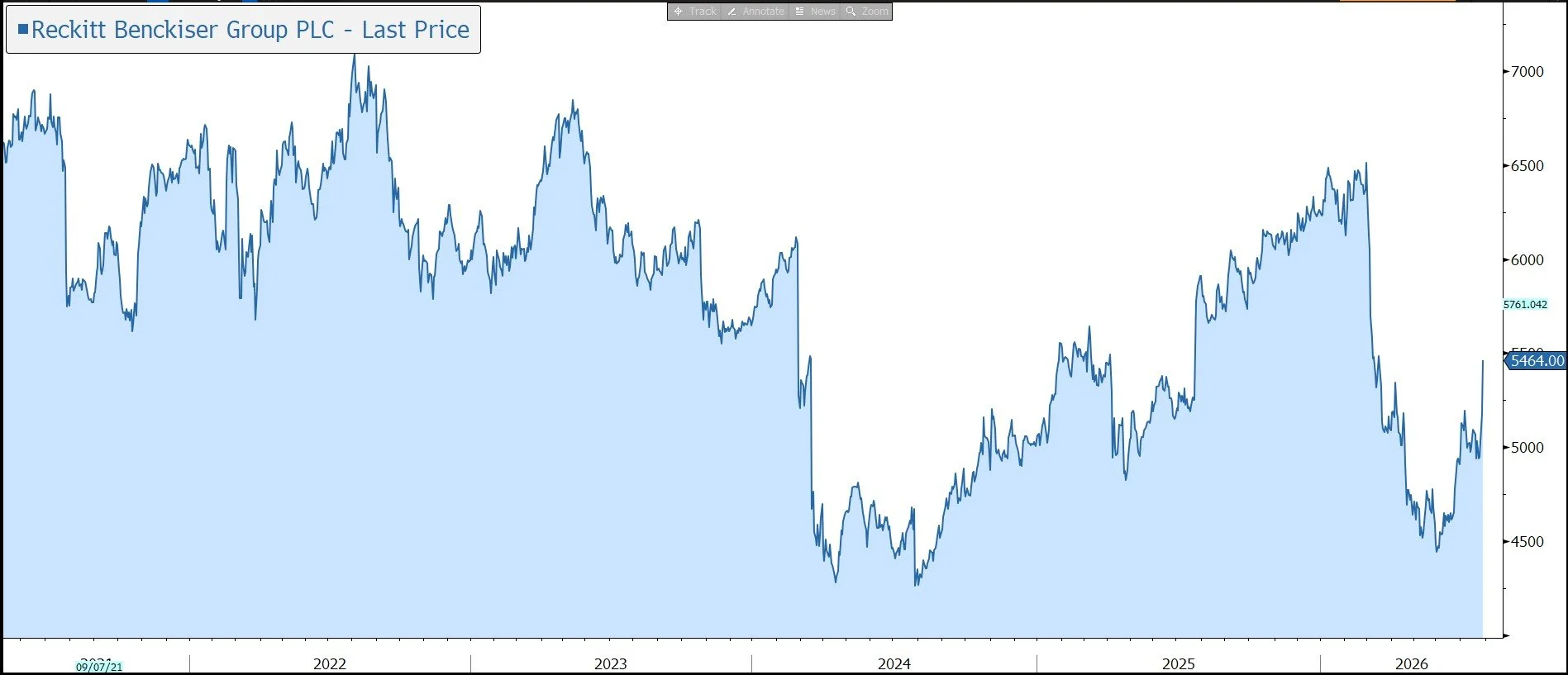
Reckitt Benckiser has today released first-half results which were ahead of market expectations. Revenue growth rebounded in the second quarter and the operating margin fell by less than expected. Given the second-half weighting of results this year, the company has maintained its guidance for the full year. The dividend has been raised by 5% and a new £500m share buyback programme launched. With greater confidence the company can meet its full-year guidance, the shares have been marked up by 5% in early trading.
Reckitt is a global leader in health, hygiene, and nutrition. Trusted brands, such as Dettol and Lysol, continue to benefit from the shift to healthier and more hygienic lifestyles, particularly in emerging markets. To help ease the pressure on state-funded healthcare systems, we are seeing a transition to self-care and growth of over the counter (OTC) brands such as Mucinex, Nurofen, and Gaviscon, all of which are owned by Reckitt. A focus on immunity, mental health, and overall well-being is expected to drive growth of the group’s preventative treatments, such as vitamins, minerals, and supplements (VMS).
Reckitt is currently refocusing its portfolio and simplifying its organisation to drive accelerated growth and value creation. Core Reckitt includes a portfolio of 11 market-leading (No.1 or No.2), high margin Powerbrands across four categories of Self-Care, Germ Protection, Household Care, and Intimate Wellness. Brands include Mucinex, Strepsils, Gaviscon, Nurofen, Lysol, Dettol, Harpic, Finish, Vanish, Durex, and Veet. Over the last three years this portfolio has delivered 5% revenue CAGR and in 2025 generated a gross margin above 60%.
Reckitt operates across three geographies: North America, Europe, and Emerging Markets, with the latter expected to grow in the high-single digits. Last week, the company sold its Russian Hygiene business, a unit which accounted for 1% of 2025 core revenue. The sale of the unit will result in a post-tax loss of £175m in 2026, with £125m recognised in the first half.
The company is undertaking a fixed cost optimisation initiative to unlock efficiencies and deliver at least a three percentage points reduction in fixed costs by the end of 2027.
In H1 2026, fixed costs as a percentage of Core Reckitt + MJN net revenue was 20.1%, broadly in line with H1 2025, despite absorption of stranded costs following the Essential Home divestment. The programme remains on track to deliver fixed costs below 19% of net revenue as the group exits 2027.
Overall, the company now believes it has the portfolio, geographic footprint, and execution capabilities for Core Reckitt to consistently deliver 4%-5% like-for-like (LFL) net revenue growth, while consistently delivering annual EPS growth and creating value for shareholders.
At the end of 2025 the company sold its Essential Home business (now called Vestacy), a portfolio of non-core brands such as Air Wick, Mortein, Calgon, and Cillit Bang. The $4.8bn transaction was fairly complex – it included up to $1.3bn of contingent and deferred consideration, and Reckitt retained 30% of the business. As part of the deal, shareholders received a $2.2bn (£1.6bn or 235p a share) special dividend and the shares underwent a 24-for-25 consolidation.
The company’s third leg is Mead Johnson Nutrition which includes infant formula brands Enfamil and Nutramigen. The company continues to evaluate all strategic options for the business. There have been persistent market rumours that French food giant Danone is considering a bid to improve its infant nutrition footprint in North America. However, any deal will likely require Reckitt to ringfence and retain its historical US litigation liabilities (see below) or offer massive structural indemnities to shield Danone from future losses.
Back to today’s results. Reported revenue fell by 8.1% to £6,411m. Stripping out the impact of currency (-0.3%) and net M&A (-10.4%), LFL growth was 2.6%. Growth was driven by price/mix (+2.9%) which offset the small volume decline (-0.3%). As expected, growth accelerated in Q2 (+4.7%) versus Q1 (+0.6%).
Core Reckitt grew revenue by 2.7% in LFL terms to £5.11bn, with Q2 up 4.2%, versus 3.6% expected by the market. Excluding Russia Hygiene, Core Reckitt grew 3.4% on the first half. Growth was driven by 2.2% increase in price/mix and a 0.5% improvement in volume.
The results were led by Emerging Markets (+8.5%), with double-digit growth in China (for the 12th quarter in a row), high-single-digit growth in India and ASEAN, offset by the Russia decline.
In Developed Markets, Europe fell by 3.0%, impacted by a challenging consumer environment and the weak cold and flu season. The decline in Q2 improved to -1.5%. North America returned to growth, up 0.8% in H1 and 2.8% in Q2.
In the Core product segments, LFL growth at Germ Protection (+10.5%), Self-Care (+2.5%), and Intimate Wellness (+0.5%) were offset by Household Care (-6.6%), reflecting continued impacts on the Russian business. Innovation continues to support long-term growth with launches across each category during the half-year including upgrades to Finish premium formats and Vanish Quick Wash formulations.
In the smaller non-core division Mead Johnson Nutrition, net revenue rose by 2.0% on a LFL basis, accelerating in Q2 to 7.2% as trading dynamics continued to stabilise and benefiting from a soft prior-year comparative period.
The adjusted gross margin fell 50 basis points to 60.5%, reflecting input cost impacts and category mix, partially offset by the divestment of lower gross margin Essential Home. As expected, adjusted operating margin fell, however the 100 basis points fall to 23.6% was ahead of management expectations driven by continued outperformance of Fuel for Growth in mitigating stranded costs. Adjusted EPS fell by 9.7% to 152.1p, principally reflecting the divestment of Essential Home.
Free cash flow generation fell by 33% to £419m, primarily driven by the divestment of Essential Home, leaving financial gearing at 2.5x net debt to adjusted EBITDA.
The dividend policy is to deliver sustainable growth in future years – the 2025 payout was raised by 5% and the 2026 half-year payment has also been lifted by 5% to 88.6p. In response to the weak share price and to reflect the board’s confidence in the continued strong free cashflow generation of the business, Reckitt has been buying back its shares and recently completed a £1bn programme. With today’s results, the company has announced a new programme to commence imminently, with up to £500m of shares to be repurchased over the next 12 months.
Although the statement acknowledges the current uncertainty arising from the war in the Middle East, as well as other operational challenges, including the impact of sale of the Russian Hygiene business, guidance for the full year has been reiterated:
· Core Reckitt LFL revenue growth in the 4%-5% medium-term guidance range.
· Modelling a scenario of oil at $110 a barrel for the remainder of 2026 indicates a £130m-£150m gross impact on the group’s input cost base in 2026 which it sees as a manageable level to offset through flexibility and productivity in its supply chain, hedging strategy, pricing, and its strong gross margin profile. Note the oil price is currently only $87 a barrel.
· Mead Johnson Nutrition - low-single-digit LFL net revenue growth.
· Further down the P&L, forecasting is more difficult given the complexity stemming from the deconsolidation of Essential Home. However, the company has maintained its expectation for adjusted operating profit margin for 2026 (24.9%-25.6%), with the delivery of this weighted to H2. In H2, Group adjusted operating profit margin will be much stronger than H2 2025, driven by more favourable mix across Categories and Areas, actions to offset commodity price inflation, as well as continued stranded cost mitigation.
The company reiterated its ambition to deliver long-term, sustainable EPS growth, acknowledging in 2026 headwinds from Essential Home dilution.
Legal Appendix …
The legal case against the company (and industry peer Abbott) relating to its cow’s milk-based infant formula is ongoing. Reckitt continues to vigorously defend these claims and believes the lawsuit’s claims are not supported by scientific evidence. In May, a US District Judge rejected Mead Johnson’s motion for summary judgment in the Inman case. Crucially, this is the only first-wave federal case to survive summary judgment after the judge dismissed the prior three test cases on expert evidence grounds. The next key date is the start of the bellwether trial in the US federal multidistrict litigation (MDL) scheduled for August. This is the first ‘test case’ inside the massive federal MDL infrastructure, which currently holds nearly 800 pending lawsuits. Crucially, the litigation landscape shifted dramatically in June and July 2026 with consecutive defence victories. First, an Illinois appeals court completely reversed the headline-grabbing $60m state court verdict against Mead Johnson from 2024, ordering a new trial due to improper jury instructions regarding corporate wealth and the duty to warn. Weeks later, a St. Louis jury delivered a watershed victory for the company by completely rejecting a plaintiff's claims that Enfamil formula was responsible for causing NEC. While nearly 800 cases remain pending in the federal infrastructure, these successive defence wins break the plaintiffs’ legal momentum, significantly improve Reckitt's leverage for an eventual global settlement, and improve the long-term prospects for the sale of the Nutrition business. However, the threat of sizeable damages continues to hang over the share price and prevents the company from offloading its Nutrition division. The court has encouraged the parties to explore settlement ahead of trial and this would be optimal as Reckitt seeks to sell its Mead Johnson business.
Source: Bloomberg
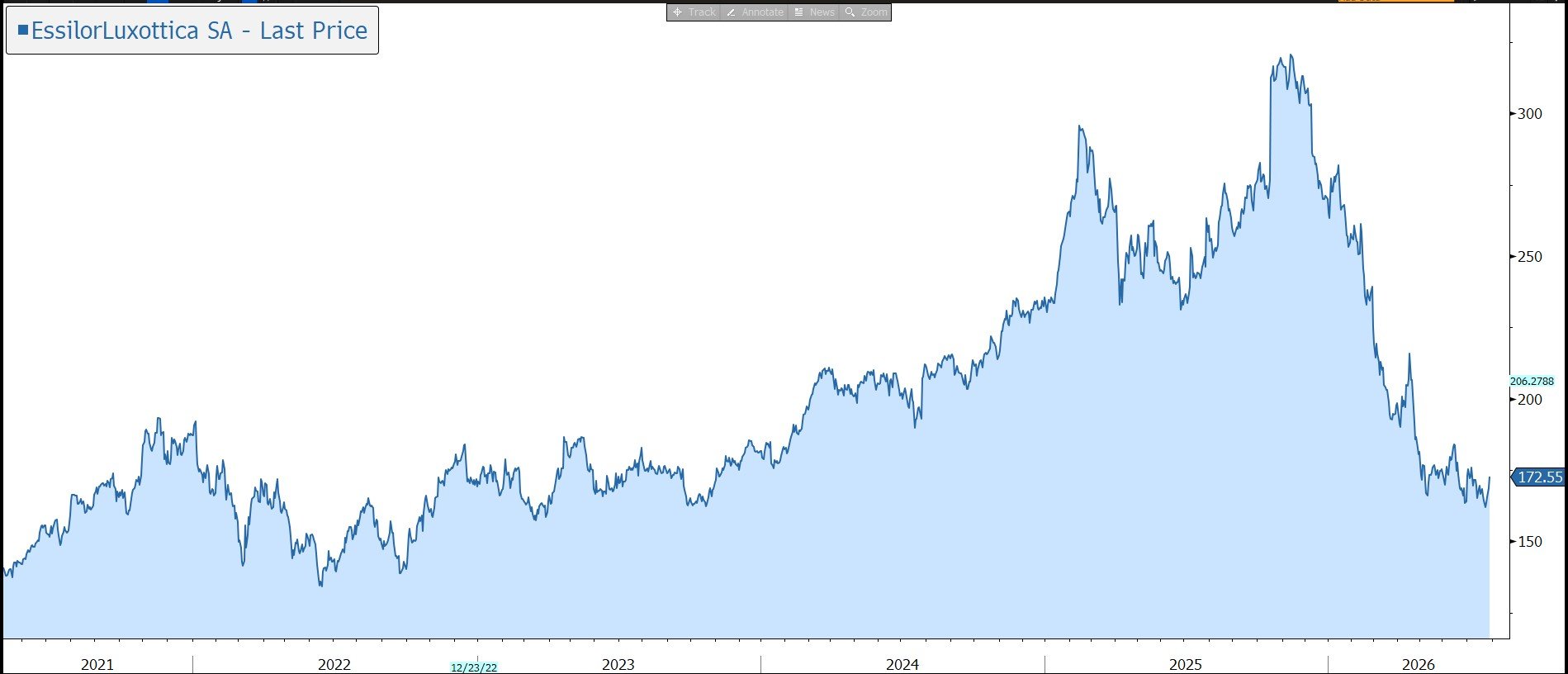
Yesterday evening, EssilorLuxottica released H1 results pretty much in line with market expectations once the positive impact of tariff refunds was stripped out. Revenue grew by almost 10%, driven by AI smart glasses and myopia management products. Medium-term guidance has been reiterated. The shares have been marked up 2% this morning.
EssilorLuxottica is the global leader (with a 25% share) in the €130bn eyecare and eyewear industry with exposure to the design, manufacture, and distribution of ophthalmic lenses, prescription frames, and sunglasses. We believe the long-term outlook for the industry is positive, driven by an ageing population, digital eye strain, a growing emerging market middle class, increased education regarding sun protection, and the growth of eyewear as a fashion and technology accessory. By 2050, uncorrected poor vision is predicted to reach epidemic proportions with over 50% of the world’s population expected to suffer from myopia (short-sightedness), many with serious vision-threatening side effects and long-term implications.
The company’s competitive advantage is based on its scale, portfolio of premium brands (such as Ray-Ban and Oakley), product innovation, flexible manufacturing base, quality service, routes to consumer, and partnerships. Essilor owns long-term licences for some of the best-known luxury brands, including Chanel, Prada, Armani, and Jimmy Choo. The group also has a global retail footprint of almost 20k stores, including LensCrafters and Sunglass Hut, and over 300k wholesale partners.
In addition to underlying market trends, growth is being driven by strong innovation across the existing product line and in new markets. The company’s myopia management product Stellest has clinically demonstrated efficacy in slowing down myopia progression in children. Following strong growth in China, the product has now been launched in the US. Given Stellest is a high-value, medically-driven, patented technology, it generates a higher margin than the group average.
In the smart glasses category, the company has a long-term partnership with Meta Platforms to develop multi-generational smart eyewear products. The collection, which includes Ray-Ban Meta and Oakley Meta Vanguard, is performing better than expected (up 3x to 7m units in 2025) with demand outpacing supply. In June, the companies launched a new, lower-cost standalone line of Meta Glasses starting at $299. Meta recently announced it would temporarily pause the rollout of the smart Ray-Bans in Europe due to strong demand and supply bottlenecks in the US. Although the company has said that, in time, wearables will be margin accretive given the increased level of quality lenses in the products and the addition of service revenue, for now growth is margin dilutive, something of a concern for the market. The other concerns are privacy issues and increased competition in the space from major tech firms investing in their own eyewear.
The company has also diversified into the hearing solutions market with a disruptive new technology (i.e., lenses with acoustic technology) to meet the needs of the 1.2bn consumers suffering from mild to moderate hearing loss. The audio component is completely invisible, removing a psychological barrier that has historically stood in the way of consumer adoption of traditional hearing aids. The product (called Nuance Audio) has now been rolled out in the US and Europe.
The company has enhanced its presence elsewhere in the MedTech space through several acquisitions: Heidelberg Engineering (diagnostic solutions, digital surgical technologies, and healthcare IT for clinical ophthalmology); Espansione (design and manufacturing of non-invasive medical devices for the diagnosis and treatment of dry-eye, ocular surface and retinal diseases); Optegra (ophthalmology platform for eye hospitals and diagnostic facilities); PUcore (monomers used in the production of high index ophthalmic lenses), and Ikerian AG (operating under the RetinAI brand, specialising in AI and data management in eyecare).
Finally, Essilor also owns streetwear brand Supreme, known for its lifestyle apparel, footwear, and accessories. The company runs a digital-first business and 20 stores in the US, Asia, and Europe. At first glance, the $1.5bn acquisition looks like a diversification from the group’s core business – the rationale is that it will provide a direct channel to an audience that is very difficult to reach and adds a margin accretive business to the group. In particular, the company intends to use Supreme’s model to test exclusive, high-value AI-eyewear releases to a younger, tech-native demographic. We have some reservations and will watch to see if the acquisition ends up being a misallocation of capital.
Back to today’s results. During the first half, revenue grew 9.7% at constant exchange rates (CER) to €14.8bn. As expected, Q2 (+8.7%) saw a slight slowdown compared to Q1 (+10.8%). Q2 revenue was €7.7bn, slightly behind the market forecast of €7.8bn.
Growth was boosted by AI glasses, with revenue almost doubling in Q2. The core eyecare/eyewear business steadily running at mid-single-digit pace. The myopia management portfolio grew by 24% in Q2, driven by the supportive clinical evidence on the efficacy of the solutions offered as well as the wide articulation of their range by technology and price-point.
EssilorLuxottica is a vertically integrated player with two distribution channels. Professional Solutions (PS) includes the supply of products and services to third-party eyecare professionals (i.e., wholesale). In H1, revenue grew by 7.8% at CER to €6.8bn.
Direct to Consumer (DTC) includes the sale of products and services directly to end consumers (i.e. retail), comprised of brick-and-mortar stores and e-commerce platforms. In H1, revenue grew by 11.4% at CER to €8.0bn. Comparable-store sales were up 7.5%, with Q2 up 8.0% as optical and sun banners equally contributed.
By geography, all the broad regions grew strongly. North America, the group’s largest region (43% of sales), grew by 9.9% at CER in the first half. Elsewhere, growth was: EMEA (+8.7%); Latin America (+6.7%); and Asia Pacific (13.4%). The company highlighted that the Middle East only accounts for 1% of revenue.
Gross margins are high and grew by 10 basis points at CER to 63.5% in H1, while operating profit grew by 15% at CER to €2.75bn. The adjusted operating margin gained 80 basis points to 18.9% at constant exchange rates. However, 60 basis points of the growth was due to the impact of tariff refunds. Although operating cost efficiencies are providing something of a margin tailwind, for now the mix effect of the AI glasses growth continues to outweigh the accretive impact of Nuance Audio, Stellest, and the MedTech segments. On the call, the company disclosed that it expects some wearables margin progression in the second half.
The business generates strong free cash flow: €1.07bn in H1, more than €100m above 2025. The company is financially robust, ending the first half with net debt (including lease liabilities) of €13.4bn, 2.0x EBITDA.
Although the company doesn’t provide annual guidance, on the call management did warn that the year-on-year revenue comparatives will be tough given the company generated 15.2% growth in H2 2025.
Looking forward, on average, over the next five years, at constant exchange rates, the company is planning to deliver ‘solid growth’ in total revenue and a ‘broadly aligned growth’ in adjusted operating profit. The company is still not providing specific margin guidance for 2026 but said the result would be driven by a combination of the full-year impact of tariffs, an ongoing currency headwind, mix effect of the growth of AI glasses, growth of Stellest in the US, and the roll-out of the hearing aid business.
Although the company hasn’t been specific on what ‘solid’ sales growth means, the consensus is for high single-digit growth, while margins are expected to decline at first before picking up over time.
Governance uncertainty remains a persistent overhang following the death of founder Leonardo Del Vecchio, whose fortune was split equally among eight heirs. A major turning point emerged in April 2026 when shareholders approved a massive €10bn leveraged buyout allowing Chief Strategy Officer Leonardo Maria Del Vecchio to buy out two siblings, tripling his stake in family holding company Delfin to 37.5%. While consolidating control under a single lead decision-maker would provide a stable anchor for Delfin’s 32.4% stake in EssilorLuxottica, the situation remains fluid and tense. At the 30 June shareholder meeting, the reorganisation hit a standstill when Leonardo Maria boycotted the session, citing lack of board transparency. The heirs failed to secure the 6-of-8 supermajority needed to raise the dividend payout cap to 80%, leaving the €10bn bank financing for his sibling buyout unresolved and keeping the governance structure in flux.
Source: Bloomberg
