
Morning Note: Market News and an Update from AstraZeneca.
Market News
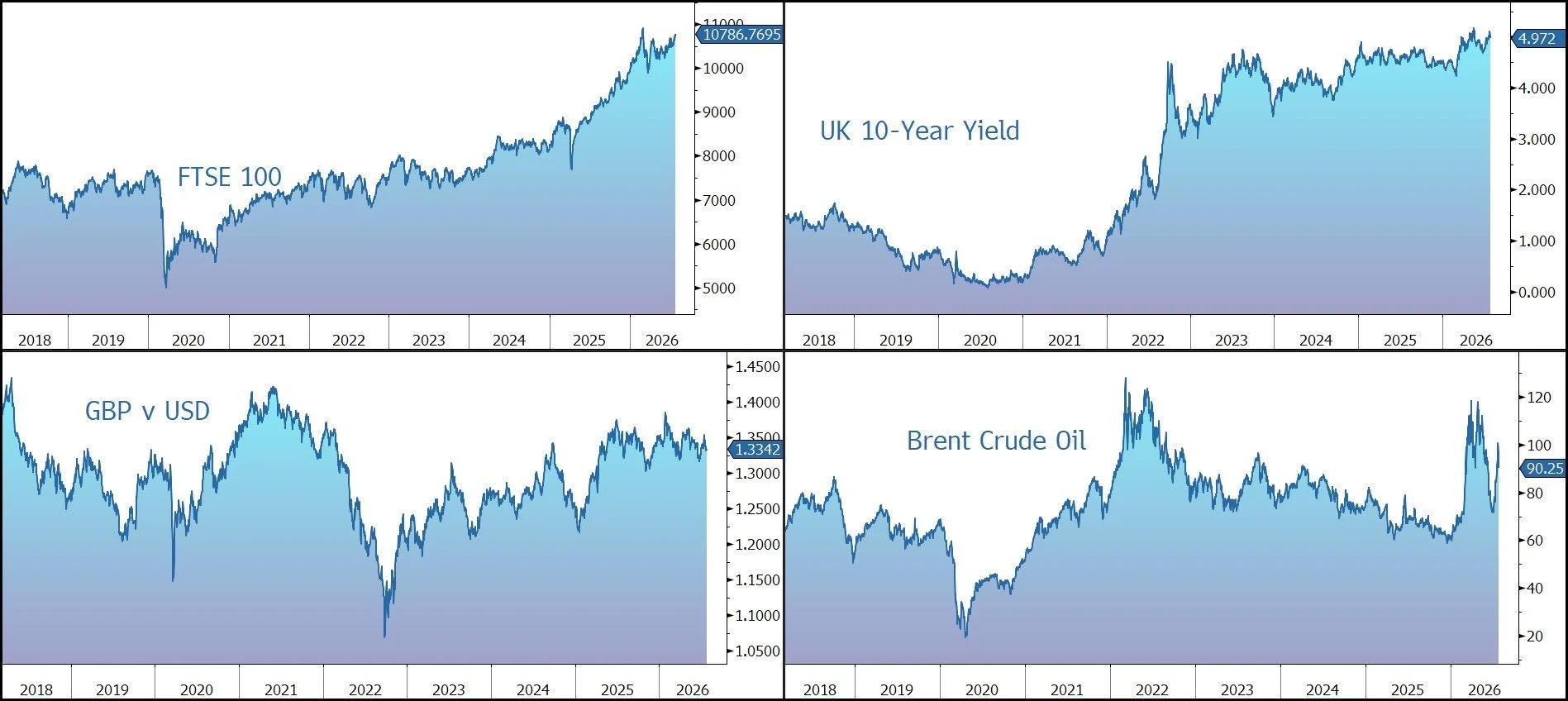
Oil dropped and bonds rose as the US and Iran refrained from attacks for the second straight day, easing tensions after two weeks of retaliatory strikes. Iranian and Omani officials held talks in Tehran on managing safe navigation through the Strait of Hormuz.
The dollar weakened against all of its G-10 peers. Brent crude is currently $90 a barrel, while gold has jumped back above $4,100 an ounce. The yield on the US 10-year Treasury slipped back to 4.63%.
In Asia, equities were firm this morning: Nikkei 225 (+0.5%); Hang Seng (+1.1%); Shanghai Composite (+1.2%); Kospi (+1.2%). The US S&P 500 is currently expected to open up 1% this afternoon. Jack Daniel’s owner Brown-Forman rejected an unsolicited offer from Sazerac, which asked the company to reconsider its previously rebuffed $15bn bid.
The FTSE 100 is currently 0.5% higher at 10,786, held back by oil majors BP and Shell. KKR and Energy Capital will acquire DCC Energy in a deal valuing the company at about £5.75bn. Sterling trades at $1.3340 and €1.1710.
Andy Burnham told the BBC that the UK should make it harder to claim welfare benefits as it seeks to rein in soaring spending. Some payments may be tied to taking up work or training opportunities.
Nvidia is in talks to provide a guarantee to help OpenAI lease computing from a data centre project in Ohio, people familiar said, creating another example of circular financing that has unnerved the market.
This week is another busy one for corporate earnings, with releases from Unilever, EssilorLuxottica, Visa, Reckitt Benckiser, Glencore, P&G, Microsoft, Shell, adidas, Samsung, Accor, Cameco, and Mastercard.
Source: Bloomberg
Company News
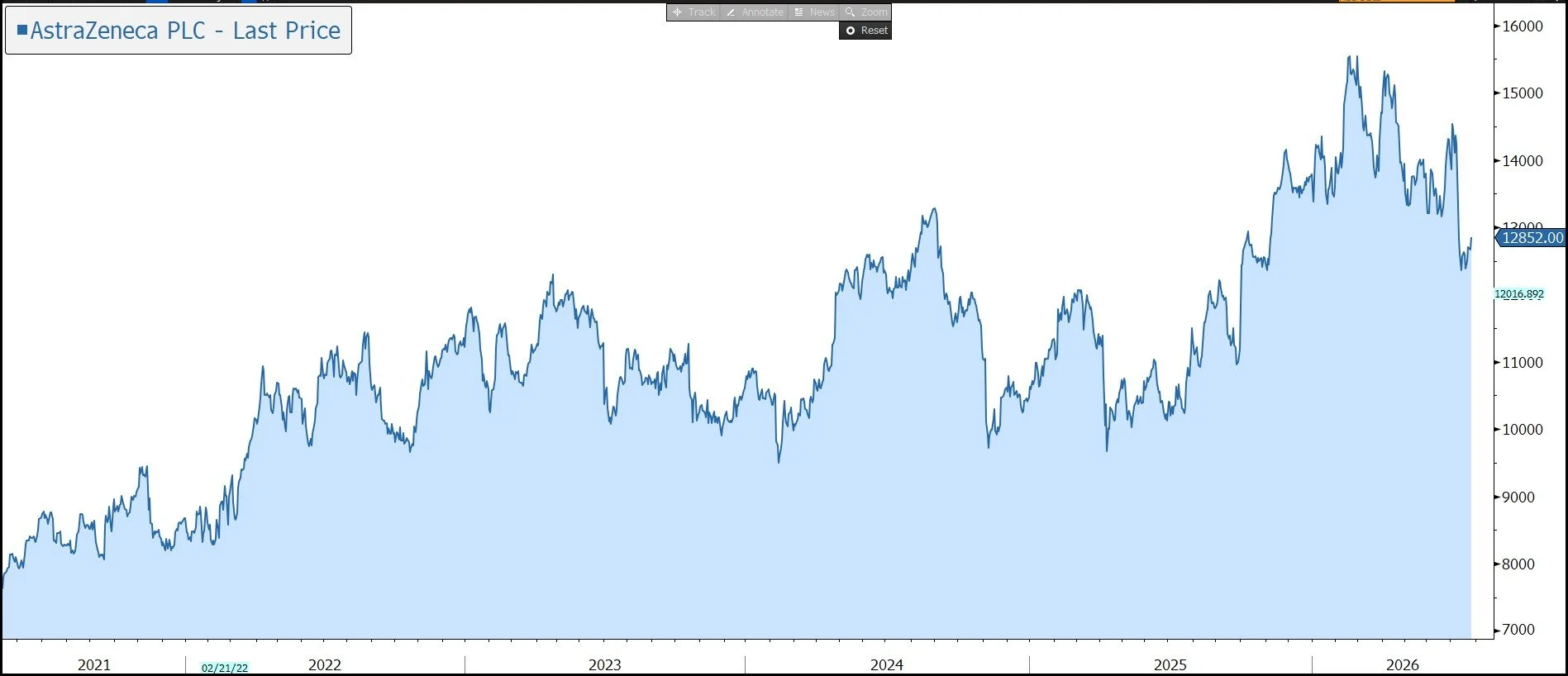
AstraZeneca has today released results for the first half of 2026 which were better than market expectations and reiterated its 2030 ambitions despite a recent disappointment in its R&D programme. Revenue was driven by double-digit growth in Oncology and Rare Disease, which offset headwinds from the loss of patent exclusivity in the US for one of its products and the impact of volume-based procurement in China. Guidance for the full year has been reiterated, with earnings expected to rise by low double-digits. In response, the shares are up 1% in early trading.
AstraZeneca (AZ) is a global, science-led biopharmaceutical company. The main growth driver has been the group’s key Oncology franchises (including Tagrisso, Lynparza, Enhertu, Imfinzi, and Calquence), which have been supplemented by the other growth platforms of Respiratory & Immunology (R&I), Cardiovascular, Renal, & Metabolic diseases (CVRM), Vaccines & Immune Therapies (V&I), and Rare Diseases (via the $41bn acquisition of Alexion).
The group’s (tough) ambition is to deliver $80bn of revenue by 2030, up 8.3% p.a. from a 2023 base of $45.8bn. This will be driven by growth across its existing portfolio through geographic expansion and follow-on indications, as well as new products currently in late-stage development, offset by the loss of patent exclusivity in some existing products. The group expects to launch 20 new medicines before the end of the decade, with some products having the potential to generate more than $5bn in peak-year revenue.
Beyond 2030, the company will seek to drive sustainable growth by continuing to invest in transformative new technologies and platforms that will shape the future of medicine. Management’s confidence is driven by the large number of readouts in 2027-29 for assets that are likely to reach peak sales beyond 2030, including camizestrant (breast cancer), rilvegostomig (oncology) and the haematology portfolio.
The aim is to generate a mid-30s core operating margin by 2026, versus 32% in 2023. Beyond 2026, the margin will be influenced by portfolio evolution and the company will target at least the mid-30s percentage range.
AZ currently invests more than 20% of sales in R&D and uses partnerships to gain access to innovative technology. The group has an attractive pipeline of potential new products, the success or failure of which will drive future profitability and the share price. In the first half of 2026, the company delivered six key positive Phase III study read-outs and eight first approvals in major markets. There have been 30 approvals in major regions since the Q4 2025 results.
However, it has not been all positive news. Earlier this month, the company announced that its nerve disease drug Wainua failed to meet its primary endpoint in a late-stage trial to treat heart disease. The shares fell by 10% in response, given management had previously signalled its confidence the trial would succeed. The product is already on the market for other indications, but its peak sales are unlikely to meet previous expectations. Furthermore, this morning, the company disclosed that its rare disease drug Ultomiris failed a late-stage trial.
Despite these setbacks, the company is confident in the strength of its pipeline and has more than 20 high-value readouts due over the next 18 months. It has also confirmed it is on track to deliver its 2030 revenue ambition, which assumes successes and setbacks.
In January, AZ announced plans to invest $15bn in China through to 2030 to expand medicines manufacturing and R&D. These investments build on the company’s substantial footprint in China, including global strategic R&D centres in Beijing and Shanghai.
Back to today’s results, in the first half of 2026, revenue increased by 6% at constant exchange rates (CER) to $30.7bn, slightly better than the market expectation. By therapy area, product sales grew 15% in Oncology, 9% in Respiratory & Immunology, and 11% in Rare Diseases. The main decline was in CVRM, which fell 12% due to a decline in Farxiga following the loss of patent exclusivity in the US.
The group’s largest market, the US, rose by 8%, while Europe (+8%) and Emerging Markets, ex China (+10%), also contributed. The main headwind was China (-5%) due to the impact of volume-based procurement.
Core operating expenses rose by 6% at CER, with R&D and SG&A also both up 6%. The operating margin rose from 33% to 34%. Core EPS grew by 11% at CER to $5.21, ahead of the market forecast. As expected, the pace of growth picked up in Q2 (+18%) relative to Q1 (+5%).
AZ has a robust balance sheet and generates strong free cash flow. In H1, net debt increased from $23.4bn to $26.9bn, around 1.3x net debt to EBITDA. The company’s capital allocation priorities include investing in the business and the pipeline. M&A also remains central to the strategy. During the first half, the company closed a new strategic collaboration agreement with CSPC Pharmaceuticals to advance the development of multiple next-generation therapies for obesity and type 2 diabetes. AstraZeneca will make an upfront payment of $1.2bn.
AZ is also committed to a progressive dividend policy and intends to maintain or grow the payout each year. In 2026, the company intends to increase the annual dividend by 3% to $3.30, equating to a yield of 2%. Today, an interim payout of $1.06 has been declared.
Political headwinds have eased somewhat following a deal struck with the US administration. In return for a three-year exemption from pharmaceutical tariffs, AZ agreed to implement price-lowering measures in certain channels in the US and announced a huge $50bn investment in the US for medicines manufacturing and R&D. This includes the massive new Virginia manufacturing site (which broke ground in October 2025) focused on the company’s weight-loss and metabolic portfolio.
AstraZeneca has harmonised its share structure and now has a direct listing on the New York Stock Exchange in place of its US ADRs. This will increase the liquidity of the shares and makes the stock much more attractive to US institutional funds. The company remains listed, headquartered, and tax resident in the UK.
Looking ahead to the full year, the company has reiterated its guidance: total revenue growth in the mid to high single-digits and Core EPS growth in the low double-digits, both at CER.
We believe the outlook for the pharmaceutical sector remains mixed despite the backdrop of an ageing population. Although the business provides some protection against macroeconomic uncertainty and R&D productivity is expected to increase with the help of AI, concerns over drug pricing are likely to remain a headwind, especially at a time when governments are looking for ways to reduce debt levels. However, with a pipeline of innovative products targeting unmet patient needs that can justify higher pricing, AZ is well placed to generate above average revenue and earnings growth. This has been reflected in the strong long-term performance of the shares.
Source: Bloomberg
