
Morning Note: Market News and an Update from Newmont Mining.
Market News
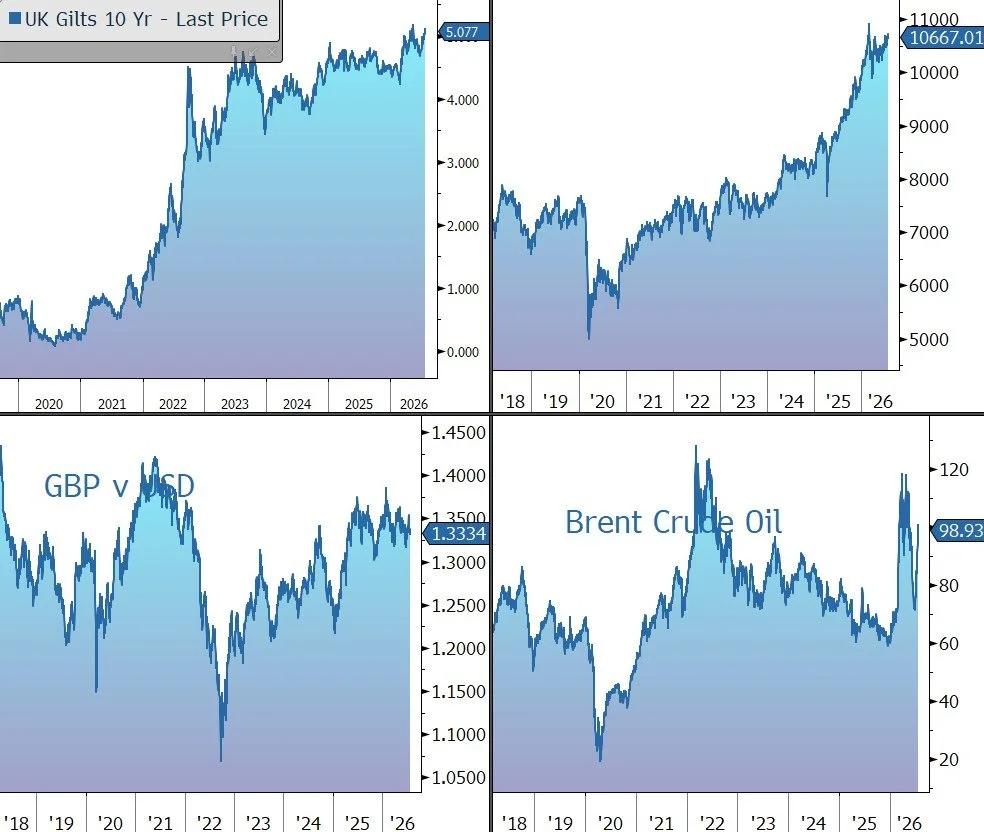
Brent crude is trading just below $100 a barrel and is on track to gain nearly 14% for the week, as escalating Middle East tensions heightened fears of deeper global supply disruptions. The US launched a 13th straight day of strikes on Iran, with both sides ruling out near-term talks. President Trump also threatened “major military punishment” against Iran and the Houthis over any further attacks on Red Sea shipping and said he was considering a “massive attack” on Iran.
The threat of higher inflation and tighter US monetary policy has sent gold back down to $4,040 an ounce and the yield on the US 10-year Treasury up to 4.70%.
The US will impose tariffs of between 10% and 12.5% on imports from most major trading partners after finding about 60 economies harmed American workers by failing to prevent forced labour. Duties on items from the EU and the UK won’t exceed 10% and products from Switzerland, Japan, and South Korea will be broadly capped at 12.5%. Fuel, foods, and fertilisers are among imports that will be exempt. Separately, Mark Carney said Canada is weighing all options for possible retaliation if it doesn’t reach a deal with the US to avert 50% tariffs next month.
A global sell-off in technology stocks gained momentum as doubts grew over returns from billions of dollars spent on artificial intelligence. Both major US indices closed lower last night – S&P 500 (-1.2%); Nasdaq (-2.2%) – and the downward momentum continued into Asia this morning: Nikkei 225 (-2.9%); Hang Seng (-1.3%); Shanghai Composite (-1.3%); Kospi (-5.9%).
The FTSE 100 is currently 0.3% higher at 10,667, while Sterling trades at $1.3335 and €1.1705. UK consumer confidence rose six points to minus 17, the biggest gain since November 2023.
Source: Bloomberg
Company News
Yesterday lunchtime Newmont Mining released Q2 2026 results which highlighted strong operational and financial performance. Earnings were above market expectations, with higher year-on-year gold prices helping counter lower production. Free cash flow remained strong and the company continued to return capital to shareholders. Newmont remains on track to achieve its full-year guidance and, in response, the shares were little changed after US trading hours.
Newmont is the world’s largest gold company and a producer of copper, silver, zinc and lead. This follows a transformational period during which the company bought US-listed Goldcorp for $10bn and Australia’s Newcrest Mining for $17bn. The company also entered into the Nevada Gold Mines joint venture with Barrick Gold – its 38.5% stake provides exposure to the single largest gold-mining complex in the world. In order to retain focus, Newmont has also divested non-core assets – in 2025 the company completed its portfolio optimisation programme which has generated $4.5bn of after-tax proceeds to date.
Newmont now operates a world-class portfolio of assets and prospects in favourable mining jurisdictions in Africa, Australia, Latin America & Caribbean, North America, and Papua New Guinea. The portfolio includes more than half of the world’s Tier 1 mines.
At the end of 2025, the company declared total reserves of 118.2m attributable gold ounces and resources of 148.7m attributable gold ounces. There is also significant upside from other metals, including more than 12.5m tonnes of copper reserves and 442m ounces of silver reserves.
The company says that every $100 an ounce change in the gold price adds just over $500m to the group’s revenue. With the current gold price (c. $4,000+ an ounce) well above the company’s conservative long-term price assumption ($2,000 an ounce) and the expected cost of sales ($1,680 an ounce), Newmont should be able to generate significant cash flow over the medium term. As a result, the company provides an attractive way to gain exposure to the gold price, albeit with the operational and political risks that come with a production company.
The company’s enhanced capital allocation framework is designed to be sustainable through the commodity cycle while maximising total return of capital to shareholders, maintaining a flexible and resilient balance sheet, and focusing on high-return capital investments for long-term value creation. In order of priority, the company will:
· Undertake ongoing sustaining capital investment in its world-class portfolio
· Pay a sustainable through-the-cycle cash dividend
· Maintain a disciplined approach to development capital reinvestment
· Maintain an optimised capital structure through the cycle, anchored by a $1bn net cash target, with flexibility of plus or minus $2bn depending on market conditions. A minimum cash balance of $5bn will be maintained.
· Once the above priorities are complete, Newmont will deploy excess cash on share repurchases.
In Q2 2026, attributable gold production fell by 1% to 1.3m ounces. This was caused by lower production at Cadia as a result of the impact of the seismic events during the quarter and lower production at Ahafo South, Peñasquito, and Yanacocha as a result of lower grade from planned mine sequencing. The group also produced 17k tonnes of copper and 7m ounces of silver.
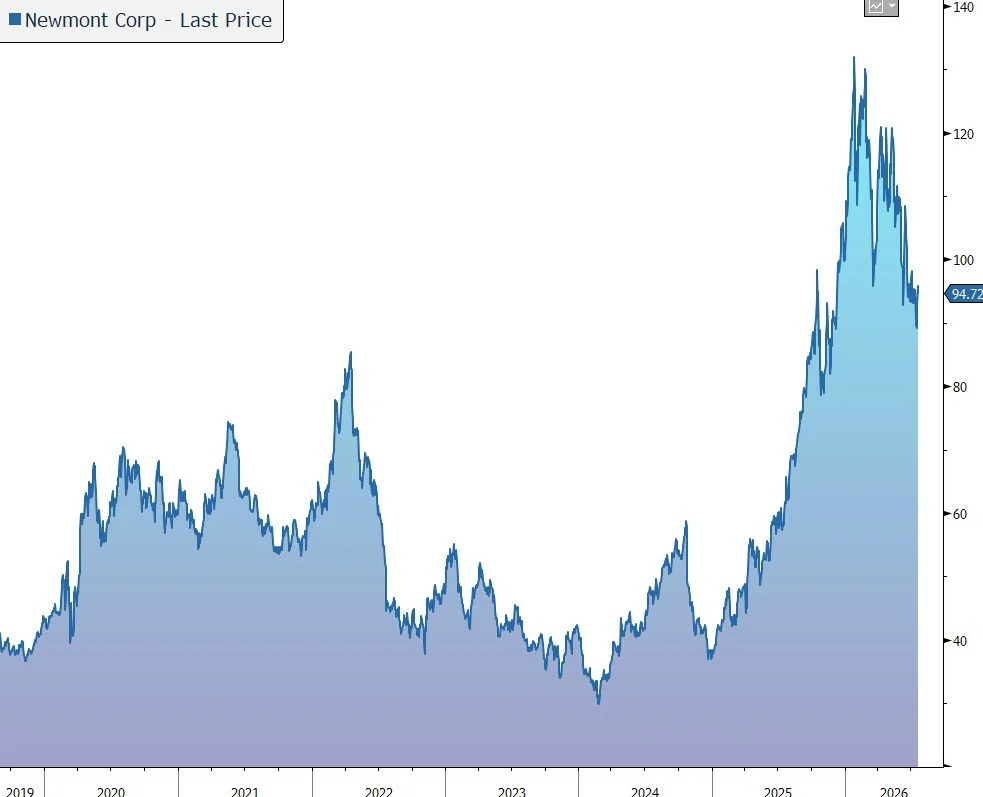
Since peaking in January at almost $5,600, the gold price has fallen back to around $4,000 due to concerns over the outlook for inflation and interest rates as a result of the Middle East conflict. However, the price remains well above this time last year – in Q2, Newmont realised a gold price of $4,414 per ounce, up 33%. Revenue grew by 15% to $6.1bn, slightly below the consensus forecast of $6.3bn.
The group’s direct operating costs are made up of labour (50%), materials & consumables (30%), fuel & energy (15%), and other expenses (5%). During Q2, total all-in sustaining costs (AISC) rose by 18% to $1,621/ounce, mainly due to higher sustaining capital and other expenses, primarily related to incremental costs incurred at Cadia during the downtime after the seismic event in April. Year-to-date costs are tracking well below Newmont’s full-year cost guidance.
Cash profits (EBITDA) increased by 25% to $3.8bn, while adjusted net EPS rose by 47% to $2.10, ahead of the market forecast of $1.99.
Capital expenditure rose by 7% to $719m as the company continued to progress major capital projects. The business generated strong free cash flow up 29% to $2.2bn. This left the group in a strong net cash position of $3.4bn, with $9.0bn of cash and $13.0bn in total liquidity.
During the quarter, the company returned $1.9bn to shareholders and has now repurchased $1.7bn of its shares as part of its $6.0bn programme authorised by the Board through to October 2026. It also declared a dividend of 26c per share for the second quarter, equating to an indicated total annualised dividend of $1.04 (1% yield).
The company remains on track to achieve its full-year guidance of attributable gold production of 5.3m ounces, including over 3.9m gold ounces from its managed operations. Gold by-product All-in sustaining costs (AISC) are expected to be $1,680 an ounce, benefitting from profitable production of other metals. Sustaining capital expenditure (i.e. maintenance) is expected to be $1.95bn, with development spend of $1.4bn.
Source: Bloomberg
