
Morning Note: Market News and an Update from Alphabet.
Market News
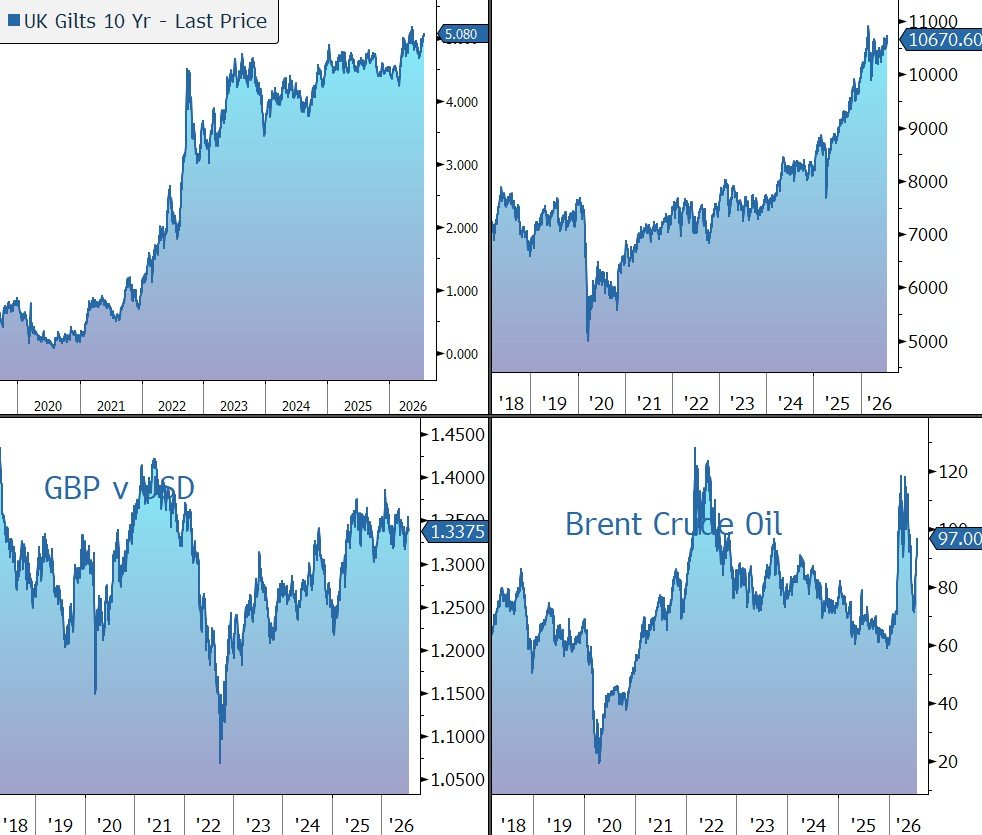
Geopolitical tensions remain elevated. Brent crude jumped to $96 a barrel after the Houthis said they attacked two Saudi Arabian tankers in the Red Sea, opening a new front in the conflict that has already snarled traffic through the Strait of Hormuz. The US military used a B-1 long-range bomber to strike targets in Iran, Axios reported.
The ECB will probably pause from hiking rates further today as it weighs the impact of re-escalation in the war. Meanwhile, Kevin Warsh is upending bond market norms, leaving traders guessing what the Fed will do at its rate-setting meeting next week.
Gold has drifted down to $4,110 an ounce, although technical analysts see potential for a secondary bull run. The yield on the US 10-year Treasury moved up to 4.68%.
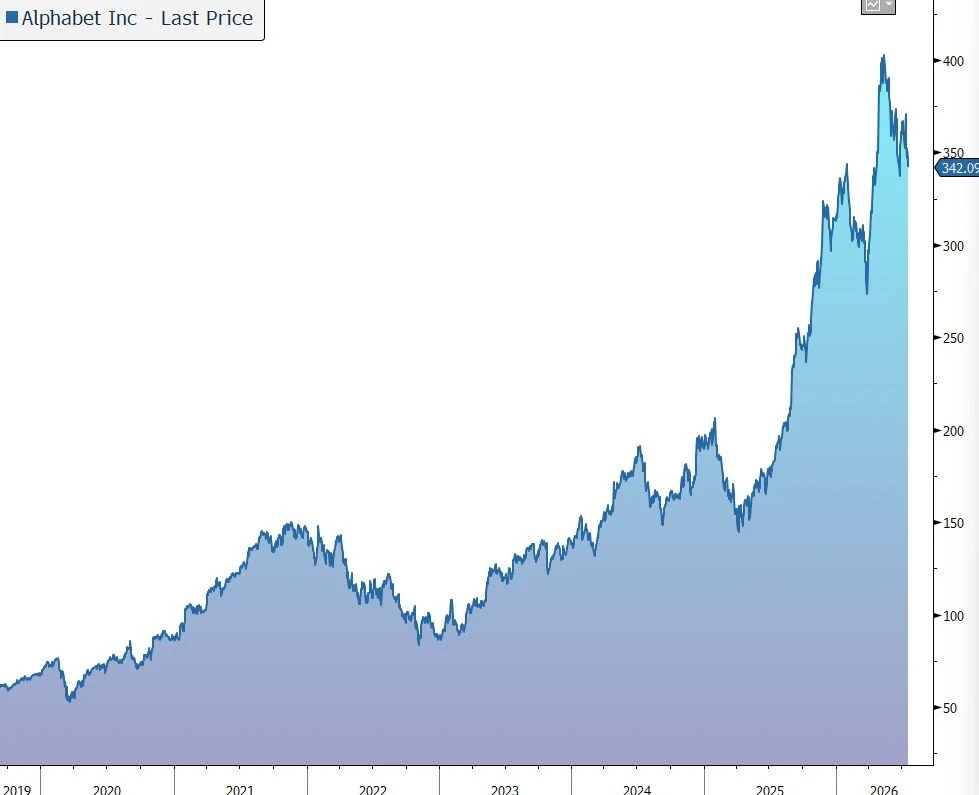
US equities drifted lower last night – S&P 500 (-0.1%); Nasdaq (-0.6%). Alphabet (see below) and Tesla were marked down 3% and 4%, respectively, after-hours following the release of results.
In Asia this morning, stocks were firmer: Nikkei 225 (+0.5%); Hang Seng (+1.1%); Shanghai Composite (+0.3%); Kospi (+4.4%). The yen fell beyond 163 a dollar for a second day.
The FTSE 100 is currently 0.3% lower at 10,670, while Sterling trades at $1.3375 and €1.1710. Anglo American is up 4% after the company lowered its 2026 copper unit cost forecast. Prologis is set to acquire UK landlord Segro after its board unanimously concluded that the financial terms are recommendable, subject to due diligence and final agreement.
Source: Bloomberg
Company News
Last night, Alphabet released Q2 results which were well ahead of market expectations, driven by a meaningful acceleration in revenue growth at Google Cloud as the company continues to benefit from its full stack approach to AI. The rapid step-up in capital investment led to a free cash outflow and the company, once again, raised its guidance for full-year spend. This trend continues to unnerve the market but the company said this was justified by strong demand, with another jump in the order backlog to $514bn, of which more than 50% will convert to revenue over the next 24 months. The other ‘niggle’ in the results was the prospect of margin dilution in the Cloud division from the inclusion of lower margin TPU sales. In after-hours trading, the shares were marked down by 3%.
Alphabet is the public holding company for Google, one of the world’s most recognised and widely used brands. In addition to the core search engine, the group owns digital video platform YouTube, Google Cloud, web browser Chrome, mobile operating system Android, Gmail, Google Maps, AI personal assistant Gemini, Fitbit, autonomous driving company Waymo, and drone delivery company Wing.
The group has a strong track record of innovation, leaving it well placed to capitalise on multiple technological themes, such as AI, digital media, e-commerce, video advertising, cloud computing, and driverless cars.
The company has seven products with more than two billion users each and another eight with more than 500m users, most of which we believe are far from being fully monetised. The group’s structure allows it to own a portfolio of businesses with different time horizons, while its broad offering provides customer stickiness and a competitive edge. Cash is allocated between capital expenditure, internal R&D, bolt-on M&A, and shareholder returns.
We believe Alphabet is very well placed for the world of AI – the company has been incorporating AI functionality into its search capabilities and other products for years. As a result of its vertically integrated ecosystem and immense financial strength, the company now holds several competitive advantages:
· Google develops its large language models (LLMs) on its own semiconductors (Trillium) which are far more cost effective than comparable Nvidia models, providing it with a substantial cost advantage versus other AI players. The TPU v6 offers 4.7xbetter performance-per-dollar on LLM inference than Nvidia H100s. Overall, the company reduced Gemini’s serving units costs by 78% in 2025.
· Google’s position in cloud services – it is one of the big three public providers, generating more than $60bn in annual revenue – leaves it well placed to provide the infrastructure and computing power needed for AI.
· Google owns the world’s largest and most robust personalised data and user histories from its scaled applications: YouTube, Maps, Gmail, Chrome, and traditional Search.
The Gemini 3 series represents Google's flagship family of multimodal models, natively designed to reason across text, code, audio, images, and video. Consistently competing at the top of frontier AI benchmarks, Gemini powers experiences across Google’s core ecosystem, including AI Mode in Search and the Gemini App. In January 2026, Apple and Google announced a multi-year deal estimated at $1bn annually to license Gemini models for the next generation of Siri and Apple Intelligence. Gemini models now process 22bn API tokens per minute, up from 16bn last quarter. The Gemini app has 950m monthly active users and continues to narrow the gap with ChatGPT (1bn+ MAUs).
Google recently delayed the public release of Gemini 3.5 Pro – originally scheduled for June – by several months after internal testing revealed that updates to its coding and software reasoning capabilities fell short of expectations. However, on the Q2 results call, the CEO highlighted that Gemini 4’s roadmap includes rolling out models “almost at a monthly cadence.”
Despite this, overall, following a period of investor concern regarding the threat to the company’s competitive position, we believe Google has the infrastructure and application vehicles to fully monetise AI. This is supported by data on AI Mode and AI Overviews which shows overall query growth, including increased user engagement and greater query depth, supporting both monetisation and advertiser return on investment. The main concern is the huge ramp-up in the level of capital investment to support AI growth (see below).
Political and regulatory headwinds remain a focus, but remedies issued in the Google search monopoly case were less destructive than feared. The judge avoided structural breakups (such as a forced sale of Chrome or Android). However, the court explicitly banned exclusive default distribution agreements (meaning Apple distribution deals must transition away from strict exclusivity) and mandated select ‘click-and-query’ data sharing with competitors.
Back to last night’s results. In the three months to 30 June 2026, revenue grew by 23% on a constant currency basis to $119.8bn, versus the consensus forecast of $117bn, reflecting strong performance across the business. This compares to the 19% growth rate in the previous quarter.
The group reports its results across three segments: Google Services, Google Cloud, and Other Bets. Google Services is the largest division (81% of revenue), generating revenue primarily from digital advertising and the sale of apps, digital content products, hardware, and YouTube subscription fees. During Q2, Google Services revenue grew by 15% to $94.5bn.
Google Search (which accounts for 78% of ad revenue) increased by 17%, slightly below the 19% last quarter. Advertising from Google Network Members’ websites (9% of ad revenue) fell by 1%. The group separates out YouTube, which accounted for 14% of ad revenue in the quarter and grew by 13%. According to ratings firm Nielsen, YouTube accounts for more than an eighth of all television usage in the US and there are currently more than 200bn daily views on YouTube Shorts.
Other sales within the Services division (known as Google Subscriptions, Platforms, and Devices) include Play, content products, hardware, service, licensing fees, Nest, and YouTube’s non-advertising revenue (which now accounts for a third of YT revenue). Revenue grew by 15% in Q2 to $12.9bn.
Traffic acquisition costs (TAC) are the fees Google pays to other companies (such as Apple) to carry its search service and adverts (i.e., cost of sales). During Q2 they grew by 10% and currently account for 19.8% of advertising revenue.
Google Cloud includes Google’s infrastructure and data analytics platforms, collaboration tools, and other services for enterprise customers. Earlier this year, Google completed the acquisition of cybersecurity firm Wiz and the platform is being heavily integrated into Google Cloud Next initiatives. In Q2, the division grew by a stellar 82% to $24.8bn, versus the market forecast (64%) and the previous quarter (63%). Performance was led by an increase in Google Cloud Platform (GCP) across enterprise AI Solutions and enterprise AI Infrastructure, as well as core GCP services. The supply-demand balance remains tight – the backlog is $514bn (vs. $462bn in the previous quarter) – and the group continues to invest to grow the business. Despite this, Cloud quarterly profit grew from $2.8bn to $8.8bn, with a margin of 35.6%. On the call, the company disclosed that a small amount of the growth in the Cloud division came from the sale of TPUs and that this, and the use of third-party capacity, would place pressure on margins in the near term.
The group’s Other Bets division (less than 1% of revenue), which is effectively an incubator fund for new products and technologies, made a quarterly loss of $1.8bn. The group continues to wind down non-priority projects and focus investment on viable businesses like Waymo, the autonomous driving technology company, which has a potentially huge total addressable market – earlier in the year, Waymo raised $16bn at a $126bn valuation.
Alphabet continues to ‘durably engineer’ its cost base to support its investment in long-term growth opportunities, most importantly AI. The number of employees rose by only 6.3% in Q2 to 199k, while actions are being taken to optimise global office space and use AI to increase business productivity and efficiency. The group has previously highlighted that 25% of new code is being written by AI. The company reiterated its warning that the ramp up in capital investment (see below) is now feeding through to higher depreciation, which rose by 42% in Q2.
In the latest quarter, operational gearing and continued efforts to improve efficiency drove a gain in the margin from 32.4% to 34.0%. EPS grew by 294% in the quarter to $9.11, albeit this included a $98bn net gain in ‘other income’, primarily the result of net unrealised gains on equity securities, most notably Alphabet’s holding in Anthropic. In underlying terms, EPS grew by 23% to $2.85.
As expected, capital expenditure rose sharply as the company continued to pour money into infrastructure for AI products – up 100% to $44.9bn in the quarter. Capex guidance for 2026 has been lifted again from $180bn-$190bn to $195bn-$205bn, with another significant step-up expected in 2027. The company has justified the spend by the current monetisation of previous investment across the business and the huge order backlog which has increased by another $50bn to $514bn, of which 50% will convert to revenue over the next 24 months. The company has previously said that 95% of the top 20 SaaS companies now use Gemini, and the models are processing over 10bn tokens per minute. The company also said that 40% of the spend is in longer duration assets like physical land and power infrastructure.
Although the increase in spend comes from a position of financial strength (see below), it equates to 1.2x consensus 2026 profit. The concern is the shift toward a more capital-intensive, asset-heavy model and the potential risk of technological obsolescence and return on investment. However, for now demand continues to exceed supply, justifying the continued ramp-up in investment. We also note the group has a strong track record for generating return on investment – together, Cloud and YouTube exited 2025 at an annual revenue run rate of $130bn.
Despite the strong operating results, the increase in capex led to a free cash outflow of $5.9bn in the quarter, the first negative quarter in recent history. The group’s large cash pile (including marketable securities and long-term debt) stands at $144bn. In February, the company raised $32bn in a heavily oversubscribed debt issue, including a 100-year Century Bond in Sterling. In June, Alphabet announced an upsized $85bn equity raise, consisting of $35bn of public offerings, a $40bn at-the-market (ATM) programme, and a $10bn private placement to Berkshire Hathaway, with the latter we believe providing a strong validation of Alphabet’s strategy. We also note that $30bn of the $40bn ATM programme is designated for employee stock-tax settlement rather than net-new share creation, minimising dilutive impact of the raise.
The company pays quarterly cash dividends (+5% to 22c), putting the company on an equal footing with Microsoft and Apple in the minds of investors looking for yield.
Source: Bloomberg
