
Morning Note: Market News and an Update from National Grid.
Market News
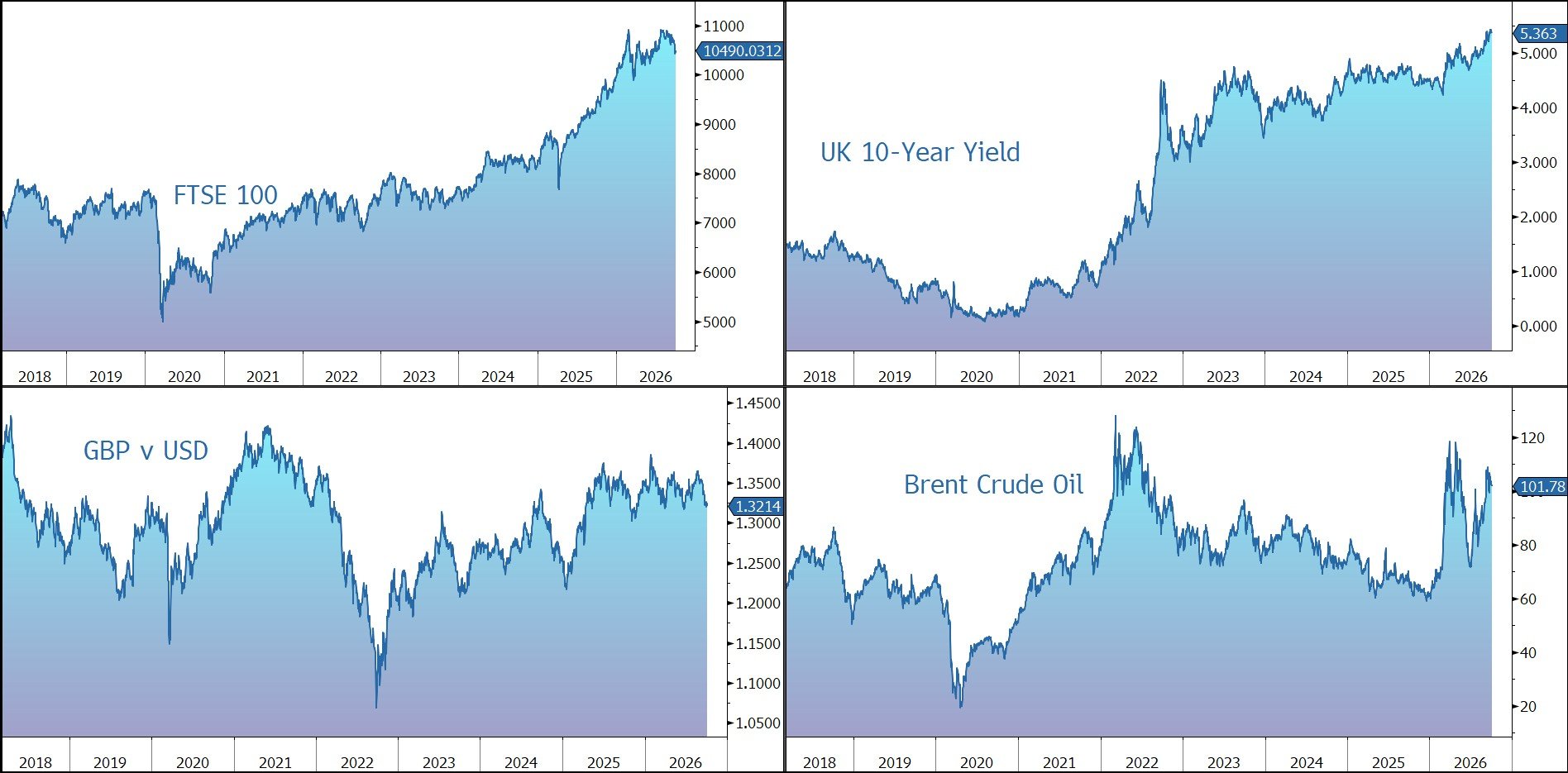
Global equities finished last week on a positive note following the release of weaker-than-expected US September nonfarm payrolls (29,000). Overnight-indexed swaps now price an 18% probability of a Fed rate hike at the October meeting, down from 29% on Thursday. The yield on the 10-year US Treasury is 5.26%, while gold is trading at $4,160 an ounce. This week’s FOMC minutes are the key event for rates markets.
The euro fell 0.7% to 1.1174 against the dollar as French fiscal and political concerns deepened, with OAT futures falling in Asia. The French 10-year yield is currently 4.92%, versus 3.43% for the German bund yield, a spread not seen since the European debt crisis.
Brent crude is trading above $101 a barrel after Iran’s parliament speaker refused to reopen the Strait of Hormuz without seven US concessions, combined with a new wave of vessel attacks and a full-scale Saudi-backed Yemeni military offensive against the Houthis.
Brazil’s first-round presidential election delivered a surprise: Flávio Bolsonaro leads Lula approximately 47% to 45%, heading to the 25 October run-off.
In Asia this morning, equity markets were firm: Nikkei 225 (+2.4%); Shanghai Composite (+0.3%); Kospi (+0.5%). The FTSE 100 is currently 0.2% higher at 10,490, while Sterling trades at $1.3225 and €1.1810.
Schneider Electric has agreed to acquire PTC Inc. for $22.6bn, with the deal expected to close in Q3 2027. The CFO has guided to €250m of cost synergies over three years.
Source: Bloomberg
Company News
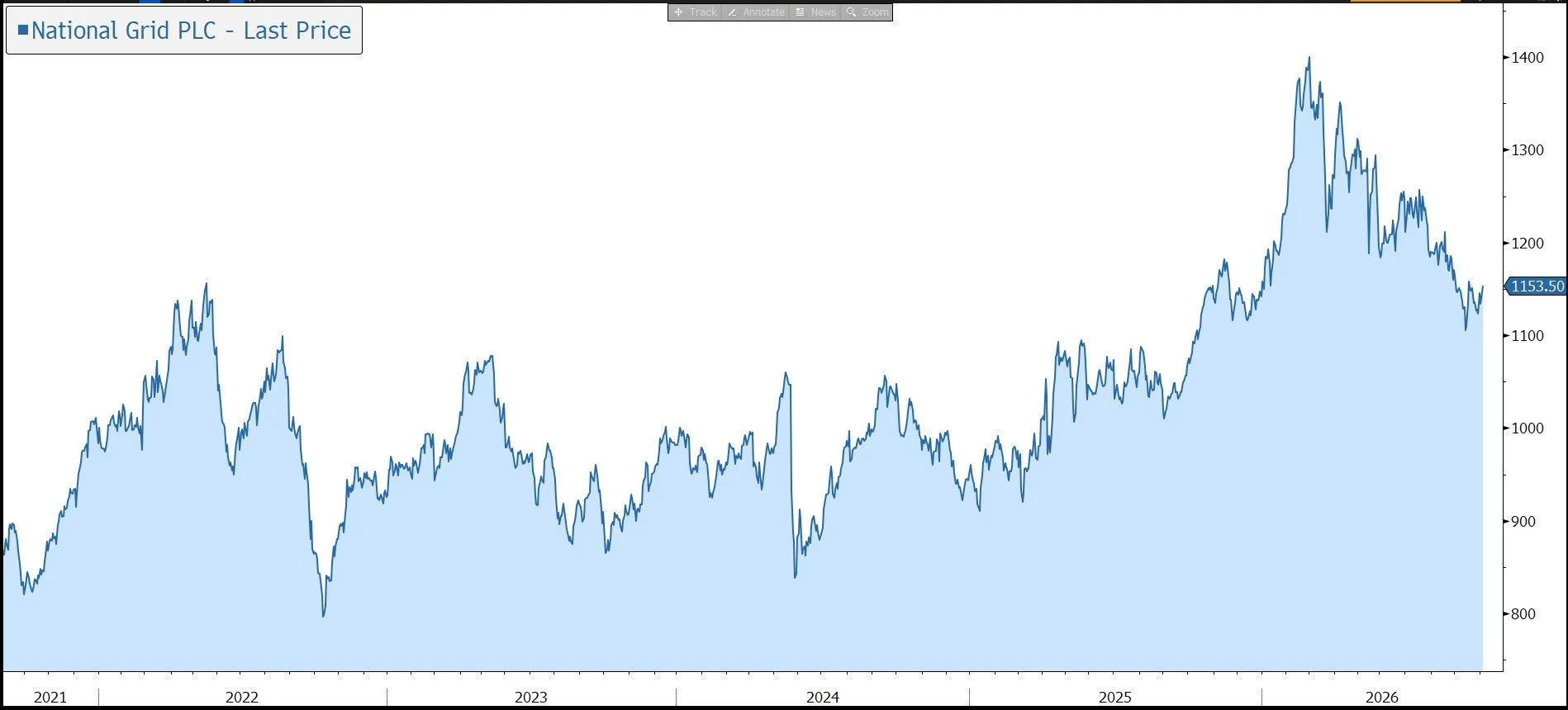
National Grid has today released a pre-close update for the six months ended 30 September 2026, ahead of announcing half-year results on 5 November. Although the group’s regulated businesses performed in line with expectations, a strong showing from the unregulated units means the group now expects earnings growth to be slightly above its guidance range. We are positive on the long-term outlook for the business given the company’s critical role in the energy transition and security of supply. As an income stock, the performance of the shares is driven, in part, by bond yields, with the recent increase providing a headwind. In response to this announcement, the shares have been marked up by 1% in early trading and currently offer a 4.4% dividend yield.
National Grid operates a regulated infrastructure business in the UK and US, with electricity and gas transmission and distribution assets. The group has limited exposure to volatile commodity prices and usage levels, while revenue is positively linked to inflation.
The global power grid is critical infrastructure that requires substantial and sustained investment to integrate an ever-growing pipeline of renewables and support the rising demands of an electrified world. Put simply, the grid needs to be larger, smarter, and more resilient to enable the energy transition to continue at pace.
Over the last few years, National Grid has pivoted its portfolio towards electricity. This has enhanced the group’s role in the decarbonisation of the energy system, with investment in infrastructure that enables higher penetration of renewable energy and low carbon technology. Increased demand will also come from new connections to AI data centres – there is currently a massive queue of data centres waiting for grid connections.
In response, the company is undertaking a significant hike in investment in order to deliver a step-change in critical energy infrastructure in the UK and US in support of energy transition, security of supply, and economic growth objectives.
Back in March, the company set out an extended and upgraded 5-year Financial Framework to March 2031. The cumulative capital investment is expected to be at least £70bn, of which around two-thirds will be covered by regulatory agreements. The plan represents a 70% increase compared to the prior five years, reflecting a doubling of investment into UK electricity networks and an almost 50% increase in investment into US gas and electricity networks. The expected split across the group is: UK Electricity Transmission (£31bn); UK Electricity Distribution (£9bn); New York Regulated (£17bn); New England Regulated (£12bn); and National Grid Ventures (£1bn). The company has secured supply chain and delivery mechanisms for around three-quarters of its investment plan. Real price mechanisms should continue to provide a hedge if costs move materially.
The company continues to streamline its portfolio to focus on pure-play networks across regulated and competitive onshore and offshore networks. It has sold its ESO (electricity system operator), National Gas Transmission, its National Grid Renewables onshore business in the US, and its Grain LNG business.
National Grid Ventures (NGV), the commercial arm of National Grid plc, develops, builds, and operates energy infrastructure that strengthens the power system and delivers reliable, affordable energy. The portfolio includes battery storage, solar, LNG storage, and conventional generation assets. In July, the company invested $1.75bn for a 35% stake in Joulent LLC, a platform focused on developing contracted power generation and high voltage infrastructure for US large load customers, particularly data centres.
Overall, the group’s target is to generate asset growth CAGR of around 10%, with group assets heading towards £115bn by March 2031. With most of the investment going into the group’s electricity networks, the mix will continue to move away from gas.
Underlying EPS CAGR is expected to be 8%-10% from an FY26 baseline of 78p, more aligned with the group’s asset growth. In the near term (i.e. the financial year to end March 2027), the company is expecting underlying EPS growth of 13%-15%, reflecting higher allowed revenue as it steps up delivery from RIIO-T2 to RIIO-T3 regulatory regimes. The accelerated rate of growth will be helped by a streamlined connection process for AI data centres.
In today’s update, however, the company has revealed that its regulated businesses continue to perform in line with management expectations, but a strong first-half performance in National Grid Ventures & Other means the company now expects to be slightly above its FY2027 EPS growth guidance of 13-15%. As usual, underlying EPS is expected to be weighted to the second half of the year.
The profile of half-year group operating profit is also expected to be broadly consistent with the prior year:
In UK Electricity Transmission and UK Electricity Distribution, operating profit is expected to be broadly evenly split across the year, consistent with FY2026.
In the US regulated businesses, operating profits are expected to be weighted to the second half in line with the usual seasonality. In New England, the company expects a return to a more typical seasonality profile following the one-off impact of the FERC Return on Equity judgement in the second half of FY2026.
National Grid Ventures & Other activities is expected to deliver c.£130m of additional performance in the first half relative to management expectations, reflecting significant one-off fair value gains following two successful capital market transactions within the NG Partners investment portfolio and stronger performance in the interconnectors business.
National Grid has a robust balance sheet and a strong investment grade credit rating, underpinned by regulatory revenue, which allows the group to secure the required long-term funding needed to invest in its business. The group believes it has the financial flexibility to deliver its strategy over the 5-year financial framework, helped in part by the £6.8bn rights issue in 2024. In addition, with around 80% of its debt locked in at fixed rates, the impact of potentially higher interest rates in the near term should be manageable. At the end of the last financial year, regulatory gearing was 61% and is expected to trend back to the high 60s range by 2030/31.
In the current financial year to March 2027, net debt is expected to increase by just over £6bn (from £44.2bn), with operating cash inflows more than offset by continued levels of significant investment in critical energy infrastructure. Reflecting this, regulatory gearing is expected to be around 64%. In today’s update, the company has disclosed that closing half-year net debt (at 30 September 2026) is expected to be broadly in line with the guidance for the full year after updating for the impact of the Joulent investment (see above) and reflecting the weighting of operating cash flows to the second half.
The stock remains popular with investors seeking an attractive income that is growing in real terms – the dividend policy is to deliver annual growth in line with the increase in average UK CPIH inflation. The estimated payout for the financial year to 31 March 2027 is just over 50p, equivalent to a yield of 4.4%, but below the 10-year gilt yield.
Although regulation provides a framework for the company to operate within, it can be a double-edged sword – at a time when many consumers are struggling to pay their energy bills, the regulator may be under pressure to hold back utility companies’ returns. However, we believe the risk is lower for the grid operators given the essential nature of their business and the fact that the grid only accounts for a small percentage of a consumer’s energy bill. Against that backdrop, the UK government recently announced plans for the creation of GB Grid, a new, publicly owned networks company. However, this is not seen as a significant threat to the growth and value creation targets of the electricity network companies.
Other than regulatory risk, the stock may also be negatively impacted by a rise in gilt yields, the threat of a cyberattack, supply chain and labour inflation risk, NIMBYism, and weakness of the US dollar.
Source: Bloomberg
