
Morning Note: Market News and an Update from Glencore.
Market News
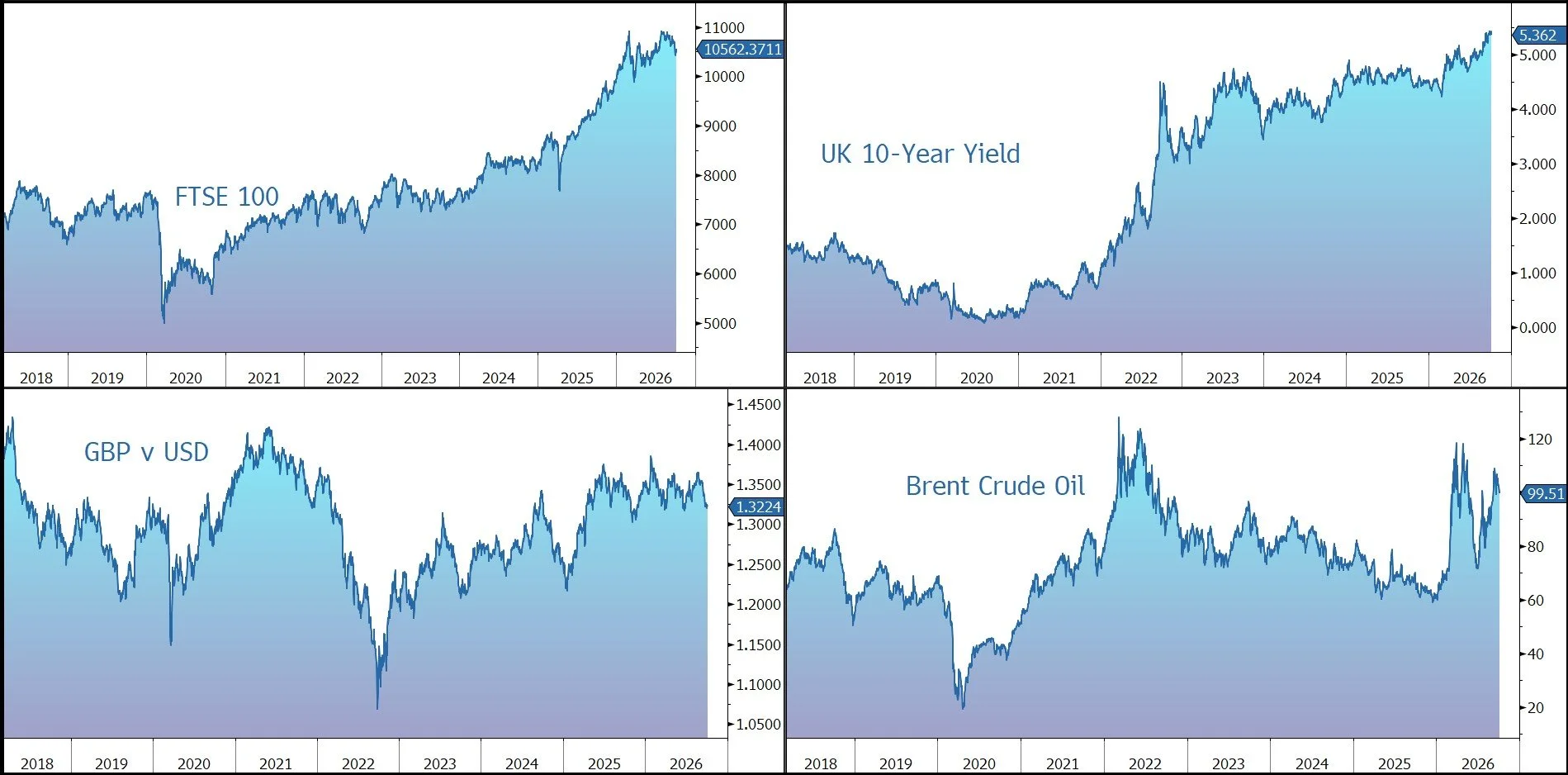
Treasury yields also climbed to fresh 24-year highs – the 10-year is 5.30% – as the global bond sell-off continued, driven by mounting fiscal risks and persistent inflation concerns. ISM data showed that cost pressures in the US services sector increased at the fastest pace in more than four years last month. Today’s US trade balance data and ADP employment figures will be watched for any signal on the Fed’s next move.
Gold slipped to $4,130 an ounce, pinned near two-month lows. Bundesbank President Joachim Nagel said rising government debt levels strengthen the case for central banks to increase gold holdings, citing growing credit risk concerns on sovereign debt.
Brent crude has fallen back below $100 a barrel, pressured by signs that Middle East crude exports are recovering toward pre-war levels. JPMorgan said crude shipments have rebounded to 17.5m barrels a day, or 98% of pre-war levels, while product flows such as diesel and gasoline reached 3m barrels a day, or 58%. Saudi Arabia sharply reduced the price of its flagship crude grade for Asian buyers as supply flows improved, further signalling a loosening market. President Trump also confirmed the US will not impose a diesel export ban after G7 nations agreed to release emergency fuel stockpiles.
The euro hovered near a 17-month low after Banque de France Governor Emmanuel Moulin warned France risks being “strangled by interest rates” absent fiscal consolidation. Marine Le Pen’s far-right party is expected to release an alternative budget today, a potential catalyst for further French government bond (OAT) spread widening and euro weakness.
US equities moved higher last night – S&P 500 (+0.7%); Nasdaq (+1.1%) – with Nvidia and Microsoft driving a broad tech rally. Amazon signed a 20-year power purchase agreement with Constellation Energy for 690MW of nuclear power from Maryland's Calvert Cliffs plant to meet AI-driven electricity demand. In Asia this morning: Nikkei 225 (+1.1%); Hang Seng (+0.7%); Shanghai Composite (holiday). DeepSeek is reportedly close to raising at least $12bn ahead of a 2027 IPO.
The FTSE 100 is currently 0.8% higher at 10560, while Sterling trades at $1.3325 and €1.1785. Informa is trading 1% higher following the announcement of a £2.24bn acquisition of Clarion, a leading international B2B Live Events business. The deal will be part-funded through a £940m equity issue. The company has also confirmed that current trading remains on track for full-year expectations and announced plans to separate its Taylor & Francis business.
Source: Bloomberg
Company News
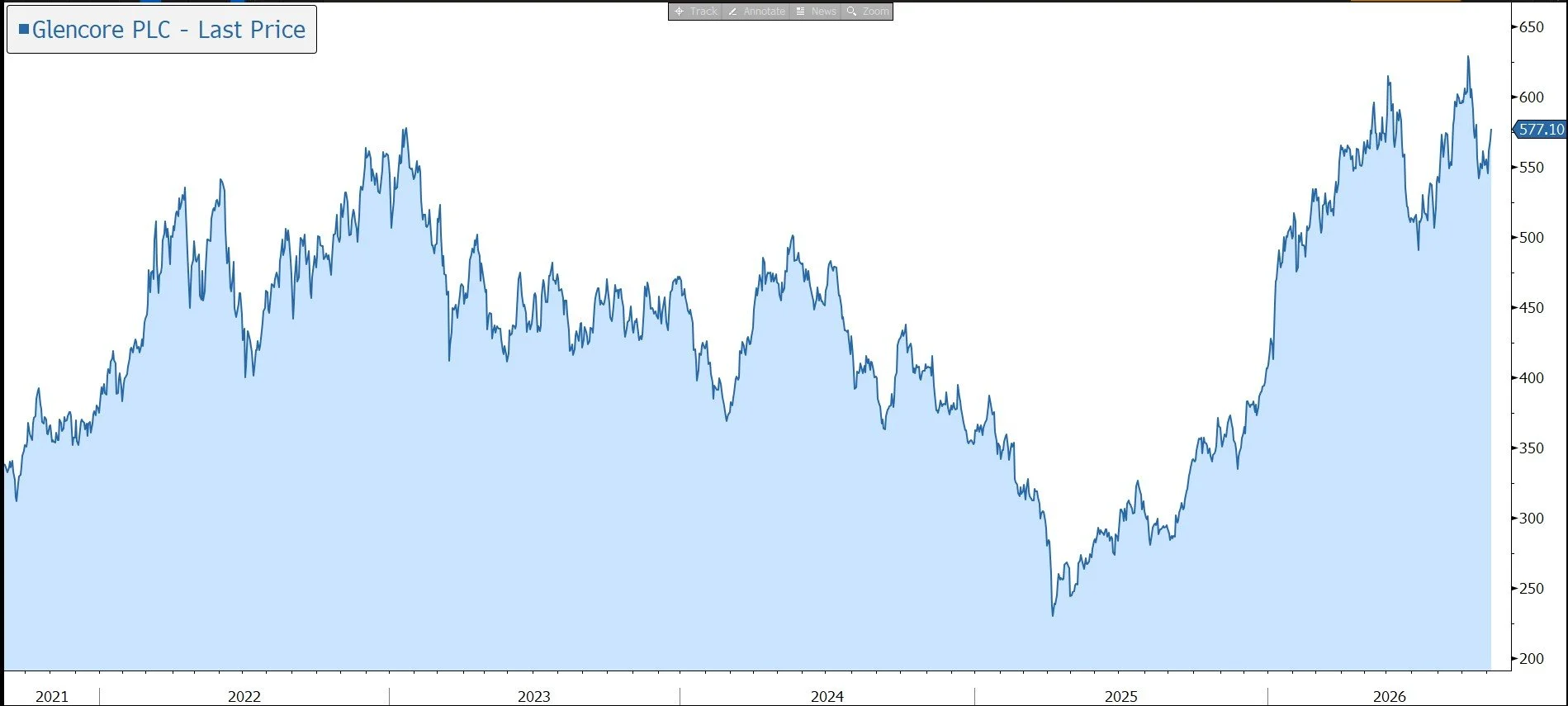
At the end of last week, Glencore updated its long-term profit guidance methodology for its marketing business and raised its full-year forecast for the unit. Strong commodity prices and ongoing volatility resulting from the Middle East conflict continue to benefit the group’s overall profitability. The company also reminded investors that a secondary listing of the group’s shares on the Australian Securities Exchange is due to commence on 14 October. The shares have been strong over the last year, driven by the interest from Rio Tinto, the ongoing strength in commodity prices, and value accretive asset management. As a standalone company, we believe Glencore is well placed, with a strong position in copper, a cash generative coal unit, and unique marketing business.
Glencore is a vertically integrated commodities business, with a strong position in the production of copper, coal, nickel, zinc, cobalt, and precious metals, and a unique marketing business which markets and distributes commodities sourced from internal production and third-party producers to industrial consumers. The group’s strategy is to own large-scale, long-life, low-cost Tier 1 assets.
Glencore’s marketing business accounts for around a quarter of the group’s profitability. It exploits arbitrage opportunities that continuously emerge as a result of different prices for the same commodities in different locations or time periods. It provides a good hedge against commodity price volatility and finances the $1bn base dividend (see below), although clearly there is always a risk of potential losses because of that volatility.
Last week, the company published an updated long-term, through the cycle, marketing guidance methodology which incorporates, via a matrix, the interplay between funding costs and Readily Marketable Inventories (RMI) on expected marketing adjusted profit (EBIT) outcomes. This new long-term methodology is intended for application from 2027.
RMI comprise the core inventories which underpin and facilitate Glencore’s marketing activities. They represent inventories, that in management’s assessment, are readily convertible into cash in the short-term due to their liquid nature, widely available markets, and the fact that price risk is primarily covered either by a forward physical sale or hedge transaction. RMI ordinarily turns more than 10 times per year.
The group’s previous long-term guidance range ($2.3bn-$3.5bn) reflected materially lower RMI levels and an interest rate environment that has more recently broken to the upside. RMI has moved progressively and materially higher over the past few years, primarily due to movements in commodity prices, inflation, the commercial opportunity set, and Glencore’s overall business volumes and scale.
Applying the updated long-term, through the cycle, marketing adjusted EBIT guidance matrix, with reference to 30 June 2026’s RMI of $32.2bn and Glencore’s current marketing funding cost of c.5%, the long-term EBIT guidance mid-point would be c.$3.5bn (within a range of $2.8bn to $4.2bn). The equivalent guidance mid-point was $3.2bn as of June 2025.
The company also nudged up its full-year profit guidance for 2026. Following a strong first half, when the marketing business generated adjusted EBIT up 142% to a near record $3.3bn, the company highlighted a mathematical full-year outcome of c.$4.9bn. Glencore now expects EBIT to exceed $5bn. Clearly, the longer the current market conditions continue the higher the potential profitability will be. As a guide, during the energy crisis of 2022, the division reported record EBIT of $6.4bn.
The improved profitability of the division will further strengthen the group’s financial position. As a reminder, at the end of the first half of 2026, net borrowing was $10.2bn, with gearing at a very comfortable 0.56x net debt to EBITDA, providing significant financial headroom.
The dividend policy is to pay a fixed $1bn base distribution from the marketing business, reflecting the resilience, predictability, and stability of the unit’s cash flows, plus a minimum payout of 25% of the industrial free cash flow. Following the decision to retain the coal and carbon steel materials business, the group’s net debt ceiling which shapes its shareholder returns framework is $10bn. When net debt falls below this level (after the base distribution), cash will be periodically returned to shareholders via special cash distributions and/or share buybacks.
Following a merger with its Viterra business, Glencore owns 16.4% of Bunge, the diversified global agribusiness solutions company. The stake is worth $3.4bn at the current share price and is recognised as surplus capital, being warehoused for appropriate monetisation for Glencore shareholders at some point in the future. Although the lock-up ended in July, the company is not looking to sell in the near term, as the investment provides good exposure to a number of attractive trends.
Underpinned by the value of these shares, the company is paying a top-up cash distribution of 7c/share (c.$0.8bn), taking the aggregate cash distribution to 17c/share (c.$2bn), which was paid in two equal instalments in June and September. Given the position of the balance sheet, the company has also paid a further top-up special cash distribution of 8.5c/share (c.$1bn) and is undertaking a $500m share buyback to be completed by February 2027. This brings total 2026 announced shareholder returns to c.$3.5bn, or 5.3% of the current market cap.
In order to broaden its investor base and enhance trading liquidity, on 14 October, the company’s shares are undertaking a secondary listing on the ASX in Australia. This provides access to a highly sophisticated investor base with deep expertise in the global resources sector who currently face restrictions on how many overseas shares they can own.
Overall, while geopolitical uncertainty continues in the near term, Glencore remains of the view that in certain commodities, the scale and pace of global mine project development will struggle to meet demand for the materials needed in the future. Glencore believes it is well placed to participate in bridging this gap through the flexibility embedded in both its marketing and industrial businesses to respond to global needs.
We believe commodities and resource stocks are inexpensive when compared to financial assets and are relatively under-owned in investor portfolios. We also believe they provide something of a hedge against inflation.
Furthermore, the mining sector has a long history of M&A. Looking forward, further industry consolidation would open the sector to generalist investors at a scale that would make it easier to bring on large and complex projects needed for new supply. Although the transaction between Glencore and Rio Tinto fell apart earlier this year, we expect a deal to be revisited at some point given management’s view a merger would be strategically compelling given the combined group’s scale, synergy potential, and growth profile. Since that time, Glencore’s share price (+18%) has outperformed Rio’s (+4%) due to a coal and copper price rally and iron ore price decline, giving Glencore a stronger hand if talks were to resume now the 6-month cool-off period is over.
Source: Bloomberg
