
Morning Note: Market News and an Update from EQT.
Market News
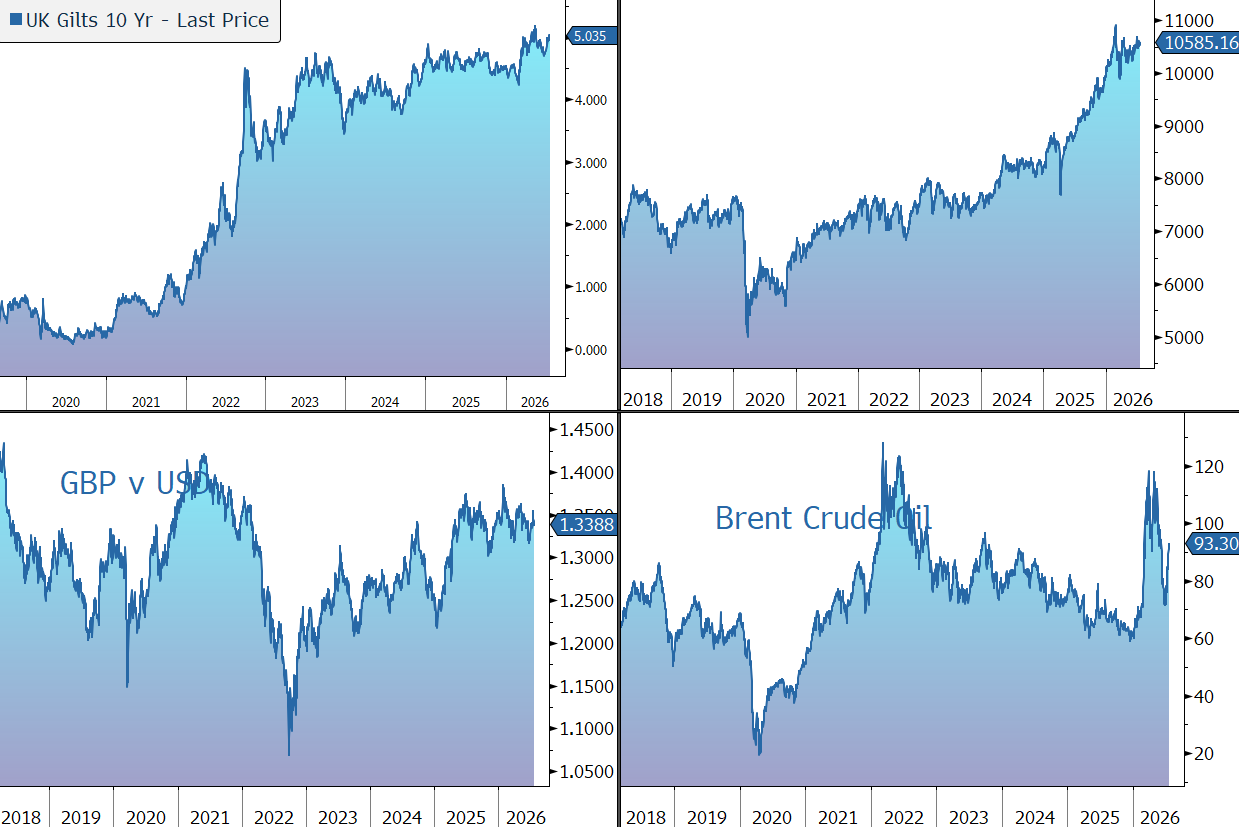
Brent crude climbed back above $93 a barrel as hopes for US-Iran peace talks faded. President Trump warned of additional strikes and pledged retaliation if Tehran-backed Houthi rebels in Yemen disrupted shipping through the Red Sea. Meanwhile, a Kuwaiti tanker carrying oil products was struck in Hormuz, underscoring persistent threats to maritime traffic. The war has cost the US $37.5bn, according to Pete Hegseth.
ADP data showed US private employers added an average of 16,500 jobs per week over the four weeks ending 4 July, down from an average weekly gain of 19,250 in the prior four-week period, marking a fourth straight slowdown in hiring. The yield on the US 10-year Treasury is 4.64%, while gold edged up to $4,110 an ounce.
US equities traded higher last night – S&P 500 (+0.9%); Nasdaq (+1.3%) – but reversed in the futures market and are currently expected to open lower this afternoon. Google owner Alphabet reports earnings this evening, with the market looking for guidance on AI spending. In Asia this morning, equities surrendered early gains as technology stocks lost momentum: Nikkei 225 (-0.1%); Hang Seng (-1.1%); Shanghai Composite (-0.2%); Kospi (+1.3%). Japan warned it would take action on the yen if necessary, as the currency traded just above a 40-year low, at Y163 to the dollar.
The FTSE 100 is currently little changed at 10,585. UK inflation fell more than expected to 2.6% in June, driven by a drop in petrol prices. Lower food and clothing costs also helped reduce the figures from 2.8% in May. The core figure, which excludes food and petrol, came in at 2.6%. Sterling trades at $1.3380 and €1.1725.
President Trump announced a 100% import duty on generic drugs from August 2028 (rising to 200% in 2029) unless manufacturers reshore production to the US. The president is also set to impose fresh levies on dozens of economies by Friday, as Trump appears to be rebuilding his tariff regime.
Source: Bloomberg
Company News
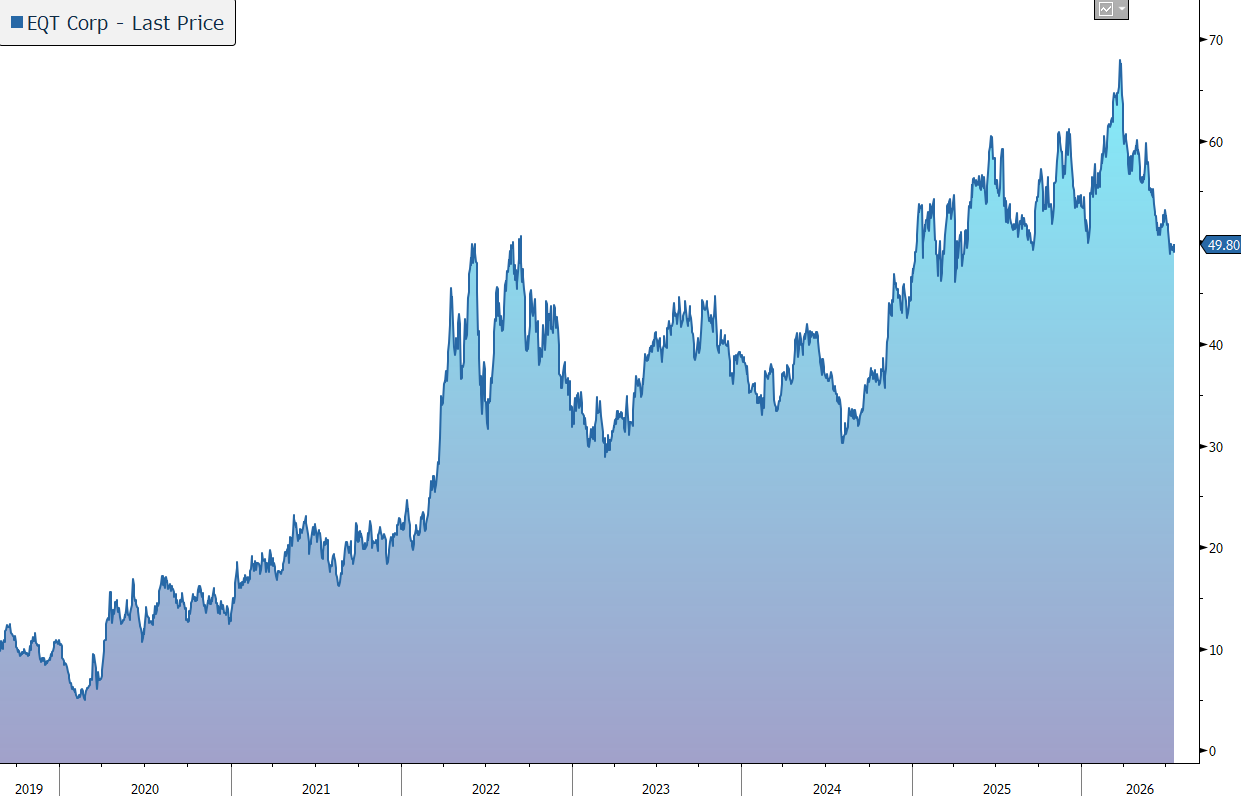
Last night EQT Corporation released results for the second quarter of 2026, which were slightly below market expectations due to weaker gas prices. However, production was better than forecast due to strong operational performance and the company raised its guidance for the full year. In response, the shares were 1% higher during after-hours trading.
EQT is the largest producer of natural gas in the US. It provides relative protection from commodity price volatility, coupled with secular growth upside. It possesses a multi-decade asset footprint, an unrivalled cost structure anchored by full vertical integration, an investment-grade balance sheet, and direct exposure to the two largest catalysts in modern energy: the global LNG export boom and the domestic AI data centre power expansion.
EQT controls more than 1m undeveloped core net acres across the world-class Appalachian Basin (spanning Pennsylvania, West Virginia, and Ohio). This yields production exceeding 6bn cubic feet equivalent per day (Bcfe/d) and leaves the company in control of a massive 30-year de-risked drilling inventory in the highest-margin windows of the Marcellus and Utica shales. The focus is on dry gas, rather than the natural gas liquids like propane and ethane.
As the world electrifies, natural gas is currently the only scalable, dispatchable fuel that can meet the sudden surge in demand. While renewable energy sources like wind and solar continue to grow, their intermittent nature means they cannot provide the guaranteed, 24/7 baseload power required by a modern digital economy. Battery storage technology remains too expensive and limited in capacity to bridge long multi-day gaps in generation, while nuclear power will take years to come onstream. This leaves natural gas-fired turbines as the essential, reliable anchor for grid stability. As Europe continues to move away from Russian piped gas and Asia pivots from coal to gas for air conditioning and industrial use, the US gas molecule has become a critical global strategic asset.
The primary risk associated with upstream energy investing is commodity price exposure, with low prices reducing near-term margins and share prices. US natural gas markets are notoriously volatile, with extended periods of sub-$2.00/MMBtu gas caused by unseasonably warm winters. The price is also frequently suppressed by cheap associated gas that is a byproduct of oil drilling in the Permian Basin (in Texas and New Mexico). Even if gas prices crash, Permian oil companies will keep producing if there is a high oil price on offer, flooding the market with ‘free’ gas that forces prices lower for others in the market. Permian producers frequently experience negative pricing – i.e. they literally pay for someone to take their gas away so they can keep pumping profitable oil.
In response to industry dynamics, EQT has fundamentally transformed its business model through industry-leading cost structures, vertical integration, and a pivot toward global LNG export markets and domestic data centre demand.
EQT is the lowest-cost dry gas producer in the US, with an unlevered free cash flow breakeven price of approximately $2.00/MMBtu. As a result, even in market downturns where regional spot prices plummet, EQT can maintain profitability and sustain its operations. In addition, the company opportunistically uses programmatic NYMEX hedges to lock in price floors for forward volumes. This active hedging programme acts as an immediate insurance policy, ensuring that even if the gas price experiences severe short-term distress, EQT’s free cash flow remains partially protected.
Historically, Appalachian gas producers faced a severe bottleneck: a lack of pipeline takeaway capacity out of the northeast US, which led to painful regional price discounts relative to Henry Hub. EQT solved this structural issue through its transformative acquisition of Equitrans Midstream, which includes a majority stake in the Mountain Valley Pipeline.
As a result, the company now controls its own gathering, processing, and transmission infrastructure – today, over 90% of EQT’s produced volume flows through its midstream assets. They generate steady, annuity-like revenue, acting as a natural financial buffer when natural gas prices dip. This allows the company to run the business for long-term value creation – this was explicitly demonstrated by management’s decision earlier in the year to strategically curtail 10-15 Bcf of production to avoid low shoulder-season pricing. The company also has the flexibility to dynamically optimise system pressures and reroute gas to premium pipelines, bypassing depressed local hubs to sell directly into higher-priced delivery points along the Gulf Coast and Southeast.
While standard utility demand remains stable (albeit seasonal), the rapid deployment of AI and hyperscale computing infrastructure has triggered an unprecedented power demand shock. The zero-downtime requirements of massive AI data centres require reliable baseload energy that can be supplied by gas-fired turbines. The proximity and scale of EQT’s assets leave it uniquely positioned to secure lucrative, long-term ‘behind the meter’ supply contracts directly with hyperscalers (Amazon, Google, Microsoft, etc.) and utilities. For example, last summer the company signed a historic agreement in principle to serve as the exclusive natural gas supply partner for Homer City Redevelopment (HCR) from 2028.
The massive valuation delta between US domestic gas (Henry Hub, currently $3.25 per MMBtu) and global benchmarks, like Europe’s TTF ($15.06 in US unit terms) or Asia’s Platts JKM ($20.95), is entirely an infrastructure and transportation bottleneck. Gas cannot be simply loaded on to standard cargo ships – it must be cooled to -162C at complex liquefaction terminals to become Liquefied Natural Gas (LNG). Also, because US LNG export terminals are currently running at maximum physical capacity, the US market is structurally isolated. Surplus domestic gas (especially ‘associated’ gas from the Permian Basin) gets trapped in North America, depressing domestic prices, while global markets are forced to pay a massive premium for whatever seaborne supply they can secure. Clearly, with 20% of global volume passing through the Straits of Hormuz, the Middle East conflict has exacerbated this issue.
In order to gain exposure to premium, higher-priced European and Asian gas prices, EQT is actively constructing an international marketing portfolio, signing binding long-term LNG tolling and offtake agreements with Gulf Coast export facilities that are currently under construction or in late-stage development. The portfolio will come online in phases between 2028 and 2030. Most recently, the company signed a 5-year offtake agreement with a large Asian integrated energy company for 0.5 mtpa of LNG sourced from various Gulf Coast LNG facilities beginning in 2028. Earlier in the year, the company explicitly stated that if its international LNG marketing portfolio were fully operational today at current global price spreads, EQT would be generating $6bn of free cash flow annually. This compares to $684m and $2.5bn in 2024 and 2025, respectively.
The main operational risk is that the expected demand growth from AI, data centres, and power projects may take longer to come through than anticipated, particularly if infrastructure or pipeline developments are delayed by regulatory and political opposition. In the meantime, the group’s low cost base and hedging ensure that even if the gas price experiences severe short-term distress, its free cash flow remains insulated while the company waits for its LNG export/AI business to kick in.
Back to last night’s results. In the second quarter of 2026, sales volume rose by 12% to 634 Bcfe, above the high-end of guidance of 570–620 Bcfe. Growth was driven by strong well performance, system pressure optimisation, and lower-than-expected price related curtailments.
During the quarter, the company generated a realised natural gas price, after the effect of hedges, down 6% at $2.65 per Mcfe. Although the Middle East conflict sent international benchmark prices sharply higher, US Henry Hub prices stayed well below year-ago averages because record domestic output, comfortable storage levels and limited LNG export capacity insulated the US market from global supply shocks.
The company also discloses the realised price differential, the difference between the benchmark market price for natural gas (such as the Henry Hub) and the actual, net price EQT receives at the wellhead or regional sales point. In Q2 this was a discount of 67c, albeit better than guidance due to marketing optimisation and curtailment strategy.
The company recently signed a 10-year definitive agreement with Competitive Power Ventures (CPV) to supply natural gas to the CPV Shay Energy Center in West Virginia, with pricing linked to PJM power prices, providing a substantial uplift relative to in-basin pricing.
Total per unit operating costs of $1.03 per Mcfe were at the low-end of guidance of $1.03-$1.17, driven by lower-than-expected SG&A, transmission, and lease operating expenses. As a result, adjusted EPS fell by 13% to 39c, just below the consensus forecast of 40c.
Capital expenditure rose by 20% to $666m, but was 9% below the low-end of guidance, benefitting from operational efficiency gains and lower-than-expected infrastructure spending.
The company generated free cash flow attributable to EQT of $330m, up 38%. Cash flow is currently being used to reduce the borrowing taken on at the time of the Equitrans acquisition. At the end of Q2 2026, net debt had fallen to $5.5bn (1x net debt to EBITDA), rapidly approaching the company’s long-term maximum target of $5.0bn, driving a credit-rating upgrade to Investment Grade (BBB) by Fitch Ratings. Once the debt target is achieved, the company plans to direct its excess cash flow back towards growing the base dividend, infrastructure and upstream growth capex, and share buybacks. The current baseline dividend is 66c, equating to a yield of 1%.
Looking to the current quarter, the company expects total sales volume of 570–620 Bcfe and operating costs of $1.09-$1.23 per Mcfe. For the full year, the company has raised its guidance for total sales volume by 90 Bcfe to 2,375-2,450 Bcfe, driven by better-than expected benefits from compression investments improving both existing and new wells and shallowing decline rates. Full-year capital spending guidance has been reduced by $25m.
Source: Bloomberg
