
Morning Note: Market News and an Update from Compass Group
Market News
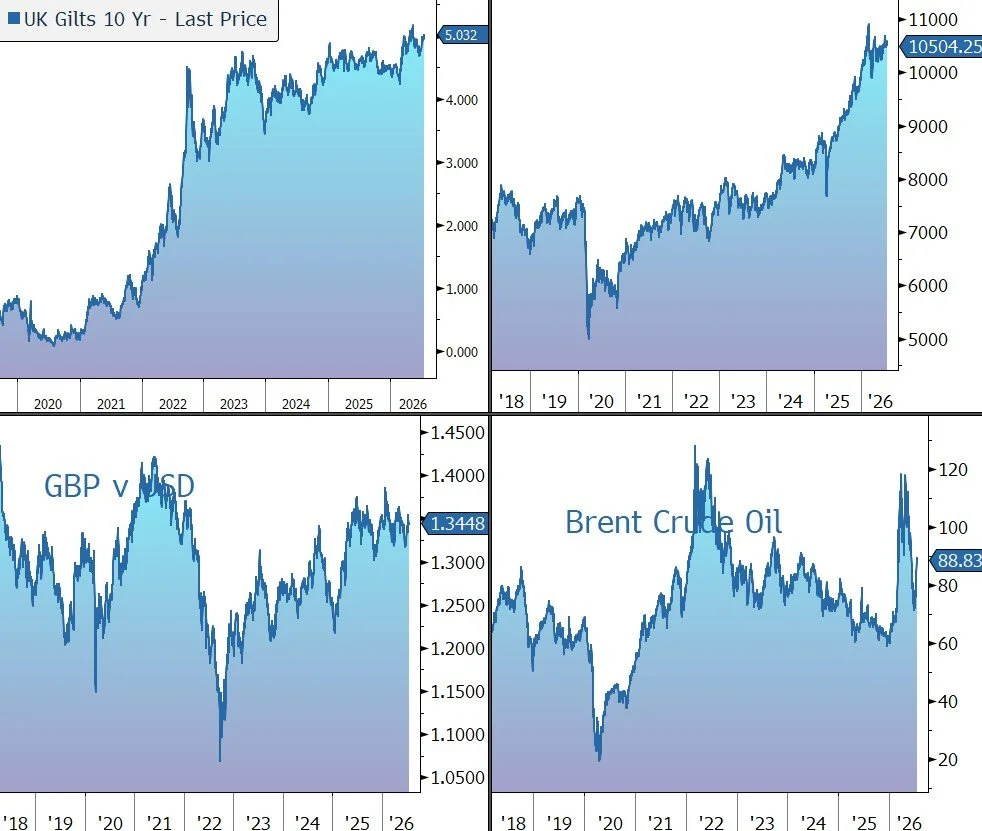
Oil fell below $88 a barrel as hopes grew that peace negotiations between the US and Iran could resume after several days of escalating attacks. US forces struck more Iranian targets as the conflict looked set to expand further after Tehran-backed Houthi militants in Yemen threatened to blockade Saudi Arabia in the Red Sea. Mediators are working to encourage both sides to agree to a new ceasefire, while reports pointed to a possible 10-day truce.
The US will impose a new 50% tariff on some Canadian goods, including milk and beer, citing unfair treatment of American products. Gold rose to $4,070 an ounce, while the yield on the US 10-year Treasury is 4.59%. Speculators are warming to gold again, with weekly CFTC data showing net longs at their highest since January, before bullion rolled over. They’ve often been contrarian, buying during ETF outflows in 2023 and selling during inflows in 2025.
US equities slipped last night – S&P 500 (-0.2%); Nasdaq (-0.1%) – but are expected to open higher this afternoon. In Asia this morning, stocks rose for the first time in four days as investors returned to chipmakers, driving a rebound in the sector after the recent sell-off: Nikkei 225 (+3.3%); Shanghai Composite (-1.8%); Kospi (+3.6%). A tech-heavy gauge in mainland China jumped over 7% as the country mobilised a range of state-linked institutions.
The FTSE 100 is currently 0.2% lower at 10,504. OCS has announced a recommended £3.1bn cash acquisition of facilities management group Mitie for 221.6p in cash, representing a 44.7% premium to last night’s close.
Andy Burnham’s pledge to seek “any flexibility” while following the government’s fiscal rules stoked concern that the new administration will add to the nation’s debt load. He appointed former Defence Secretary John Healey as Chancellor while Ed Miliband was tapped to be Foreign Secretary. An early announcement was the decision to remove the 5% VAT from energy bills to provide ‘breathing space’ for people struggling with the cost of living.
Sterling trades at $1.3440 and €1.1765, while the 10-year Gilt yield moved back above 5%. The latest economic news highlighted that annual wage growth, excluding bonuses, held at 3.4% in the three months to May, while the government borrowed £16bn in June, a third less than in the same month last year.
Source: Bloomberg
Company News
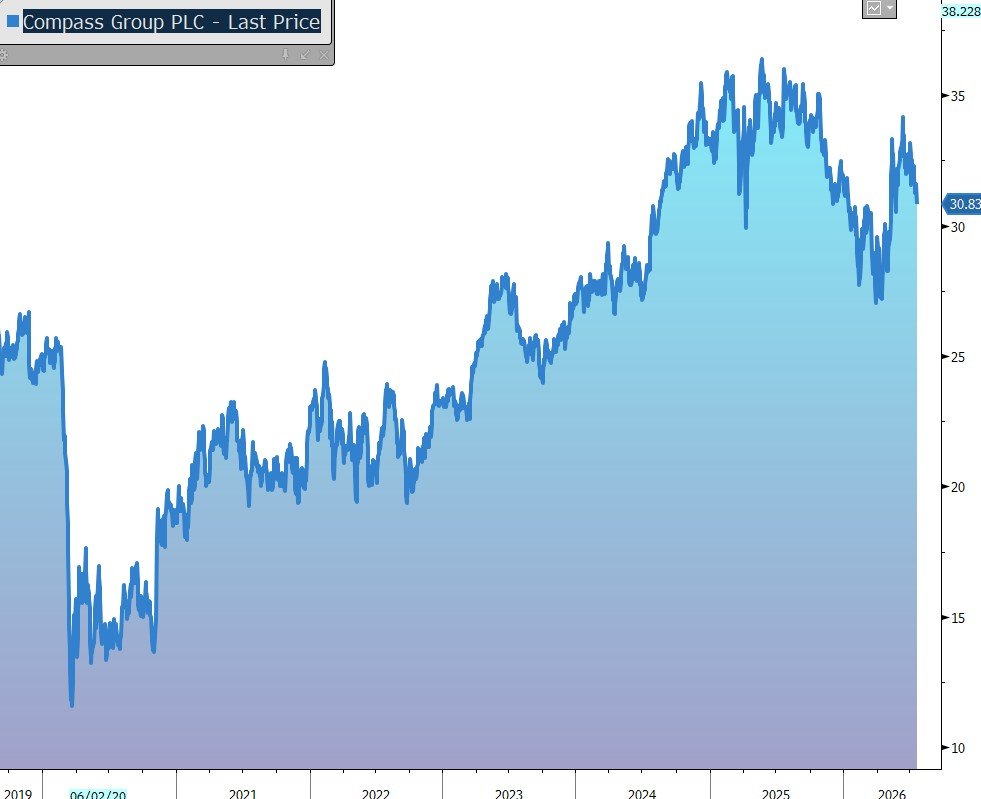
Compass Group has released an update for the three months to 30 June, the third quarter of its financial year to 30 September 2026. The group delivered another strong quarter, with net new business accelerating into the group’s target range, as expected. Guidance for the full year has been reiterated. With financial gearing slightly above the target range, we are unlikely to see a resumption of share buybacks in the near-term. However, we believe the current strategy of reinvesting in the core business, both organically and via M&A, is a good allocation of capital and will generate strong cash flow over time. Ahead of this morning's call, the shares are trading down 1%.
Compass is the world’s largest foodservice company, operating in over 25 countries, serving more than 5.5bn meals a year. The group also operates a targeted support services operation, which accounts for 15% of revenue, and a third-party food purchasing business. Although the company’s shares are listed in the UK, they are priced in US dollars, the company’s reporting currency.
The company operates in a $360bn global market, which has expanded by a third in the last four years, despite exits from 15 countries, with the help of acquisitions in segments which increase its captive audience. Matching the historical industry growth of 5% p.a., the market could reach $600bn by 2035.
As the largest player (albeit with a 15% share), the company’s scale provides a vital advantage over smaller players in terms of buying power. It is the fastest growing major operator, with the highest level of retention and margins in the industry.
The scope for growth from first-time outsourcing and share gains is significant – nearly 75% of in-house catering is still self-operated or managed by regional players. Companies and other institutions are open to outsourcing as they seek to reduce operating costs, cope with increased complexity, improve health and safety protocols, and ensure resilient food supply chains. As a result, Compass is well placed to consolidate its position as a trusted, financially strong provider, able to offer clients and consumers safe and innovative solutions. The company has an excellent pipeline of new business.
Management therefore believes net new business growth can be sustained at 4%-5%, above the historical level of 3%. This comes on top of like-for-like volume and price growth.
There are threats: permanently increased levels of working from home and online learning, rising unemployment (exacerbated by AI), increased competition from delivery providers, and reduced volume driven by weight-loss pills. However, we believe Compass is well placed to cope as a result of its diversified and defensive revenue mix, decentralised business model with predominantly local sourcing and supply chain, and a higher level of volume protection in its contracts.
Compass may actually be a ‘physical reality’ beneficiary of the shift to AI. With 90% of operations in tangible services—like food prep and hospital sanitisation—its core business remains immune to digital replication. As ‘white-collar’ displacement expands the available labour pool, Compass could benefit from reduced wage inflation and improved margins. Compass is using AI to reduce management overhead and cut food waste.
Overall, the company has a significant runway for long-term growth. Management is confident it can sustain mid-to-high single-digit organic revenue growth, ongoing margin progression, and profit growth ahead of revenue growth.
In the three months to 30 June 2026, organic revenue – a combination of like-for-like volume growth, price, new business, and client retention – grew by 7.1%. This leaves the nine-month growth rate at 7.2%, in line with the company’s full-year guidance of ‘around 7%’.
The group’s largest region, North America (67% of revenue), grew by 7.3%, while the International division grew by 6.9%. We note the company has no direct contract exposure to the Middle East.
The group benefitted from strong outsourcing trends, with net new business growth back in the group’s 4%-5% target range, as expected, and an acceleration versus the 3.8% growth delivered in the group’s first half. Annualised new business wins totalled $4.3bn, up 16% year on year, with half generated from first-time outsourcing. Client retention was 96% and the pipeline of opportunities continues to support confidence in future growth.
Like-for-like growth was in line with management expectations, with volumes in North America benefiting modestly from the Football World Cup. In International, like-for-like growth moderated, reflecting lower inflation and Sports & Leisure calendar timings.
Business & Industry remains the strongest performing sector, delivering double-digit organic growth, driven by the leading AI hyperscalers across the data centre ecosystem. Sports & Leisure in the International region continues to grow strongly, with a significant contribution from first-time outsourcing. In Education, the recent University of Kentucky win highlights the growing demand for integrated solutions which include food, hospitality, facilities, and healthcare support services. Healthcare & Senior Living continues to represent a significant long-term opportunity – in North America, six of the group’s top 20 new business wins this year were in the sector. Finally, Defence, Offshore & Remote continues to benefit from increased investment in defence and energy infrastructure.
As expected, there is no update on profitability or the group’s financial position at this stage. The group’s flexible cost base has helped the margin to recover from pandemic lows despite re-opening expenses, the cost of mobilising new contracts wins, and inflationary pressures.
As Compass focuses on the significant structural growth opportunities in its core markets, it has stepped up its M&A activity to expand its portfolio of brands, focusing on digital innovation and delivered-in solutions. So far this financial year, the group has spent $2.4bn. Integration of the most recent deal, the $1.7bn acquisition of Vermaat, is progressing well. This adds a leading premium food services business in Europe which will be used to create a strong growth platform in a region which has consistently underperformed North America on both organic growth and margin. Following the acquisition of Pro Care Management in Germany, Compass now operates Group Purchasing Organisations (GPO) in five of its top ten markets.
As a result of its M&A activity, the company’s financial leverage has increased: net debt to EBITDA was 1.7x at 31 March 2026, just above its medium-term target of 1.0x-1.5x. Compass anticipates its leverage will still be above 1.5x at the end of FY2026, having peaked at the half-year stage, before falling in FY2027. Although this clearly reduces the amount of excess cash flow available for share buybacks in the near term, we believe reinvesting in the core business is good capital allocation and will generate strong cash flow and returns over time. In the meantime, the company continues to pay an attractive dividend – the interim FY2026 payout was increased in May by 13% to 25.5c.
Compass has reaffirmed its guidance for FY2026 – it still expects constant currency underlying operating profit growth of ‘above 11%’, driven by organic revenue growth of around 7%, around 2% profit growth from M&A (including Vermaat), and ongoing margin progression. Although the revenue target still appears conservative, the company does face some tough year-on-year comparatives. The company also provided an update on the impact of currency movements – if current spot rates were to continue for the remainder of the year, FX translation would positively impact revenue by $438m and operating profit by $23m.
Source: Bloomberg
