
Morning Note: Market News and an Update from Barrick Mining.
Market News
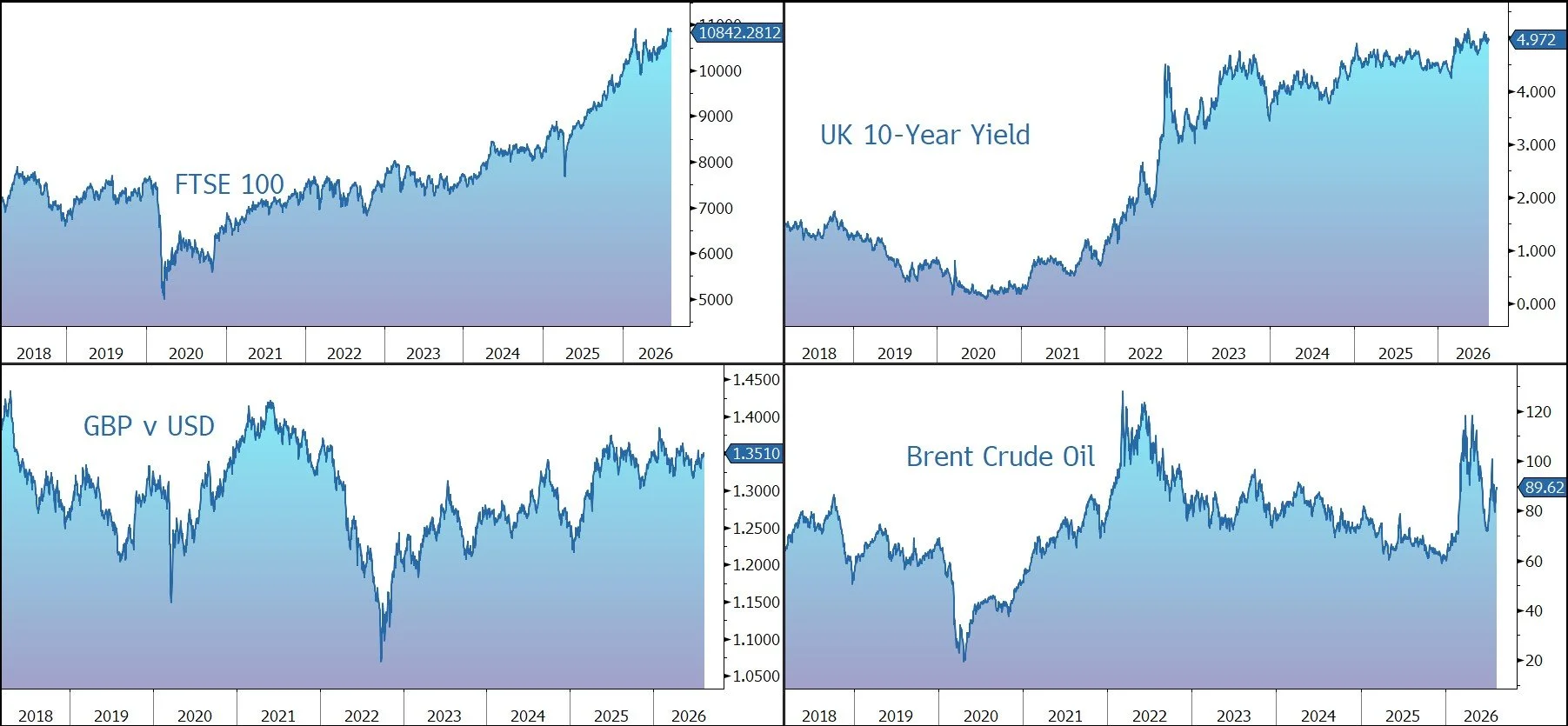
Brent crude moved up to $89.50 a barrel as traders remained wary over the prospects for a Middle East deal. Iran and the US remain at an impasse despite Pakistan’s defence minister saying a deal is reportedly close. Oil supply disruptions stemming from the Iran war may reach about 600,000 barrels a day through to the end of 2027, the EIA said.
Ahead of today’s July US inflation print, the yield on the 10-year Treasury is 4.68%. Bloomberg survey consensus expects core CPI to come in at +0.2% month on month.
Gold moved back up to $4,400 an ounce as it was reported that China’s central bank added about 20 tons to its reserves in July after buying around 15 tons in June. This marks the largest monthly increase since October 2023.
US equities lost ground last night – S&P 500 (-0.3%); Nasdaq (-0.6%) – although gains were made after hours as strong earnings from technology companies lured investors back into the AI trade. CoreWeave jumped post-market on a stronger sales outlook and Super Micro surged after its revenue forecast topped even the rosiest estimate. The positive momentum continued in Asia this morning: Nikkei 225 (+0.8%); Shanghai Composite (+0.2%); Kospi (+3.7%). Samsung Electronics and SK Hynix both jumped amid optimism over their shareholder return policies.
The FTSE 100 is currently little changed at 10,842, while Sterling trades at $1.3510 and €1.1705. Around 90,000 of London’s white-collar jobs worth £9bn in employers’ spending are set to transfer out of the city over the next five years as part of Andy Burnham’s devolution plans, according to Robert Walters. The north-west is set to be the main beneficiary.
Source: Bloomberg
Company News
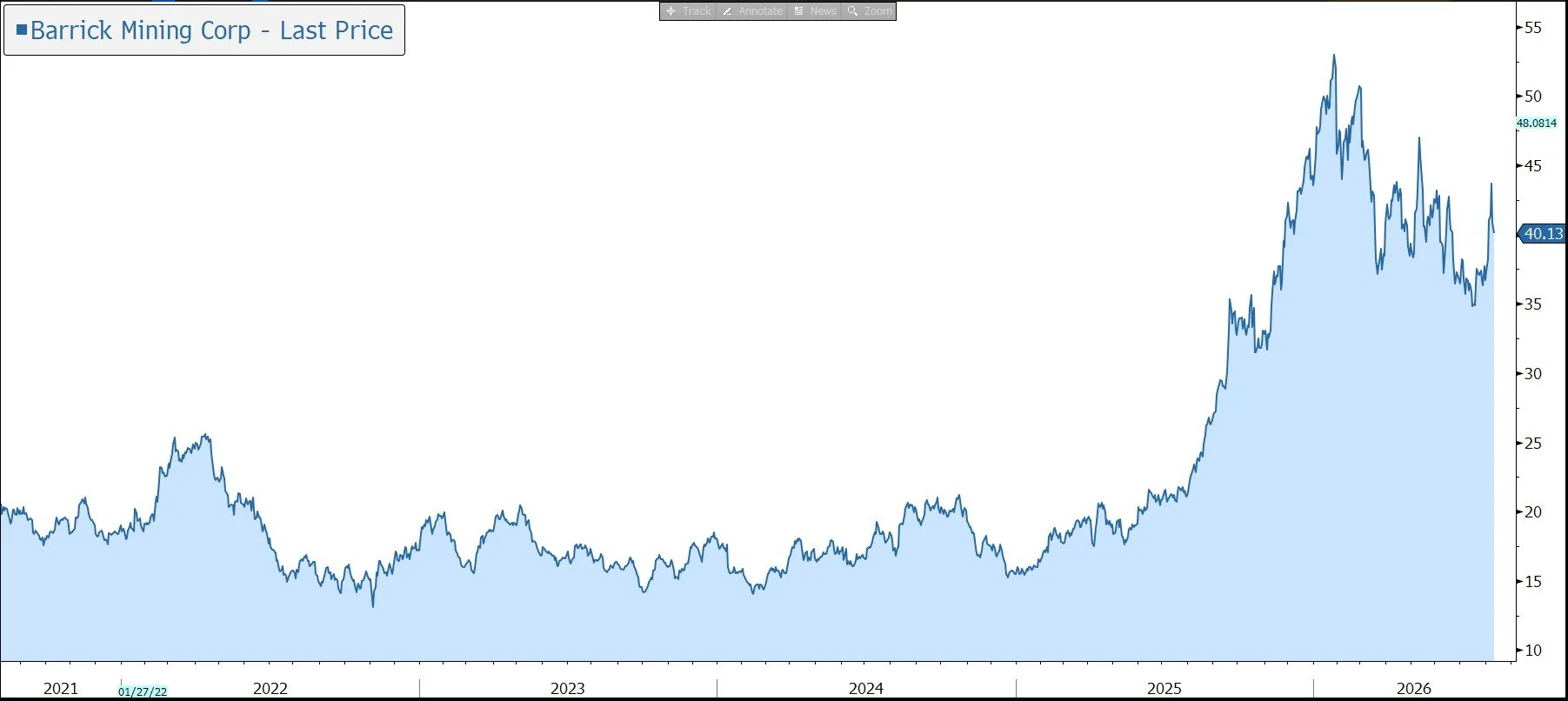
Earlier in the week, Barrick Mining Corporation released Q2 results which were in line with market expectations. Strong year-on-year growth in commodity prices and gold production ahead of guidance helped to offset increased cost pressures. The company continued to make progress on key growth projects and repurchased $1.2bn of its shares. The company settled a dispute with Newmont regrading it Nevada JV. Although this paves the way for the IPO of the North American business, the settlement price was slightly disappointing. In response to this update, the stock fell by 5%.
Barrick Mining Corp. is the world’s second largest gold producer. The company was created following the 2018 merger of Barrick Gold and Randgold Resources. In addition, in 2019, the group improved its portfolio through the formation of the Nevada Gold Mines joint venture with Newmont, providing exposure to the single largest gold-mining complex in the world.
As a result, the group operates mines and projects in 17 countries in North and South America, Africa, Papua New Guinea, and Saudi Arabia. It now owns six of the world’s Top 10 Tier-One gold assets with the largest reserve base among its senior gold peers. At the end of 2025, attributable gold reserves were 85m ounces, with 10-year mine plans based on reserves and geologically understood resource extensions. The group doubled the gold resource at the Fourmile project in Nevada with further increases expected in 2026. Non-core assets are being sold, including the $1bn disposal of its 50% interest in the Donlin Gold Project.
In the second quarter of 2026, Barrick reached an agreement with Newmont to expand the assets in the Nevada Gold Mines JV. Both companies are vending in their excluded properties early, creating a nearly 100m oz gold complex in Nevada. Newmont will pay Barrick a top-up payment of $1.95bn cash. The agreement resolves all outstanding disputes related to NGM.
In order to unlock further shareholder value, the company is undertaking an IPO of its North American gold assets, expected to be completed by the end of 2026. The separate unit will house Barrick’s interests in Nevada Gold Mines, Pueblo Viejo, and its wholly owned Fourmile project in Nevada. Barrick plans to retain a controlling stake in the new entity following the listing. Importantly, as part of the dispute resolution at NGM highlighted above, Newmont has consented to the IPO.
Overall, Barrick provides an attractive way to gain exposure to the gold price, albeit with the operational and political risks that come with a production company. The company is also well positioned to capitalise on global decarbonisation trends driving the long-term fundamental strength of copper with two world-class projects set to deliver into a rising price and demand market.
In the second quarter of 2026, revenue grew by 44% to $5.29bn, a touch above the $5.23bn market forecast. Revenue was 1% higher than the previous quarter. Adjusted net EPS rose by 74% to 82c, in line with the market consensus.
Gold production was down 0.1% to 796k ounces. However, this was above the guidance range of 730k–770k ounces, driven by the ahead-of-schedule ramp-up at Loulo-Gounkoto and a faster-than-expected recovery at Pueblo Viejo.
The gold price has rallied sharply over the last year, driven by global geopolitical and macro-economic uncertainty, exacerbated by the Trump administration, continued central bank bullion buying, and concern over fiat currency debasement. More recently, however, the price has fallen back from its January peak of c. $5,600 an ounce due to the removal of speculative froth and profit-taking since the beginning of the Middle East conflict. During Q2, Barrick realised a gold price of $4,417 an ounce, up 34% on last year, but down 8% versus Q1.
Barrick has the lowest total cash cost position among its senior gold peers – in the latest quarter, all-in sustaining costs were up 11% to $1,866/ounce. This was within guidance despite fuel price pressures.
Group copper production fell by 5% to 56k tonnes in the quarter. The realised price was up 41% to $6.15/pound in the quarter, with all-in sustaining costs up 36% to $3.95/pound.
Group attributable capital investment rose by 36% in Q2 to $978m, with good progress made at Lumwana and Fourmile. This jump explained the 33% fall in attributable free cash flow to $141m. The group lowered its full-year capex guidance to $3.8bn–$4.2bn due to a review of one of the group’s copper projects.
Net cash at 30 June was of $1,245m and the group has no meaningful debt due until 2033. This leaves the group with the flexibility to manage its business and take advantage of new opportunities independent of the vagaries of the capital markets.
The dividend policy targets a total payout of 50% of attributable free cash flow, including a fixed quarterly base dividend of 17.5c per share, plus performance year-end top-up. Barrick also bought back $1.2bn of its own shares in Q2 as part of the $3.0bn programme announce in May.
The company reiterated its guidance for 2026: Gold production expected to increase sequentially throughout the year, while copper production will step up in the second half.
Full year production (2.90m-3.25m ounces) and cost guidance ($1,760-$1,950 an ounce) remains unchanged. Copper guidance – production of 190kt–220kt and all-in sustaining costs of $3.45-$3.75 a pound – also remains unchanged. For 2026, the group is assuming an average gold price of $4,500/ounce in 2026 – it is currently $4,400/ounce. A $100/ounce move has a $450m impact on cash flow. The group is assuming an average copper price of $5.50/pound – it is currently $6.62/pound – and discloses that a 25c/pound move has a $120m impact on cash flow.
Source: Bloomberg
