
Morning Note: Market News and an Update on Copper and Antofagasta.
Market News
US inflation for July was in line with market expectations, with CPI at 3.4% and the core figure, which strips out food and energy, up 2.5%. Markets now see around a 40% chance of a 25 basis point rate hike from the Federal Reserve in September, down from nearly 50% a day earlier. Gold initially rallied but has drifted back to $4,375 an ounce this morning, while the 10-year Treasury is now yielding 4.68%.
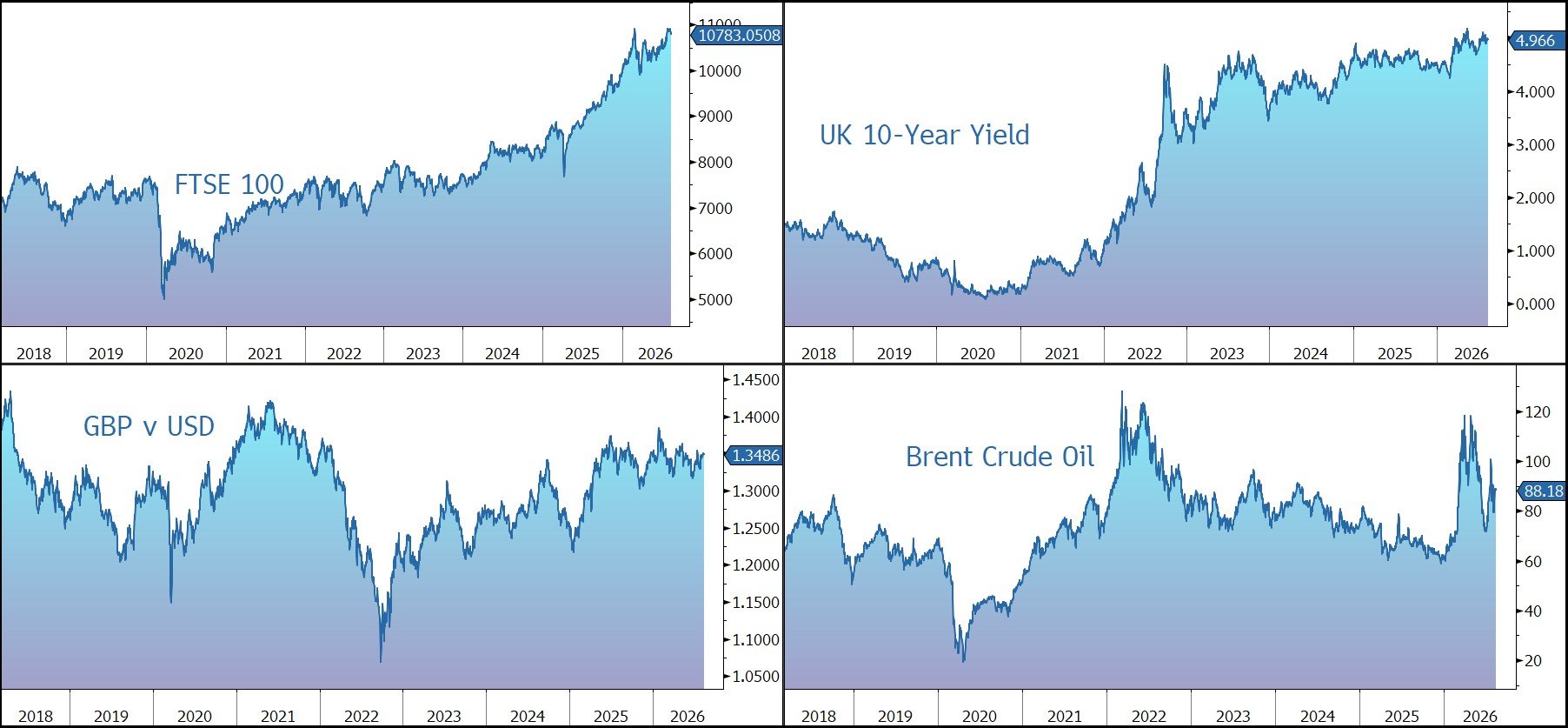
Donald Trump is reviving his ‘maximum pressure’ playbook against Iran, turning to sanctions and an oil blockade despite the approach falling short before 2020. Brent crude fell to $87.50 a barrel after a six-day rally.
US equities traded higher last night – S&P 500 (+0.3%); Nasdaq (+0.5%). Lenovo surged as much as 22% to a record after quarterly revenue jumped 43%, beating estimates on strong AI-driven demand.
Tech shares led gains in Asia, pushing the Kospi (+3.6%) into a bull market: Nikkei 225 (+1.2%); Hang Seng (-0.3%); Shanghai Composite (-0.5%). The yen gained after Japan’s government is said to support a near-term Bank of Japan rate hike.
The FTSE 100 is currently 0.5% lower at 10,783. Companies trading ex-dividend today include BP (1.22%), GSK (0.88%), HSBC (0.48%), LSE (0.62%), Melrose (0.55%), NatWest (1.69%), Pearson (0.67%), Rio Tinto (2.08%), Shell (0.88%), and Tritax Big Box (1.22%).
Sterling trades at $1.3485 and €1.1695. UK GDP rose 0.4% in the second quarter, weathering the initial Iran-war shock.
Source: Bloomberg
Commodity Update
Copper is an amazing metal: it is corrosion resistant, extremely malleable, and an exceptional conductor of heat and electricity, making it a key input for a wide range of technologies including power generation and transmission, motor vehicles, domestic appliances, and industrial machinery. Demand is forecast to grow by between 2% and 3% per annum through to 2030, driven by:
- emerging markets – urbanisation and industrialisation in India and Southeast Asian countries are expected to dominate copper consumption growth as the rate of Chinese demand growth begins to slow. A growing middle class in emerging economies is also boosting sales of copper-rich consumer goods such as electronic devices and cars.
- the expansion, modernisation, and maintenance of traditional electric power grids and regional transmission networks remain the single largest absolute consumer of global copper.
- renewable energy – needed to tackle global warming. Solar and wind technologies need four to six times as much copper as conventional energy mainly owing to the need to connect larger numbers of smaller units to the grid.
- electric vehicles – take-up is being driven by stricter environmental standards to restrict emissions and reduce air pollution. Electric vehicles contain on average around three times the amount of copper as conventional ones owing to their use in batteries, high-voltage wiring, windings, and rotors. Charging stations will also boost demand.
- AI – the sharp increase in demand for computing power is significantly impacting electricity consumption, particularly in data centres which will require robust power systems, efficient cooling, and high-speed connectivity.
At the same time, the outlook for supply is uncertain. The world’s largest copper mines have all been in production for decades and are in decline. There is plenty of copper ore, but it is of lower grade which means it is more expensive to mine. In addition, new discoveries of copper are declining – most of the good stuff has already been found. In recent years, only a handful of mines have come into production. Furthermore, the industry is increasingly being forced to take on technically complex projects in countries where foreign ownership and exploitation of natural resources are highly sensitive issues. As a result, bringing a newly discovered greenfield copper deposit into commercial production currently averages 15 years due to regulatory, environmental, and permitting delays. Supply is also being undermined by past and ongoing reductions in maintenance activity and sustaining capital expenditure. Finally, inflation has pushed up costs throughout the supply chain, so that a higher copper price is needed to incentivise production.
Although we believe the long-term outlook for the copper price is positive, we expect periods of volatility and price weakness driven by uncertainty over economic growth, particularly in China, and global interest rate expectations.
That said, copper prices are trading at or very close to all-time record highs. The rally has been helped by tightening physical supply outside the US and caution about potential US import tariffs on copper, which have continued to divert metal away from international markets and into US warehouses.
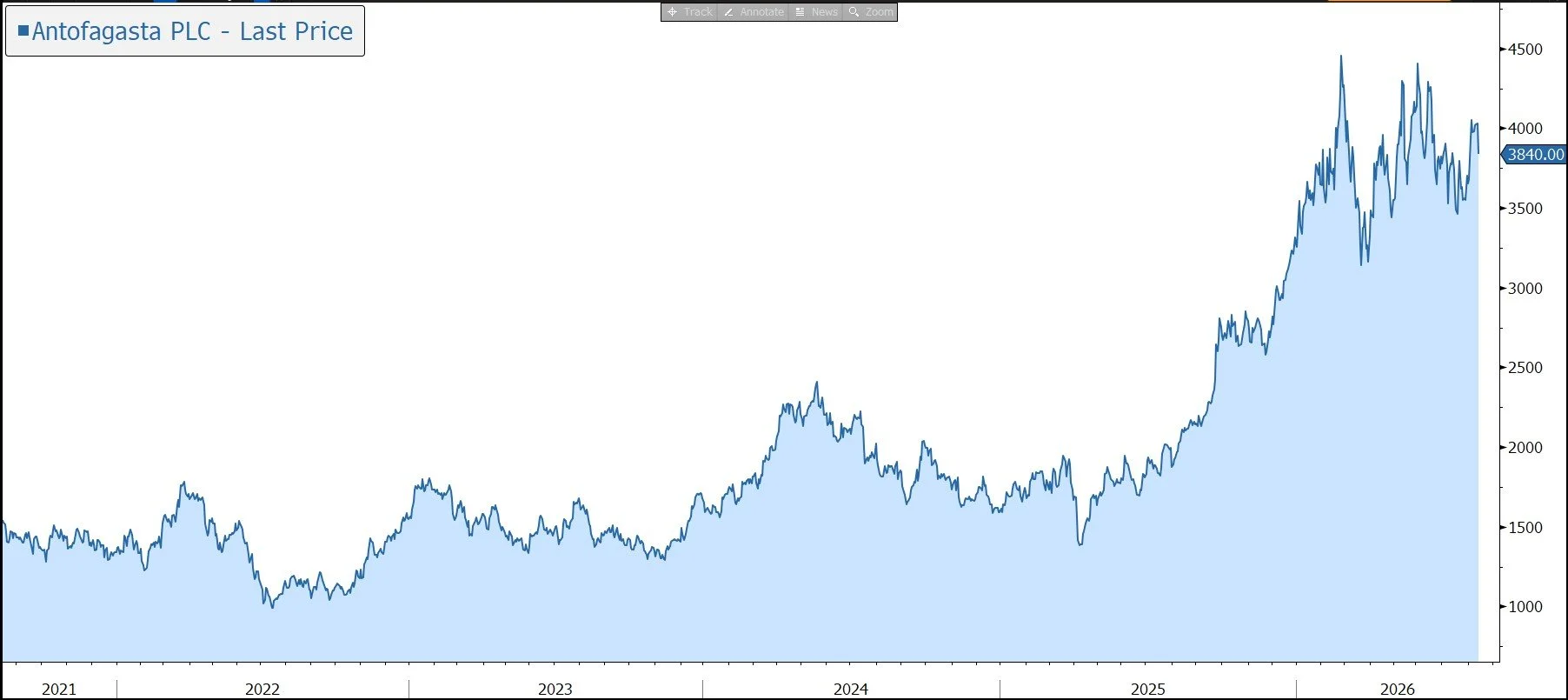
This morning, Antofagasta released results for the first half of 2026 which were slightly below market expectations. A 27% increase in earnings was driven by higher prices, offset partly by lower production. The cost savings plan remains on track, cash flow was strong, and the dividend was raised by 81%. Production guidance for the full year was lowered in response to July’s mine shutdown. In response the shares are down 5% in early trading.
Antofagasta is a FTSE-100 listed mining company based in Chile focused on copper and its by-products including gold. The company has a significant mineral resource base of more than 21bn tonnes of resources, including more than 6bn tonnes and 5bn tonnes at Los Pelambres and Centinela respectively. The target is to increases output by 30% over the medium-term. The shares provides a way to gain exposure to the copper price, albeit with the operational and political risks involved with the exploration and production.
These risks were illustrated by extraordinarily severe weather conditions in Chile this year which led to the shutdown of its Los Pelambres mine. As previously disclosed on 24 July, Los Pelambres has resumed operations following an orderly shutdown. Mining and processing activities have continued to gradually increase, with the level of mine movement ramping up as conditions permit. While there has been no material impact on key equipment and infrastructure, detailed inspections have identified the need for repairs to certain pipeline platforms and water management systems.
In the six months to 30 June, copper production was 314,900 tonnes, 9% lower than last year, principally driven by lower output at Los Pelambres and Centinela. The average realised copper price rose by 36% to $6.19/lb.
Gold production rose by 2% to 92,800 ounces, reflecting higher output at Centinela Concentrates partially offset by lower output at Los Pelambres. The average realised gold price was up 46% to $4,772/oz.
As inflationary pressures continue to persist across the mining industry, Antofagasta remains focused on its supply chains to ensure security of sourcing, disciplined cost control, operational excellence and project execution, in addition to the significant benefit provided through by-product credits. During H1 2026, net cash costs were 8% lower on a year-on-year basis at $1.22/lb, following stronger by-product credits and disciplined cost control, with the main offsetting factor being lower production at both Los Pelambres and Centinela, in addition to higher input costs and the settlement of a three-year labour agreement at Centinela.
The group’s Competitiveness Programme generated savings and productivity improvements of $67m, 74% from operational efficiencies and throughput run time and 26% from contract management. This leaves the group on track to deliver $110m of savings in the full year and is equivalent to more than 7c/lb of unit cash costs.
EBITDA increased by 27% to $2.84bn, with margins up five percentage points to 63.4%, at the top end of global pure-play copper producers and the highest level achieved since 2021.
Capital expenditure rose by 3% to $1,620m, as the group’s major growth projects continue to advance towards the completion of commissioning next year. Full-year guidance of $3.4bn has been confirmed.
Cash flow from operations remains strong, up 53% to $2.8bn, helped by a decrease in working capital in relation to lower receivables and higher payables. The group’s balance sheet is very robust, with a net debt to EBITDA ratio at the end of the period of only 0.68x.
In line with its policy to pay out 35% of earnings as dividends, the company has today declared an interim dividend of 30.1c, 81% higher than last year, reflecting management’s confidence in the business.
Given the events in Chile, full-year production is now expected to be in the range of 625,000-655,000 tonnes, versus 650,000-700,000 tonnes previously. Cash cost guidance, both before and after by-product credits, is $2.40-2.60/lb and $1.15-1.35/lb respectively.
Source: Bloomberg
