
Morning Note: Market News and an Update from IHG.
Market News
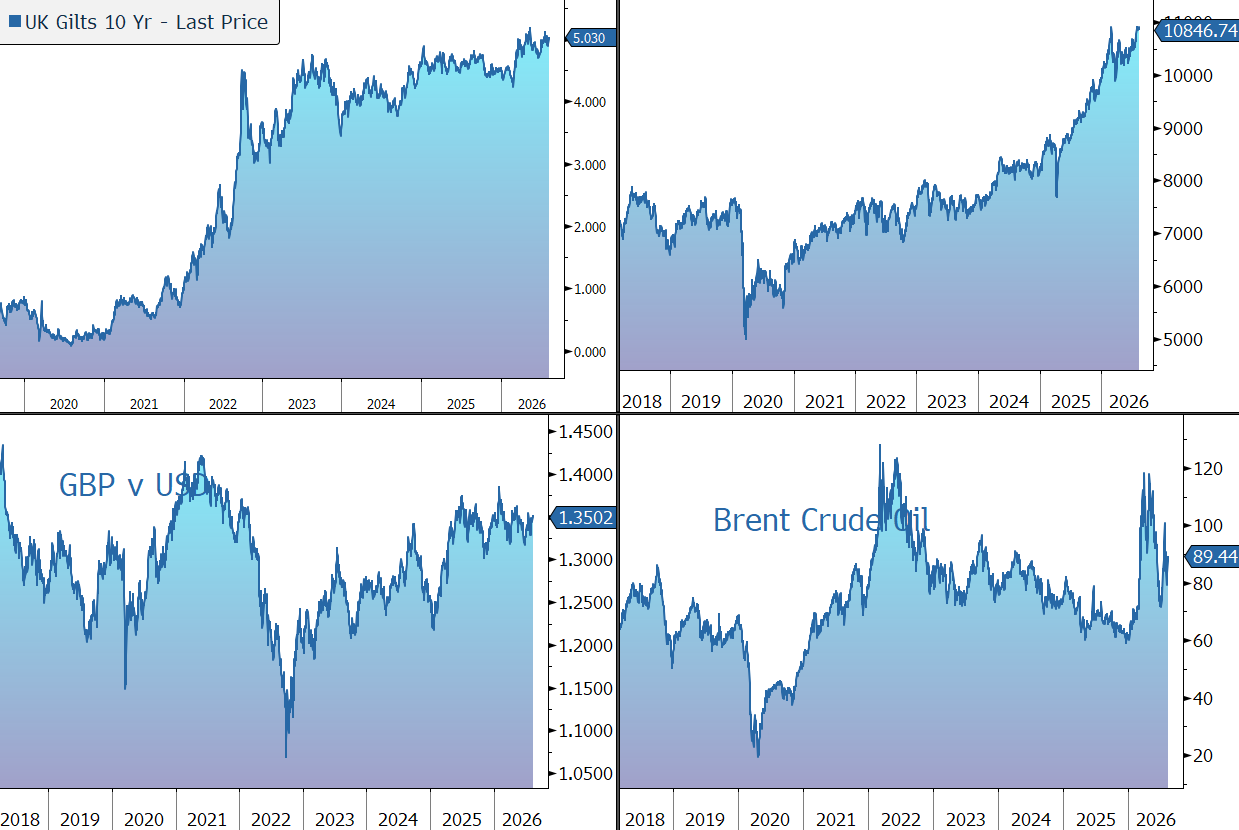
Brent crude climbed to $89 a barrel, rising for the fourth straight session amid heightened uncertainty over a potential deal between the US and Iran to end the war and reopen the Strait of Hormuz. President Trump issued sweeping new demands on Iran, including compensation for people the Islamic Republic has killed in conflicts, after Tehran reiterated calls for reparations as part of negotiations to wind down the conflict. The demands have clouded prospects for a near-term agreement, keeping markets wary of prolonged supply disruptions.
After a strong run, gold lost some momentum and currently trades at $4,365 an ounce. The yellow metal had climbed to a two-month high as Chinese institutional investors continued to build bullion positions as a hedge against volatility across other markets, while gold-backed exchange-traded funds in China posted their longest run of inflows in months. China’s central bank also stepped up gold purchases last month.
US equities drifted lower last night: S&P 500 (-0.1%); Nasdaq (-0.3%). Nvidia secured a $500bn commitment from six Wall Street firms — including Apollo, Goldman and BlackRock — to create dedicated funds for AI infrastructure financing. Nvidia shares fell by 3% as investors digested potential execution risk and circular financing concerns.
In Asia this morning, equity markets were mixed: Hang Seng (-1.0%); Shanghai Composite (-0.8%); Kospi (+0.7%). Nikkei 225 (closed).
The FTSE 100 is currently little changed at 10,847. Sterling trades at $1.3505 and €1.1710, while the 10-year Gilt yield moved back above 5%. UK retail sales rose an annual 1.3% in July, half the pace recorded a year earlier and slower than the 12-month average, BRC data showed, as consumers stayed at home during the heat wave.
Source: Bloomberg
Company News
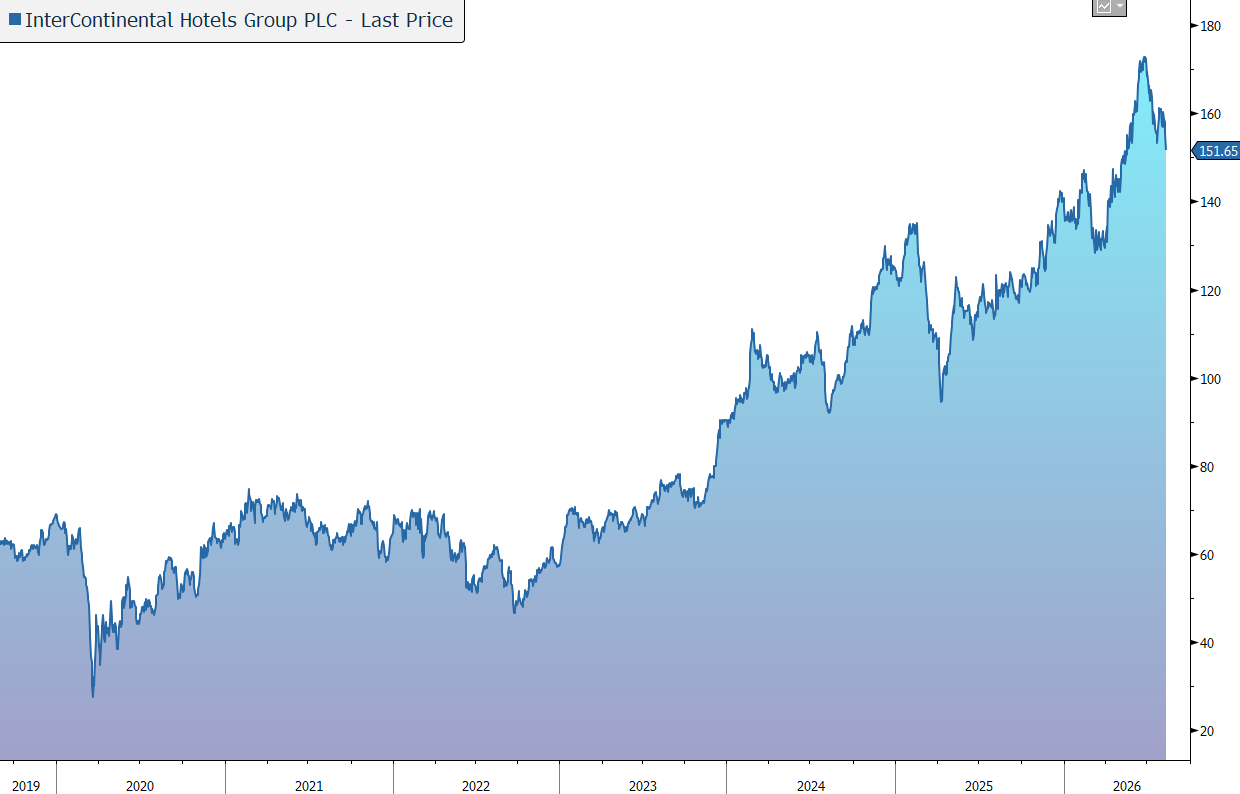
InterContinental Hotels Group (IHG) has released robust H1 2026 results. Trading in the US accelerated in the second quarter, growth in Greater China continued, and a good performance elsewhere in the EMEAA region helped offset challenges in the Middle East. Room growth momentum has continued, with underlying signings and openings ahead of last year. The share buyback programme is ongoing and the dividend was raised by 10%. Despite the geopolitical headwinds, the company remains on track to meet full-year consensus profit and earnings expectations. Ahead of the analysts’ meeting, the shares are down 2%.
IHG owns a portfolio of 21 attractive brands across all price tiers (including Crowne Plaza, InterContinental, Holiday Inn, and Six Senses) and has a strong operating system, both of which drive customer loyalty and pricing power. The group operates a highly scalable, asset-light model, based on franchising and management contracts, with low capital intensity and high returns. The model also means the group doesn’t own hotels or bear the operational costs of running them. The company is focused on delivering industry-leading net rooms growth over the medium term. It currently has a 4% global market share and a 10% share of the new room pipeline. At the end of June 2026, the global estate was just over a million rooms across 7,109 hotels, with 65% in midscale segments and 35% in upscale and luxury. Annual gross revenue generated by the group’s hotels is more than $35bn.
Long-term growth is being driven by a rising global middle class with a desire to travel – Oxford Economics forecasts this cohort to nearly double in size to over 670m households by 2035, with China accounting for almost half of the growth. Global leading hotel brands are expected to continue the long-term trend of taking market share. In periods when developers are adding less new supply, revenue growth from existing room inventory is expected to be stronger, as are conversion opportunities, which IHG has proven highly successful at capturing.
The group’s medium- to long-term financial framework targets:
· high single-digit growth (i.e. 7%-9%) in fee revenue, through a combination of growth in RevPAR (revenue per available room, the key measure of industry performance), system size, and ancillary revenue. In addition, the company expects 100-150 basis points of fee margin expansion annually on average. This excludes the positive margin impact of the credit card business.
· 100% conversion of adjusted earnings into adjusted free cash flow, supporting investment in the business to optimise growth, sustainably growing the ordinary dividend and returning surplus capital.
· 12-15% adjusted EPS compound annual growth rate, including the assumption of ongoing share buybacks.
From the start of 2026, the trading currency of the group’s shares on the LSE changed from Sterling to US dollars. The move does not affect the nominal currency of the shares, which remains in Sterling, nor does it impact IHG’s London listing or its New York ADR listing. Shareholders based in the UK will continue to receive dividend payments in Sterling. The company’s aim is to better align its share price with its financial performance – the company already reports its results in US dollars – and simplify investment appraisal.
In the first half of 2026, the company delivered a better-than-expected demand in most markets around the world. This resilience has been helped by a heavy weighting to domestic and intra-regional travel.
Global revenue per available room (RevPAR) grew by 4.1%. Growth in occupancy – up 1.0 percentage points – was supplemented by an increase in pricing, with average daily rate up 2.5%. As expected, Q2 (+3.5%) saw a slowdown compared to Q1 (+4.4%).
By sector, global rooms revenue on a comparable basis in H1 was strongest in Groups (+6%) and Leisure (+3%), with Business (+2%) lagging.
By region:
· In Americas (the group’s largest division), RevPAR was up 4.8%. The US (+4.5%) saw an acceleration in the second quarter to 5.2% as a result of a stronger economy, easing year-on-year comparatives, and the World Cup. Overall, the Americas saw a 1.0% benefit from the tournament in Q2 and is expected to see a further, lesser positive impact benefit in July, and a 0.4% full-year benefit.
· The diverse EMEAA region grew by 3.0% (slowing to 0.6% in Q2) due to the conflict in the Middle East. This sub-region, which represents 19% of EMEAA’s system size but just 5% of IHG globally, declined 2% in Q1, then 19% in Q2. We note the majority is in Saudi Arabia which has a big domestic market. In terms of the Middle East pipeline, 90% is in currently ‘safer’ countries: Egypt, Turkey, and Saudi Arabia.
· Greater China RevPAR rose by 3.1%, driven by resort locations in Tier 4 cities and strong growth in Taiwan and Hong Kong. The second quarter slowed to 0.8% due to the impact of public holiday timings.
First-half revenue was $1,255m, up 6% in underlying terms, with fee revenue also up 6% to $971m. Partnership and ancillary revenues are a growing source of earnings (e.g. co-brand cards and points monetisation). The IHG loyalty programme remains a key advantage, accounting for two thirds of global room nights and supported by over 160m members. The company says that members spend more and are 10x more likely to book directly.
Operating profit grew by 10% in underlying terms to $665m, helped in part by the impact of $5m insurance-related expense on a fire‑damaged leased hotel. Fee margins rose by 120 basis points from 64.7% to 65.9%, as revenue growth exceeded cost growth by three percentage points. For the full year, the fee business cost base is still anticipated to increase within the range of 1%-3%. Adjusted EPS grew by 13% to 274.7c, spurred on by the reduced number of shares following the buyback (see below).
IHG continued to open new hotels and sign more rooms into its pipeline as owner demand for its world class brands continues to increase. In H1 2026, a record 31.5k rooms across 197 hotels were opened, up 8% year-on-year.
Gross system growth was 6.5% year-on-year, while after removals, net system size growth was 5.0% year-on-year (and 2.2% YTD). Demand for quick-to-market conversions to IHG’s brands continues to be high, representing 43% of openings and half of signings in the half-year. This is a big positive given the time to open is much shorter than with a new build. Note that accelerating system growth is creating near-term fee drag as hotels ramp up over 1-3 years.
IHG signed 49.2k rooms (352 hotels) in the first half, up 8%, in underlying terms excluding the acquisition of Ruby, a premium urban lifestyle brand. This included the first signing for the new Premium brand Noted Collection in EMEAA and the arrival of the Essentials conversion brand Garner into Greater China. This leaves a global pipeline of 348k rooms (2,385 hotels), up 3% year-on-year, and 33% of the current system size, providing good growth visibility. Around 50% of the global pipeline is under construction.
The asset-light model means IHG has low investment requirements and a negative working capital cycle. The group operates a conservatively leveraged business model and maintains strong liquidity. During H1 2026, adjusted free cash flow rose by 19% to $360m. Net debt rose from $3.3bn to $3.7bn, mainly due to shareholder returns, M&A, and adverse currency movements. Gearing at the end of June was 2.63x net debt to EBITDA, in the middle of its 2.5x-3.0x target range.
The group is returning surplus capital through share buybacks. The current $950m programme is expected to be completed by the end of 2026, with 42% repurchased by 30 June. In addition, the company has today declared an interim dividend of 64.5c, 10% higher than last year. In total, the company expects to return more than $1.2bn to shareholders in 2026, amounting to 5% of the current market cap.
Looking ahead, while there are ongoing impacts from the Middle East conflict, including some wider disruption to international travel flows, the company continues to expect these to be fully offset by growth in demand elsewhere. As a result, the company remains on track to meet full-year consensus profit and earnings expectations. Management is also confident in the successful delivery of the group’s growth algorithm, which is driven by the strength of IHG’s enterprise platform and its ability to further capitalise on its scale, leading positions and the attractive long-term demand drivers for its markets.
Source: Bloomberg
