
Morning Note: Market News and an Update from ASML.
Market News
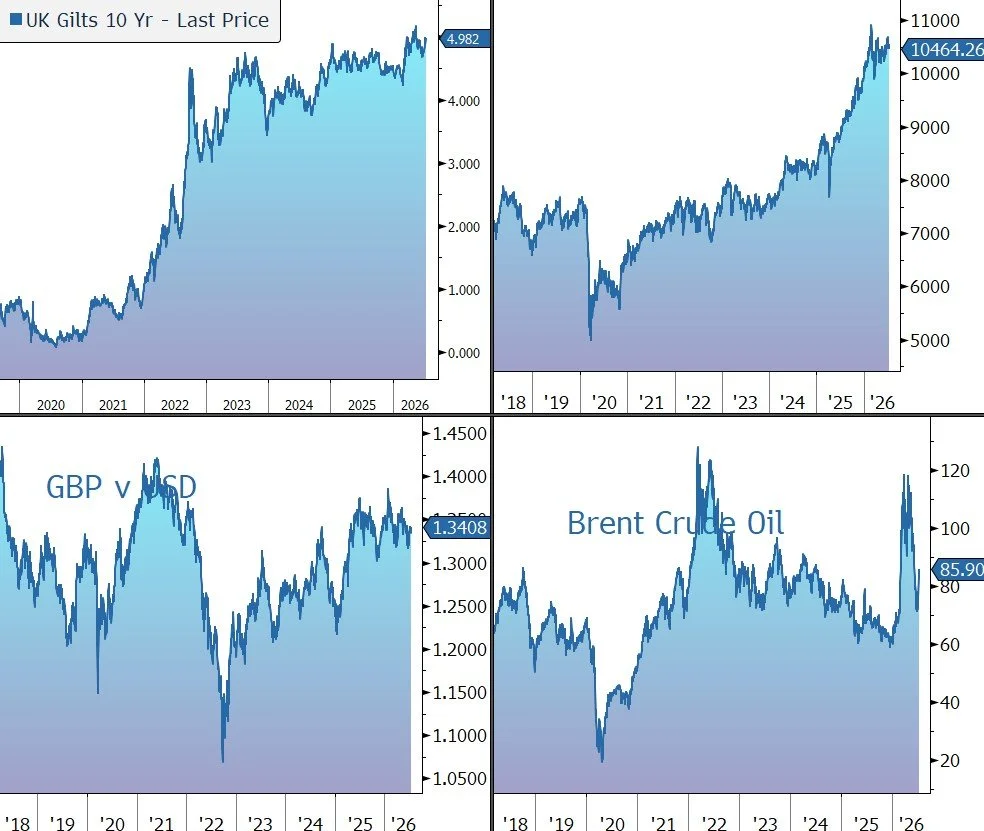
Investors scaled back expectations for US interest rate hikes following the release of weaker-than-expected inflation data. Annual inflation eased to 3.5% in June, while core inflation slowed to 2.6%, both below forecasts. Despite the slowdown, inflation remains well above the Fed’s target. Investors now await Fed Chair Kevin Warsh’s first congressional testimony for signals on the policy outlook. Money markets still assign more than a 50% chance of a rate hike by the end of the quarter, with expectations supported by renewed geopolitical tensions. Gold rose before falling back to $4,025 an ounce, while the yield on the US 10-year Treasury slipped to 4.59%.
The US hit dozens of military targets near the Strait of Hormuz and the Iranian coast as tensions simmer over the shipping passage. Donald Trump has discussed a wider scope of strikes on Iran, Axios reported. The US president told Fox News that Washington would hit power plants and bridges next week unless Tehran comes to the negotiating table. Brent crude trades at $86 a barrel.
US equities moved higher last night – S&P 500 (+0.4%); Nasdaq (+0.9%) – boosted by the financial sector. Bank earnings powered ahead in the second quarter with a strong lift from fees for advising on mergers and acquisitions and surging trading revenue, but the lenders warned about risks to the economy and markets. In contrast, IBM fell 25% after announcing preliminary Q2 revenue below analyst estimates.
In Asia this morning markets were also strong: Nikkei 225 (+1.5%); Hang Seng (+1.3%); Kospi (+6.2%). China’s GDP grew 4.3% on year in the second quarter, unexpectedly falling below the government’s official target range of 4.5% to 5%, marking the weakest growth in more than three years.
The FTSE 100 is currently 0.6% lower at 10,464, while Sterling trades at $1.3410 and €1.1735. Incoming UK PM Andy Burnham’s advisers disagree over who he should appoint as Chancellor, people familiar said. Bank of England Governor Andrew Bailey said Britain needs to prioritise economic growth and maintain fiscal discipline, in a thinly veiled warning to the incoming PM.
Source: Bloomberg
Company News
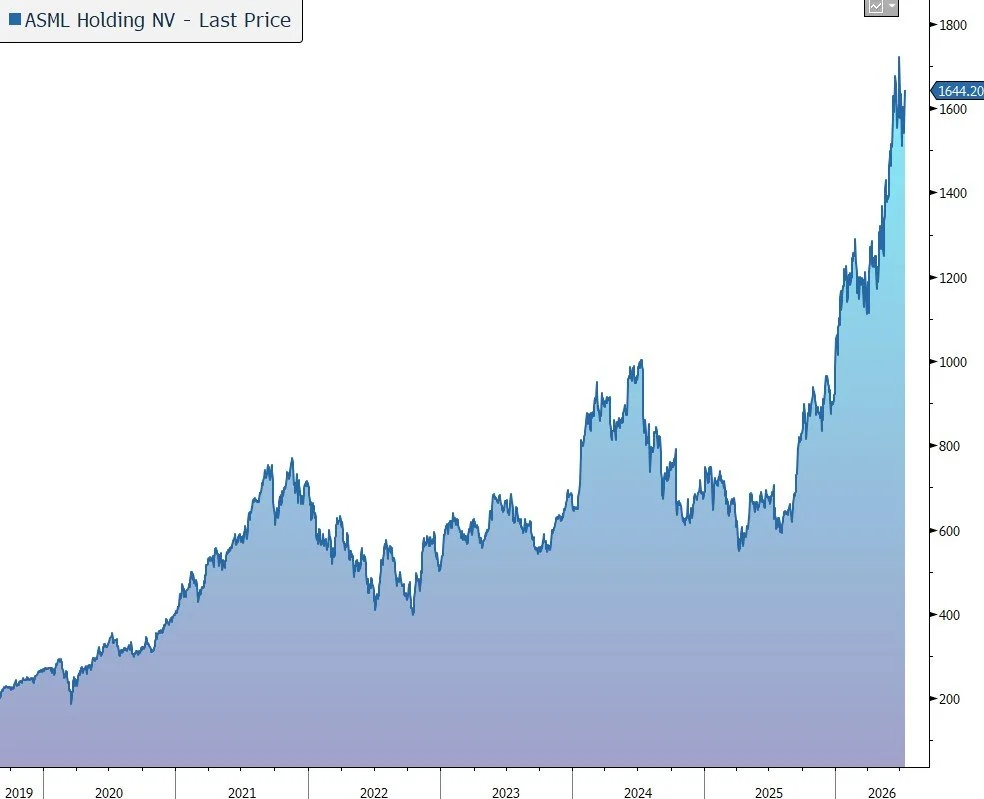
ASML has released Q2 2026 results which were better than market expectations, driven by ongoing AI-related investments and continued progress in AI technologies. Guidance for the full year has been raised and the company has increased its long-term production capacity targets. In response, the shares, which are listed in Amsterdam and on NASDAQ, are trading up 6% this morning.
ASML is a Dutch company that manufactures complex lithography systems critical to the production of semiconductors (or microchips). The systems allow light to be projected through patterns to make blueprints for manufacture of chips, without which semiconductor producers would not be able to develop the next generation of chips.
As the only global supplier of the latest generation of lithography machines, ASML is in a critical position in the production of new chips, which are key in all efficient electronic-based processes. Without ASML’s lithography, it would be near impossible to deliver increasing compute power on decreasing chip sizes at the pace required to meet ever expanding demand for connected devices. As a result, the company is well placed to benefit from structural disruptive trends such as AI, climate change, Internet of Things, and big data.
The company benefits from strong growth dynamics, while its near-monopolistic position drives high gross margins (50%+) and returns (20%+). The group aims to pay an annual dividend that will grow over time – the 2025 payout was increased by 17%. After paying dividends, ASML uses remaining free cash flow for share buybacks and is currently undertaking a programme of up to €12bn to be executed by the end of 2028.
The company provides chipmakers with everything they need – hardware, software and services – to mass produce patterns on silicon through lithography. Based on different market and lithography intensity scenarios, as presented at its last Investor Day, the company sees an opportunity to achieve 2030 annual revenue between €44bn and €60bn with a gross margin between 56% and 60%.
The company highlights that the semiconductor industry remains strong, driven by AI adoption across an expanding applications space. However, the industry will require major innovations to address AI power consumption and cost challenges. The company anticipates that an increased number of critical lithography exposures for advanced logic and memory processes will be required. ASML has announced it will host its next Capital Markets Day in June 2027, at which it will update its longer-term views, to reflect the market and technology dynamics since the 2024 event.
Back to today’s update. In Q2 2026, the company grew sales by 21% to €9.3bn, above the upper end of the company guidance of €8.4bn-€9.0bn and above the consensus expectation of €8.9bn. This was made up of New System sales of €6.5bn and Installed Base Management sales (i.e. net service and field option sales) of €2.8bn. The number of new and used lithography systems sold was 86 and 5, respectively.
The gross margin rose from 53.7% to 54.0%, above the top-end of the company’s guidance of 51%-53%. Net income rose by 29% to €2.9bn, while EPS grew by 28% to €7.58, well above the market expectation of €7.01.
ASML has a strong balance sheet, with quarter-end cash and cash equivalents and short-term investments of €7.6bn. In the second quarter, the company purchased around €1.1bn worth of shares under the current 2026–2028 programme.
In the near term, sales in the current quarter are expected to be between €11bn and €12bn, with a gross margin between 55% and 57%. For the full year, the company now expects 2026 total net sales of €43bn-€45bn, with a gross margin of 54%-56%.
Looking to the second half of 2026, ongoing AI-related investments and continued progress in AI technologies are driving demand for advanced Logic and Memory chips, further strengthening the semiconductor industry’s growth outlook. ASML’s customers, in turn, continue to accelerate their capacity expansion plans. This is translating into customer commitments across the group’s product portfolio, providing ASML with increased visibility into longer-term demand. Based on this momentum, the company is planning to add 30% to its 2026 NXE capacity of around 65 for 2027 and is investigating whether to increase capacity with another 30% for 2028.
Source: Bloomberg
