
Morning Note: Financial Market News and an Update from Spirax Group.
Market News
Donald Trump predicted the war with Iran would resolve “very soon,” even as he vowed not to stop “until the enemy is totally and decisively defeated.” The president said he didn’t believe the conflict would be over this week. He said he’s also weighing waivers for some oil sanctions and that the operation was ahead of schedule. Bottlenecks could be seen at the Strait of Hormuz, where ship clusters indicated elevated electronic interference.
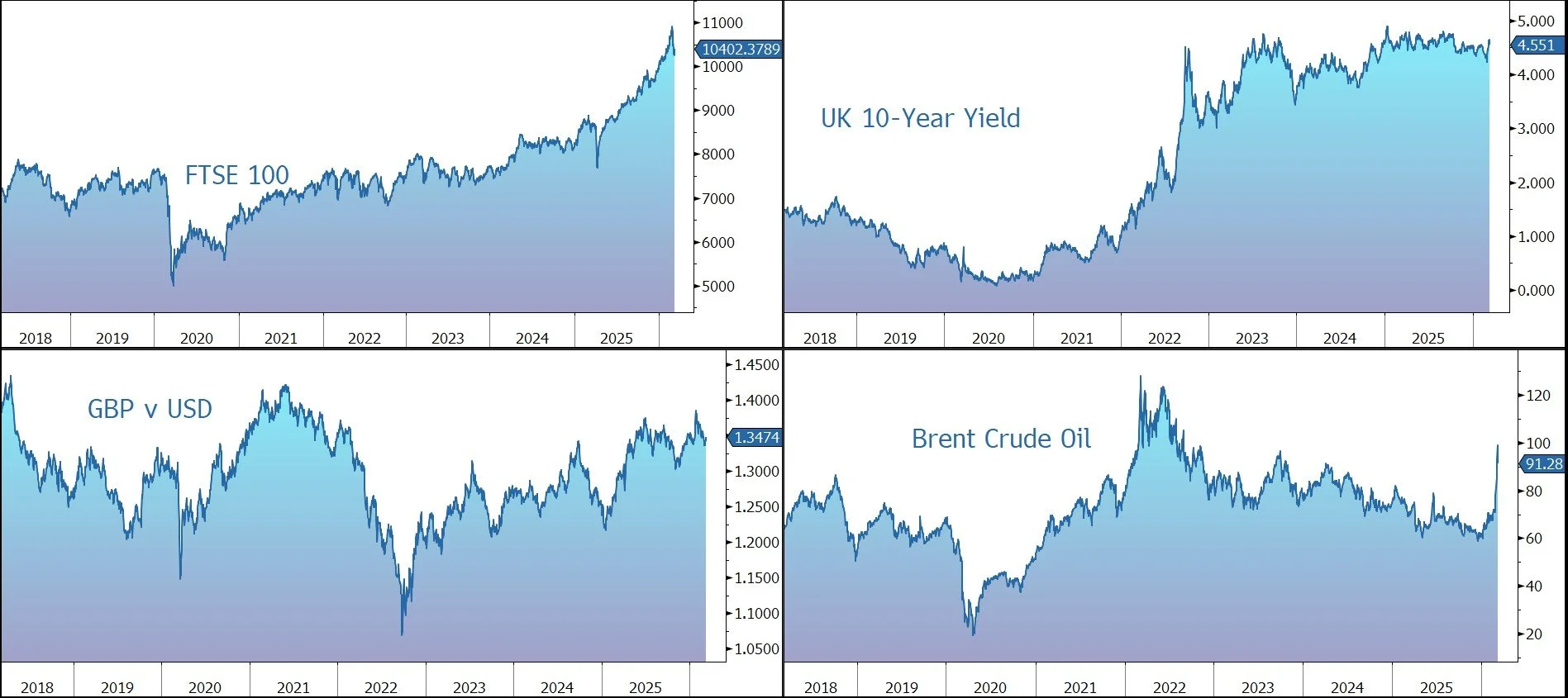
After a day of extreme volatility which saw the oil price rise to $119 a barrel, Brent Crude has fallen back towards $86 a barrel.
Equity markets have reacted positively. In the US last night both the main indices traded higher – S&P 500 (+0.8%); Nasdaq (+1.4%) – and are expected to show further gains at the open this afternoon. Gains were enjoyed in Asia this morning; Nikkei 225 (+2.9%, and a further 2% after-hours); Hang Seng (+2.1%); Shanghai Composite (+0.7%). The FTSE 100 is currently 1.5% higher at 10,402.
The bond market has steadied after its recent loss – the 10-year Treasury yields 4.09% (having hit 4.21% yesterday), while 10-year Gilts yield 4.49% (down from 4.75%). However, both remain well above the levels from before the Iran War began. Gold has moved back up towards $5,200 an ounce.
Sterling trades at $1.3470 and €1.1550. UK consumer sentiment dropped to a 4-month low in March, reversing gains made at the start of the year, Barclays said. The BRC said British retail sales grew modestly in February.
Source: Bloomberg
Company News
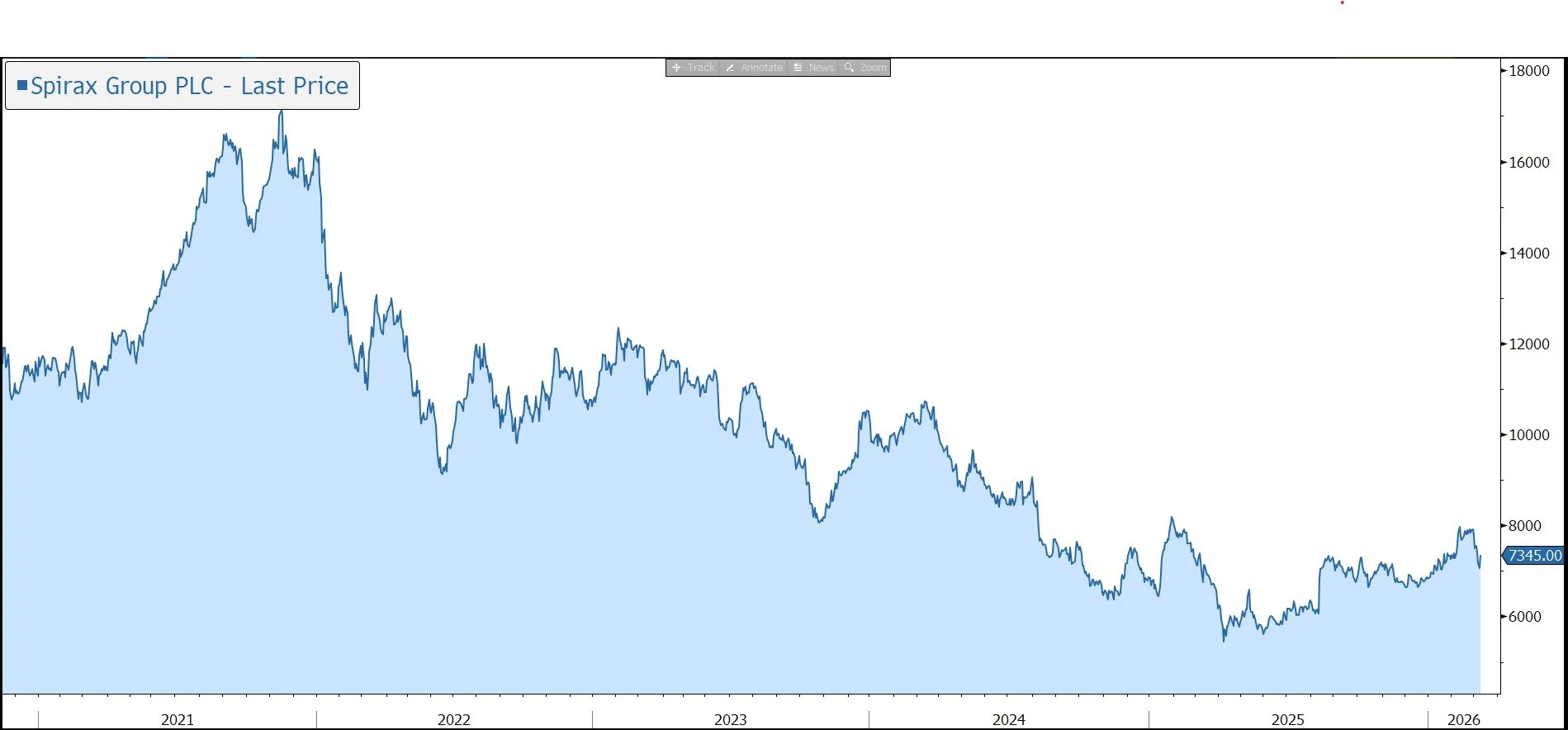
Spirax Group has released its full-year 2025 results. Despite the challenging macroeconomic environment, the company generated good organic sales growth and operating profit ahead of market expectations. This highlights the company’s good operational leverage. Guidance for 2026 was initiated and the dividend was raised by 3%. In response, the shares are up 4% in early trading.
Spirax (formerly Spirax-Sarco Engineering) is a UK-listed industrial company, with annual sales of £1.7bn. The group is a world leader in each of its three businesses. In Steam Thermal Solutions (50% of revenue), Spirax Sarco and Gestra are leaders in the control and management of steam. In Electric Thermal Solutions (26%), Chromalox and Thermocoax provide electrical process heating and temperature management solutions. Finally, Watson-Marlow Fluid Technology (24%) provides niche peristaltic pumps and associated fluid path technologies.
The group’s products are used in almost every industry worldwide: from the food sector where steam products are used in blanching, baking, packaging, and cleaning; to the pharmaceutical industry where pumps and associated fluid path equipment are critical to the production of life-saving medicines; through to the aviation industry where electrical heating elements are used in the de-icing of aeroplanes.
85% of revenue is generated from maintenance and operational (opex) budgets rather than capital (capex) budgets. Of that 85%, 50% comes from essential repair and maintenance activities, while 35% comes from small projects that improve existing systems. As a result, the group has a long history of stable, sustainable growth and strong profitability.
However, in response to a weaker macroeconomic environment, the group took early action across all three businesses to appropriately right-size capacity and overhead support costs, as well as implementing temporary cost containment actions and reducing variable compensation. The company has now completed its restructuring programme and realised annualised savings of £40m, with half delivered in 2025. Most of this will be reinvested in organic growth initiatives.
In 2025, the group continued to face a challenging macroeconomic environment. Global Industrial Production growth (IP) of 2.1%, or 1.7% excluding China, was lower than had been forecast at the beginning of the year and remained weak throughout the year in the group’s key markets. As expected, trading conditions in China reflected customers’ reduced expenditure on large projects. In Korea, political instability early in the year led to capital investment decisions being temporarily deferred.
In 2025, revenue grew by 2% to £1,703m, adversely impacted by currency movements of 3%. In organic terms, growth was 5% and well ahead of global IP of 2.1%.
All three Businesses delivered organic sales growth and higher adjusted operating profit margins.
Within the Steam Thermal Solutions business, sales were up 1% in organic terms, with good growth in MRO (Maintenance, Repair, and Overhaul) and solution-sales offset by anticipated weakness in large projects, particularly in China and Korea which are more exposed to customers’ capital spending than other regions. However, as expected, the weakness in large project demand in China and Korea moderated through the year. Excluding the latter impact, growth was 3%.
Sales in the Electric Thermal Solutions business were up 11% organically, driven by further operational progress and improved demand from Wafer Fabrication Equipment manufacturers (Semicon).
Watson-Marlow organic sales grew by 6%, supported by growth in Process Industries and an expected recovery in Pharmaceutical & Biotechnology (Biopharm) customers.
The group’s adjusted operating profit margin rose by 30 basis points in organic terms to 20.0% with cost inflation and tariff impacts offset by efficiency savings and continued pricing discipline. As a result, adjusted operating profit grew by 6% in organic terms to £340m, ahead of the market forecast of £332m.
The group is financially robust, with adjusted cash conversion rising from 87% to 89%, reflecting capital discipline and working capital efficiency. During 2025, net debt fell from £596m to £565m, with gearing down to 1.5x net debt to EBITDA, at the upper end of the target range. The group has a strong track record of dividend growth, with 58 years of progress. A full-year payout of 170p has been declared, up 3%, equal to a yield of 2.5%.
Looking ahead, while IP forecasts have been revised down for the remainder of the year, the company anticipates good organic growth and further margin progress. While the Middle East represents only 1% of group revenue, there is potential for some disruption to supply chains reliant upon transport through the region. By division, organic sales growth is expected to be: STS (low-single-digit), ETS (high-single-digit), and Watson-Marlow (high-single-digit).
Over the medium term, the aim is to grow ahead of underlying markets, with high-single digit profit growth delivered through mid-single digit organic sales growth (close to 2x IP) and an improving margin reaching between 22% and 23%. This will drive cash conversion of over 80% and an improving return on capital.
Source: Bloomberg
