
Morning Note: A Round-up of Global Financial Market News.
Market News
The Bank of England Monetary Policy Committee yesterday voted 6-3 to hold interest rates at 3.75%, in line with market expectations. The three dissenting members voted for a 25 basis points increase. However, the Bank gave its strongest signal yet that it will need to raise rates in response to the Middle East crisis which is expected to push inflation above 4% next year. The Bank also announced a six-month pause in bond sales under its quantitative tightening programme. It intends to keep £130bn of gilts on its books permanently while selling off its remaining holdings over the next eight years. The plan to reduce sales of long-dated bonds pushed the 30-year yield down to 5.74%.
The Japanese yen has weakened to around 157 per dollar, touching two-week lows after the Bank of Japan delivered a widely anticipated interest-rate hike. The central bank lifted its policy rate by 25 basis points to 1.25%, its highest level since April 1995, as policymakers contend with persistent inflationary pressures and ongoing disruptions from the Middle East. The decision was not unanimous, however, with board members Toichiro Asada and Ayano Sato voting against the increase. Attention now turns to the BOJ’s guidance on the scope and timing of further policy tightening.
Brent crude fell back to $102 a barrel, extending its decline for a third consecutive session as concerns over supply disruptions in the Middle East eased and hopes grew for renewed diplomatic efforts to end the conflict and restore energy flows. The prospect of reduced inflation as a result of any sustained fall in the oil price helped to push the gold price back up to $4,400 an ounce. The yield on the 10-year US Treasury is currently 4.93%.
The US is reportedly holding off on announcing new tariffs on China and other trading partners until after next week's summit between Presidents Xi Jinping and Donald Trump, according to people familiar with the matter, preserving the tariff threat as negotiating leverage. Morgan Stanley cautioned that even a trade truce extension may do little to lift Chinese equities given domestic headwinds.
US equities moved higher last night – S&P 500 (+1.1%); Nasdaq (+1.7%) – helped by the lower oil price and a bullish AI demand signal from Nvidia CEO Jensen Huang, who said the company expects to sell twice as many chips next year. The rally continued in Asia this morning: Nikkei 225 (+1.4%); Hang Seng (+0.9%); Shanghai Composite (+0.9%); Kospi (+2.7%).
The FTSE 100 is currently little changed at 10,800, while Sterling trades at $1.3365 and €1.1645. UK August retail sales beat expectations, rising +0.5% month-on-month, versus a consensus of -0.2%. PM Burnham faces an estimated £10bn fiscal gap ahead of the 28 October budget, as rising UK borrowing costs constrain Chancellor John Healey’s room for manoeuvre. The 10-year Gilt currently yields 5.24%.
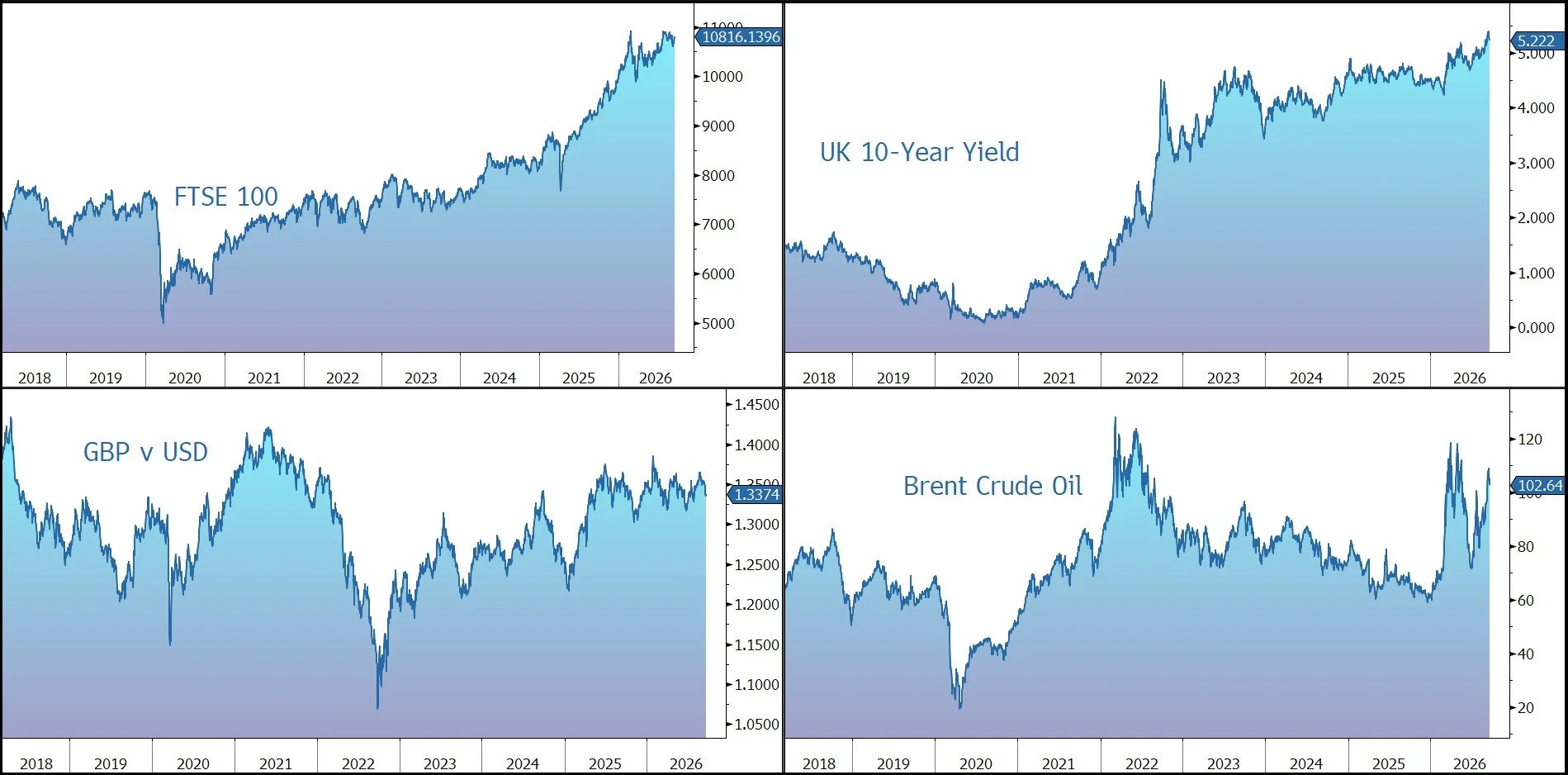
Source: Bloomberg
