
Morning Note: Market News and an Updates from Shell and Constellation Brands.
Market News
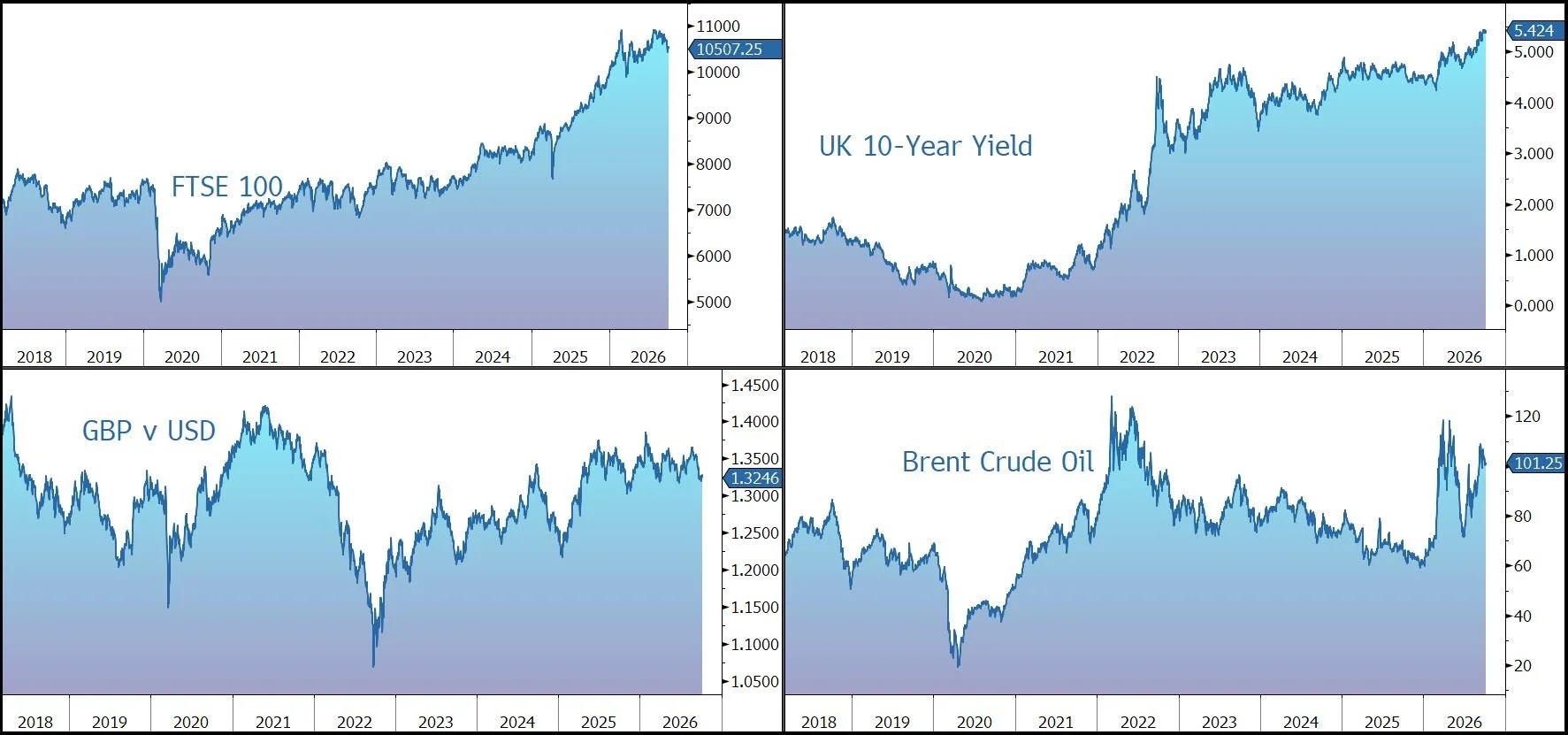
Brent crude moved back above $101 a barrel, extending gains from the previous session as persistent risks to Middle East energy flows overshadowed signs of rising supply from the region. Iran has intensified attacks on tankers in the Strait of Hormuz in recent days, with the UK Maritime Trade Operations reporting nine incidents so far this month. European natural gas held near a two-week high of €76/MWh, with storage at only 73%, below seasonal norms.
As a result, bond yields remain elevated, with the 10-year US Treasury at 5.31% and Germany’s Bund at 3.50%. In India, the RBI raised rates 25bps to 5.50%, its first hike in nearly four years, sending Indian bond yields to three-year highs. France’s fiscal and political stress, driven by student protests and widening spreads, remains a latent European risk. Gold slipped to $4,130 an ounce.
The FOMC minutes due this evening will be closely watched for any shift in the Federal Reserve’s posture following last week’s soft payroll data. Markets have dialled back near-term interest rate hike expectations.
US equities rose last night – S&P 500 (+0.6%); Nasdaq (+0.5%) – on AI enthusiasm but the positive sentiment didn’t flow through into Asia this morning: Nikkei 225 (-0.9%); Hang Seng (-0.6%); Kospi (-2.0%).
The FTSE 100 is currently 0.4% lower at 10,507, while Sterling trades at $1.3240 and €1.1830. Water company Pennon is trading 18% lower following the announcement of a £550m rights issue. The company cut its dividend by 30% and plans to sell Pennon Power and apply proceeds to debt.
Alphabet agreed to purchase nuclear power from Constellation Energy for 20 years. Constellation shares surged 12% in their best session since April 2025.
Source: Bloomberg
Company News
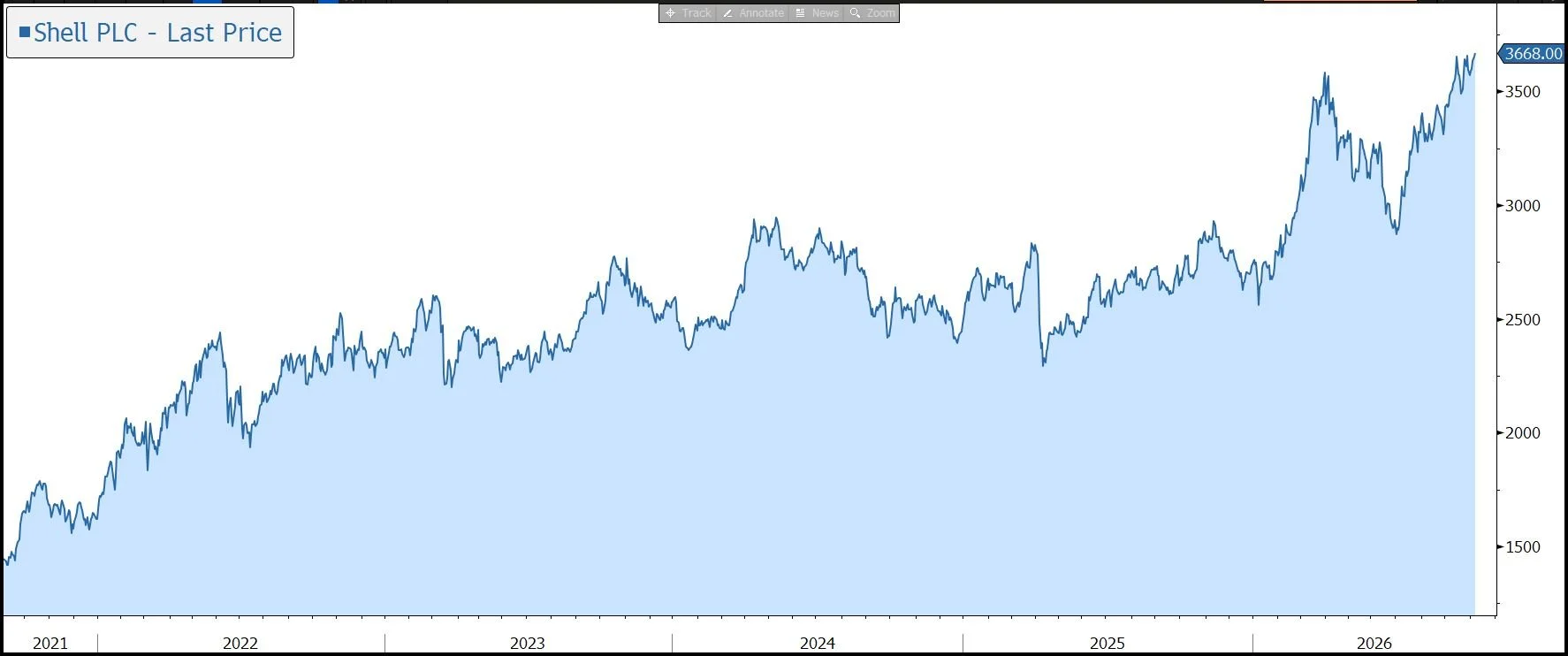
Shell has released an overview of its current expectations for the third quarter of 2026. The update highlights a positive refining margin environment, softer chemical margins, and trading profits in line with the previous quarter. Production volumes now include a contribution from the recently-completed ARC acquisition, although underlying volume continues to be impacted by the conflict in the Middle East. Full details including news on the dividend and share buybacks will be published with the results on 29 October. The shares are little changed in early trading.
Shell is a global integrated energy company with expertise in the exploration, production, refining, and marketing of oil and natural gas, and the manufacturing and marketing of chemicals. The group is also allocating capital to low and zero carbon products and services including wind, solar, advanced biofuels, EV charging, hydrogen, and carbon capture & storage. According to Brand Finance Global 500, Shell is the most valuable brand in the industry, valued at around $50bn.
The business is divided into five segments:
· Upstream (i.e. E&P) explores for and extracts crude oil, natural gas and natural gas liquids. Shell has best-in-class deepwater assets complemented by resilient conventional assets in the Gulf of Mexico, Brazil, Nigeria, UK, Kazakhstan, Oman, Brunei, and Malaysia.
· Integrated Gas includes liquefied natural gas (LNG), conversion of natural gas into gas-to-liquids (GTL) fuels, and other products. Shell is the global leader in LNG (achieved through the 2016 acquisition of BG), a critical fuel for the energy transition, with a business that spans upstream, liquefaction, shipping, marketing, optimising, and trading. We believe the level of commercial control derived from its global reach is difficult to replicate.
· Chemicals & Products is made up of a focused set of assets – there are currently five energy and chemicals parks (i.e. integrated refining and chemicals sites) and seven chemicals-only sites.
· Marketing includes mobility, lubricants, and decarbonisation. In addition to the service stations with their EV charging footprint, Shell is the global number one lubricants supplier and operator of assets in renewable natural gas, sugar cane ethanol, and biofuels.
· Renewables & Energy Solutions includes Shell’s production and marketing of hydrogen, integrated power activities (solar and wind), carbon capture & storage, and nature-based projects. The assets are helping to reduce the carbon intensity of the group’s hydrocarbon product sites. The group is however stepping back from new offshore wind investments – it is returning a 3GW offshore wind lease back to the UK government – and is splitting its power division following an extensive review of the business.
To deliver more value with less emissions Shell will aim to:
reinforce its leadership position in LNG by growing sales by 4%-5% per year through to 2030.
grow production across the combined Upstream and Integrated Gas business by 1% p.a. to 2030, sustaining 1.4m barrels per day of liquids production to 2030 with increasingly lower carbon intensity.
drive cash flow resilience and higher returns in the Downstream and Renewables & Energy Solutions businesses where around 20% of the company’s capital employed currently generates a negative return. This will be achieved through focused growth in the high-return Mobility and Lubricants businesses, directing up to 10% of capital employed by 2030 across lower carbon platforms, and through unlocking more value from the portfolio of Chemicals assets by exploring strategic and partnership opportunities in the US, and both high-grading and selective closures in Europe.
The company has set out several operational and financial targets including:
· structural cost reduction of $5bn-$7bn by the end of 2028, compared to 2022. In 2025, the company generated $2.0bn of savings, with the cumulative total standing at $5.1bn. Around 60% of the savings are coming from non-portfolio actions (i.e. not as a result of disposals). The company is actively exploring and harnessing AI to transform workflows and enhance business outcomes.
· invest for growth while maintaining capital discipline: disciplined cash capex of $24bn–$26bn for 2026 – which includes $4bn allocated toward the ARC Resources acquisition (see below) and asset integration – while maintaining an unchanged baseline guidance of $20bn–$22bn p.a. for 2027–2028. The company continues to divest non-core assets and step back from projects with limited returns.
· grow free cash flow per share by more than 10% p.a. through to 2030 (at $70 Brent) and generate a return of more than 10% across all business segments.
· shareholder distributions of 40%-50% of cash flow from operations (CFFO) through the cycle, continuing to prioritise share buybacks, while maintaining a 4% p.a. progressive dividend policy.
The company has disclosed the impact of the conflict in the Middle East on its activities:
Pearl GTL is the world’s largest gas-to-liquids plant developed by Shell and QatarEnergy, in which Shell has a 30% stake. The company currently expects no damage to Train One and an initial assessment of around one year for full repair of Train Two.
LNG - Shell has a 30% interest in QatarEnergy LNG N(4) equating to 2.4 MTPA of equity production. QatarEnergy shut in production on 2 March across all LNG facilities and subsequently declared force majeure. The complex was not impacted during the attacks on 18 March but has been largely idle since then because the closure of the Strait of Hormuz has trapped specialised LNG carriers in the Gulf.
Today’s statement highlights that in the three months to 30 September 2026:
· In the Integrated gas division, production is expected to be 740 kboe/d - 780 kboe/d. LNG liquefaction volumes are expected to be 7.2-7.6 MT. Trading & Optimisation is expected to be in line with the previous quarter. The outlook includes the acquisition of ARC Resources (see below) which completed on 2 September.
· Upstream production is expected to be 1,735 kboe/d - 1,835 kboe/d.
· Marketing adjusted earnings are expected to be lower than the previous quarter. Marketing sales volumes are expected to be 2,550 kb/d - 2,650 kb/d.
· Chemicals & Products - Refinery utilisation is expected to be 93%-97%, impacted by low Rhine water levels. Chemicals manufacturing plant utilisation of 81%-85%. Trading & Optimisation is expected to be in line with the previous quarter.
· The underlying indicative refining margin rose from $24/barrel to $42/barrel, while the indicative chemicals margin slipped from $270/tonne to $208/tonne.
· Renewables and Energy Solutions is expected to generate adjusted earnings between zero and $0.4bn.
· The company expects a working capital movement of between -$0.4bn and +$0.1bn.
Shell recently acquired Canadian energy company ARC Resources for $16.5bn. The deals adds complementary oil and gas assets in a shift back toward stable, democratic jurisdictions for long-term supply. It also helps address the group’s shrinking reserve life and is expected to be free cash flow accretive from 2027. With 75% of the transaction cost funded from the issue of new Shell shares, the company retains cash reserves for dividends and share buybacks. We would highlight potential integration risk given the difference in operating models.
The balance sheet is very strong, both in absolute terms and relative to the peer group, and the company targets AA credit metrics through the cycle. This provides resilience regardless of the industry or operational backdrop. At the end of the first half of 2026, net debt stood at $41.8bn, with gearing at a very comfortable 18.7%. Further details on the group’s Q3 gearing and capital expenditure (which will include the impact of the ARC deal) will be provided with the results on 29 October.
As highlighted above, Shell’s current policy is to return 40%-50% of cash flow from operations (CFFO) to shareholders through the cycle via a combination of dividends and share buybacks. The group’s dividend breakeven is around $40 a barrel (vs. $100 currently) and the group is targetting 4% growth annually. The Q3 dividend will be declared with the results on 29 October.
Even as low as $50 a barrel, share buybacks will be undertaken as a priority to debt reduction and capital investment as management believe the shares are undervalued. The company is currently undertaking a $3bn quarterly programme and an additional $1.232bn that was not repurchased in connection with the ARC acquisition. A new programme is likely to be announced with the Q3 results at the end of the month.
We believe decarbonisation can’t happen at the flick of a switch – oil and gas will remain part of the global energy mix for decades, with demand driven by population growth and higher incomes, particularly in developing countries where the desire for energy intensive goods and services like cars, international travel, and air conditioning is rising. We also believe the production of the materials needed to transition to net zero can’t happen without hydrocarbons. At the same time, reduced investment in new production, partly because of environmental concerns, and natural decline rates, are increasingly leading to constrained supply.
The shares remain on an undemanding valuation, both in absolute terms and relative to its US peers, which fails to discount the potential for free cash flow generation and shareholder returns. We believe they also provide something of a hedge against inflation.
Source: Bloomberg
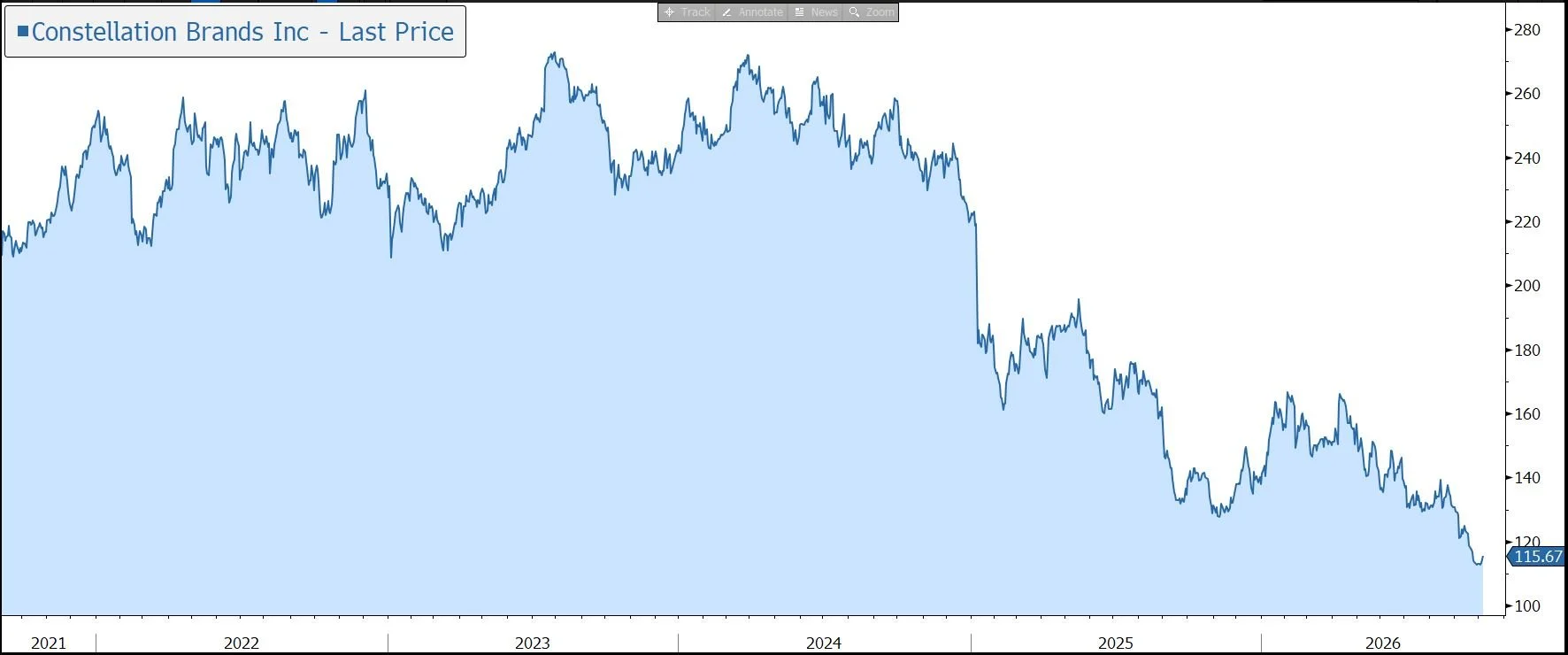
Constellation Brands released results for the second quarter of its financial year ending February 2027. Despite a discerning and value-conscious consumer environment, the company grew organic net sales and earnings ahead of the market forecast. However, guidance for the full year was left unchanged and, in response, the US-listed shares were marked down by 4% in after-hours trade.
Constellation Brands is a leading international producer and marketer of beer, wine, and spirits, with a portfolio of higher-end brands including Corona and Modelo. Part of the group’s strategy is to supplement organic growth with bolt-on acquisitions, and to focus on premium, margin-accretive, growth opportunities. As a part of that process, the wine business has been restructuring and downsized via disposals. The group recently acquired SpikedAde, a spirit-based ready-to-drink (RTD) brand. The transaction included a $75m payment for 100% ownership of the business, as well as additional contingent consideration of up to $278m payable over five years based on the future performance.
While the company continues to navigate a challenging socioeconomic environment that has dampened consumer demand, the results for the latest quarter were better than expected.
During the three months to 31 August 2026, comparable net sales rose by 6% to $2.63bn, slightly above the market expectation of $2.54bn. Comparable EPS was up 3% to $3.74, well ahead of the market forecast of $3.56.
By division, the beer business increased net sales by 5% to $2,474m, driven by a 5.5% increase in shipment volumes and flat price/mix. Depletions only fell by 0.6%, as declines for Modelo Especial of 2% and Corona Extra of 5% were partially offset by growth from Pacifico, Victoria, and the Modelo Chelada brands. The beer business continued to lead the category in dollar share gains, outperforming the total beer category in year-over-year dollar sales. The beer operating margin fell by 160 basis points to 39.0% as lower tariff expenses and favourable fixed cost absorption were more than offset by increased marketing investment and other SG&A spend.
In Wine & Spirits, sales rose by 17% to $159m, driven by a 15.4% increase in organic shipment volumes. The unit outpaced the corresponding higher-end wine segment in both dollar sales and volume sales performance. During the latest quarter, depletions were up 10.2%. The division moved from a loss to a small $6m profit, driven by recoveries of US tariffs and savings across marketing and other SG&A from optimization and restructuring initiatives.
The overall business is cash generative, with free cash flow up 4% to $1.1bn in the quarter. Financial gearing remains around the group’s target of 3.0x. The group has returned $530m to shareholders in share repurchases in the year to date and increased its quarterly dividend by 1% to $1.03.
The company is expanding its beer business in Mexico and expects to spend $3.0bn between FY2025 and FY2028 to support the future growth of the core, high-end Mexican beer portfolio with modular additions at existing facilities and a third brewery site at Veracruz.
Looking to the full year, group organic net sales growth is still expected to come in between -1% and +1%, with Beer and Wine & Spirits both in the same range. Target comparable EPS of $11.20-$11.90 has been confirmed (vs. $11.82 last year), as has free cash flow of $1.6bn-$1.7bn.
Source: Bloomberg
