
Morning Note: Market News and an Updates from Rio Tinto and Johnson & Johnson.
Market News
Ahead of this afternoon’s pivotal US September CPI print, the yield on the 10-year US Treasury stands at 5.20%, while gold trades at $4,150 an ounce. Headline inflation of 3.6% is expected, with a core figure at 2.5%, a step-up from August’s number, driven in part by energy pass-through from the US-Iran conflict. With overnight swaps pricing only a 22% probability of a Fed hike at the next meeting, a strong print could reprice that sharply higher.
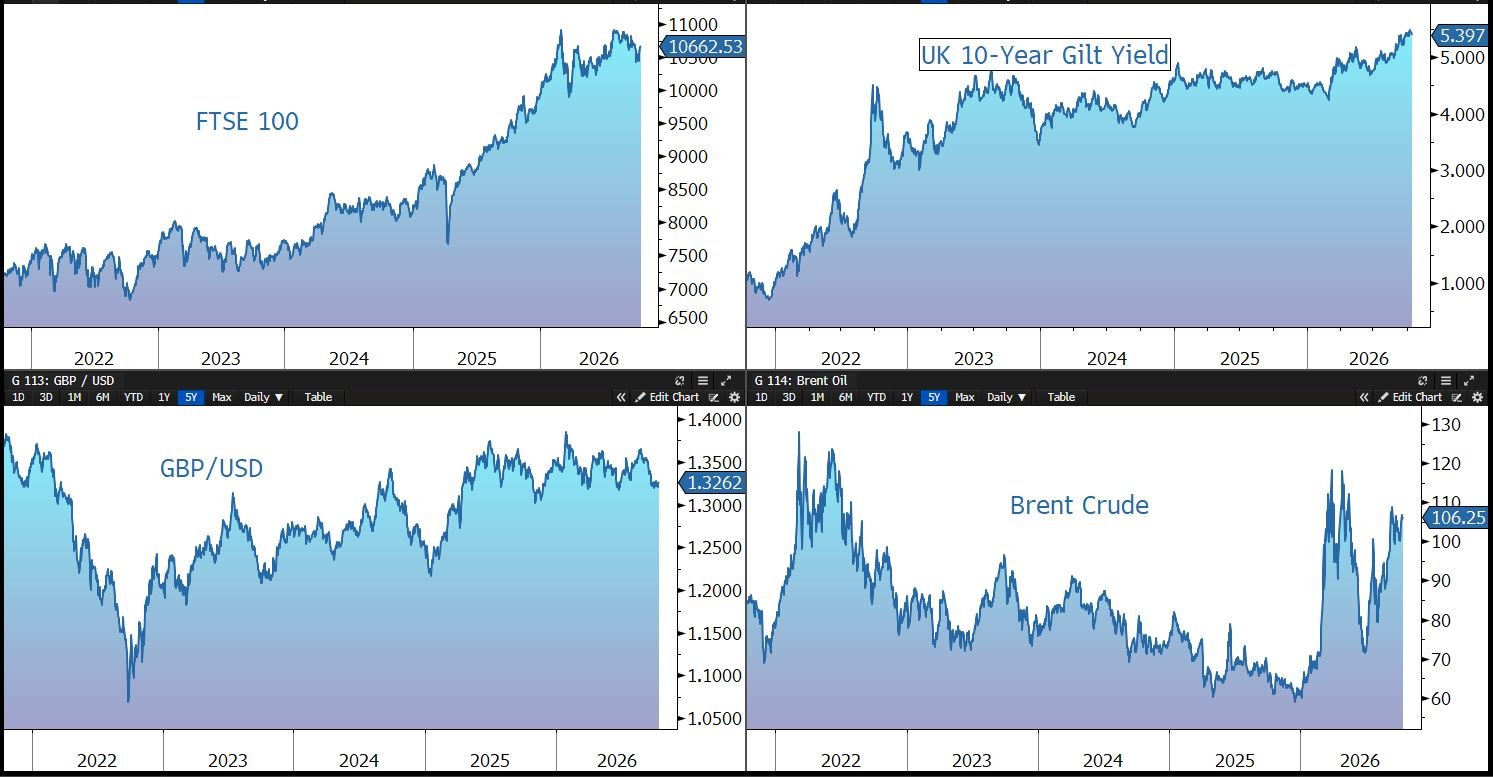
Brent crude held above $106 a barrel amid ongoing Houthi attacks on Saudi Arabia, including a strike on Aramco’s Dhahran headquarters.
US equities were little changed last night – S&P 500 (flat); Nasdaq (-0.2%). The bank earnings season is underway with mixed results. JPMorgan missed, Citigroup beat and raised NII guidance, Wells Fargo missed on revenue. BofA reports today with a $1.2bn regulatory charge headwind. Equity markets in Asia were mixed this morning: Nikkei 225 (-0.1%); Hang Seng (flat); Shanghai Composite (-0.9%); Kospi (-0.4%). China released blow-out trade data: September exports surged 36.3% year-on-year, well above the 25.7% consensus.
The FTSE 100 is currently little changed at 10,662, while Sterling trades at $1.3265 and €1.1835. Gilt yields remain elevated – the 10-year is 5.41%.
ASML generated record net sales of €11.66bn in Q3, with net income more than doubling to €4.96bn. Guidance was raised and provides a positive read-across for the AI semiconductor supply chain. However, the company warned it cannot fully meet demand in 2027–28. The shares are trading up 2%.
The IMF warned the UK government that departmental spending cuts will be needed to fund a planned increase in defence expenditure to 3% of GDP by 2030, estimated to cost £11bn annually. It also urged France to ensure “timely approval” of its budget bill to preserve market confidence, warning the indebted country cannot afford to delay at a time of heightened investor scrutiny.
Source: Bloomberg
Company News
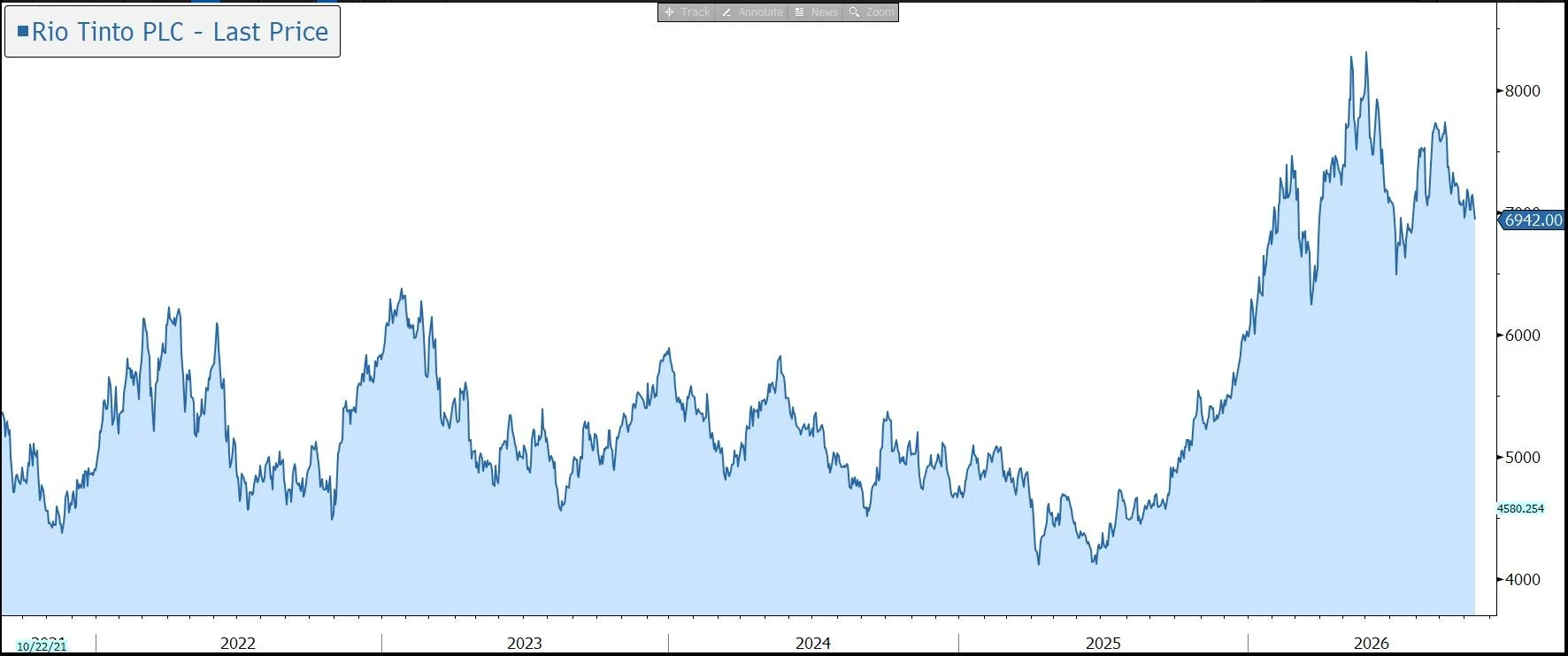
This morning, Rio Tinto released its third quarter of 2026 production results highlighting a strong operational performance. The company has provided an update on the impact of the conflict in the Middle East and reiterated its full-year guidance. In response, the shares are little changed in early trading.
Rio Tinto is a diversified global mining company. It is the second-largest seaborne iron ore producer – a commodity that accounts for around three quarters of underlying product earnings – and a major producer of aluminium, copper, and other minerals and materials. The group currently has more than 100 projects at varying stages of maturity. The target is to generate 3% CAGR production growth between now and 2033.
Rio is looking to pivot toward energy transition materials to reduce its reliance on Chinese steel demand. The company is currently on a path to reach 1 mt of copper production annually by the end of the decade, largely fueled by the ramp-up of the Oyu Tolgoi mine in Mongolia. Further expansion of the group’s exposure to copper was one of the main motivations for the (failed) merger attempt with Glencore earlier in the year.
The strategy is one of value over volume. The focus is on high-quality, long-life assets predominantly located in lower-risk countries and generally positioned in the first quartile of the industry’s cost curve. A combination of capital discipline, increased productivity, maximising cash flow from operations, and portfolio shaping is aiming to deliver strong cash generation and shareholder returns. The company is expected to reach an annualised run-rate of $1.8bn by the end of 2026, with significantly more to come.
During the third quarter of 2026, Rio reported a 1% year-on-year increase in copper equivalent production.
· Copper – production at Oyu Tolgoi is up 27% year on year, with the operation running at a 450 kt annualised rate in the quarter. This made up for the temporary decline at Escondida and Kennecott. Drilling at Resolution is now underway following completion of the land exchange in March.
· Iron ore – global sales were up 3% to 90.8 Mt, with Pilbara up 2%. The Simandou iron ore mine hit an annualised production run-rate of 10 Mtpa (on a 100% basis) in the quarter as the project continues to ramp up on its way to a 60 Mtpa production run-rate during H2 2028.
· Aluminium – Production fell by 2% with a stable performance across the full operating system.
· Lithium – Production was up 4% in the quarter despite adverse weather impacting operations. Fenix 1B ramp-up continues to progress well.
The statement provides some reassurance on the impact of the conflict in the Middle East. Ongoing disruptions in the region continued to drive volatility in energy and freight markets. Operational impacts on Rio Tinto remained limited, with no material disruption to production or outbound supply chains. Rio Tinto’s fuel availability remained adequate, supported by inventory buffers and alternative sourcing.
In today’s update, the company has announced it has achieved more than $2bn of capital release year-to-date, as it actively manages its portfolio to maximise long-term value, as part of the $5bn to $10bn capital release programme. The deals entered into so far include an agreement with Yindjibarndi WaterCo for the proposed sale of the Dampier Seawater Desalination Plant in Western Australia and the sale of land in Kitimat, British Columbia, Canada, to LNG Canada for their Phase II project.
Guidance for the full year is unchanged for production/sales and unit costs. For copper, the target production is 800kt-870kt, with net unit costs of 30c-50c per lb. For iron ore, target sales are 343Mt-366Mt, with unit cash costs of $23.5-$25.0 per wet metric tonne.
Overall, we believe commodities and resource stocks are inexpensive when compared to financial assets and are relatively under-owned in investor portfolios. We also believe they provide something of a hedge against inflation. Furthermore, the mining sector has a long history of M&A. Looking forward, further industry consolidation would open the sector to generalist investors at a scale that would make it easier to bring on large and complex projects needed for new supply. Although the transaction between Rio Tinto and Glencore fell apart earlier this year, we expect a deal to be revisited at some point given management’s view that a merger would be strategically compelling owing to the combined group’s scale, synergy potential, and growth profile.
Source: Bloomberg
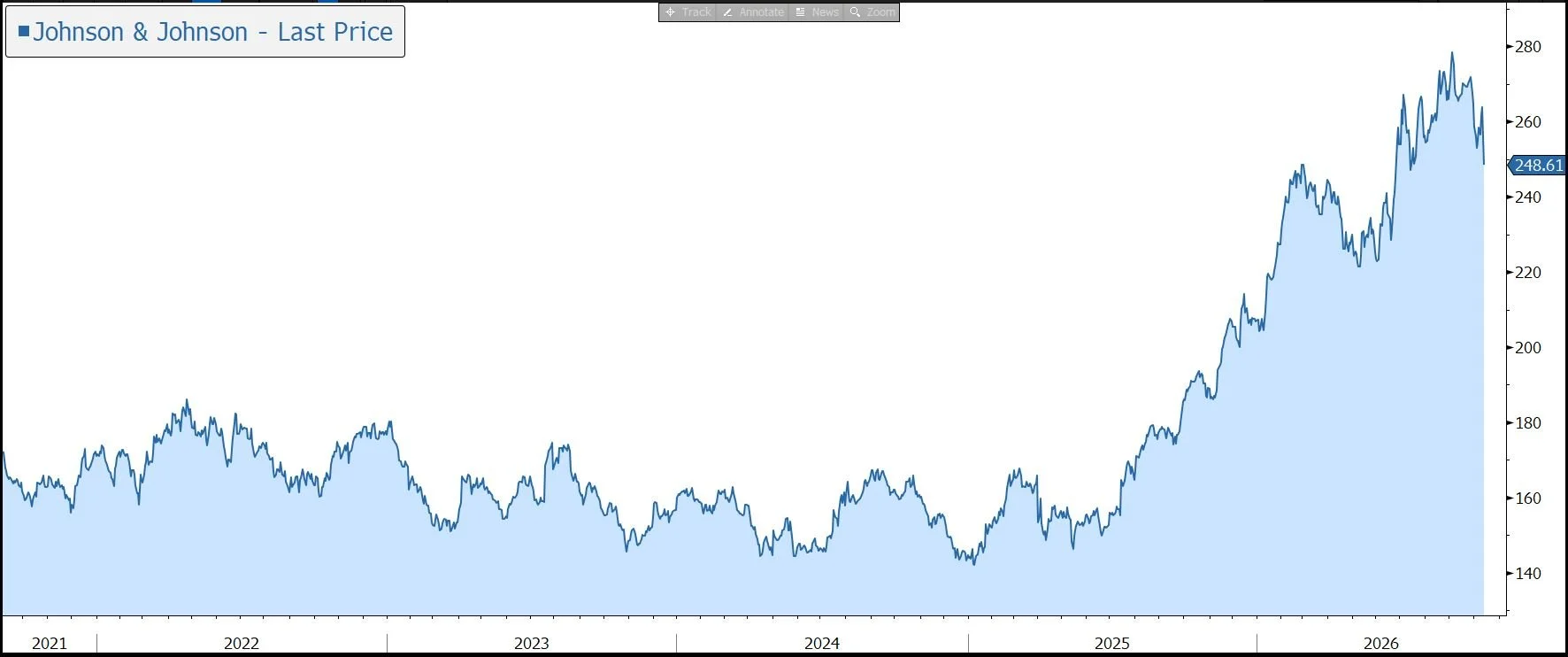
Yesterday at lunchtime, Johnson & Johnson released Q3 results that were slightly better than the market expectation and guidance for the full year was nudged up. However, the market focused on the weak performance of the MedTech division, particularly outside the US, and, in response, the shares were marked down 5% in US trading hours.
J&J is a global healthcare company with leading positions in Oncology, Immunology, Neuroscience, Cardiovascular, Surgery, and Vision. The group has 29 products/platforms, each with sales of more than $1bn. More than 75% of sales come from No.1 or No.2 global market share leading positions. The group’s strategy is to increase sales faster than the market, and to grow earnings faster than sales. Given its broad spread of businesses, J&J is considered the bellwether of healthcare companies, providing a good read-across for a range of other stocks.
J&J is undertaking a strategy of ‘shrink to grow’. The company’s former Consumer Health unit was spun off in 2023 and trades as a separately listed company, Kenvue. The company is also spinning off its orthopaedics business, with a target completion timeline of mid to late 2027 – the standalone DePuy Synthes will be the largest, most comprehensive orthopaedics-focused company in the world, currently generating sales of more than $9bn.
Progress on innovation, together with strategic investments in high-growth areas, gives clearer line of sight to double-digit growth by the end of the decade.
During the three months to 30 September 2026, reported sales grew by 5.9% to $25.4bn, a touch above the market forecast. On an adjusted operational basis, which excludes the impact of acquisitions and disposals, sales grew by 6.1%, with US domestic sales (+9.1%) outpacing international sales (+1.9%) which were held back by Middle East conflict, austerity measures in Europe, and pricing in China.
The group continued to deliver a flow of innovation including the market authorisation of OTTAVA as the world’s first table-integrated soft tissue robotic system, approval of IMAAVY in warm autoimmune hemolytic anemia (wAIHA), and priority review for RYBREVANT FASPRO for advanced head and neck cancer.
Innovative Medicine (i.e., Pharmaceuticals, 65% of sales) grew by 8.0% in the quarter to $16.8bn. Growth was driven by a broad range of products including TREMFYA in Immunology and ERLEADA in Oncology. Growth was partially offset by an approximate 690 basis points impact from Stelara in Immunology.
MedTech (i.e., medical devices, 35% of sales) increased by 2.5% to $8.6bn, slightly below the market expectation of $8.7bn. Growth was driven primarily by electrophysiology products and Shockwave in Cardiovascular, contact lenses in Vision, as well as trauma in Orthopaedics.
EPS of 9c reflected a one-time special charge for the proposed talc litigation resolution, the acquisition of Firefly Bio, and the strategic collaboration with Sail Biomedicines. On an adjusted basis, EPS fell by 7.5% to $2.59, better than the consensus forecast of $2.54.
J&J has raised its dividend for 63 consecutive years. In the current quarter, the payout was raised by 3% to $1.34 per share, implying a full-year yield of 2%.
J&J has a very strong balance sheet and ended the third quarter with net debt of $28bn on the back of free cash flow generation of $15.1bn in Q3. The group has consistently invested in organic growth – R&D spend was $4.7bn in the quarter – and, as a result, around 25% of sales come from products launched in the last five years.
Guidance for 2026 has been nudged up because of strong operational performance. Sales are expected to be $101.2bn, with growth in adjusted operational terms of 6.6% at the midpoint. Adjusted EPS is expected to be $11.00, up 2.0% at the midpoint.
Source: Bloomberg
