
Morning Note: Market News and an Update from BP.
Market News
According to the IMF, the world’s leading economies need to take urgent action to rebuild public finances. Its forecasts show leading economies are headed this year for their biggest budget deficits since the pandemic, equal to 5.2% of GDP. At its meeting in Bangkok, the IMF also warned that surging bond yields represent the top risk to the global financial system and raised its 2026 global growth forecast to 3.1% while projecting 3.4% for 2027.
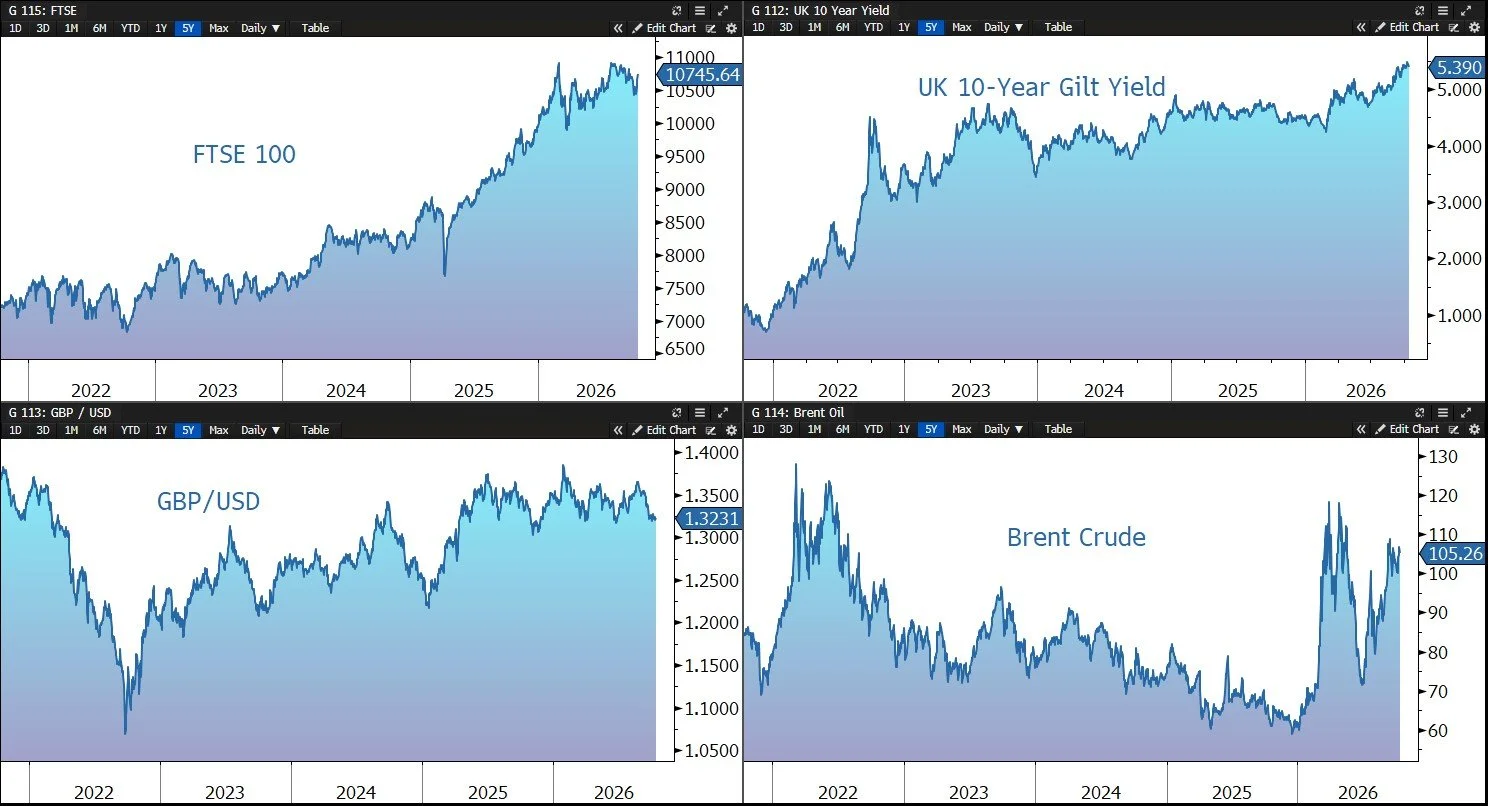
US equities drifted lower last night – S&P 500 (-0.4%); Nasdaq (-0.4%) – while markets in Asia slumped overnight driven by a sharp AI-sector rotation. South Korea’s Kospi tumbled 5.5% after China’s CXMT claimed a memory chip breakthrough threatening the DRAM oligopoly, while Broadcom’s CEO likened AI market sentiment to a “casino”. Elsewhere, the Nikkei 225 fell 1.8% and the Hang Seng and Shanghai Composite were flat. The FTSE 100 is currently 0.9% higher at 10,750.
Visa hit an all-time high following the receipt of approval of its Application to Prepare from the People’s Bank of China which allows the company to begin formal preparations to establish a domestic bankcard clearing institution in China. This marks an important milestone toward the company serving China’s domestic payments market.
Treasuries rallied on haven demand. The yield on the 10-year note has fallen below 5.2% as bond trading resumed after a market holiday, extending its retreat from 24-year highs. Gold held below $4,200 an ounce, remaining under pressure as the US dollar climbed to an 18-month high ahead of key inflation reports that could shape the Federal Reserve’s next interest rate decision.
Brent crude fell toward $105 a barrel, ending a three-session winning streak as investors weighed the impact of Russian diesel exports against escalating geopolitical tensions. BP issued a robust trading update (see below).
Source: Bloomberg
Company News
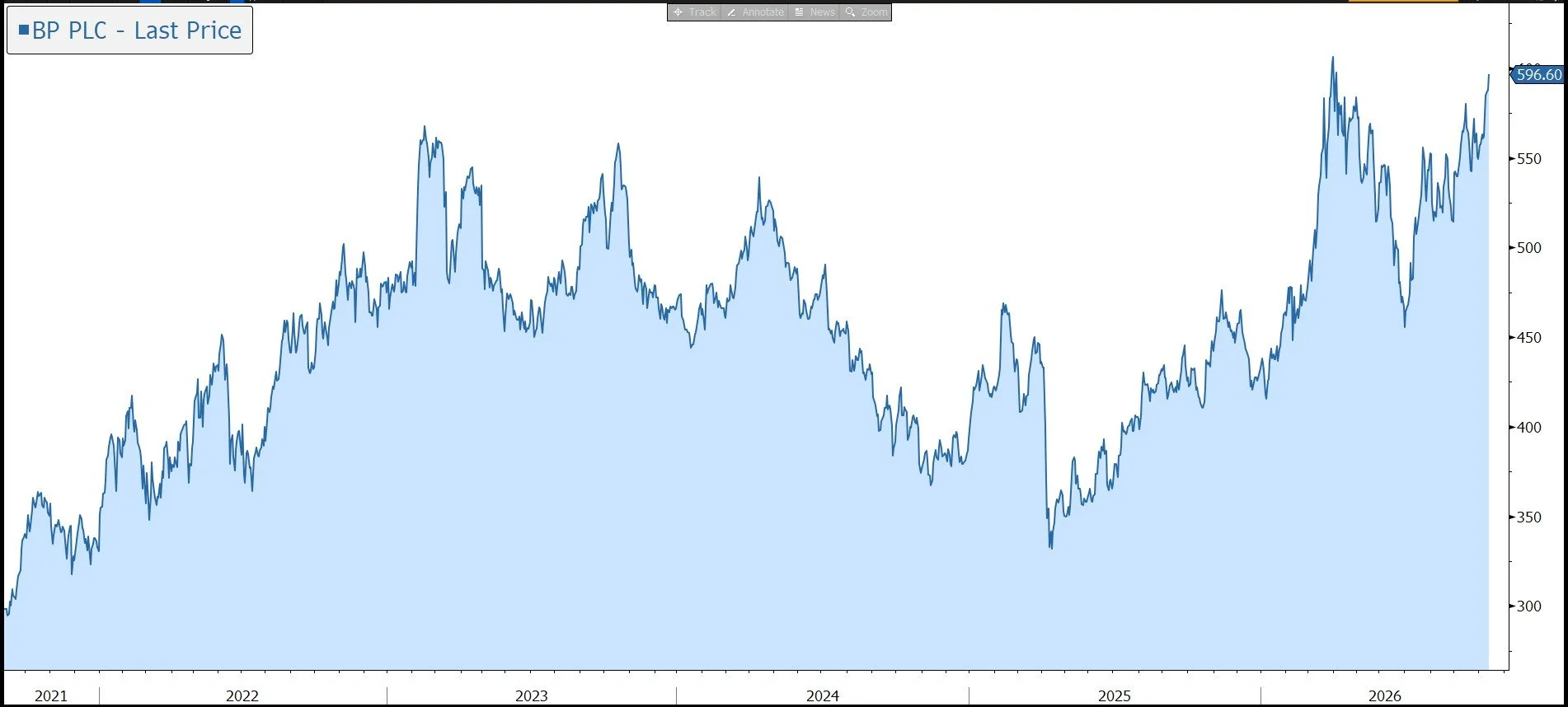
BP has today released a trading statement ahead of its results scheduled for 30 October. The update provides a brief summary of current expectations for the third quarter of 2026, including data on the commodity price environment as well as group performance during the period. The release points to a gas marketing and trading result significantly higher compared with the previous quarter and stronger realised refining margins. This was partly offset by a significantly lower result in the customers segment. There will also be another large impairment in its transition business. As expected, we will have to wait until the full results at the end of the month for a full update on the group’s profitability, financial position and dividend, however we note strong progress on debt reduction. The shares are trading 1% higher in early trading.
BP is a global integrated energy company with operations and assets across traditional hydrocarbon businesses (oil and gas exploration and production, refining, and retail), as well as select investments in renewable energy (e.g., EV charging, carbon capture, offshore wind). Embedded within its core businesses is a world class oil, gas, and power trading operation.
BPX Energy comprises BP’s onshore oil & gas shale operations within the Lower-48 of the US, primarily focusing on developing unconventional resources in Texas and Louisiana across three plays (Permian, Eagle Ford, Haynesville). Elsewhere, the company owns exploration & production assets in Trinidad, Egypt the US Gulf, Libya, Indonesia, Namibia, Azerbaijan, Oman, Angola, the North Sea, and Brazil.
Following a period of corporate governance chaos, which saw two CEOs and a Chairman leave the company, BP has hopefully entered a period of management stability. New CEO Meg O’Neill – the first outsider to lead BP – is continuing the strategic reset, reorganising the group into simpler upstream and downstream units to drive efficiency. In September, Ian Tyler assumed the role of Chairman. The focus now will be on sustained operational execution.
The company has set out five priorities to deliver a step change in performance and grow shareholder value:
· Strengthen the balance sheet to provide the financial resilience needed to generate greater flexibility to invest to grow through the cycle and reward shareholders.
· Simplify the portfolio based on value, not sentiment and history. The group will focus on the assets with the strongest potential to deliver competitive returns and long-term value. Given the pool of potential organic growth opportunities, there are no plans for major acquisitions. That said, we note reports in late September of BP’s interest in Devon Energy’s Eagle Ford shale assets. However, the portfolio was formally sold to Crescent Energy for $4.2bn in early October, underlining BP’s focus on capital discipline.
· Invest with greater discipline to ensure every dollar of capital competes. The company will use balanced investment criteria to make decisions rooted in profitability, cash generation, and market realities. The company will compete in the ‘weight class’ it is in.
· Drive operational excellence. Although the company has made progress on reducing structural costs, it has not improved enough where it matters most: the bottom line. The company will move faster and has the opportunity and technology to do so. The target is $6.5bn-$7.5bn of structural cost savings by 2027, of which $3.5bn have been achieved. Portfolio actions, including the disposal of Castrol, should contribute around $1.5bn of cost base reduction. The majority of the organisational simplification benefits should start to materially flow through to earnings during 2027.
· Hard wire high-performance and accountability into BP – making better, faster decisions, reducing complexity, and sharpening accountability.
During the latest quarter, the company continued to simplify its portfolio. The sale of its 37.2% stake in the Bay du Nord offshore oil project in Canada was announced, as well an agreement to sell its French EV charging business. Terms were agreed for Shell to buy 50% of the Tupinambá exploration block in Brazil’s Santos Basin and 30% of five deepwater Gulf of Mexico leases. Gas producer Energean is in exclusive talks to buy some of BP’s upstream oil and gas assets in Egypt which could raise about $1bn. Processes are also ongoing to market the group’s North Sea business and Archaea Energy, the US biogas business. It has previously been reported that BP is close to a deal to sell its solar business Lightsource BP to a Kuwait-backed group and is weighing options for its Brazilian biofuels business. The largest transaction remains Castrol, which is expected to close and generate around $6bn of proceeds before the end of 2026, following which BP will continue to own 35% of the business under a two-year lock-up.
Back to today’s update which highlights the continued impact of conflict in the Middle East. Heightened volatility in crude oil, natural gas, and refined products prices have impacted financial results, including trading results and working capital movements.
In the three months to 30 September 2026, the commodity price backdrop was mixed: Brent crude averaged $96.99/barrel (down from $103.85/barrel in the previous quarter); US gas Henry Hub averaged $2.96/mmBtu (vs. $2.90/mmBtu); and the refining margin averaged $46.70/barrel (vs. $29.6/barrel). The environment has been volatile as a result of ongoing geopolitical uncertainty and the company believes that even when the conflict ends it will take months for the oil and gas supply/demand balance to normalise.
As a rule of thumb, the company has disclosed that: a $1 movement in Brent has a $340m profit impact, a $0.1 movement in Henry Hub has a $40m profit impact, and a $1 movement in the refining margin has a $450m profit impact.
By division, the company has disclosed:
· Reported upstream production in the third quarter is expected to come in at 2,190-2240 mboe/d. This compares to 2,201 mboe/d in the previous quarter and previous guidance of 2,100-2250 mboe/d. The result mainly reflects seasonal maintenance recovery partly offset by a reduced equity interest in Latin America. It includes the impact of continued disruption in the Middle East and no impact from weather events in the Gulf of Mexico.
· Full-year underlying upstream production is still expected to be broadly flat.
· In the gas & low carbon energy segment, price realisations, compared to the prior quarter, are expected to have an impact of +$0.1bn to +$0.3bn, including the impact of changes in non-Henry Hub natural gas marker prices. The gas marketing and trading result is expected to be significantly higher compared with the second quarter.
· In the oil production & operations segment, price realisations, compared to the prior quarter, are expected to have an impact of -$0.2bn to -$0.4bn including the impact of changes in non-Henry Hub natural gas marker prices. Exploration write-offs are expected to be significantly lower than the previous quarter.
· In the customers & products segment, compared to the prior quarter, the customers segment has generated a significantly lower result, driven by weaker fuels margins and higher base oil prices in Castrol, as well as a lower contribution from midstream, partly offset by slightly higher volumes due to seasonal effects. The products segment benefitted from stronger realised refining margins in the range of $1.9bn to $2.1bn. The oil trading result is expected to be broadly flat compared with the second quarter.
· The Q3 results are expected to include post-tax adjusting items relating to asset impairments of $3.0bn-$4.5bn. These charges are primarily attributable to transition businesses in the gas & low carbon energy segment.
Further detail on operating cash flow and shareholder distributions will be provided with the Q3 results on 30 October.
As a reminder, the company’s first capital allocation priority is a resilient dividend, which is expected to increase by at least 4% per ordinary share a year. The Q3 dividend will be declared at the time of the results later in the month – current forecasts imply a full-year yield of 4.5%.
BP remains committed to maintaining a strong investment grade credit rating and a reduction in net debt to $14bn–$18bn by the end of 2026. We note, however, the net debt figure doesn’t include other financial obligations and instruments such as lease liabilities ($13.3bn at the H1 stage), Gulf of Mexico oil spill payables ($5.0bn), and hybrid bonds (£13bn). Treating hybrids as 50/50 equity/debt, the gearing measure rises to nearer 40%, rather than the 22.6% disclosed at the H1 stage. With this in mind, the company plans to reduce hybrids by $4.3bn by end 2027.
With today’s update, the company has stated that net debt at the end of the third quarter is expected to have fallen from $22.3bn to $13.5bn-$14.5bn as a result of the redemption of $1.0bn of hybrid securities on 30 September. This leaves remaining hybrid bonds and securities of around $12.0bn. The other flows are higher income taxes paid ($1.0bn), a working capital release of $0 to $1.0bn; and capital expenditure of around $3.0bn.
As a result, the company expects the total of net debt, hybrid bonds, leases, and Gulf of Mexico settlement liabilities to reduce by around $9.0bn to $10.0bn compared with the second quarter.
In a nod to these ‘other’ financial obligations, the company is currently not buying back its shares and is fully allocating excess cash to accelerate the strengthening of its balance sheet, a process that has accelerated with higher commodity prices. We believe this is the right decision – it saves $3bn a year and will create a strong platform to invest with discipline into the group’s ‘distinctive’ deep hopper of oil and gas opportunities.
We believe decarbonisation can’t happen at the flick of a switch – oil and gas will remain part of the global energy mix for decades, with demand driven by population growth and higher incomes, particularly in developing countries where the desire for energy intensive goods and services like cars, international travel, and air conditioning is rising. We also believe the production of the materials needed to transition to net zero can’t happen without hydrocarbons. At the same time, reduced investment in new production, partly because of environmental concerns, and natural decline rates, are increasingly leading to constrained supply.
Against this backdrop, investor disillusion with BP’s tilt towards low carbon energy, particularly in terms of capital discipline and returns (as evidenced by $18bn of impairments since 2023), and its poor recent governance track record, has had a negative impact on the share price over the medium term relative to the peer group. However, the recent arrival of a new CEO, combined with operational high-grading, reduced financial gearing, and occasional M&A speculation suggests that the valuation gap between BP and its peers should narrow.
Source: Bloomberg
