
Morning Note: Market News and an Update from Unilever.
Market News
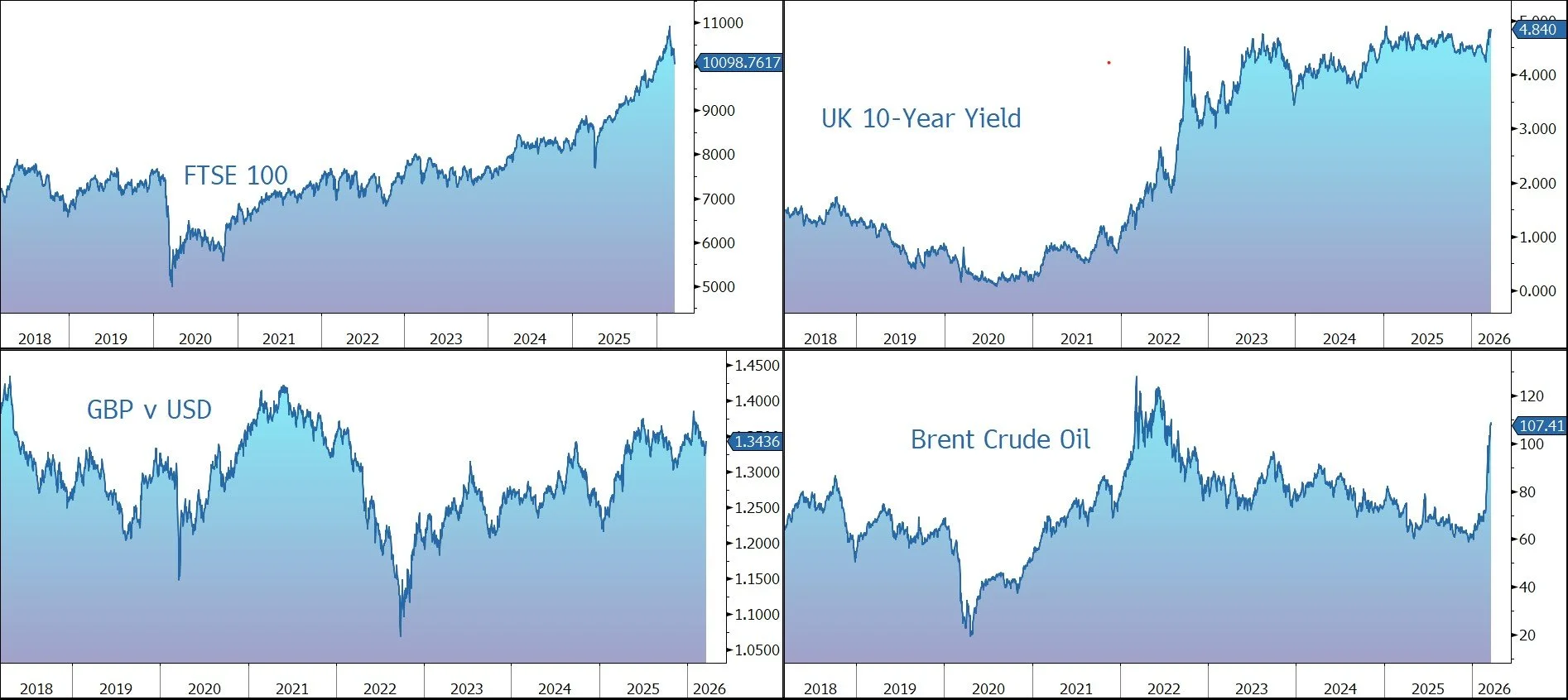
Brent crude fell from its highest closing level since July 2022 to trade around $108 a barrel after the US and Israel sought to calm investors shaken by serious damage to key Gulf energy assets. Israel’s PM Benjamin Netanyahu said the nation will no longer target energy infrastructure and added that the war will end a lot faster than people think as Iran is no longer able to enrich uranium or manufacture ballistic missiles.
Gold has recovered somewhat to $4,700 an ounce following a steep two-day sell-off driven by higher energy prices and intensifying inflationary pressures that prompted investors to rotate into the dollar at the expense of safe-haven metals.
US equities recovered most of their early losses last night – S&P 500 (-0.3%); Nasdaq (-0.3%) – while in Asia this morning, the main indices fell: Nikkei 225 (holiday); Hang Seng (-1.1%); Shanghai Composite (-1.2%). Alibaba slumped after failing to lay out clear visions for AI.
The FTSE 100 is currently 0.3% higher at 10,098, while Sterling trades at $1.3410 and €1.1595. The UK 10-year gilt yield climbed above 4.8%, reaching its highest level since September 2025, after the Bank of England unanimously voted to hold rates at 3.75%, a more hawkish stance than expected. Markets had anticipated a 7-2 split in favour of steady rates, but policymakers highlighted concerns over surging global energy and commodity prices.
The UK’s public sector borrowing jumped to £14.3bn in February, far ahead of the £8.8bn expected by Bloomberg consensus. It followed the anticipated January surplus of £31.9bn.
In a joint statement President Trump and Japanese PM Sanae Takaichi announced that GE Vernova and Hitachi will build nuclear reactors in Tennessee and Alabama for up to $40bn.
Source: Bloomberg
Company News
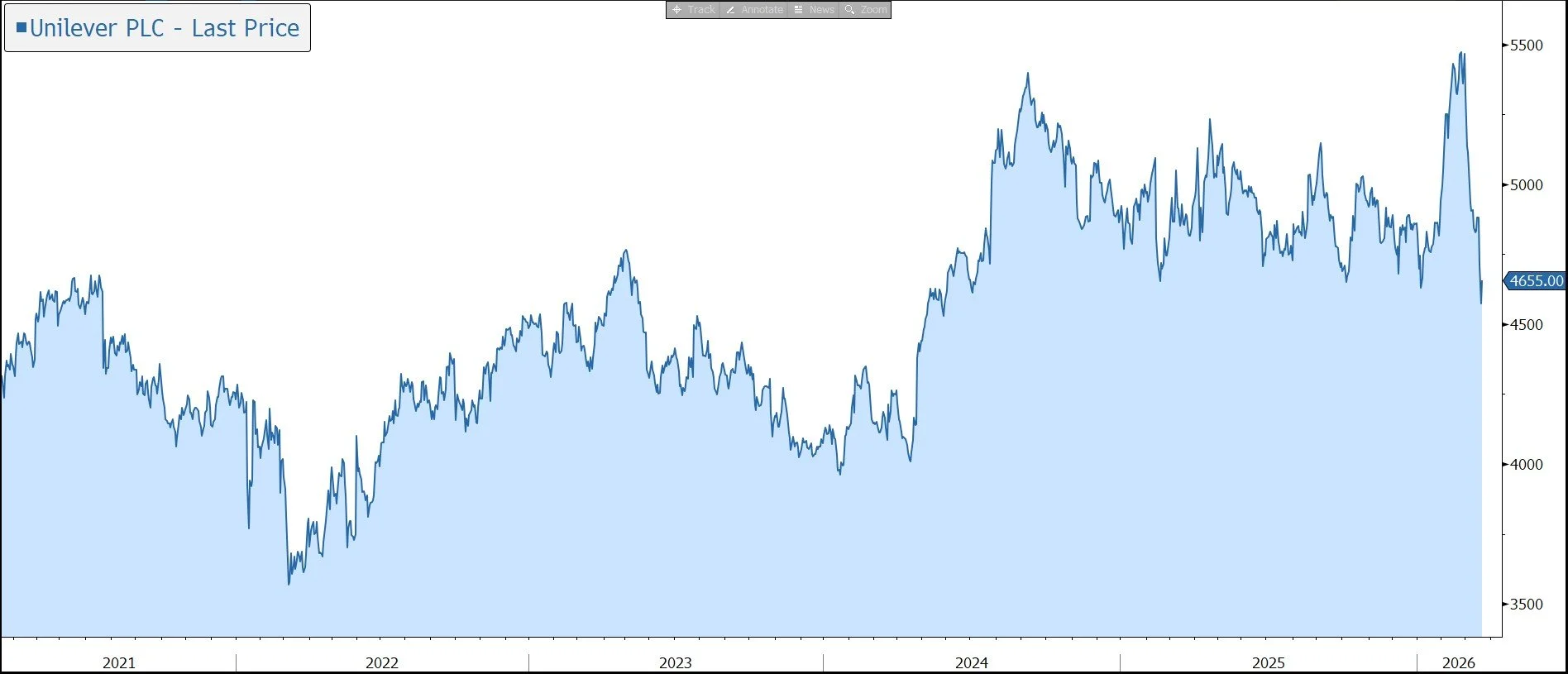
Unilever has this morning responded to recent media speculation regarding a potential transaction involving its Foods business. The company has confirmed that it has received an inbound offer for the unit and is in discussions with McCormick & Company. The brief statement highlights that there can be no certainty that any transaction will be agreed. In response the shares are up 2% in early trading.
Unilever is one of the world’s leading suppliers of consumer goods, with annual sales of more than €50bn. Its products are low-ticket, repeatable purchases, with 3.4bn people using a Unilever brand every day. With unique routes to market, the company has an unrivalled emerging market presence and generates more than half of its sales from those parts of the world expected to experience strong long-term growth in demand. In particular, the group’s 62% holding in India-listed Hindustan Unilever Limited provides exposure to the largest consumer goods company in India.
Following the recent demerger of its Ice Cream unit Magnum, in which it has retained a 19.9% stake, Unilever is focused on four fairly equally-weighted Business Groups: Beauty & Wellbeing (25% of 2025 sales), Personal Care (26%), Home Care (23%), and Foods (26%).
Under the group’s 2030 Growth Action Plan (GAP), growth will be driven by 30 Power Brands (including Dove, Hellmann’s, and Domestos) which account for 78% of turnover and operate across 24 Business Group-led markets, which represent nearly 85% of turnover. The main focus is to generate more sales in the US, India, the beauty sector, premium markets, and the e-commerce channel. The remaining 100+ smaller markets will be run on a ‘One Unilever’ basis to benefit from scale and simplicity, further enhancing the group’s focus. The company’s major organisational change is now complete, with the current focus on brand building and execution.
Overall, Unilever is aiming to deliver mid-single digit underlying sales growth, supported by underlying volume growth of at least 2%. The company expects modest underlying operating margin improvement, driven by gross margin expansion through operating leverage and productivity improvements. The cost programme is running ahead of plan and delivered an aggregate €670m of savings by the end of 2025 on the path to €800m by the end of 2026. The company is also targetting 100% cash conversion over time and has a ROIC ambition in the high teens.
This morning Unilever has confirmed it has received an offer for its Foods business and is in discussions with US-listed McCormick & Company.
Unilever’s Foods portfolio is dominated by two mega-brands – Hellmann’s and Knorr – that account for 60% of its turnover. Knorr is the world’s leading cooking brand. It spans bouillons, seasonings, soups, and mini-meals. In a world of rising food costs, Knorr is seen as an affordability play, helping consumers cook at home. Hellmann’s is the world’s number one mayonnaise. It has successfully premiumised into vegan options and squeeze formats, maintaining a dominant market share even against cheaper private-label rivals. There is also a range of niche heritage and regional brands including Colman’s, Marmite, Bovril, and Horlicks. There is also Unilever Food Solutions, the B2B arm that sells specifically to professional chefs and commercial kitchens.
A deal with McCormick, the world leader in flavours and spices, would create a global condiments powerhouse with unrivalled shelf-space leverage.
Unilever believes its Foods division is a highly attractive business, with a strong financial profile led by market-leading brands in growing categories and is confident in the future of the Foods business as part of Unilever.
However, following the recent demerger of the ice cream unit, the strategic direction of the company has been towards higher-return personal and beauty categories. We also note Unilever recently held (and ended) talks with Kraft Heinz about a similar mega-merger.
In 2025 Unilever’s food business contributed about a quarter of its total sales at €12.9bn and generated an underlying operating profit of €2.9bn and a margin of 22.6%. On this basis, several analysts have suggested a valuation for the standalone business at around €28bn. The synergies available in a deal could justify a higher valuation.
While McCormick’s $14.5bn market cap presents a structural challenge, a Reverse Morris Trust or a significant equity-linked merger could bridge the valuation gap.
As an alternative Unilever could choose to keep power brands Knorr and Hellmann’s while selling the smaller brands to private equity or a smaller player.
The company has said there can be no certainty that any transaction will be agreed. We await a further announcement.
Source: Bloomberg
