
Market News
US data released on Friday showed that job growth accelerated in October – nonfarm payrolls increased by 165,000, more than double the 65,000 forecast, while the unemployment rate edged lower to 4.1%. Markets are now pricing in an 81% probability of a Fed rate increase in December, up from 71% before the report. Investors are now turning their attention to key US inflation data due this week for further clues on the Fed’s monetary policy direction. There are also 30-year auctions in both the US and Japan. The yield on the 10-year US Treasury is currently 4.85%.
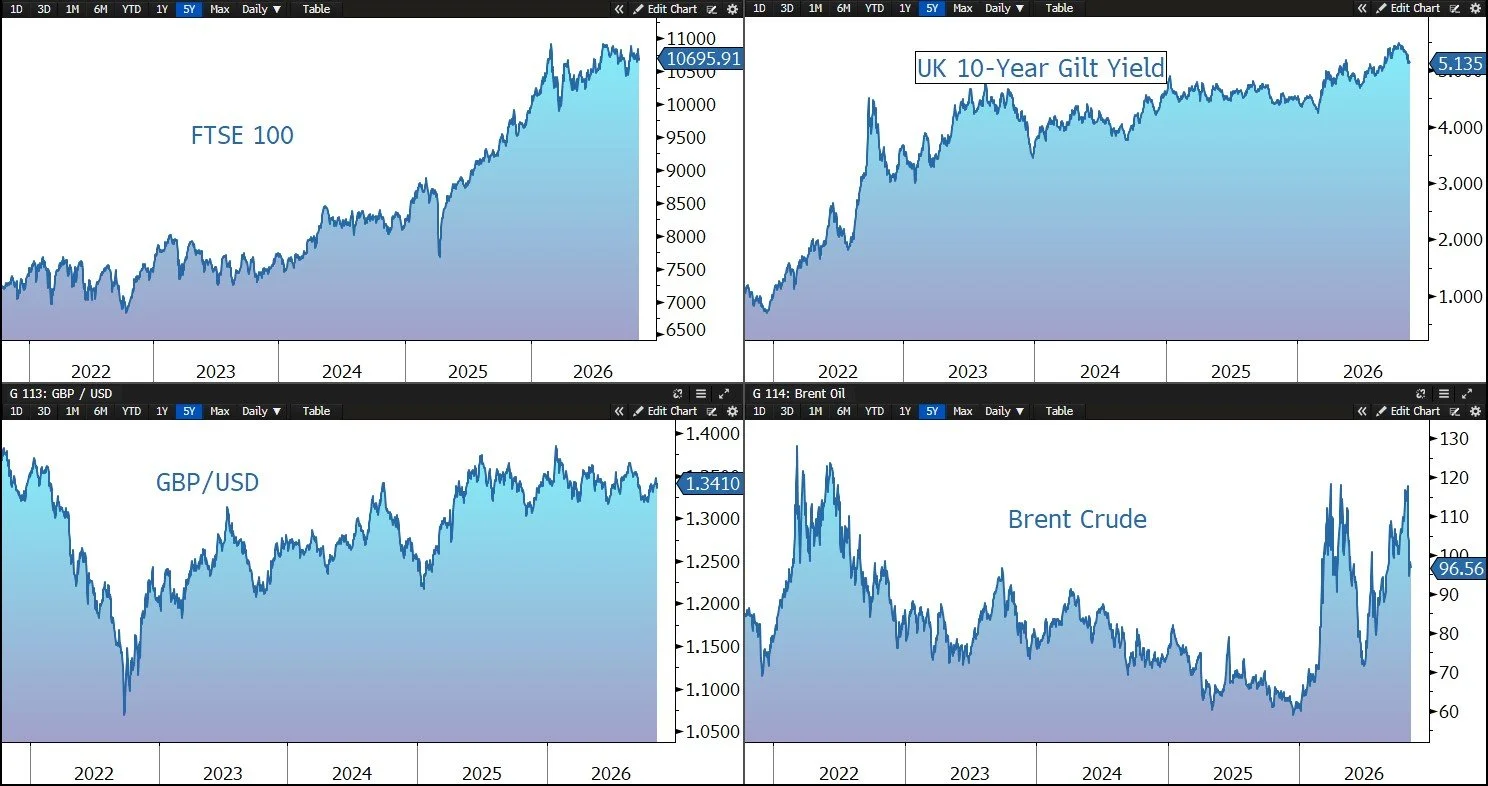
Brent crude has fallen back to $96.50 a barrel this morning, extending losses from last week after President Trump said it was “highly unlikely” that he would authorise further strikes on Iran if negotiations over its nuclear programme and the reopening of the Strait of Hormuz make significant progress. Secretary of State Rubio meets G7 counterparts in Paris today with the US-Iran conflict and its energy implications front and centre.
Gold is trading around $4,100 an ounce, extending last week’s gains as weaker oil prices eased inflationary pressures, although expectations of a more hawkish Federal Reserve capped further upside. The PBOC extended its gold-buying streak to 24 consecutive months, adding 25.8 metric tons to China’s holding in October.
Global equities begin the week on steadier footing after last week's sharp AI-driven selloff. Sentiment, however, remains fragile as the Democratic sweep of Congress has raised concerns about tighter regulation of AI investment, data centers, and semiconductor exports. Elsewhere, an internal Nvidia investigation into whether CEO Jensen Huang had been targeted by a foreign intelligence effort put his future at the AI chipmaker under scrutiny. Its shares fell 6% in Frankfurt.
In Asia this morning, the main indices were mixed: Nikkei 225 (+2.3%); Hang Seng (-0.1%); Shanghai Composite (+0.3%); Kospi (-0.8%). The FTSE 100 is currently 0.2% higher at 10,696. Investors’ attention will later remain with tech, with results from CoreWeave, Applied Materials, and Cisco Systems expected to provide new insight into whether hefty AI-related spending is translating into profits.
Sterling trades at $1.3410 and €1.1985, while the 10-year Gilt yields 5.15%. Chief Economist Huw Pill said there is a possibility that interest rates remain on hold or even fall if growth stalls and second-round inflation effects weaken but noted upside risks remain.
Source: Bloomberg
Investment Trust News
Scottish Mortgage Investment Trust is a £18bn global equity investment trust run by Tom Slater and Lawrence Burns, two highly regarded fund managers at Baillie Gifford. The fund has a strong long-term performance record compared to its benchmark to beat the FTSE All-World Index (in sterling terms) on a rolling 5-year basis. The Fund is actively managed, with an 87% deviation from the index, and an average holding period of more than five years. The manager believes that over long time periods, it is through supporting and holding just a small number of extraordinary companies that exceptional returns can be achieved. However, investing in such companies at the forefront of structural change means share price volatility is inevitable, for both the companies the fund owns and the trust itself.
At the end of last week, the company released results for the financial half-year to 30 September 2026. During the period, the NAV rose by 31.5%, above the 16.0% increase for the benchmark index, while the share price was up 33.8%. The long-term performance track record remains impressive – over the last ten years, the NAV is up 464% (with the share price up 413%), versus 228% for the benchmark.
The Manager believes the investment landscape will be shaped by key themes of resilience, adaptability, and innovation. In a volatile world, resilience is a strategic advantage, allowing companies to adapt and emerge stronger. The Manager’s focus remains on identifying ‘outlier’ companies capable of delivering exceptional returns. The fund currently holds a small number of high conviction ideas – there are just over 100 holdings, although the top 30 account for 81% of assets.
Beneath the recent geopolitical turbulence and upheaval of the old-world order, the Manager believes a transformation of a fundamentally different kind is underway. The acceleration of artificial intelligence into a global infrastructure buildout is, in the Manager’s judgment, the most important structural change in the global economy since the emergence of the internet, and we are still in its early stages.
The length of tasks an AI agent can complete on its own has been doubling roughly every four months. Businesses are adopting these tools at a pace with few precedents. Anthropic saw annualised revenue more than triple in three months, from $14bn in February to $47bn in May. The companies the Manager speaks with are clear that they expect to spend more on AI, with that spend earning a positive return. New holdings were added in SK hynix, which makes memory for AI chips, and KLA and DISCO, which make the equipment used to inspect and cut chips. With power becoming a binding constraint on the AI build-out, the Fund also added holdings in Vistra, a power generator, and EQT, a natural gas producer.
These new positions were funded from the sale of Tesla (as the share price had come to reflect much of its promise in autonomy and robotics), Netflix (whose business is maturing), Delivery Hero (after Uber agreed to buy it), as well as Kering, Insulet, HeartFlow, and Sana Biotechnology.
Once again, SpaceX was the largest single contributor to returns during the half year, adding an 8% absolute contribution. The decision to reduce the position following its flotation in June, while retaining a substantial investment, demonstrates the importance of balancing conviction with disciplined portfolio management. On 4 November 2026, SpaceX represented 11.1% of the Company’s total assets, compared with 15.0% on 30 September 2026.
Moderna contributed another 4.5% to performance, helped by the share price nearly tripling in a single day in August when its personalised cancer vaccine succeeded in a late-stage melanoma trial
The portfolio is global and so offers good geographic diversification. The high weighting to the US (c. 62%) brings exposure to the global centre of entrepreneurial excellence but also to a highly-rated stock market. The most difficult area of the portfolio this year was China (10% of NAV), although the real issue was not tariffs. It was what happens when well-capitalised companies fight for market share in an economy where domestic consumption is barely growing. The Fund has maintained exposure to selected Chinese companies where compelling opportunities exist, notwithstanding a more challenging domestic economic backdrop and heightened competitive dynamics.
At the end of September 2026, the largest holdings in the Fund were: SpaceX (15.0%); TSMC (6.5%); NVIDIA (6.2%); Moderna (4.7%); ByteDance (4.0%).
The Manager believes the long-term risk taking, essential to economic and social progress, is continuing to migrate to private markets. At the end of September 2026, the fund had 25% of its assets in 53 unquoted investments, providing exposure to early-stage businesses that investors would not usually be able to gain access to. SpaceX, Anthropic, and Revolut are all key examples. Although this increases the level of volatility in the Fund, the Manager believes these investments provide the potential for asymmetric returns, with a maximum 100% loss set against the potential for unlimited upside. The Fund’s private company exposure tends to be weighted to the upper end of the maturity curve, focussed on late-stage private companies which are scaling up and becoming profitable.
Earlier in the year, the Company updated its investment policy to provide the Managers with limited additional flexibility to invest in private companies when the portfolio is above the Fund’s 30% limit, through an additional capacity of up to £250m. This ensures the company is not forced to forgo attractive new or follow-on investment opportunities in exceptional private businesses, while maintaining robust guardrails and oversight. For example, this enabled the Managers to add to the Company’s investment in Anthropic in May.
Scottish Mortgage is in a robust financial position. The Fund continues to deploy a ‘strategically appropriate’ level of gearing in the portfolio as the Board believes this offers a potential source of additional value for shareholders over time. However, during the last six months, the level of gearing has fallen from 11% of NAV to 4%, reflecting portfolio appreciation and the repayment of borrowings, funded in part by proceeds from reductions in the SpaceX holding. The overall cost of debt remains low at 2.7%, well below the 10-year Gilt yield.
Although the focus of the Fund is capital growth, the company has committed to paying a small dividend – with these results, a half-year payout of 1.8p has been declared, up 12.5% on last year. The yield is currently 0.3%.
The size of the Fund helps to keep costs low, with an ongoing charge of 0.33% for the year and no performance fees. This is much less than most actively managed funds invested in public equities and significantly less than private equity funds.
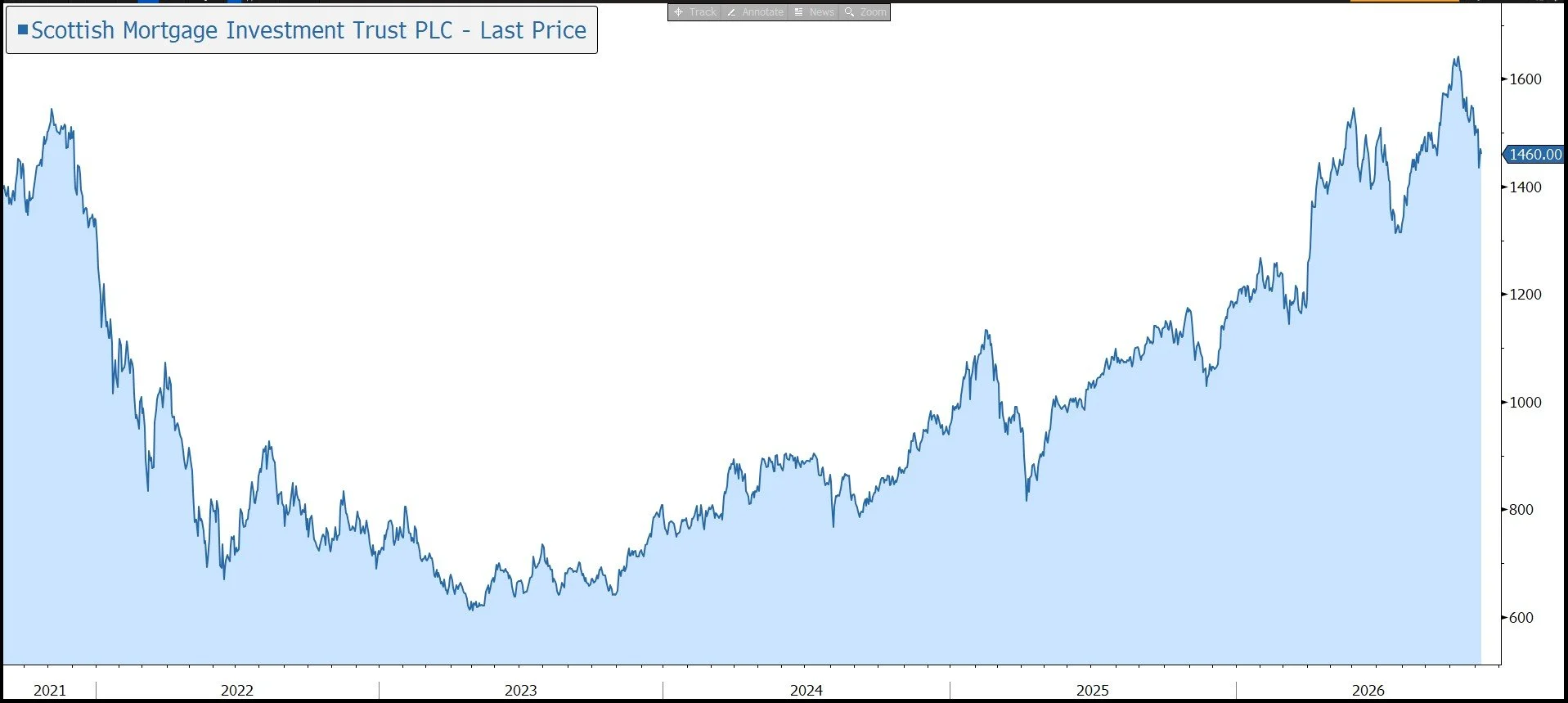
Having traded at or around NAV for years, since 2022 the shares have traded at a discount, which widened to around 20% in 2023. In response, the Company has been buying back its shares – more than £3bn since the beginning of 2024 – and as a result the discount to NAV narrowed substantially. In the last six months, the shares traded at both a premium and a discount to NAV, and ended the period at a 7.9% discount.
Given its growth/technology bias, this equity fund is at risk from falling stock markets, particularly if highly-rated stocks fall out of favour or their valuations are questioned. The use of gearing, combined with investment in private companies, and the concentrated nature of the portfolio also leads to significantly greater volatility compared to the peer group. We note that the 5-year performance track record – 27.8% NAV growth versus 79.3% for the index – still feels the drag of the brutal 2022 growth-stock crash, while during the downturn in 2008/09, both the NAV and the share price fell by around 40%.
Source: Bloomberg
