
Market News
Global equities are extending the post-midterm rout as the AI selloff deepens. The S&P 500 fell 4.4% last night – its worst session in over 18 months – and the Nasdaq 100 plunged 5.5%, its steepest drop since March 2020, erasing roughly $2.5 trillion in value as investors unwound AI-related positions on fears of tighter Democratic regulation of the technology sector. The carnage continued in Asia this morning, Japan’s Nikkei 225 entered a technical bear market overnight, down 6% and 20% below its June peak, while South Korea’s Kospi triggered a circuit breaker after falling as much as 8.8%, recovering slightly to close the session down 6%. The copper price has also been caught up in the malaise, slumping to its lowest since July.
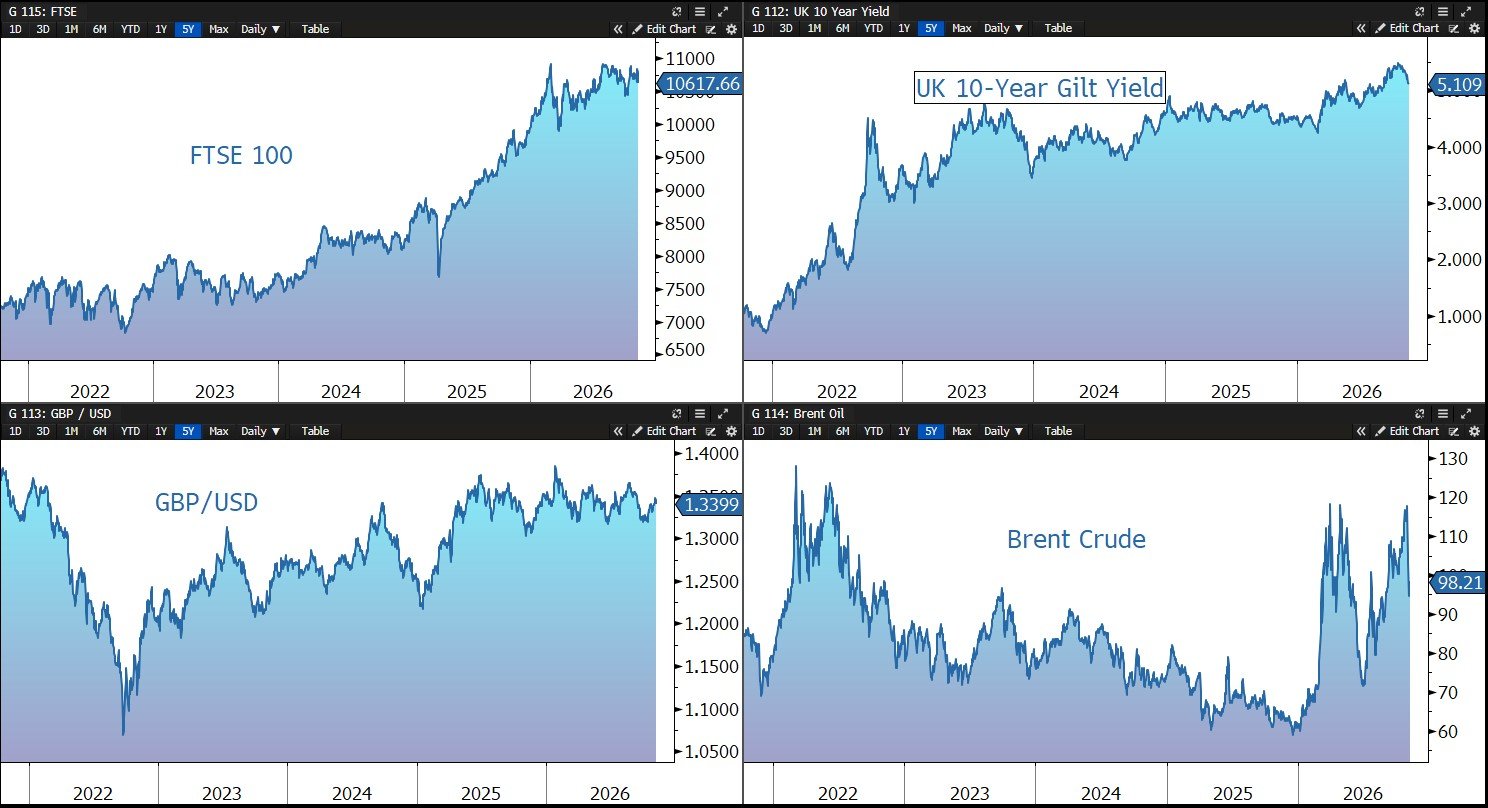
Brent crude has regained some of its recent losses and currently trades at $98 a barrel. Tehran is reportedly reviewing proposals submitted by mediators regarding its nuclear programme but maintained that the US naval blockade of its ports must be lifted, sanctions eased, and frozen assets released before it fully reopens the Strait of Hormuz. Meanwhile, at least five vessel-related incidents have been reported in the Persian Gulf since Sunday, highlighting continued risks to maritime shipping.
The US October nonfarm payrolls are due out later today. The survey median is 70k – more than double September’s 29k print. A strong beat would reinforce the Fed’s hiking path and add further pressure to a market already in risk-off mode. A miss, conversely, could provide some relief to equities and bonds. The yield on the 10-year US Treasury is currently 4.83%, while gold trades at $4,070 an ounce.
Democrats are targeting Trump’s Canada tariffs as their first legislative priority after taking control of Congress in January. Although support for repeal is “overwhelming,” legal and procedural hurdles remain.
The FTSE 100 is currently 1.5% lower at 10,617. Airline operator IAG is holding up relatively well as the company’s operating profit beat expectations and full-year capex guidance was cut from €3.4bn to €3.1bn.
The Bank of England raised its key rate to 4.0% from 3.75% on Thursday, its first hike in over three years. Governor Bailey signalled that a second hike is “more likely than not” if energy prices remain elevated. The 10-year Gilt yield has fallen back to 5.10%. Sterling trades at $1.3395 and €1.1975.
Lloyds reported UK house prices fell 0.6% MoM and 1.2% YoY in October, following a similar report from Nationwide, with monthly data described as “unmistakably deteriorating.”
Source: Bloomberg
Company News
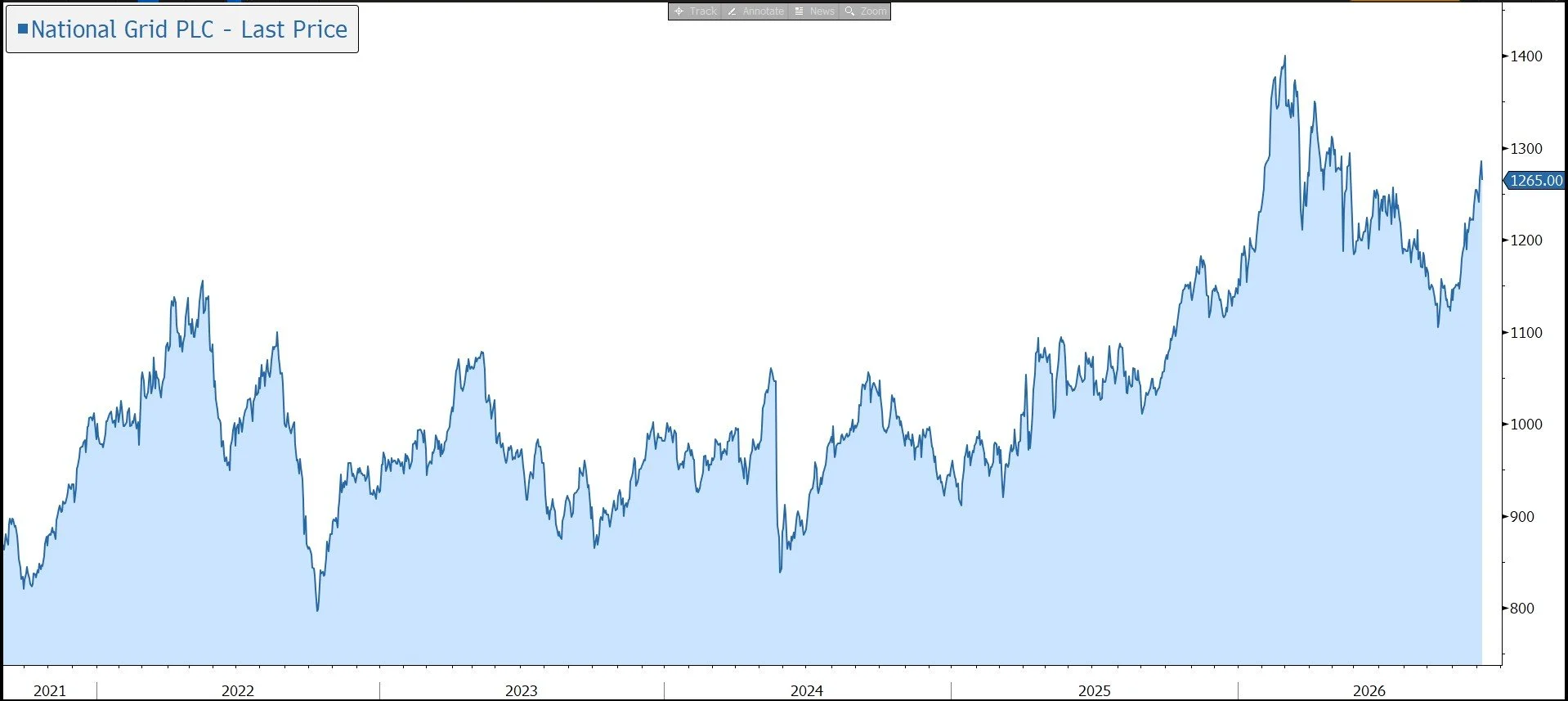
Yesterday National Grid released results for the financial half-year to 30 September 2026 that were better than market expectations. Earnings growth guidance for the full year was raised, reflecting higher allowed regulatory revenue. We are positive on the long-term outlook for the business given the company’s critical role in the energy transition and security of supply. As an income stock, the performance of the shares is driven, in part, by bond yields, with the recent increase over recent months providing a headwind. In response to this announcement, the shares were marked up by 2% and currently offer just below 4% dividend yield.
National Grid operates a regulated infrastructure business in the UK and US, with electricity and gas transmission and distribution assets. The group has limited exposure to volatile commodity prices and usage levels, while revenue is positively linked to inflation.
The global power grid is critical infrastructure that requires substantial and sustained investment to integrate an ever-growing pipeline of renewables and support the rising demands of an electrified world. Put simply, the grid needs to be larger, smarter, and more resilient to enable the energy transition to continue at pace.
Over the last few years, National Grid has pivoted its portfolio towards electricity. This has enhanced the group’s role in the decarbonisation of the energy system, with investment in infrastructure that enables higher penetration of renewable energy and low carbon technology. Increased demand will also come from new connections to AI data centres – there is currently a massive queue of data centres waiting for grid connections.
In response, the company is undertaking a significant hike in investment in order to deliver a step-change in critical energy infrastructure in the UK and US in support of energy transition, security of supply, and economic growth objectives.
Back in March, the company set out an extended and upgraded 5-year Financial Framework to March 2031. The cumulative capital investment is expected to be at least £70bn, of which around two-thirds will be covered by regulatory agreements. The plan represents a 70% increase compared to the prior five years, reflecting a doubling of investment into UK electricity networks and an almost 50% increase in investment into US gas and electricity networks. The expected split across the group is: UK Electricity Transmission (£31bn); UK Electricity Distribution (£9bn); New York Regulated (£17bn); New England Regulated (£12bn); and National Grid Ventures (£1bn). The company has secured supply chain and delivery mechanisms for around three-quarters of its investment plan. Real price mechanisms should continue to provide a hedge if costs move materially.
The company continues to streamline its portfolio to focus on pure-play networks across regulated and competitive onshore and offshore networks. It has sold its ESO (electricity system operator), National Gas Transmission, its National Grid Renewables onshore business in the US, and its Grain LNG business.
National Grid Ventures (NGV), the commercial arm of National Grid plc, develops, builds, and operates energy infrastructure that strengthens the power system and delivers reliable, affordable energy. The portfolio includes battery storage, solar, LNG storage, and conventional generation assets. In July, the company invested $1.75bn for a 35% stake in Joulent LLC, a platform focused on developing contracted power generation and high voltage infrastructure for US large load customers, particularly data centres.
Overall, the group’s target is to generate asset growth CAGR of around 10%, with group assets heading towards £115bn by March 2031. With most of the investment going into the group’s electricity networks, the mix will continue to move away from gas. Underlying EPS CAGR is expected to be 8%-10% from an FY26 baseline of 78p, more aligned with the group’s asset growth.
In the six months to 30 September 2026, underlying operating profit grew by 13% on a constant currency basis to £2,591m. This improvement was driven by strong performance across the regulated businesses, predominantly in the UK Electricity Transmission business with the start of the RIIO-T3 price control, reflecting higher allowed revenue supporting the financing of the step-up in pace and scale of investment and delivery in RIIO-T3. New York benefitted from higher revenues reflecting higher rate base and recovery of historical storm and environmental costs, and National Grid Partners saw the benefit of two capital markets transactions within the investment portfolio. National Grid Ventures saw higher performance from the Interconnector portfolio, partly offsetting the divestment of Grain LNG
Capital investment rose by 33% to a record £6.7bn, principally driven by UK transmission projects, asset replacement, and network enhancements in the UK and US.
National Grid has a robust balance sheet and a strong investment grade credit rating, underpinned by regulatory revenue, which allows the group to secure the required long-term funding needed to invest in its business. The group believes it has the financial flexibility to deliver its strategy over the 5-year financial framework, helped in part by the £6.8bn rights issue in 2024. In addition, with around 80% of its debt locked in at fixed rates, the impact of potentially higher interest rates in the near term should be manageable. At the end of the last financial year, regulatory gearing was 61% and is expected to trend back to the high 60s range by 2030/31.
During the first half, net debt rose from £44.2bn to £48.6bn, primarily driven by increased capital investment, the funding of the investment in Joulent (see above), along with interest costs, partially offset by operating cash inflows of £4.1bn and the impact of currency movements.
In the current financial year to March 2027, the company expects to deploy £13.5bn of capital investment and with continued strong operational performance across the group, underlying EPS is now expected to increase 15%–16% from the 2025/26 baseline (13%-15% previously), reflecting higher allowed revenue as the company steps up delivery from RIIO-T2 to RIIO-T3. Net debt is expected to increase by a further £4bn in the second half to £52.6bn, with operating cash inflows more than offset by continued levels of significant investment in critical energy infrastructure. Reflecting this, regulatory gearing is expected to be around 65%.
The stock remains popular with investors seeking an attractive income that is growing in real terms – the dividend policy is to deliver annual growth in line with the increase in average UK CPIH inflation. The estimated payout for the financial year to 31 March 2027 is just over 50p, equivalent to a yield of 3.9%. While this is below the 10-year gilt yield, the dividend offers the benefit of growing in real terms.
Although regulation provides a framework for the company to operate within, it can be a double-edged sword – at a time when many consumers are struggling to pay their energy bills, the regulator may be under pressure to hold back utility companies’ returns. However, we believe the risk is lower for the grid operators given the essential nature of their business and the fact that the grid only accounts for a small percentage of a consumer’s energy bill. Against that backdrop, the UK government recently announced plans for the creation of GB Grid, a new, publicly owned networks company. However, this is not seen as a significant threat to the growth and value creation targets of the electricity network companies.
Other than regulatory risk, the stock may also be negatively impacted by a further rise in gilt yields, the threat of a cyberattack, supply chain and labour inflation risk, NIMBYism, and weakness of the US dollar.
Source: Bloomberg
