
Market News
Global equities extended their losing streak into a fourth consecutive session as fresh US Commerce Department restrictions on China’s access to advanced AI chips and remote computing capacity compounded investor caution ahead of NVIDIA’s earnings after the close today. The decline endured by the main US indices last night – S&P 500 (-1.9%); Nasdaq (-2.5%) – continued in Asia this morning: Nikkei 225 (-1.3%); Hang Seng (-1.0%); Shanghai Composite (-0.5%); Kospi (-2.6%).
Further data on the US economy is due out today, including October Retail Sales, Industrial Production, and Import/Export Prices. The figures will offer the first hard read on consumer and industrial momentum in October. With the Federal Reserve firmly in hiking mode and Cleveland Fed President Hammack signalling a preference for steady incremental increases, any upside surprise in retail sales or prices could reprice the December rate decision. Against that backdrop, the US 10-year yield eased to 5.11%, while gold ticked up to $3,880 an ounce.
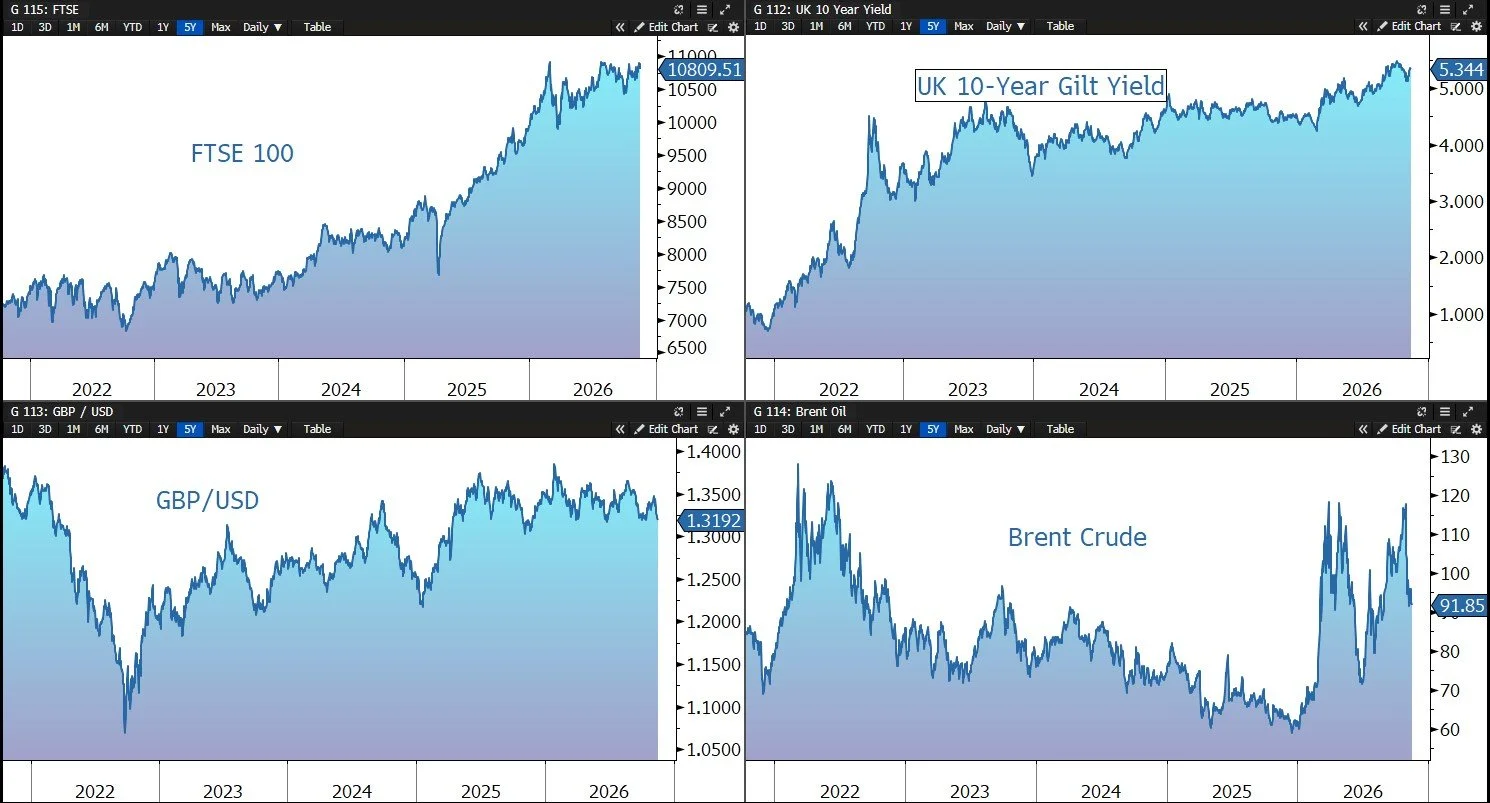
Brent crude fell to $92 a barrel, extending losses from the previous session as expectations of stronger global supply outweighed persistent geopolitical tensions in the Middle East.
Copper fell to its lowest level in more than four months, driven by the tech sell-off and weaker Chinese economic data.
The FTSE 100 is currently 0.6% lower at 10,810. Regular pay (ex-bonus) rose 3.5% year-on-year in the three months to September, below the 3.6% consensus. Sterling trades at $1.3195 and €1.1990, while the 10-year Gilt yields 5.34%.
Source: Bloomberg
Company News
Imperial Brands has released results for the financial year to 30 September 2026 which were in line with the guidance provided at last month’s trading update. Performance has been supported by higher tobacco prices and growing demand for smoking alternatives. Free cash flow generation was very strong and continues to support attractive shareholder returns. In particular, the new £1.5bn share repurchase programme which reflects management’s continued confidence in future business performance. The shares have bounced of late on the back of reassurance on current trading and are little changed in a soft overall stock market this morning.
Imperial Brands manufactures and sells cigarettes, fine cut tobacco, smokeless tobacco, cigars, and next generation products. The main brands include Winston, Davidoff, L&B, West, Gauloises, JPS, Rizla, and blu.
The 2030 strategy builds on the strong foundations of the previous five-year plan. As a ‘distinctive challenger,’ the company has two focused objectives:
· Drive sustainable value in combustibles where the company will continue to focus on its five largest markets – the US, Germany, the UK, Australia, and Spain – which represent 70% of adjusted tobacco operating profit. Within these markets, Imperial has identified specific areas for further investment by category, brand, and sales channel. Imperial has slightly tilted its strategic objective, highlighting that while market share remains important, the company will continue to balance share and value. Having successfully stabilised aggregate share across its top five markets, the company will continue to evolve its approach to reflect changing market dynamics and a focus on more profitable segments, to deliver long-term, sustainable value creation. Outside the top five markets, the company will apply the same performance-driven, consumer-led approach so that they make a greater contribution to overall performance over the next five years. Most notable is the group’s African cluster which now accounts for 10% of operating profit and is bigger than UK, Spain, and Australia.
· Build scale in next generation products (NGP) – Imperial has a strong platform for a fast growing and agile NGP business with credible brands in all three categories (vaping, heated tobacco, and modern oral) and differentiated products available in all material markets where the group has distribution routes. Imperial will retain disciplined investment and market entry criteria as it builds a meaningful business with additional growth opportunities and strong profit and cash performance. For now, however, the business remains loss-making with the company targeting a breakeven run-rate by early 2028.
To support the delivery of its strategy, the company has identified further opportunities to create a simpler, leaner, and more agile organisation. These initiatives are expected to generate annualised savings of at least £320m by 2030, the majority of which will be reinvested to support growth. In today’s announcement, management also specified that this efficiency drive involves cutting up to 2,500 jobs globally by 2030. The anticipated cash cost of these initiatives is £600m, £500m of which will fall in FY2027 and FY2028. With today’s results, the group highlights it has delivered annualised savings of £90m so far, with actions taken since the programme began supporting future savings of £180m, more than half of the target.
A strategic partnership with Capgemini gives the company access to new capabilities to support growth, including data-led insights and agentic AI, that will enable the business to capture new commercial opportunities and deliver efficiencies.
The company’s medium-term guidance for growth on a constant currency basis is: low-single digit tobacco net revenue growth and double-digit NGP net revenue growth; adjusted operating profit growth of around 3%-5%; adjusted EPS growth at a high-single digit rate, supported by a continued reduction in share count through the share buyback (see below); and annual free cash flow generation of between £2.2bn and £3.0bn.
Back to today’s results. In the financial year to 30 September 2026, tobacco and NGP net revenue grew 2.1% at constant currency to £8.5bn.
Tobacco net revenue grew by 1.7%, in line with guidance for low-single-digit growth and represents the sixth consecutive year of growth. The result was driven by robust pricing (+5.1%), partially offset by a 3.4% decline in volume (to 180.6bn sticks equivalent).
Growth in the group’s AAACE region (+2.9%) and the Americas (3.3%) offset a 0.5% decline in Europe. As expected, the company suffered a small (15 basis points) aggregate share reduction across the top five markets in the period. The company is intentionally walking away from low-margin volume to focus on profitable segments. The market’s lingering concern is that share is being lost due to increased competition.
NGP net revenue grew by 11.4% at constant currency, with performance driven by market share growth in all three categories for the third year. Strong growth in Europe and AAACE more than offset declines in US as the group withdrew its legacy myblu vape from the market. Growth has been enhanced by the acquisitions of Black Buffalo in the US and Helwit in Sweden. Going forward, the group will combine its traditional oral nicotine and NGP net revenue and adjusted operating profit and refer to it as “Smokeless”.
Adjusted operating profit rose by 3.7% at constant currency to £4,130m, within the 3% to 5% guidance range. Profit growth accelerated in the group’s second half, underpinned by the usual flow through of embedded combustible pricing taken in the first half and the phasing of investment.
Outside of tobacco, NGP operating losses were £63m, a £5m improvement on the prior year, reflecting growing profitability in Europe, offset by the inclusion of Black Buffalo in the US. Distribution (Logista), the Spanish-based distribution business in which Imperial has a 50.01% stake, grew by 4.1%, driven by an improvement in long-distance transportation.
Adjusted EPS grew by 8.8% at constant currency to 341p, in line with guidance for growth in the high-single-digits. Growth was supported by the ongoing share buyback programme (see below), partly offset by higher adjusted finance and tax costs as well as increased minority interests, given strong growth in some of the group’s African markets.
The capital allocation framework includes investment in organic growth initiatives in combustibles and NGP, while continuing to evaluate opportunities for small bolt-on acquisitions, which will be focused on enhancing NGP capabilities. The capital intensity of the business is low with modest annual capex needs of £300m-£350m – in the last year it was £326m.
The 12-month free cash flow of £2.6bn, was above guidance of £2.2bn, and reflected strong cash conversion of 102%. Following the decision of the Supreme Court of Delaware in December 2025, a payment of $150m was made to R J Reynolds in the first half of the financial year, with the remaining $162m to be made in roughly equal instalments over the next three years.
The company aims to maintain a strong and efficient balance sheet to support its investment grade credit rating with a leverage target at the lower end of 2.0-2.5 times net debt to EBITDA. Over the last year, adjusted net debt has risen from £8.4bn to £8.8bn, due to the share buyback. This leaves financial gearing of 2.0x, in line with target.
In light of the recent step-up in government bond yields, it is worth highlighting the group’s exposure to higher rates. Importantly, with 80% of its debt fixed or hedged and a well-staggered maturity profile, the group’s interest cost isn’t rising too fast and is currently around 4.4%. As a result of the improved performance and credit profile, the group’s lenders have removed the leverage and interest cover financial covenants that were a condition of the previous facilities.
The company has a progressive dividend policy that provides a reliable, consistent cash return to shareholders. Dividends per share will grow annually considering underlying business performance. The full-year dividend has been increased by 4% to 166.72p, equal to a yield of 5.6%.
Surplus capital is being returned to shareholders via an ‘evergreen’ (i.e. ongoing) share buyback over the five years to FY2030. The board will determine the quantum of future buybacks on an annual basis, in line with current practice, but has said they will be ‘material’. For FY2026, a £1.45bn programme was completed earlier than expected. At the trading update on 8 October, the company announced a new £1.5bn programme reflecting continued confidence in future business performance. The first £750m tranche is ongoing, with the entire programme expected to complete no later than 29 October 2027.
Taking dividends and the buyback together, we expect the capital return to shareholders will be around £2.7bn in FY2027, representing more than 12% of the current market capitalisation.
The company’s expectations for the financial year to 30 September 2027 are in line with its medium-term targets. On a constant currency basis, the group expects to deliver low-single-digit tobacco and double-digit NGP net revenue growth. Tobacco pricing will continue to more than offset cigarette volume declines. Adjusted operating profit is expected to grow at a similar level to FY2026 (+3.7%) on a constant currency basis. The usual second-half weighting will be more pronounced due to near-term supply issues in Ukraine on top of the phasing of price increases and investment. After restructuring costs and the second instalment of the Delaware settlement, free cash flow is expected to be at least £2.2bn in FY2027. Growth in operating profit combined with the impact of the ongoing share buyback is expected to result in at least high-single-digit adjusted EPS growth for the full year.
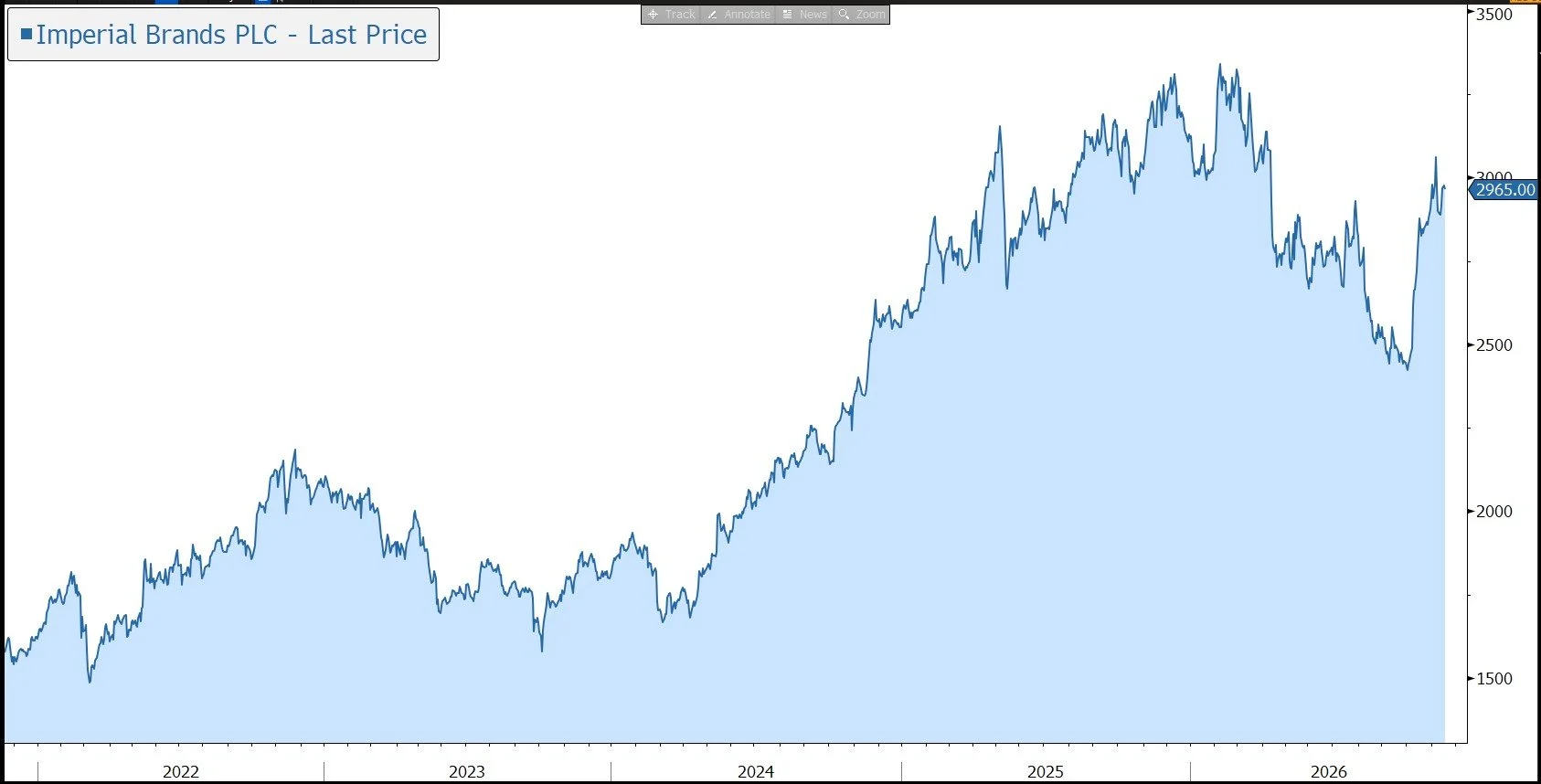
Up until the trading update at the beginning of October, the shares had been weak this year both in absolute terms and relative to the peer group for several reasons. Firstly, market share loss in the US and German combustible market, following the company’s shift to a profit over volume strategy. The concern is that there is more share to be lost. Secondly, increased competition in US next generation products which has pushed out the time to breakeven in NGP. Thirdly, Kenneth Dart (via Spring Mountain Investments) reduced his stake from 7% to 3%, and there is still a potential overhang. Fourthly, potential margin pressure due to increased shipping costs as a result of the Middle East conflict. In addition, there’s the impact of higher government bond yields to consider. As highlighted above 80% of its debt is fixed or hedged and the maturity profile is well-staggered. However, as a yield stock, higher risk-free government bond yields lower Imperial’s relative attraction to income investors.
All of this comes on top of lingering concerns after former CEO Stefan Bomhard stepped down just after launching the new strategy. While his successor, former CFO Lukas Paravicini, and current CFO Murray McGowan helped draft the 2030 plan, the transition forced the market to attach a higher ‘execution risk premium’ to the shares until the new leadership team proves it can maintain free cash flow generation.
However, following the reassuring update on 8 October and the commencement of a new buyback, the shares have bounced 20% so far this quarter.
Source: Bloomberg
