
Morning Note: Market News and an Update from Imperial Brands.
Market News
Hawkish minutes from the US Federal Reserve’s September meeting showed that all 19 policymakers supported the September rate hike, while most believed another increase would be appropriate by year-end. This reinforced the higher-for-longer narrative and pushed the US 10-year yield to 5.36%. The dollar held near three-month highs, while gold fell before regaining some of the losses to trade at $4,120 an ounce. Investors now await the latest weekly US jobless claims data for further insight into labour market conditions, with 200k the market estimate.
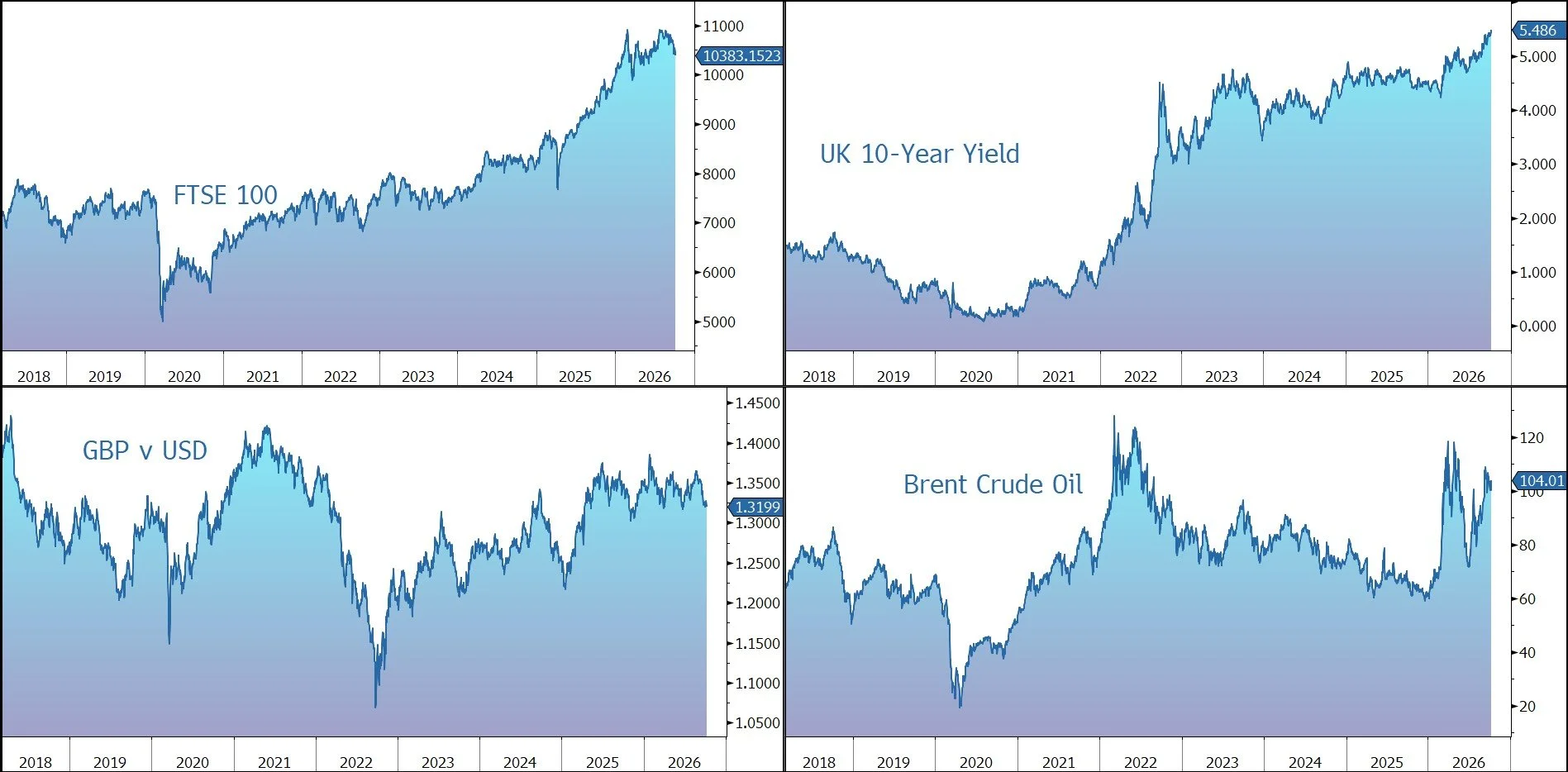
Brent Crude is trading above $104 a barrel, reaching a two-week high following reports that the Trump administration had instructed the Pentagon to develop strike options against Iran that could be carried out before the midterm elections. The development goes against the widely held expectation that the President would refrain from escalating tensions with Tehran ahead of the November polls. Meanwhile, oil producers in the Gulf of Mexico shut in more than 510,000 barrels per day of crude output, equivalent to around a quarter of the region’s production, due to Tropical Storm Isaias.
US equities traded slightly lower last night – S&P 500 (-0.2%); Nasdaq (-0.2%) – snapping a winning streak that had taken the index to an all-time high in the prior session. In Asia this morning, equity markets were also soft: Nikkei 225 (-1.4%); Hang Seng (-1.3%); Kospi (-2.6%). Samsung Electronics reported a preliminary Q3 operating profit up nearly ninefold year-on-year, driven by AI-related memory demand. However, the result still fell short of elevated analyst expectations. Prime Minister Takaichi stated Japan’s economy does not require reflationary measures and is not in a deflationary state, while affirming respect for BOJ independence.
The FTSE 100 is currently 0.6% lower at 10,383, while Sterling trades at $1.3210 and €1.1795. Imperial Brands (see below) and Tesco are both firm on the back of positive updates. Companies trading ex-dividend this morning include Barratt (0.33% price impact), Kingfisher (1.15%), Ruffer Investment Company (1.13%), and WPP (1.95%).
Lloyds house price index showed the housing market’s summer lull has extended into September and economists do not expect things to improve soon given the outlook for mortgage rates. The 10-year Gilt currently yields 5.48%, a level not seen since July 2007.
Source: Bloomberg
Company News
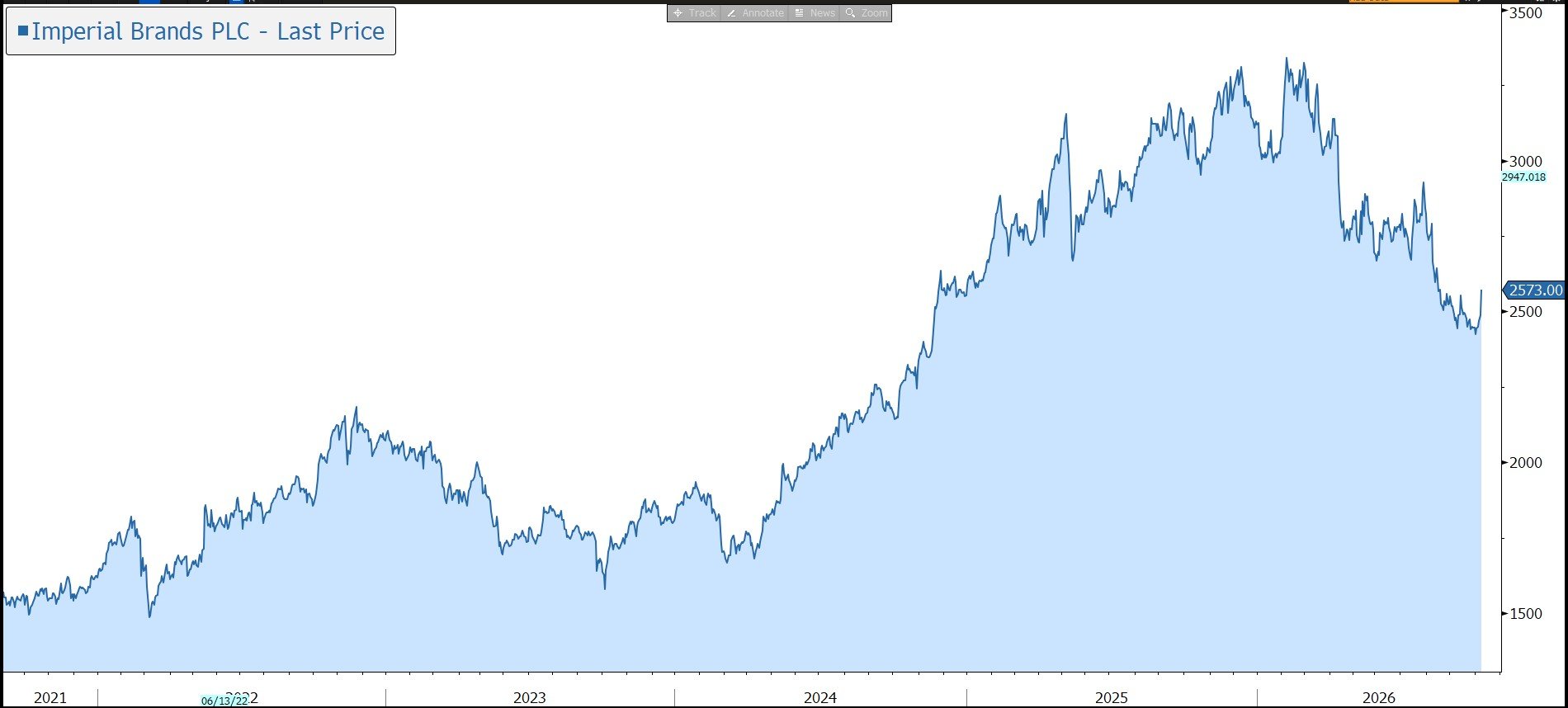
Imperial Brands has released a scheduled trading update which highlights the company is on track to deliver its guidance for the financial year to 30 September 2026 on all metrics. This is positive news given the market’s lingering doubts when performance was heavily weighted to the second half of the year. Following the early completion of the FY2026 £1.45bn share repurchase, the company has today announced a £1.5bn programme for FY2027, reflecting continued confidence in future business performance. The shares have been a weak performer this year for a number of reasons including, most recently, the impact of the sharp rise in government bond yields. However, in response to today’s reassuring update, they are up 3%.
Imperial Brands manufactures and sells cigarettes, fine cut tobacco, smokeless tobacco, cigars, and next generation products. The main brands include Winston, Davidoff, L&B, West, Gauloises, JPS, Rizla, and blu.
The 2030 strategy builds on the strong foundations of the previous five-year plan. As a ‘distinctive challenger,’ the company has two focused objectives:
· Drive sustainable value in combustibles where the company will continue to focus on its five largest markets – the US, Germany, the UK, Australia, and Spain – which represent 70% of adjusted tobacco operating profit. Within these markets, Imperial has identified specific areas for further investment by category, brand, and sales channel. Imperial has slightly tilted its strategic objective, highlighting that while market share remains important, the company will continue to balance share and value. Having successfully stabilised aggregate share across its top five markets, the company will continue to evolve its approach to reflect changing market dynamics and a focus on more profitable segments, to deliver long-term, sustainable value creation. Outside the top five markets, the company will apply the same performance-driven, consumer-led approach so that they make a greater contribution to overall performance over the next five years. Most notable is the group’s African cluster which now accounts for 10% of operating profit and is bigger than UK, Spain, and Australia.
· Build scale in next generation products (NGP) – Imperial has a strong platform for a fast growing and agile NGP business with credible brands in all three categories (vaping, heated tobacco, and modern oral) and differentiated products available in all material markets where the group has distribution routes. Imperial will retain disciplined investment and market entry criteria as it builds a meaningful business with additional growth opportunities and strong profit and cash performance. For now, however, the business remains loss-making with the company targeting a breakeven run-rate by early 2028.
To support the delivery of its strategy, the company has identified further opportunities to create a simpler, leaner, and more agile organisation. These initiatives are expected to generate annualised savings of £320m by 2030, the majority of which will be reinvested to support growth. The anticipated cash cost of these initiatives is £600m, £500m of which will fall in FY2027 and FY2028. The company is to cease production at its Langenhagen factory in Germany, either via a sale of the site to a third party or closure of the factory. Costs expected in relation to this process are within the group’s current guidance.
A strategic partnership with Capgemini gives the company access to new capabilities to support growth, including data-led insights and agentic AI, that will enable the business to capture new commercial opportunities and deliver efficiencies.
The company’s medium-term guidance for growth on a constant currency basis is: low-single digit tobacco net revenue growth and double-digit NGP net revenue growth; adjusted operating profit growth of around 3%-5%; adjusted EPS growth at a high-single digit rate, supported by a continued reduction in share count through the share buyback (see below); and annual free cash flow generation of between £2.2bn and £3.0bn.
Back to today’s update. In the financial year to 30 September 2026, tobacco net revenue is expected to show low-single-digit growth at constant currency, driven by robust pricing and share gains in the group’s target segments in US and Germany, partially offset by low-single-digit volume declines at a group level. This represents the sixth consecutive year of tobacco net revenue growth.
The company continues to build scale in NGP and expects to grow share in all three categories, with double-digit net revenue growth at constant currency. Imperial is seeing strong momentum in heated tobacco with Pulze 3.0 and new iD sticks, in vape, the blu kit range continues to perform well, and in modern oral the existing portfolio of growing brands, including Zone and Skruf, has been enhanced by the acquisitions of Black Buffalo in the US and Helwit in Sweden.
Group adjusted operating profit growth is anticipated to be within the 3% to 5% guidance range at constant currency, while earnings per share growth is expected to be in the high-single-digits.
The capital allocation framework includes investment in organic growth initiatives in combustibles and NGP, while continuing to evaluate opportunities for small bolt-on acquisitions, which will be focused on enhancing NGP capabilities. The capital intensity of the business is low with modest annual capex needs of £300m-£350m.
Adjusted operating cash conversion remains strong, and the group is on track to deliver free cash flow of more than £2.2bn for the full year. Following the decision of the Supreme Court of Delaware in December 2025, a payment of £150m was made to R J Reynolds in the first half of the financial year, with the remaining £162m to be made in roughly equal instalments over the next three years.
The company aims to maintain a strong and efficient balance sheet to support its investment grade credit rating with leverage ending the year at the lower end of its 2.0-2.5 times net debt to EBITDA target. As a result of the improved performance and credit profile, the group’s lenders have removed the leverage and interest cover financial covenants that were a condition of the previous facilities.
In light of the recent step-up in government bond yields, it is worth highlighting the group’s exposure.
Importantly, with 80% of its debt fixed or hedged and a well-staggered maturity profile, the group’s interest cost isn’t rising too fast and is currently around 4%.
The company has a progressive dividend policy to provide a reliable, consistent cash return to shareholders. Dividends per share will grow annually considering underlying business performance. The final dividend will be declared at the time of the full-year results on 17 November. We note that if the full-year payout grows in line with the half-year increase of 4%, the shares would currently yield 6.7%.
Surplus capital is being returned to shareholders via an ‘evergreen’ (i.e. ongoing) share buyback over the five years to FY2030. The board will determine the quantum of future buybacks on an annual basis, in line with current practice, but has said they will be ‘material’. For FY2026, a £1.45bn programme was recently completed, earlier than expected. With today’s update the company has announced a new £1.5bn programme reflecting continued confidence in future business performance. The first £750m tranche will commence immediately, with the entire programme expected to complete no later than 29 October 2027.
Taking dividends and the buyback together, we expect the capital return to shareholders will be around £2.7bn in FY2027, representing more than 14% of the current market capitalisation.
The shares have been weak this year both in absolute terms (-20%) and relative to the peer group for several reasons. Firstly, market share loss in the US and German combustible market, following the company’s shift to a profit over volume strategy. The concern is that there is more share to be lost. Secondly, increased competition in US next generation products which has pushed out the time to breakeven in NGP. Thirdly, Kenneth Dart (via Spring Mountain Investments) reduced his stake from 7% to 3%, and there is still a potential overhang. Fourthly, potential margin pressure due to increased shipping costs as a result of the Middle East conflict. In addition, there’s the impact of higher government bond yields to consider. As highlighted above 80% of its debt is fixed or hedged and the maturity profile is well-staggered. However, as a yield stock, higher risk-free government bond yields lower Imperial’s relative attraction to income investors. All of this comes on top of lingering concerns that the former CEO stepped down just after launching the new strategy. While former CFO Paravicini and current CFO Murray McGowan helped draft the 2030 strategy, the transition forced the market to attach a higher ‘execution risk premium’ to the shares until the new management team proves it can maintain free cash flow generation.
Source: Bloomberg
