
Market News
Global equities failed to mount a meaningful recovery overnight, after Nvidia (+5% after hours) reported stronger-than-anticipated third-quarter profits and revenue, while also raising its revenue outlook. Nasdaq futures pared most of their initial 2% gain to trade up 1%, while in Asia markets notched up small gains this morning: Nikkei 225 (+0.3%); Shanghai Composite (+0.1%); Kospi (+2.0%).
Meanwhile, SpaceX is reportedly preparing to launch $4bn of bonds as soon as this week as part of a $40bn debt sale to fund AI chip purchases, with Goldman Sachs and Apollo as underwriters, a signal of the scale of private-sector AI financing demand.
Gold has declined below $3,800 an ounce, sinking to its lowest levels in over a year as the US dollar continued to strengthen on growing expectations for a faster pace of Federal Reserve rate hikes. St. Louis Fed President Alberto Musalem indicated that several rate increases may be necessary to bring inflation under control. Meanwhile, New York Fed President John Williams also supported further tightening to contain persistent inflation but cautioned against expectations of a more aggressive rate-hiking path. Attention now turns to the release later today of the FOMC meeting minutes for additional guidance on the Fed’s monetary policy outlook. In the meantime, the yield on the 10-year US Treasury has fallen back to 5.09%.
On the geopolitical front, Presidents Trump, Xi, and Putin are due to meet tomorrow on the sidelines of the APEC summit in Shenzhen, with Ukraine having struck the Crimean Bridge on Monday as a show of force ahead of the talks. Any signal from Shenzhen on Ukraine peace terms or US-China trade could move risk assets sharply.
Brent crude remains weak ($91.50 a barrel), with supply recovery signals and higher US inventories outweighing renewed Middle East fighting.
UK headline inflation rose to 3.6%, the highest in a year, driven by a surge in energy bills and motor fuel costs. Services CPI came in at 3.7%, a touch below the 3.8% consensus. More worryingly, PPI Input surged 10.8%, significantly above the 9.2% expected, signalling persistent upstream cost pressures that could feed through to consumer prices in coming months. The data offers little comfort to the Bank of England, whose MPC members all voted for an interest rate hike earlier this month. Sterling trades at $1.3150 and €1.1995, while the 10-year Gilt yields 5.32%.

Source: Bloomberg
Company News
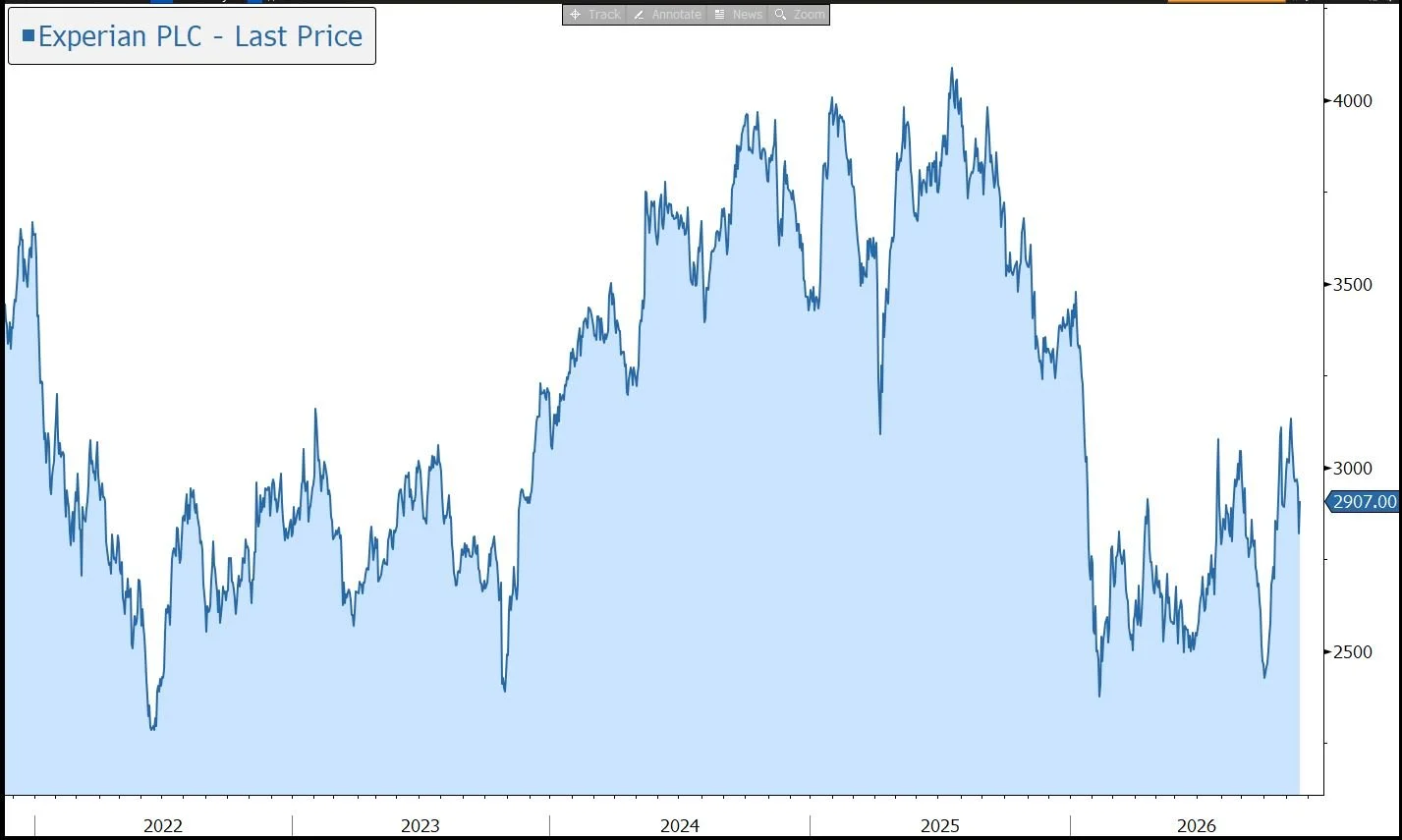
Experian has today released results for the financial half-year ended 30 September 2026. The group has started the year strongly driven by strategic progress in the B2B division and positive margin growth. The dividend was raised by 9% and company has announced a further $500m share repurchase programme. Although revenue guidance for the full year to 31 March 2027 has been trimmed slightly, due to the impact of higher interest rates on US mortgage volumes, guidance for operating margin has been increased, leaving EPS growth expectations still in the double-digits. In response, the shares have been marked up 1% in early trading.
Experian is a global information services company that helps businesses to manage credit risk, prevent fraud, target marketing offers, and automate decision-making. The group also helps individuals check their credit report and credit score and protect against identity theft. The company has credit data on 200m businesses and 1.4bn people, with over 215m consumers on the group’s free finance platform.
The ownership of such rich, unique, and valuable data has become more important in an increasingly digital world, and the group is targeting a total addressable market of more than $155bn.
Experian operates an attractive business model where its customers supply the company with raw credit history data for free under strict reciprocal data-sharing agreements. The company aggregates it, applies analytics and tools, and sells it back to the customers as a credit report. The industry operates as an oligopoly with high barriers to entry because of large historical databases and regulatory know-how.
The company has shifted from simply supplying data to selling enhanced decision tools and analytics software which are essential in automating customers’ decisions, helping to reduce costs, and managing risk. Experian Ascend is the company’s flagship, cloud-based data, analytics, and AI platform. Instead of requiring enterprise clients (such as banks, credit card issuers, mortgage lenders, and retailers) to manually pull static files, Ascend integrates Experian’s vast credit, fraud, and demographic datasets directly with a client’s own internal data into a single, secure environment. In the latest half-year, Ascend client solutions increased by 20% to 2,600, while platform capabilities increased by more than 25% to 43. By the end of 2025, Ascend’s fraud prevention tools had helped clients avoid $19bn of losses.
As a result, customer relationships are very ‘sticky’, with renewal rates of 90%, and revenue is very resilient. The business has a long history of weathering uncertainty – notably, revenue grew in organic terms in both the Great Financial Crisis (GFC) of 2008 and the COVID-19 pandemic of 2020. Although credit application volumes slow in a recession, we believe the company has a natural hedge of risk management and asset protection products, as well as exposure to healthcare and other defensive segments.
Regarding the potential opportunities and threats posed to the business by AI, we believe that although AI can replicate parts of the company’s business – analytical software or marketing data without proprietary credit rails – it cannot replicate its economic moat of exclusive access to proprietary data, legal and regulatory infrastructure, and reciprocal data agreements.
AI is only as good as the data it’s trained on. Large Language Models can’t see private bank accounts or individual credit histories due to strict regulatory frameworks. As a result, we believe Experian is relatively well placed given its hard-to-replicate proprietary datasets with scope to accelerate product innovation and increase operational efficiency, ultimately enhancing margins. AI has made identity theft and fraud incredibly easy to scale (e.g. deepfake voices for bank authorisation or AI-generated synthetic identities), forcing banks and other businesses to upgrade their defences. Furthermore, AI generated a 30% improvement in developer productivity in the latest six months, while labour costs, at 32% of revenue, are over 300 basis points lower than two years ago.
We note the announcement earlier in the year from Fair Isaac (FICO), the company behind the credit scores that lenders use, of the launch of a new Direct License Program. Traditionally, Experian (along with its rivals) act as the middleman, ‘marking up’ FICO scores and re-selling them to lenders. FICO’s new programme allows lenders to bypass the credit bureaus to some extent, threatening a high-margin revenue stream. That said, FICO still cannot generate a score without the bureaus’ raw data.
There are other risks to the business, including the threat of a breach of IT security that could result in reputational and legal damage, the risk of adverse regulatory changes, and the risk of a very deep recession. However, we believe the company is well placed to cope with these threats.
Although the company is listed in the UK, it reports its results in US dollars.
Back to today’s results. In the six months to 30 September, revenue from ongoing activities grew by 8% at constant exchange rates to $4,448m. In organic terms (i.e., underlying before M&A), growth was 7%, versus the full-year guidance range of 6%-8%, and driven by new product innovation, client wins, and consumer expansion. Growth in the group second quarter was 7%, in line with Q1.
The company continued to strengthen its differentiated data assets, scaled its platforms, and accelerated the deployment of AI across both the B2B and Consumer businesses. This is helping to win important new B2B clients and deepen existing relationships, create new propositions and expand into new markets and distribution channels.
Building on last year’s strong renewal performance, Experian continues to see strategic clients in North America renewing contracts at higher values and for longer durations. These wins reflect the value of combining proprietary data with analytics, decisioning, and increasingly AI-enabled capabilities through integrated platforms.
All regions contributed to organic revenue growth during the period. In the group’s largest division, North America, which accounts for two-thirds of revenue, organic growth was 6%. B2B organic revenue growth in the region was 11%, while Consumer Services fell 4%. Elsewhere, growth in EMEA/Asia Pacific was 3%, Latin America was 15%, and UK & Ireland 4%.
By division, B2B (74% of the total) serves the Financial Services sector (54%) and other Verticals (20%) such as automobile, health, and marketing services. During the half-year to 30 September, revenue was up 9% in organic terms. Growth was strong across both Financial Services and Verticals, supported by healthy client demand, new business wins, and continued product innovation.
The Consumer Services unit (26% of revenue) has become one of the largest platforms in the world to help consumers manage their personal finances and to save money. The group currently has over 215m free members. In the half-year, revenue grew by 1% in organic terms, reflecting the anticipated temporary headwinds in North America from the roll off of two long-term contracts supporting consumers impacted by large data breaches and a contractual catch-up from a large insurance marketplace carrier in the prior Q2 period.
‘Benchmark’ operating profit from ongoing activities grew by 10% at constant exchange rates to $1,279m, with the margin up by 50 basis points at constant currency to 28.8%, versus the medium-term framework to grow by 30-50 basis points. This reflected 110 basis points of underlying progression from operating leverage and productivity, partially offset by 60 basis points of dilution from FICO mortgage royalty cost pass-through and acquisitions. ‘Benchmark’ EPS rose by 15% to 97.5c.
The business is very cash generative, with conversion of 81% and operating cash flow up 16% to $1,029m, in what is the seasonally weaker half. The post-tax return on capital employed is 17.3%. The group ended the period with financial leverage of 1.9x net debt to EBITDA, below the target range of 2.0x-2.5x.
Cash flow is sensibly reinvested in organic and strategic investments that generate attractive returns. Capital expenditure focused on data, technology, and new products and represented 8% of revenue. The group invested $329m on acquisitions to support strategic growth, including Own Up, an AI-powered mortgage platform in North America, Konfir, an income and employment verification business in the UK and Ireland, and idwall, an identity verification business in Brazil.
The interim dividend was raised by 9% to 23.25c. The group also spent $780m repurchasing its own shares. The company has now completed its $1bn programme announced in January 2026 and has today announced a further $500m buyback to run until June 2027.
The company has adjusted its guidance for the financial year to March 2027. Organic revenue growth is expected to be 6%–7% (versus 6%-8% previously), reflecting the effect of higher interest rates on US mortgage volumes, with strong momentum continuing across the rest of the business. The company expects around 10% Benchmark EBIT growth and around 12% Benchmark EPS growth (versus double-digit growth previously), with margin expansion now of at least 50 basis points (vs. at the higher end of 30-50 basis points previously). Cash flow conversion is still expected to be above 90%.
Source: Bloomberg
