
Market News
US equity futures are staging a rebound this morning – S&P 500 (+2%) and Nasdaq 100 (+3%) – after the S&P 500 entered a technical correction on Friday, falling for a seventh consecutive session and posting its worst weekly decline since the pandemic-era sell-off. Anthropic’s record IPO failed to revive the AI trade, instead deepening concerns about AI monetisation and lofty valuations, while Nvidia – already under pressure from Jensen Huang’s resignation and an SEC accounting probe – fell a further 14% on Friday to an 18-month low. Given the fragility of sentiment, time will tell how durable the rebound is.
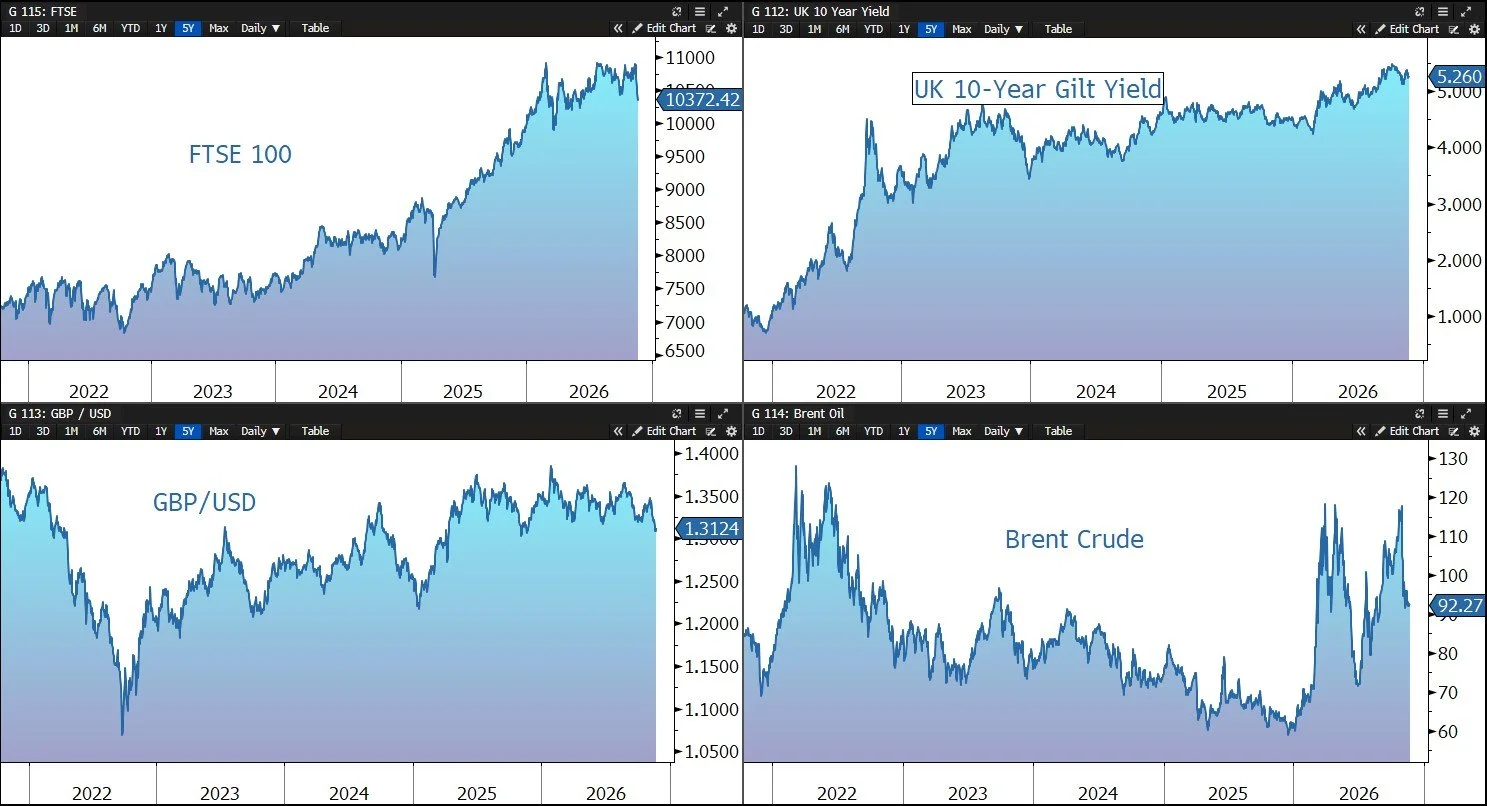
Asian equities were mixed overnight. South Korea’s Kospi slid as much as 5% before paring losses (-3.3%) after state support measures were announced. Chinese shares closed marginally higher (+0.2%) after the CSRC lowered margin requirements for leveraged stock purchases. Japan was closed for a holiday. The FTSE 100 is currently 0.2% higher at 10,372. Sterling trades at $1.3140 and €1.1945, while the 10-year Gilt yields 5.26%.
Gold has rebounded back above $3,600 an ounce, reversing losses from the previous session as traders dialled back bets on US Federal Reserve interest rate hikes. US Treasury Secretary Scott Bessent cautioned that the Fed could put the US economy at risk by tightening monetary policy too aggressively in response to recent inflation data. The yield on the 10-year US Treasury nudged higher but remains below 5%. The key data out today is the US Purchasing Managers’ Index (PMI), a monthly economic survey that measures whether business activity in the manufacturing and services sectors is expanding or contracting.
Brent crude fell to $92 a barrel, entering a fourth week of declines as expectations of strong global supply offset concerns over escalating geopolitical tensions in the Middle East.
According to the FT, Compass Group, the world’s largest caterer, plans to shift its primary listing to New York from London, in a move that would deal a further blow to the UK stock market. The company is scheduled to report its full-year results tomorrow. Drax is trading 6% higher after announcing its full-year cash profit (EBITDA) will be significantly above current consensus of £721m and its dividend will grow by over 10% p.a. to 2031. The UK housebuilding sector is under pressure this morning, with Crest Nicholson down 30% after warning of a full-year adjusted loss of £30m–£40m with challenging trading expected to persist into 2027.
Source: Bloomberg
Investment Trust News
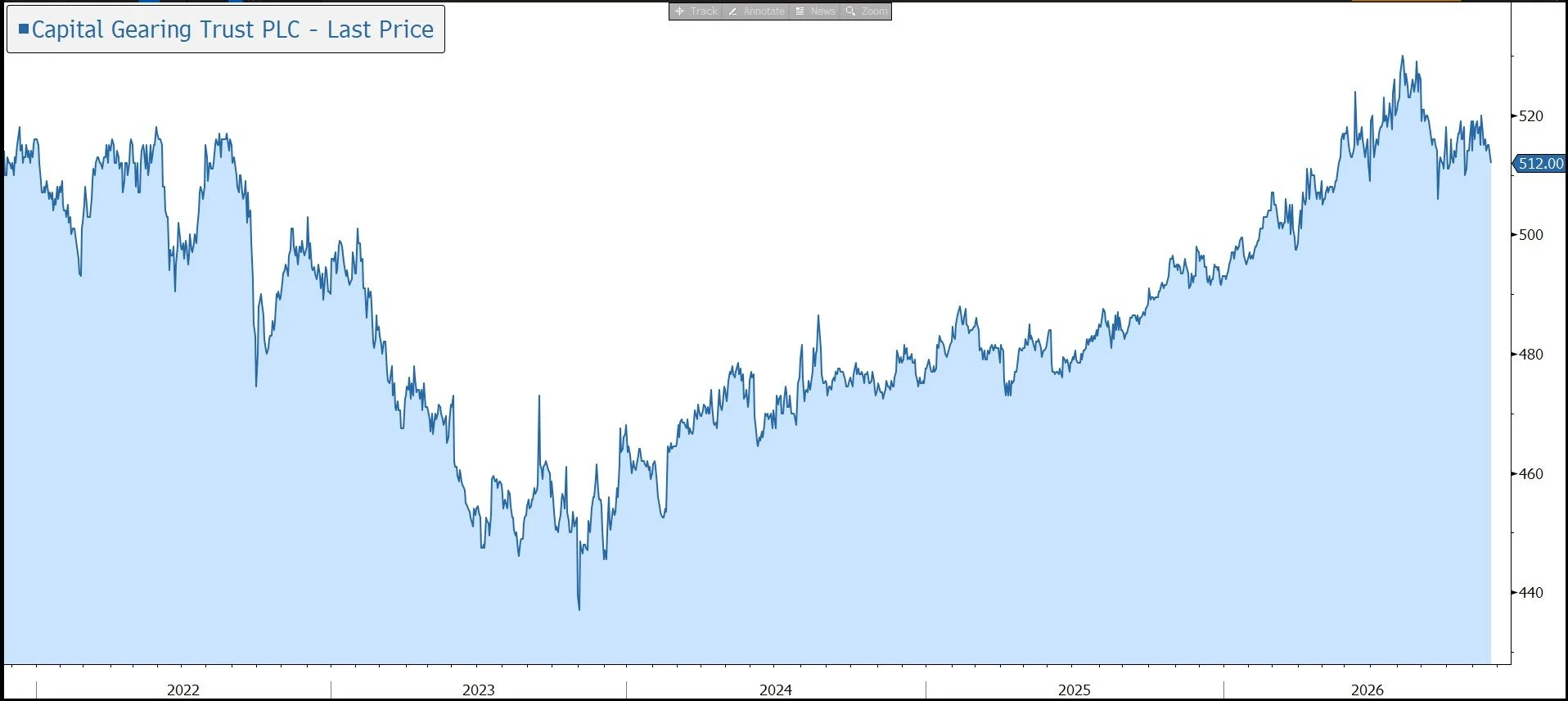
Last week, Capital Gearing Trust released results for the financial half-year to 30 September 2026. Performance has been robust, with the NAV outpacing inflation. The manager remains cautious on the medium-term outlook and the portfolio is very defensively positioned. The shares, which are listed in the FTSE 250 Index, remain on a small discount to NAV and the company continues to buy back its shares.
Capital Gearing Trust (CGT) is a closed-ended listed vehicle with a goal to preserve and grow shareholders’ real wealth over time. The strategy is managed by the investment team at CG Asset Management, led by Peter Spiller, Chris Clothier, and Emma Moriaty.
In order to enhance the marketability of the shares, the company undertook a 10-for-1 stock split in July 2026.
The c. £800m fund is actively managed, without reference to a benchmark, with a total return mindset made up of capital growth and income. A cautious asset allocation aims to avoid losses and, as a result, the fund tends to lag during large equity market upswings. In 2022, for example, a year in which a 30/70 equity/bond portfolio fell by 11.4%, the fund NAV was only down 3.2%.
The fund is made up of a global portfolio of equities, bonds, commodities, and alternative assets, which are split into three core components:
· Managed Liquidity Reserve (29% - formerly dry powder, i.e. cash, treasury bills, and high quality short-dated corporate credit).
· Inflation-Linked Bonds (49% - UK and US).
· Risk Assets (22% - i.e. listed funds with underlying holdings in equity, infrastructure, and alternative assets).
Annualised performance since 2000 (to Q3 2026) has been good: share price (+7.3%) versus CPI (+2.6%). In the six months to 30 September 2026, the share price rose by 5.3%, versus an NAV total return of 3.2% and CPI of 2.2%.
During the last half-year, equity markets performed strongly, recovering quickly from the negative shock experienced at the outset of the Iran conflict. Bond yields rose across developed markets, with the UK 10-year gilt yield ending the period at 5.4%, more than 0.4% higher than at the start of the six months.
The Company’s shorter-duration exposure drove outperformance across US TIPS, UK index-linked gilts and corporate credit relative to benchmarks, despite inflation-linked bonds being the only asset class to detract from overall returns amid rising real interest rates. So far, real interest rates have risen in lockstep with nominal interest rates. Some commentators have suggested that this rise in real interest rates is due to the bond market anticipating rising productivity from AI. The manager thinks otherwise, and believes the reason is rather more prosaic, highlighting that with ever greater issuance, ever higher yields are required to entice investors to part with their capital.
While the company’s modest equity allocation detracted from performance during strong equity markets, the equity portfolio returned 18%, outperforming the MSCI World Index by 2.3% in sterling terms. The fund had a relatively large number of investment trust special situations conclude favourably during the period, including Pacific Assets (+21%) and Impax Environmental Markets (+22%). North Atlantic Smaller Companies delivered a 29% return during the half, driven by a mixture of good portfolio performance and by it repurchasing 3.6% of its shares. No stocks in the portfolio underperformed materially.
The company saw continued strong performance in its infrastructure holdings, with the share prices of HICL, INPP, and 3IN rising 13%, 8%, and 18% respectively. These positions have been trimmed as they approach fair value, with the manager somewhat surprised at how resilient they have been in the face of rising bond yields. This contrasts starkly with the performance of other assets with similar financial characteristics such as long-lease property.
Looking forward, the manager continues to view the medium-term outlook with caution – the global investment environment continues to be marked by elevated levels of uncertainty. Persistent inflationary pressures, rising interest rates, concerns over AI investment returns, and ongoing geopolitical tensions are reshaping market dynamics. In response, the company remains defensively positioned with a focus on inflation protection. The manager is confident that the portfolio offers attractive real yields while taking little interest rate or credit risk.
The share price total return of the listed vehicle tends to be more volatile than the NAV, with larger drawdowns during periods of equity market weakness. CGT operates a zero-discount control policy (DCP) between a 2% discount to 2% premium. When the shares are trading at a premium, new shares are issued at a premium. When the fund is trading at a discount, as it is at present (1.0% on 19 November), the accretion from the share buyback programme helps to cover the fund fees. During the half-year, CGT repurchased £8.6m of its shares.
The company pays an annual dividend, and to mitigate the corporation tax liability from higher bond income, the board has designated two-thirds of the distribution as an interest distribution. The ongoing charges ratio (OCR) remains competitive at 0.58%.
Source: Bloomberg
