
Market News
Anthropic’s IPO soared on its first day following the AI lab's record-setting fundraising. The shares opened 34% above their $83 offering price at $111.50 each, briefly conferring on Anthropic a $2 trillion market value. However, they closed only 17% higher at $97 and have drifted back to $91 in extended trading.
The IPO overshadowed another rough day on Wall Street amid ongoing concerns over elevated AI valuations and financing risks: S&P 500 (-2.0%); Nasdaq (-2.3%). Nvidia’s leadership crisis, along with a bearish report from short seller Hunterbrook Capital highlighting AMD’s dependence on Chinese markets and supply chains, further weighed on market sentiment. Intuit fell by 10% following the release of weak guidance and news that it will sell its Mailchimp unit for a third of its 2021 purchase price.
The negative trend continued in Asia this morning: Nikkei 225 (-5.1%); Hang Seng (-2.2%); Shanghai Composite (-1.2%); Kospi (-5.2%). In the futures market, the Nasdaq is currently trading down a further 1%.
The yield on the US 10-year Treasury note has eased toward 5%, extending its decline for a fifth consecutive session as the sell-off in global equities fuelled demand for safe-haven bonds.
In contrast, gold isn’t acting as a safe haven – the price has fallen toward $3,500 an ounce, reaching its lowest level since September 2025 and heading for a sharp weekly decline of nearly 9%. The precious metal has faced significant selling pressure this week as the US dollar strengthened amid growing expectations of a more aggressive monetary tightening stance by the Federal Reserve. Higher interest rates raise the opportunity cost of holding non-yielding assets such as gold, reducing its appeal to investors. Gold has also come under pressure from liquidity needs, as the AI-driven sell-off in global equities prompted investors to liquidate bullion holdings to cover losses in other markets.
The key US data release today is the University of Michigan final consumer sentiment print. With the preliminary reading at 51 and 1-year inflation expectations at 4.3%, any upside surprise could reinforce the hawkish Fed narrative and extend the equity sell-off. Fed speakers also remain in focus after a week of hawkish commentary.
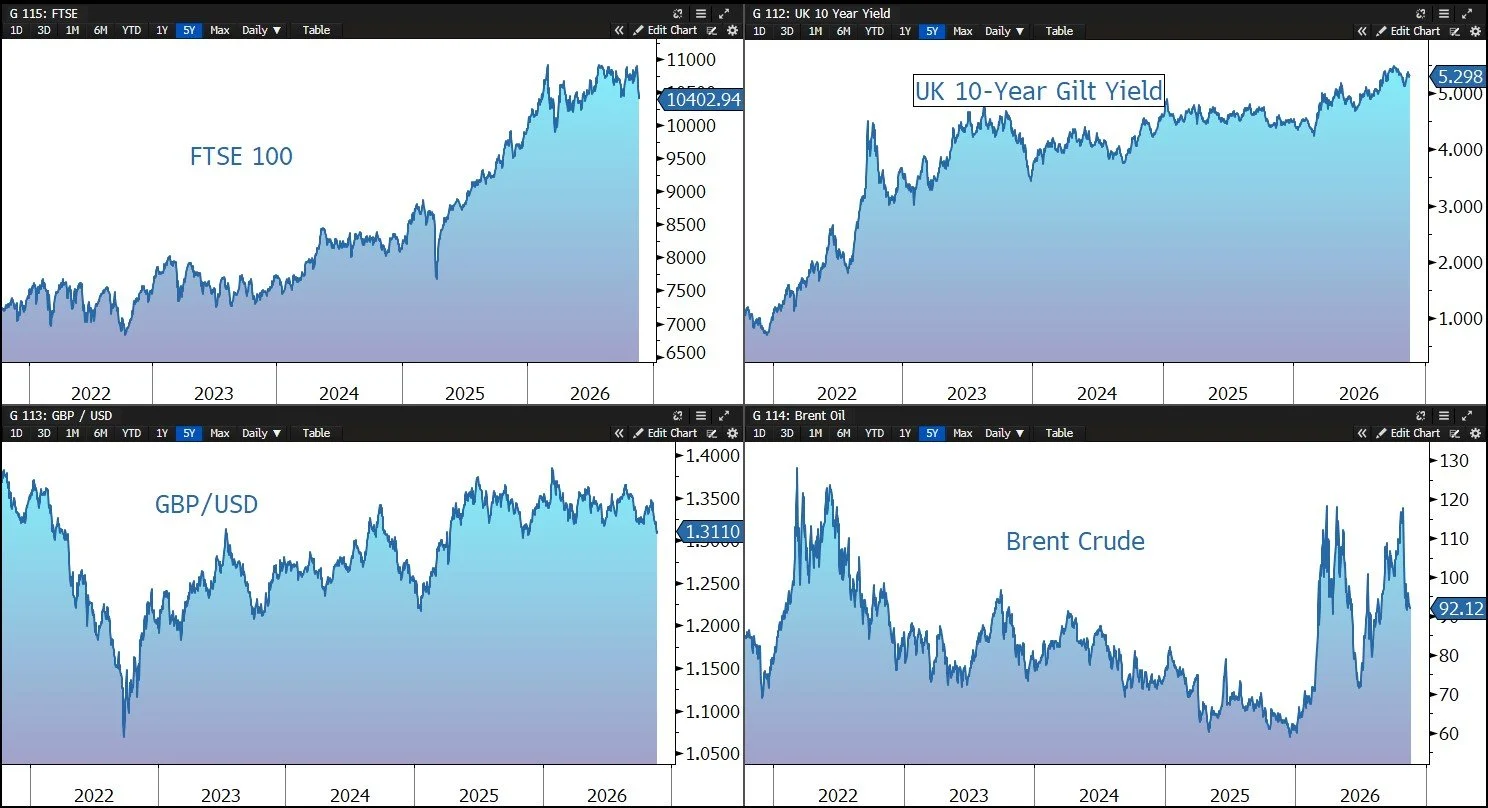
Brent crude edged above $92 per barrel but remained on track for a third consecutive weekly decline, as signs of abundant global supply outweighed concerns over potential renewed US strikes on Iran. US Energy Secretary Chris Wright said oil flows through the Strait of Hormuz had reached record levels as Middle Eastern supplies continued to recover. Meanwhile, the US, China, and Russia agreed at a trilateral meeting on Thursday to boost the production and supply of refined petroleum products.
The FTSE 100 is currently 0.4% lower at 10,414. Retail sales (including fuel) rose by 0.7% month-on-month in October, versus zero growth expected and a 0.4% decline in the previous month. The bounce was driven by government warnings to stock up on emergency supplies. Meanwhile, Monetary Policy Committee member Megan Greene warned that five-plus years of above 2% inflation poses a credibility risk to the Bank of England, stating “the risk of not doing enough is bigger than” the alternative – a hawkish signal ahead of the next MPC meeting. Sterling trades at $1.3120 and €1.1940, while the 10-year Gilt yield drifted to 5.28%.
Source: Bloomberg
Company News
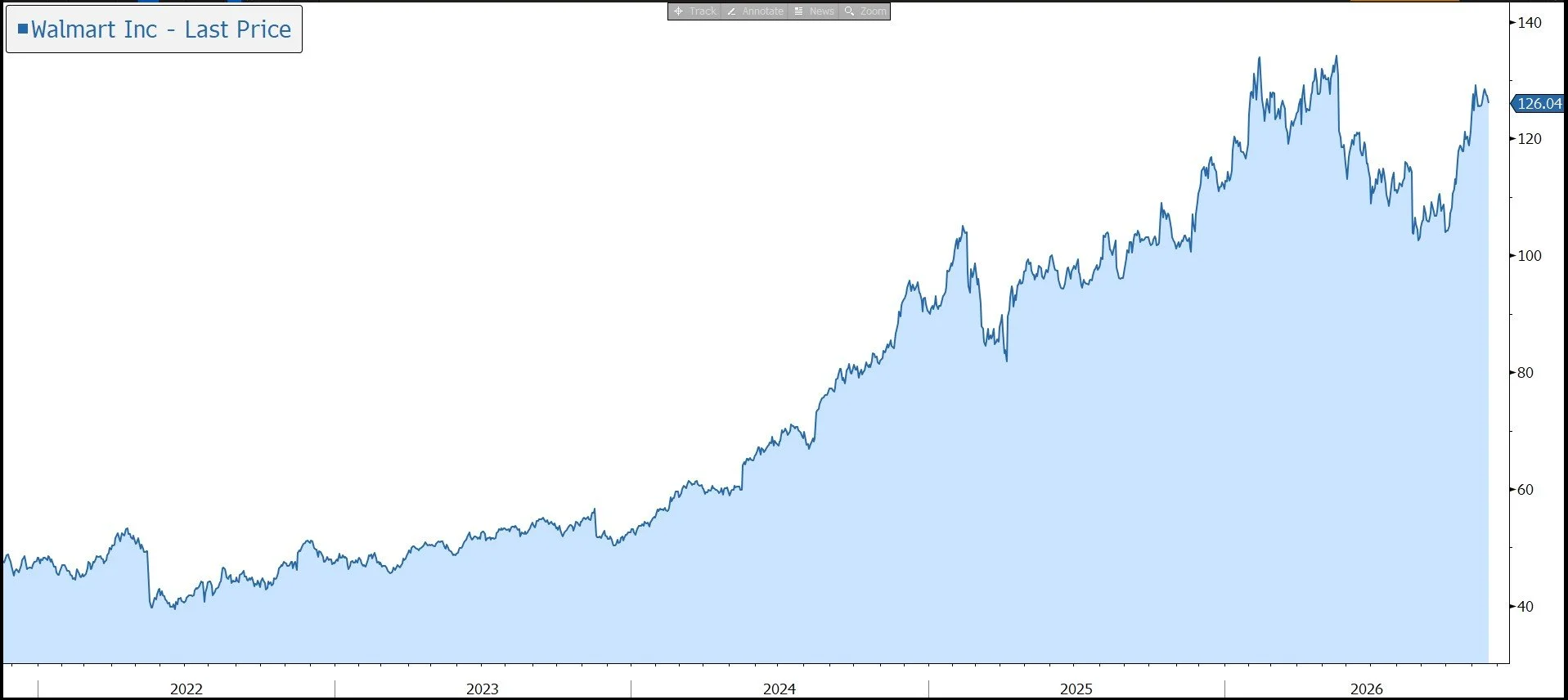
Yesterday lunchtime, Walmart released results for the three months to 31 October 2026, the third quarter of its financial year to 31 January 2027. Earnings came in slightly above the market forecast, driven by growth in the core business and increased market share. The company raised its guidance for the full-year. Although the figures were robust, they were not enough to push the stock higher after a strong pre-earnings run, and the shares were marked down by 2%.
Walmart operates more than 10,900 stores and numerous e-commerce websites under 46 banners in 19 countries. In the face of strong competition, the group’s strategy is ‘to lead on price, invest to differentiate on access, be competitive on assortment, and deliver a great experience’. This means the company can often weather economic storms better than others.
During the three months to the end of October, total revenue increased by 4.5% on a constant currency (CC) basis to $188.8bn, slightly better than the company guidance. eCommerce sales were up 17% globally, led by store-fulfilled pick-up & delivery, while global advertising sales were up 25%. Membership fee revenue grew 17% globally. The company recently launched a new membership bundle in the US, combining Walmart+ and Sam’s Club Plus for $120 annually.
In the US, comparable sales increased by 2.9% (ex-fuel) to $125.0bn, in line with the market forecast. The result was made up of a 1.5% increase in transactions (i.e., volume) and 1.4% rise in average ticket (i.e., price). Continued strong momentum in eCommerce (+23%) and broad-based share gains were partially offset by 70bps headwind to comp sales from pharmacy deflation related to new maximum fair price regulation.
Sam’s Club, the trade business, generated revenue of $22.3bn, up 4.9% in comparable terms (ex-fuel), led by grocery and general merchandise.
Outside of the US, the International business grew by 3.3% at CC to $34.7bn, with broad-based strength across markets.
The group’s gross margin rose by 28 basis points to 24.5%, primarily driven by improved business mix and merchandise mix shifts in Walmart US. Adjusted operating income was up 5.5% at CC to $7.7bn, above the 2%-4% guidance range as the group kept a tight rein on costs. Adjusted EPS was up 4.8% to 65c, versus the market forecast of 64c.
Global inventory was up 8.1% to $70.6bn, due to strategic initiatives, the timing of seasonal events, and cost inflation.
In the year to date, free cash flow has fallen by $2.0bn to $6.8bn, driven by a $4.0bn increase in capital expenditure to support the group’s omnichannel growth strategy. Net debt ended the quarter at $60.9bn. During the quarter, the group issued $6.5bn in long-term debt at favourable rates for general corporate purposes.
Excess cash is being returned to shareholders through dividends and buybacks. During the quarter, the group bought back $2.7bn of its shares, leaving $22.4bn of its $30bn repurchase authorisation. Earlier in the year, the annual dividend was increased by 5% to $0.99.
Guidance for the financial year to January 2027 has been raised, driven by growth in the e-commerce division. The company now expects consolidated net sales growth of 4.9%-5.2% at constant currency (vs. 4.0%-5.0% previously). Adjusted operating income growth is now expected to be 8.0%-8.6% (vs. 7.0%-8.5% previously), while adjusted EPS is expected to come in at $2.84-$2.89 (vs. $2.80-$2.87 previously).
Source: Bloomberg
