
Morning Note: Market News and an Update on Winton Trend Fund.
Market News
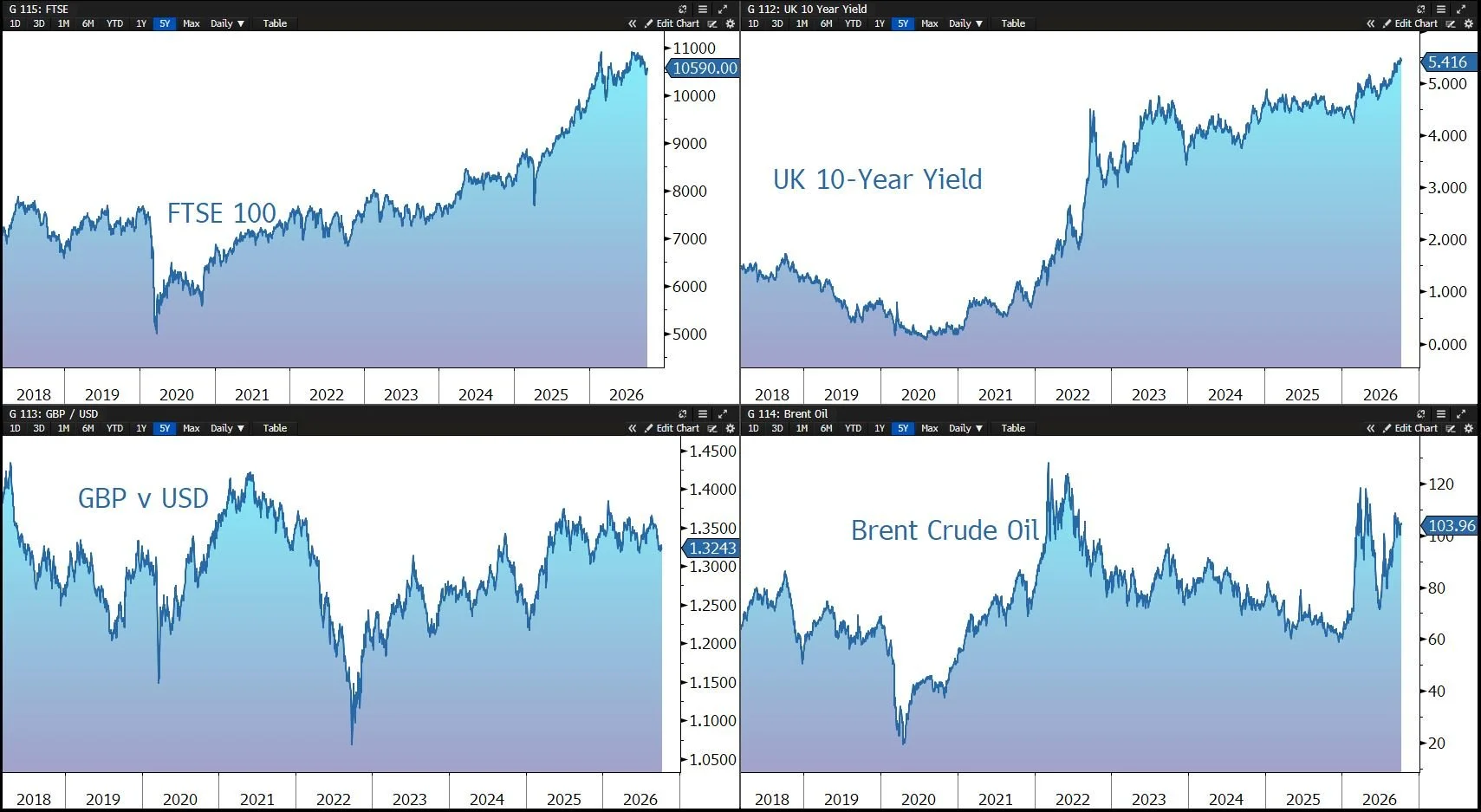
Brent crude fell back to $103 a barrel after President Trump announced a Russia-Ukraine “energy ceasefire” — a claim Ukraine disputed as attacks on energy infrastructure continued overnight.
Gold is trading at $4,180 an ounce, while the yield on the 10-year US Treasury is 5.24%. With the US bond market closed today for Columbus Day, European bond markets will set the tone. The UK 10-year gilt yield remains above 5.4%, close to a recent 19-year high.
In Asia this morning, South Korea’s Kospi slid 3.7% on its return from a long weekend, dragged lower by chip stocks. Elsewhere, equity markets were mixed: Nikkei 225 (flat); Hang Seng (+0.2%); Shanghai Composite (-0.4%). The S&P futures are currently predicting a 0.3% rise at the open this afternoon.
The FTSE 100 is currently 0.4% higher at 10,590. Recruitment company Hays is down 10% in early trading following the release of a muted update. Sterling trades at $1.3240 and €1.1820.
The Q3 US earnings season formally kicks off tomorrow with JPMorgan, Goldman Sachs, Citigroup, and Wells Fargo all reporting before the open. Last Friday, Delta Airlines cut its full-year adjusted EPS guidance to $5.10–$5.60 from $6.50–$7.50, citing elevated jet fuel costs. The revision signals mounting pressure across the airline sector.
The European Commission is reportedly preparing safeguard measures to cap imports of Chinese hybrid vehicles, which now account for approximately a quarter of total European hybrid sales. Germany and France separately urged the EU to adopt new powers to cut off single-market access if China destabilises trade relations.
Source: Bloomberg
Investment Fund Update – Winton Trend
Diversification across asset classes is a critical element of managing your investments. At Patronus, when we construct a portfolio, we look to allocate a portion of capital to so-called ‘anti-fragile’ investments that provide shelter in difficult times when other (‘fragile’) asset classes (such as equities and bonds) are struggling to generate a positive return. We believe the Winton Trend Fund is one such investment.
Winton Trend is an actively managed fund which seeks to achieve long-term capital appreciation through a trend following strategy. The manager invests in a diversified portfolio of financial contracts (derivatives) that provide a return linked to the performance (up or down) of certain share indices, bonds, commodities, and currencies. Although the fund has a relatively short track record (since July 2018), it has performed very well in times of market stress.
Total assets in the UCITS vehicle currently stand at around $1.3bn, while the overall trend strategy has assets of $4.2bn.
· The correlation to equities and bonds is low.
· The fund employs a low level of leverage – the margin-to-equity ratio is currently 9.9%.
· The annualised volatility is the rate at which the price of a fund increases or decreases for a given set of returns (i.e. magnitude of the fund’s price fluctuations over time). It is measured by calculating the standard deviation of the fund’s monthly returns and is currently 8.8%. The manager seeks to mitigate sharp reversals – positions decrease when volatility increases and the system naturally takes profits.
· Despite periodic bursts of outperformance for faster systems, Winton believes the evidence still suggests stronger performance for slower systems over most investment horizons. The fund continues to trade a blend of speeds with the twin aims of maximising risk-adjusted returns and portfolio diversification.
· The fund is relatively low cost: 1% OCR (of which Management fee is 0.80%) and no performance fee.
The manager highlights that although trend-following strategies are often associated with strong performance in difficult times for the stock market, the strategy can also perform well at the same time as equities. What is more important for trend followers is the diversity of the trends on offer – the strategy tends to perform strongly when there are large moves relative to volatility in markets across multiple sectors. Managers can therefore increase the consistency of a trend-following strategy’s returns by maximising the range of idiosyncratic trends in which the strategy can participate.
Although it is difficult to predict where trends will come from, an investor can identify the types of environments where trend-following works well. These are environments where there is a high level of uncertainty that leads to large market moves that are difficult to price in.
Last year, a cross-sectional trend-following system in equity indices was introduced. The system had been traded in Winton’s Diversified Macro CTA since 2021 and is designed to be non-directional, taking long positions in outperforming indices and short positions in underperforming indices. The system has had low correlation with the strategy’s directional trend-following in stock indices and other sectors historically. The allocation to the signal is intentionally small, with the aim of modestly improving the overall strategy’s Sharpe ratio, while retaining the performance properties associated with directional trend following.
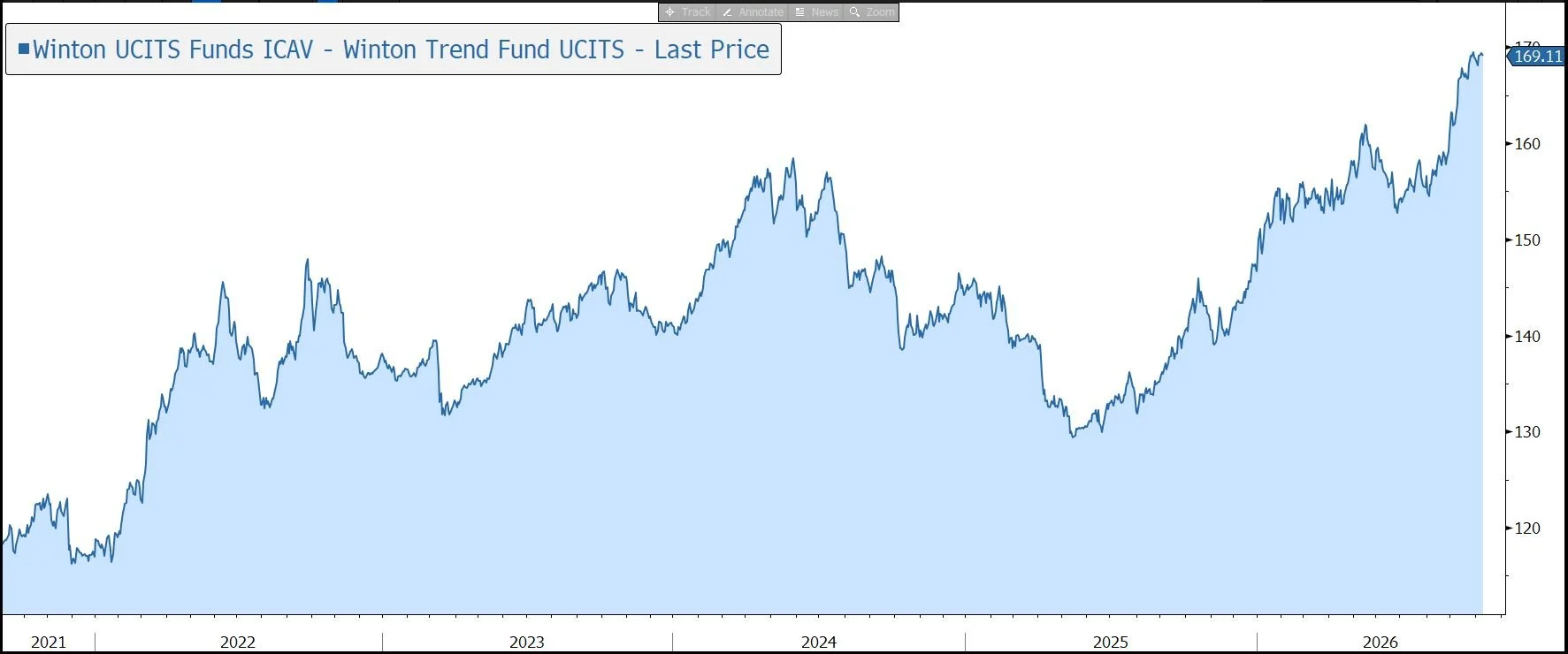
Overall, we believe the decision to hold the fund depends on whether it will perform well and provide capital protection during periods of market stress. Clearly, 2022 was such a year, with a marked pick-up in risk and volatility as a result of Russia’s invasion of Ukraine. The fund achieved an 18% positive return – outstanding in the context of the heavy fall in both equities (-8% for the MSCI World Equity Index in Sterling terms) and UK bonds (-15% for the Bloomberg/Barclays Bond Indices UK Govt 5-10 Year Index). On this measure, a typical 60/40 equity/bond portfolio was down by 10.8%.
Trend-following funds tend to struggle when a market moves sideways or oscillates and when there is a sharp reversal in a trend.
The Winton Trend strategy generated a strong 9.5% return in the third quarter of 2026, driven by profits in fixed income, energies, and base metals, which outpaced losses from agricultural commodities, equity indices, and precious metals.
This brought the year-to-date return to +15% and the five-year annualised return to +7.4%.
Q3 performance was ahead of the peer group. The SG Trend Index was up 4.3% (with returns for the largest strategies ranging from -4% to +12%), with tilting to slower models, particularly in fixed income and energies, providing an edge.
Looking at the performance of Winton Trend in the third quarter in detail:
· Fixed income was the primary driver of performance over the quarter (+8.2%), with the strategy’s short positioning in the sector profiting as renewed concerns about the inflation outlook pushed yields higher. Short positioning in the US yield curve led performance, with the 10-year treasury note yield surpassing 5% for the first time since 2023. The Bank of Japan raised its benchmark rate to a 31-year high in September, with the strategy’s long positioning in government bonds profiting as the country grappled with normalising monetary policy after decades of near-zero rates.
· Long positioning in energies was another notable contributor. The resumption of US-Iran hostilities pushed oil prices higher, with profits subsequently accruing across the oil complex. Natural gas was another source of profits, with long positioning in UK and Dutch markets and short exposure to US natural gas all generating returns.
· Base metals were a more modest source of profits, with profits from long copper and zinc positioning and short nickel exposure leading gains in the sector.
· Agricultural commodities weighed on returns over the quarter. Disruption to Black Sea grain supplies and concerns about the impact of a strong El Niño on crop-growing regions pushed prices higher in the sector.
· Equity indices ended the quarter lower as gains from cross-sectional signals were outpaced by losses from directional trend following.
In terms of positioning, the strategy headed into the final quarter with short positioning in fixed income and precious metals, and long exposures in crops, equity indices, energies, and base metals. These positions will continue to adapt systematically to the prevailing trends as markets price in ever-developing geopolitical and macroeconomic news.
We remain positive on the fund given its portfolio diversification attributes. At a time when the geopolitical and macro-economic outlook is uncertain and the prospects for other asset classes remain unclear, we believe an allocation to Winton Trend Fund could continue to help mitigate any losses suffered elsewhere in portfolios.
Source: Bloomberg
