
Morning Note: Market News and an Update from BP.
Market News
Global equities extended their record rally as momentum in technology shares accelerated and geopolitical tensions eased: S&P 500 (0.6%); Nasdaq (1.2%). In Asia, equities were more mixed: Nikkei 225 (+0.2%); Hang Seng (-1.1%); Shanghai Composite (-1.2%).
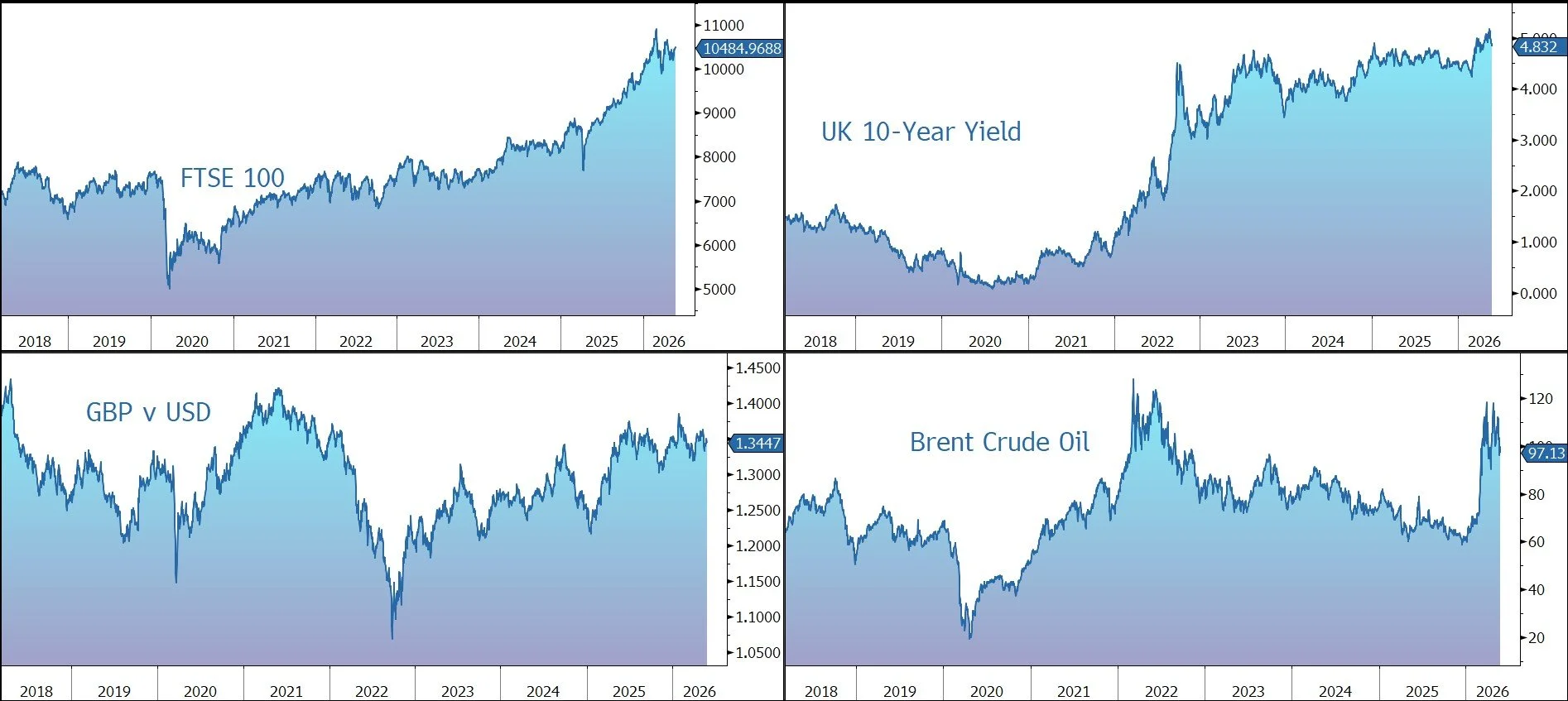
Brent crude has fallen to $97.50 a barrel, resuming a decline as investors assessed signs of potential progress toward a US-Iran peace agreement alongside renewed tensions and lingering uncertainty surrounding the strategic Strait of Hormuz. The US conducted defensive strikes on missile launch sites and Iranian vessels attempting to lay mines in southern Iran. CENTCOM described the action as necessary to protect US forces during the ceasefire period. Iran labelled the strikes a “flagrant violation” of the April truce.
Treasuries extended their gains, sending the yield on the benchmark 10-year lower by one basis point to 4.47%. Gold has slipped to $4,475 an ounce.
The FTSE 100 is currently little changed at 10,485. BP (see below) has steadied after yesterday’s decline. Sterling trades at $1.3445 and €1.1545, while the 10-year Gilt yield trades at 4.87%. UK households face the biggest increase in energy bills since 2023 after Ofgem raised the energy price cap by 13% from 1 July.
Tony Blair criticised the Labour party for “playing with fire” in its attempt to oust Keir Starmer, while also slamming the government for lacking a clear agenda.
Source: Bloomberg
Company News
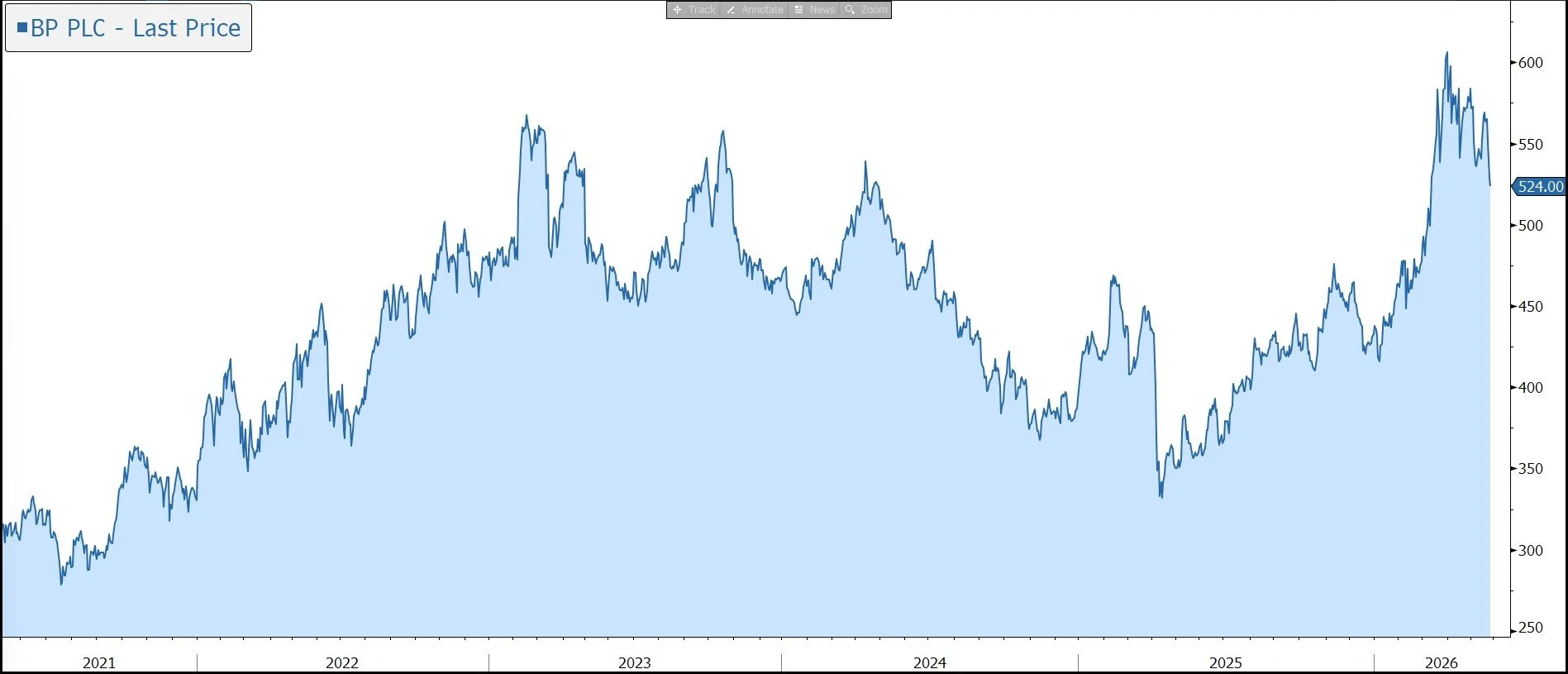
Yesterday lunchtime BP announced the immediate removal of its Chairman due to serious concerns regarding governance standards, oversight, and conduct. Although the company reaffirmed its strategic direction and commitment to strong operational performance and financial discipline under new CEO Meg O’Neill, the shares fell by 5% on concerns over the future direction of the company. The hope now is that the CEO will be left to focus on driving the company forward; otherwise, any prolonged depression of BP's relative valuation will leave it increasingly vulnerable to a hostile takeover.
BP is a global integrated energy company undertaking a strategic reset involving a reduction of capital expenditure, a reallocation of spend away from low carbon activities, and a significant cost reduction programme, all of which will drive improved cash flow and returns to support a stronger balance sheet and resilient distributions.
Following last year’s appointment of Albert Manifold as Chairman, the company had accelerated the delivery of its plans, including undertaking a thorough review of its portfolio to drive simplification and targeting further improvements in cost performance and efficiency. On 1 April, Meg O'Neill, the ex-CEO of Woodside Energy, became BP’s new CEO – the first outsider to lead the company in its century-plus history. She was tasked with driving this transition further and had already disclosed the company will be reorganised into two main business units – one for upstream and one for downstream.
In a surprise statement yesterday, the company announced it had unanimously decided to remove Albert Manifold as Chair and Director with immediate effect due to serious concerns regarding governance standards, oversight, and conduct. Ian Tyler has been appointed Interim Chair with immediate effect and a succession process for a permanent Chair will be initiated.
The company has deliberately kept the exact details under wraps for now. However, removing a major FTSE 100 chairman this quickly, without a transition period, indicates a severe breach of company standards rather than a routine disagreement over business direction.
Reports from insiders and whistleblowers suggest Manifold was viewed as too aggressive, with control exerted more akin to that of an executive chairman. Insiders claim he attempted to restrict the newly appointed CEO from meeting independently with non-executive directors. Encouragingly, the lack of financial details in the company’s release suggests the issue is purely behavioural/governance-related rather than financial fraud.
Manifold had already survived a shareholder rebellion at the company’s AGM last month, with 18% of investors voting against his election, after advisory group Glass Lewis raised concerns about governance and recommended investors oppose his re-election.
The company has been plagued by leadership instability. It is the second time in less than three years that a top executive has been forced out for conduct reasons—following the shock resignation of CEO Bernard Looney back in September 2023. Serious questions will now be asked about the board’s vetting and decision-making processes.
The timing of the dismissal is also unfortunate given Manifold played a key role in the removal of former CEO Murray Auchinloss and the recent appointment of new CEO Meg O’Neill.
However, the company has reaffirmed its strategic direction and commitment to strong operational performance and financial discipline under the CEO who has ‘already taken bold action to simplify and strengthen the organisation.’
The hope is this removes a source of boardroom friction and leaves the new CEO to get a grip of the company at a time when radical restructuring is required; the concern is that the company has become almost ungovernable with serious questions about executive stability and structural churn.
In the meantime, the ousted Chairman has fiercely disputed these claims, stating he was removed without warning and without explanation, leaving the company potentially faced with a (high profile and distracting) legal action.
If this chaos causes BP’s share price to continue to lag behind the other oil majors, it could attract a hostile takeover.
Source: Bloomberg
