
Morning Note: Market news and an update from BP.
Market News
President Trump said he’ll announce his Fed chair pick “soon.” He also touted plans to award payments to service members and roll out housing reforms to address economic anxieties during his prime-time address. The 10-year Treasury yield slipped to 4.14%.
The Bank of England is poised to cut rates by a quarter point to 3.75% today, responding to cooling inflation and economic struggles. The ECB is seen keeping the borrowing costs at 2%, with analysts expecting the rate to stay there through 2027. The 10-year gilt yield has fallen to 4.49%.
US equities fell last night – S&P 500 (-1.2%); Nasdaq (-1.8%) – as AI names retreated. However, Micron rose 10% post-market after giving an upbeat forecast for the current quarter. OpenAI held preliminary talks with investors to raise as much as $100bn at a valuation of about $750bn, The Information reported.
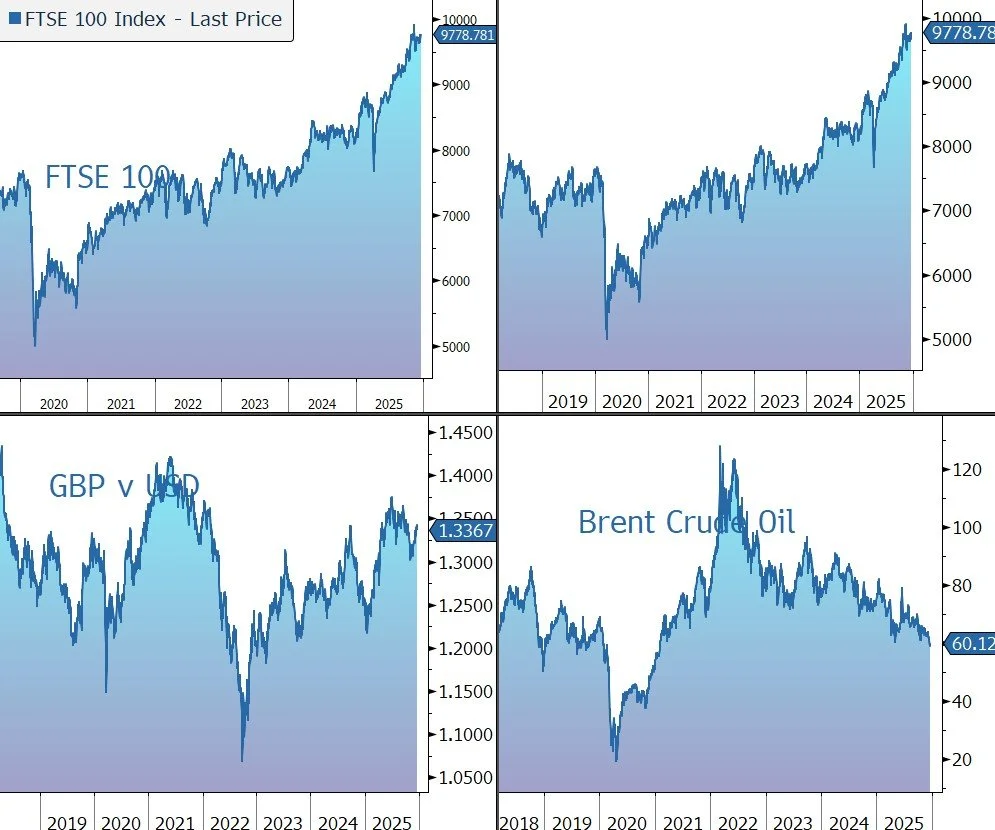
In Asia this morning, equity markets were mixed: Nikkei 225 (-1.0%); Hang Seng (+0.1%); Shanghai Composite (+0.2%). The FTSE 100 is currently little changed at 9,779, while Sterling trades at $1.3350 and €1.1385. Gold moved up to $4,325 an ounce, while Brent Crude is back up to $60 a barrel
Rising costs are pushing inactive Brits back into the workforce, the latest data suggests. The inactivity rate – measuring those neither in work nor looking for it – has fallen to 21%, close to pre-pandemic norms.
Source: Bloomberg
Company News
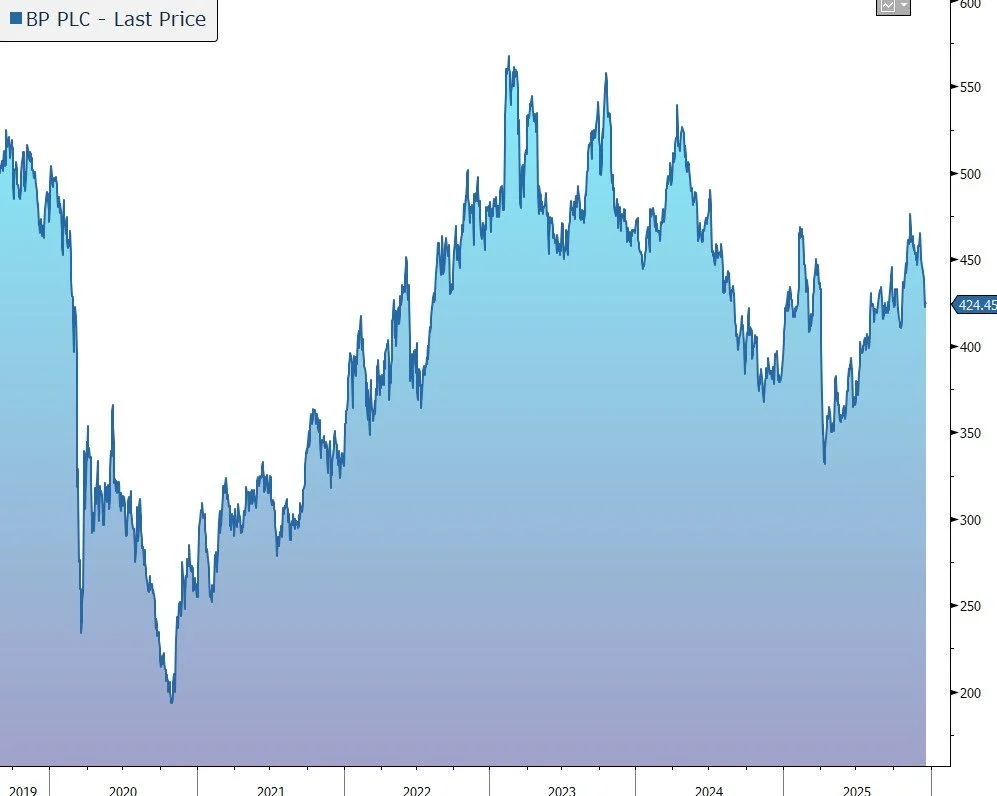
BP has today announced a leadership transition, appointing Meg O'Neill as its next CEO effective April 1, 2026, while Murray Auchincloss will step down as CEO today. Carol Howle will act as interim CEO until O'Neill assumes the role. Although today’s announcement will create turbulence and uncertainty in the short term, we expect the pace of change at BP to accelerate once the new CEO is in place. The reaction to the announcement has been mixed and hence the share price is little changed in early trading.
Over the last five years, BP has been gradually transforming from an International Oil Company (IOC) to an Integrated Energy Company (IEC). However, performance has been disappointing and the market has questioned the company’s ability to generate a return on investment at a time when the world was more focused on security of supply and affordability. As a result, the group’s share price performance relative to industry peers has been poor.
Earlier this year, BP announced a reset of its strategy which will involve reducing capital expenditure and reallocating spend back toward the exploration & production business (i.e. the Upstream), significantly reducing costs, and driving improved performance in cash flow and returns to support a stronger balance sheet and resilient distributions. However, some shareholders (notably activist investor Elliott Investment Management) would have liked the company to go further.
In October, Albert Manifold (ex CRH) became Chairman, following which the company said it was looking to accelerate delivery of its plans, including undertaking a thorough review of its portfolio to drive simplification and targeting further improvements in cost performance and efficiency.
Today’s announcement that Meg O'Neill is to be company’s next CEO is the next stage in this process.
O’Neill currently serves as CEO of Woodside Energy, the Australian petroleum exploration and production company. Since her appointment as CEO in 2021, O’Neill has grown the company into the largest energy company listed on the Australian Securities Exchange. She oversaw the transformative acquisition of BHP’s petroleum assets, creating a geographically diverse business with a portfolio of high-quality oil and gas assets. Before joining Woodside Energy in 2018, O’Neill spent 23 years at ExxonMobil in technical, operational, and leadership positions around the world.
The BP Chairman highlights that following a comprehensive succession planning process, the Board believes this transition creates an opportunity to accelerate the company’s strategic vision to become a simpler, leaner, and more profitable company, aiming to maximise shareholder value.
In the transition period until the new CEO joins in April 2026, Carol Howle, current executive vice president, supply, trading & shipping of BP, will serve as interim CEO. With 25 years at BP, she has a deep knowledge of the company and will ensure strategic continuity until O’Neill joins. In addition, the current CEO, Murray Auchincloss will serve in an advisory role until December 2026 to ensure a smooth transition.
The reaction to the announcement has been mixed and hence the share price is little changed in early trading.
· O’Neill is the first outsider in BP’s century-plus history. This is probably much needed given the company’s mediocre performance held back by complexity, lack of focus, and internal bureaucracy – BP has more than three times the number of staff per barrels of oil equivalent produced than Chevron and Exxon. The worry is that O’Neil has not managed a company anywhere as large, complex, and political as BP, with 20 times the number of staff as Woodside. However, with no legacy baggage and the Chairman’s full backing, O’Neill is well-placed to disrupt for change.
· O’Neill’s reputation is in the upstream operations, in particular LNG, with a skillset closer to that of a COO rather than CEO.
· She has little or no experience in managing businesses in the downstream (i.e. refining and chemicals), retail, or trading – this could mean a sale of BP’s assets in these sectors.
· As Woodside CEO, her investment decisions had a lower return profile than practically anything BP does in upstream oil and gas.
· O’Neill does have M&A experience. Clearly given BP’s stretched balance sheet and shareholders demand for attractive returns, disposals would be preferred to acquisitions. As a smaller company, BP would clearly be vulnerable to a predator.
Although today’s announcement will create turbulence and uncertainty in the short term, we expect the pace of change at BP to accelerate once the new CEO is in place.
Source: Bloomberg
