
Morning Note: Market News and an Update from Atlas Copco.
Market News
A deepening rout in AI-related equities dominated overnight price action, with the Philadelphia Semiconductor Index having slumped 6.7% yesterday, dragging the Nasdaq Composite down 2.6% and the S&P 500 lower by 1.2%. Asian markets extended the sell-off before staging a partial recovery: the Korean Kospi trimmed an early 4.1% plunge to end the session 0.3% higher, while the Nikkei pared losses to around -0.3%. Global credit spreads hit a 17-month high at 129 basis points.
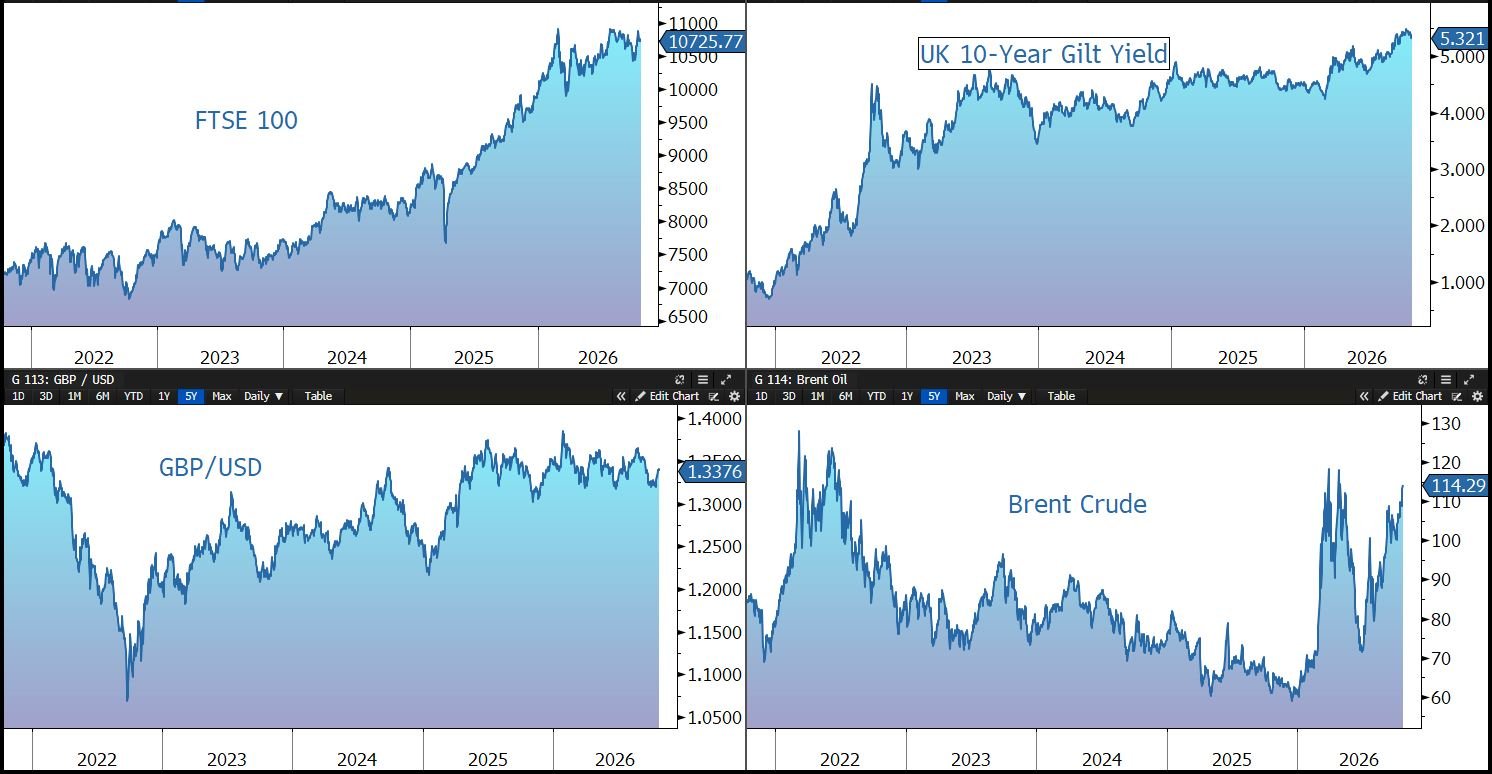
The tech rout triggered a classic haven rotation: Treasuries posted their best single day in over two years, with the 10-year yield plunging 17 basis points before retracing to 4.98% this morning.
Brent crude extended gains to $114 a barrel, a five-month high. Escalating Houthi attacks on Saudi targets and Iran's threat to invade neighbouring countries if attacked are the primary drivers. US crude exports to Asia are reportedly set to hit multi-year lows as tanker lease costs for the Pacific route hit a record of nearly $80m.
Gold dipped below $4,000 an ounce before paring losses to $4,015. Newmont, the world’s largest gold producer, reported Q3 adjusted EPS of $2.20, beating estimates by $0.23.
Today’s flash PMIs for France, Germany, the UK, and the US will be closely watched for signs that the AI investment boom and geopolitical uncertainty are feeding into real-economy weakness. Japan’s core CPI (ex-fresh food) rose to 2.1% year-on-year in September, above the Bank of Japan’s 2% target for the first time this year, reinforcing the case for a widely expected December rate hike.
President Putin has reportedly proposed a three-way summit with Trump and Xi Jinping next month to negotiate a Ukraine settlement on terms favourable to Moscow, according to people familiar with the discussions. France’s Yellow Vests movement has called for a second round of protests on Saturday, adding to market turmoil.
The FTSE 100 is currently 0.4% lower at 10,686, while Sterling trades at $1.3375 and €1.1945. UK retail sales fell 0.4% month-on-month in September, worse than the -0.1% consensus, as above-average temperatures hit autumn clothing demand and food volumes declined. Meanwhile, GfK Consumer Confidence fell sharply in October to -24 vs survey -14 and prior -13, the largest miss in recent months, pointing to deteriorating household sentiment. The 10-year Gilt yields 5.33%.
Source: Bloomberg
Company News
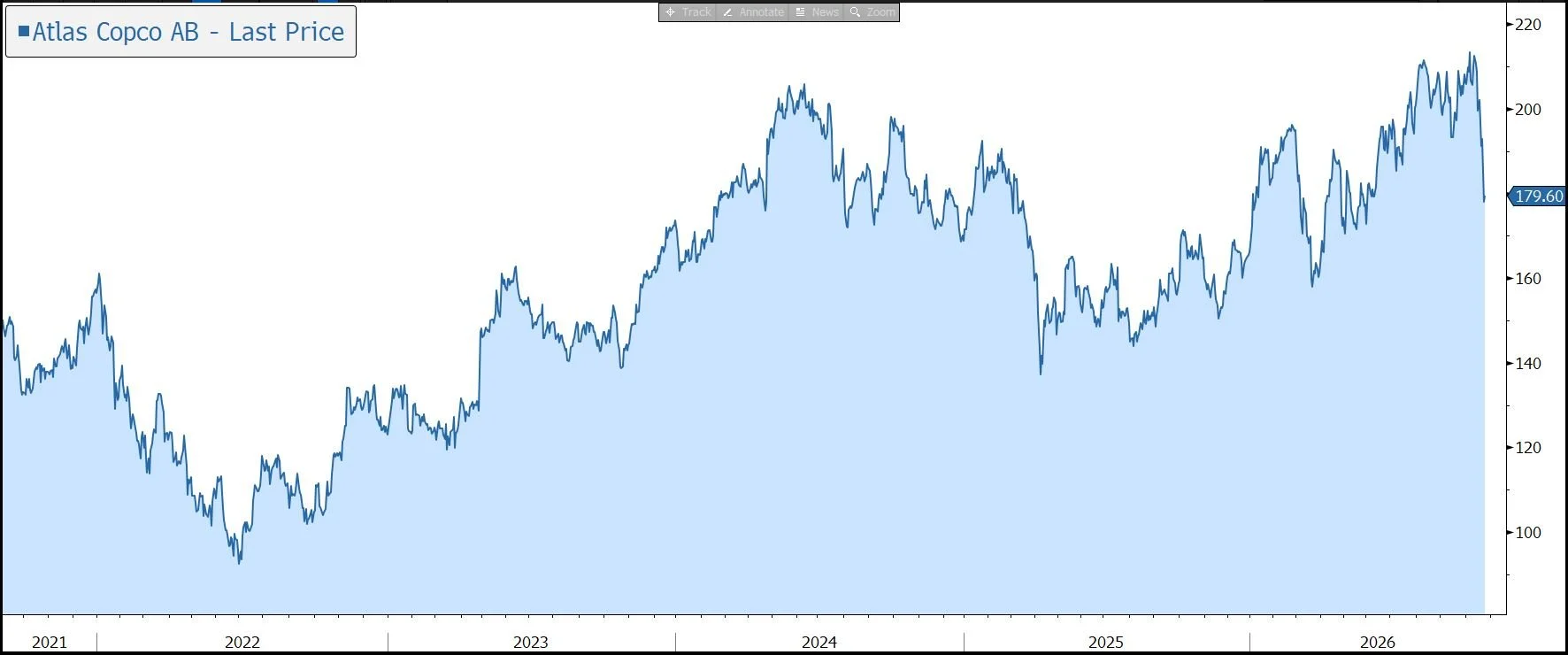
Yesterday lunchtime Atlas Copco released Q3 2026 results which were slightly below the market forecast. The company generated strong orders, record revenues, and solid cash flow. The growth was primarily driven by higher demand for vacuum equipment to the semiconductor industry, while most other product groups and the service business also delivered solid growth. The main disappointment was the Compressor business where the margin slipped. Looking forward, in the near term the group expects customer activity to remain at the current level. In response, the shares, which are listed in Sweden, were marked down by 7%. We remain positive on the long-term outlook for the company as it is a quality compounder exposed to attractive growth trends.
Atlas Copco is a world-leading manufacturer of innovative compressors, vacuum solutions, generators, pumps, power tools, and assembly systems. The group has a diverse customer base made up of general manufacturing (22%), process industry (20%), electronics/semiconductors (16%), construction (12%), automobile (10%), and other sectors (20%). Many of the products are critical to customers’ operations, helping to increase operational performance, save energy costs, reduce contamination, cut down on failures in the field, lower noise levels, and extend service intervals.
As a result, the company provides exposure to a broad range of trends: demand for increased energy efficiency and reduced emissions; increased use of lightweight materials in transport industries; the transition from petrol to electric vehicles; increased use of demanding materials and production environments in processes for semiconductor and industrial production; increased production automation and smart factories; and increased demand for digitally-supported service offers. Overall, Atlas will play a role in the effort to reorganise and improve the resilience of supply chains, bring manufacturing closer to domestic markets, and increase automation in the face of higher labour costs or deteriorating demographics. Finally, over time the vacuum business should benefit from the expansion of the North American semiconductor manufacturing market.
Product innovation lies at the heart of the business, with initiatives including advanced battery-powered torquing tools, automated dispensing systems, and vision-enabled machine systems. In the current environment, energy efficiency is a key driver of innovation – a new hybrid generator is capable of delivering up to an 80% reduction in fuel consumption compared to standard diesel units.
Atlas Copco is a giant in its niche – it is three times the size of its nearest competitor in compressors and has a near-50% market share in semiconductor vacuum. The group is also the market leader in most industrial and power equipment niches in which it operates.
The target is to increase revenue by 8% p.a., primarily through organic means, complemented by selective acquisitions of companies in or close to existing core competencies. Using a decentralised structure, the company lets these small bolt-on companies run autonomously while plugging them into its global service network.
The group operates an asset-light strategy – only components that are critical to the performance of the equipment are manufactured in-house. The company has integrated itself with its customers and can provide rapid and extensive support to their installed base of equipment. Almost 40% of revenue (and c. 60% of operating profit) is generated from service (i.e., spare parts, maintenance, repairs, consumables, accessories, and rental). This is more stable than equipment sales and provides a strong base for the business and greater resilience in difficult times. The cost of the group’s equipment is low relative to the customer’s overall operating costs, and as a result, the company has strong pricing power, helpful when trying to pass on raw material cost inflation or tariffs.
The Wallenberg Family (through its holding company, Investor) is the largest shareholder in Atlas Copco, having overseen its entire history, and has a member on the Board. The business is run for the long term in a way that ensures it is passed on to the next generation in better shape than it was inherited, with a focus on consistent operational culture, financial prudence, and sensible capital allocation. Atlas Copco is based in Sweden and reports in Swedish Krona (SEK).
During the third quarter of 2026, the overall demand for Atlas Copco’s equipment and services was very strong, and order intake increased significantly. The growth was primarily driven by higher demand for vacuum equipment to the semiconductor industry, while most other product groups and the service business also delivered solid growth. The service business, including specialty rental, continued to grow, with increased order intake across all business areas and regions. Overall, it looks like customers are not deferring or delaying their capex plans despite the geopolitical and macro volatility, as they are now accustomed to such a backdrop.
Revenue increased by 15% in the quarter to SEK 47.9bn, a touch above the market forecast of SEK 47.7bn. In organic terms, which excludes M&A (+3%) and currency (+1%), revenue was up 11%. This compares to 8% growth in the previous quarter and +9.7% expected by the market. The group continued to see positive price growth across all segments.
Order intake was up 25% in organic terms in the quarter to a record SEK 52.3bn. The growth rate was in line with the elevated rate of 26% in the prior quarter and primarily driven by explosive demand in Vacuum Technique (+82%) from semiconductor customers.
Atlas Copco operates through four divisions or ‘Techniques’, with the performance in the latest quarter as follows:
· Compressor Technique (45% of 2025 sales) is the world leader in the provision of compressed air and gas solutions, such as industrial compressors, gas and process compressors and expanders, air and gas treatment equipment and air management systems. During the latest quarter, organic revenue and orders rose by 5% and 6%, respectively. Order intake increased for both industrial compressors and gas and process compressors. Profits came in below expectations (SEK 4.80bn vs. SEK 5.24bn) and the margin slipped from 25.3% to 23.6%. On the call the company disclosed that it is happy to sacrifice some margin to invest in growth.
· Vacuum Technique (22% of sales) provides vacuum products, exhaust management systems, valves and related products. Organic revenue rose by 28%, while orders soared by 82%. Order intake for vacuum equipment increased sharply, primarily driven by higher demand from the semiconductor industry, while scientific and general industrial vacuum applications also delivered significant growth. On the call the CEO revealed that to meet the sheer volume of customer demand for advanced and mature semiconductor nodes, Atlas Copco is continuing to ramp up capacity. The company is also putting in place actions to provide protection for when the cycle eventually turns down.
· Industrial Technique (16% of sales) provides industrial power tools, assembly tools, machine vision solutions, quality assurance products, and the associated software and service. Organic revenue and orders rose by 2% and 12% respectively. Solid order growth was achieved for industrial assembly equipment and vision solutions to the general industry and automotive markets.
· Power Technique (17% of sales) provides a range of portable air and power, industrial and portable flow solutions. The business unit also provides specialty rental and service through global network. Organic revenue and orders rose by 14% and 13%, respectively. Order volumes for power equipment increased markedly, driven by higher demand for products such as portable compressors and industrial pumps.
Atlas Copco generates attractive margins, with gross margin above 40%, providing some shelter against rising raw material costs. The company aims to maintain an operating margin of 20%–22% over a full business cycle, anchored by Compressor Technique operating margins that consistently sit around 23%–24%. In Q3, adjusted operating profit increased by 15% to SEK 10.2bn, a touch below the SEK 10.4bn market forecast. The margin was unchanged in organic terms to 21.3%, with the impact of higher organic revenue volumes, offset by currency and acquisitions. EPS rose by 15% to SEK 1.58.
The return on capital employed is very high. Although it has slipped over the last 12 months from 25% to 24%, it is still well above the group’s 20% target and 8.0% cost of capital. The group continued to consolidate its industry with acquisitions, with 29 deals closed in 2025 and a further 13 so far this year. Just after the quarter end, Atlas completed the acquisition of Euroklimat, a Chinese manufacturer of industrial heating and cooling solutions. The price was not disclosed for a company that generated sales of SEK 1.8bn (£143m) last year.
The company has a robust balance sheet and continues to generate strong operating cash flow (+19% to SEK 8.7bn in Q3). Net debt ended the quarter at SEK 14.2bn, well above the SEK 11.1bn of a year ago, mainly due to acquisitions. However, financial gearing is a very comfortable 0.3x net debt to EBITDA, while interest-bearing liabilities have an average maturity of 4.2 years.
The dividend policy is to pay out 50% of net income. For 2025, the group approved an ordinary payout of SEK 3.00 per share, in line with the previous year, and an extra distribution of SEK 2.00 per share, resulting in a total combined dividend of SEK 5.00 per share paid in two equal installments and equivalent to a 2.8% yield. We believe this sends a strong signal of management confidence.
Atlas Copco does not provide specific guidance, although brief commentary on the near-term outlook is disclosed – the company expects the customer activity to remain at the current level.
Source: Bloomberg
