
Morning Note: Market News and an Update from Adobe.
Market News
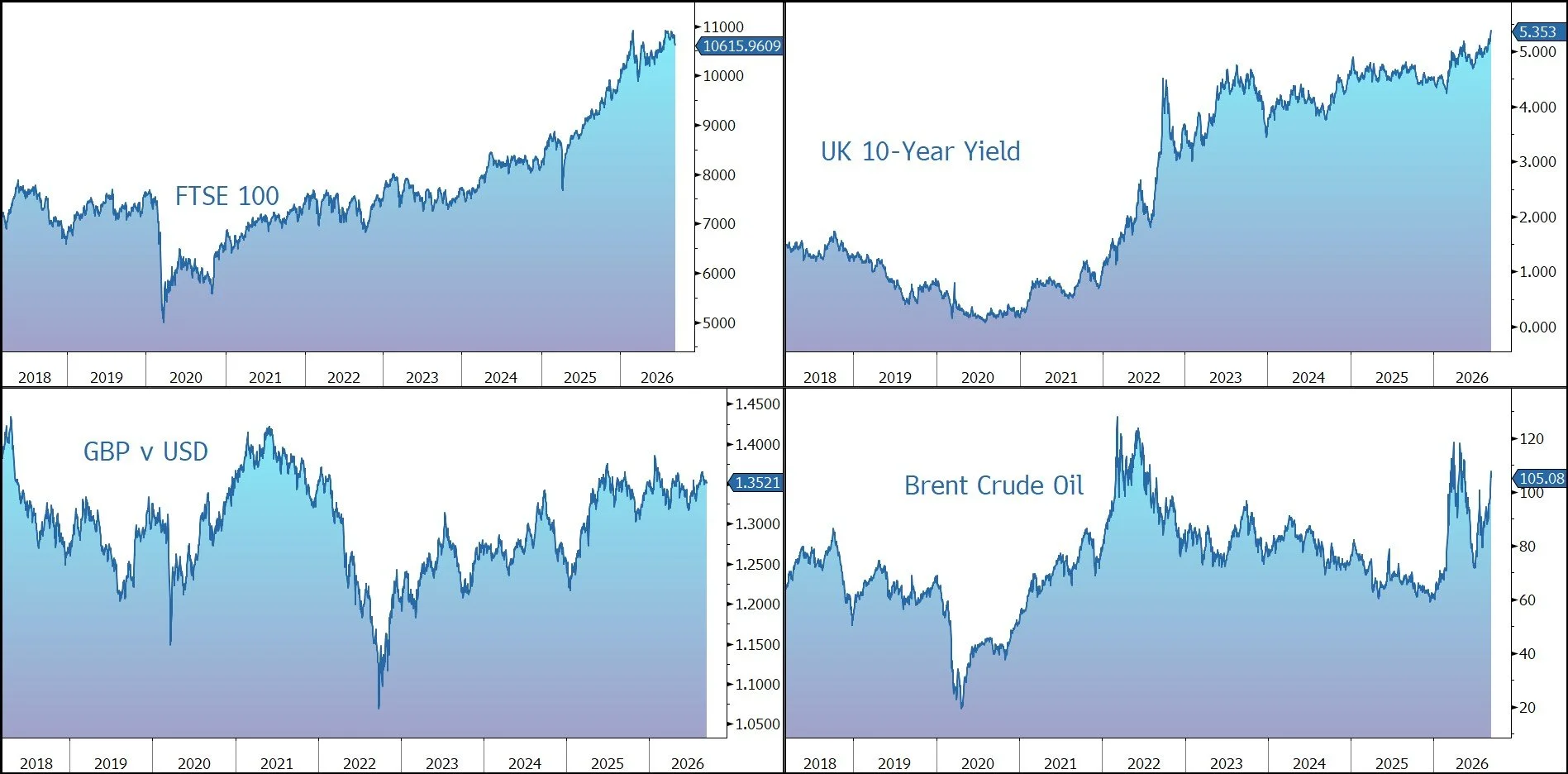
Brent crude rose to $110 a barrel overnight, reaching its highest level since May, before slipping back to $106, as escalating tensions in the Middle East raised fears of prolonged disruption to global energy supplies. Meanwhile, Saudi Arabia’s oil production fell sharply in August, by around 1.9m barrels a day to 6.238m barrels a day, its lowest level since 1990. The deteriorating backdrop dims expectations that supply from the region could be normalised as Asian economies are forced to re-enter the energy market.
The 10-year US Treasury yield has risen to 4.95% as soaring energy prices support the case for a rate hike. New data showed producer prices rose 0.4% from the previous month in August with a surge in energy prices combining with signs of pass-through costs in broader sectors. Meanwhile, the US government purchased fewer 10- to 20-year securities than investors had expected in Treasury Secretary Scott Bessent’s first expanded buyback operation. Gold slipped to $4,350 an ounce. All eyes now turn to the August US CPI print this afternoon – a core figure of 2.4% is expected.
The heightened tension had a negative impact on equity markets, with the main indices in the US – S&P 500 (-0.6%); Nasdaq (-0.7%) and Asia – Nikkei 225 (-1.9%); Hang Seng (-0.6%); Shanghai Composite (-1.3%); Kospi (-1.8%) – trading lower. Bond market weakness remains a headwind for rate-sensitive sectors including utilities, real estate, and long-duration growth. Oracle was a positive outlier, with the shares trading higher after hours after the company reported faster growth in its cloud-computing business than analysts had projected. The FTSE 100 is currently little changed at 10,615.
In the eurozone, the ECB delivered its expected rate hike, raised its inflation forecasts for the next two years, and warned that inflation could remain above its 2% target for an “extended period.”. Another rise as soon as October was signalled.
President Putin arrived in New Delhi for the BRICS summit (12–13 September), his first in-person attendance outside Russia since the Ukraine invasion. The gathering will address the Middle East conflict, Ukraine, and the bloc's push for greater economic influence.
Source: Bloomberg
Company News
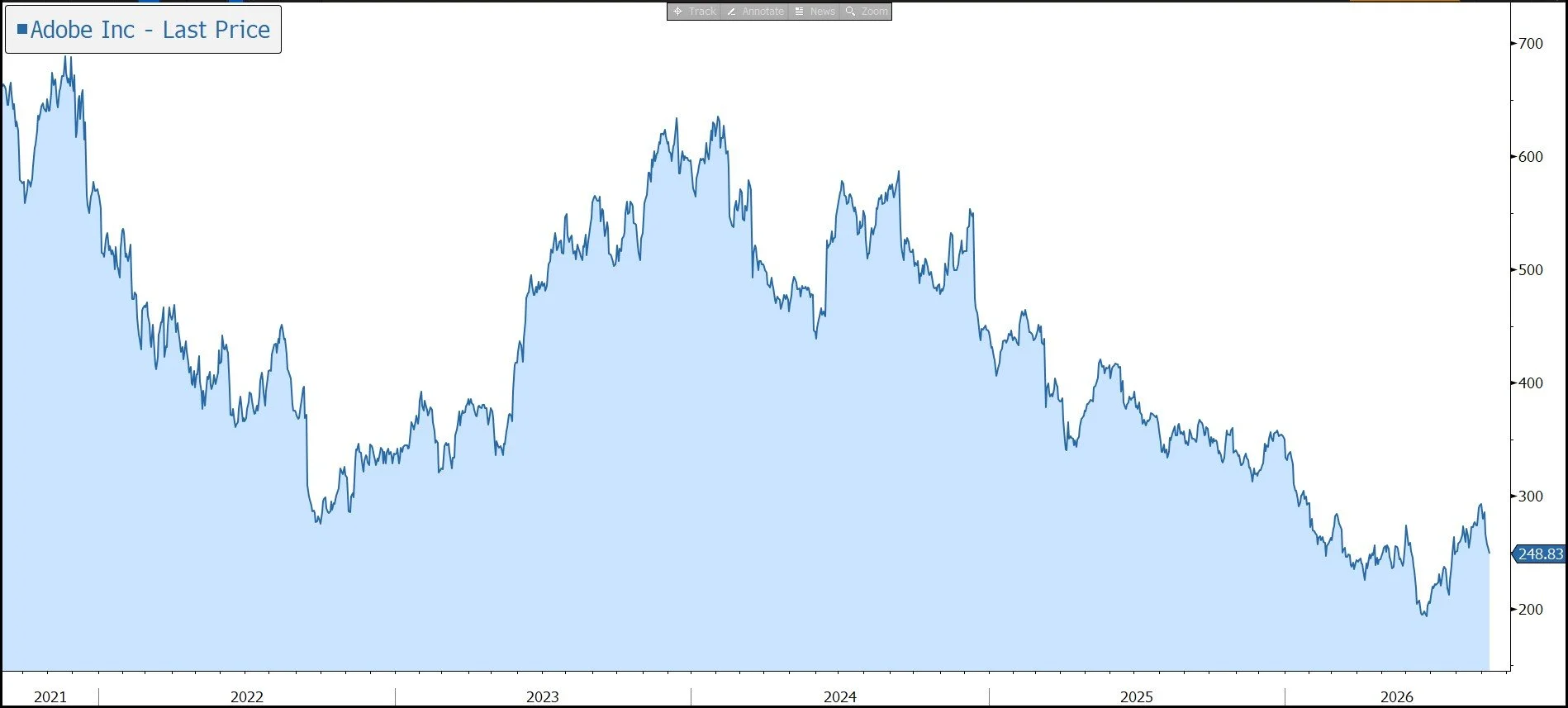
Last night, Adobe released results for the third quarter of its financial year to end November 2026 which were slightly better than market expectations. Although guidance for FY2026 was nudged higher, the extent of the raise came as a disappointment, sending the shares down 2% in after-hours trade.
Adobe is a global software company best known for the Acrobat product, considered the gold standard for creating, editing, scanning, signing, and sharing digital documents. The company generates annual revenue of almost $24bn through a recurring revenue model with real-time visibility – subscriptions account for more than 96% of the total. As a result, the business has traditionally been fairly resilient during economic downturns.
The group believes every disruptive technology has presented opportunities for Adobe to innovate and increase its addressable market opportunity. This has been true for cloud computing, mobile, as well as AI. The company estimates it has an addressable market of more than $200bn, leaving it well positioned for significant growth in the years ahead with its industry-leading products and platforms.
The company has introduced multiple generative AI models in the Adobe Firefly family including Imaging, Vector, Design, and most recently Video. However, there is increased competition, with smaller firms such as Figma eager to capture market share.
The concern is that the changing software landscape, where AI is lowering the barrier to entry for design, the company’s dominant position in the industry is being threatened by newcomers embracing the technology.
The company recently named Anil Chakravarthy as its next president and CEO, effective 1 December. Chakravarthy currently leads Adobe’s Customer Experience Orchestration business and worldwide field operations.
During the three months to 28 August, revenue grew by 12% in constant currency to $6.76bn, slightly above the market forecast of $6.70bn and the company guidance of $6.67bn-$6.72bn. The company passed the landmark of more than one billion monthly active users.
Total Adobe Annualised Recurring Revenue (ARR) exiting the quarter was $27.50bn. Exiting the quarter, Remaining Performance Obligations (RPO – i.e. its future sales pipeline) were $22.16bn, and Current Remaining Performance Obligations (i.e. expected to be recognised as revenue within the next 12 months) were 67%.
Total Customer Group subscription revenue rose by 13% to $6.56bn, made up of Business Professionals & Consumers subscription revenue (+15% to $1.91bn) and Creative & Marketing Professionals subscription revenue (+12% to $4.65bn). Other smaller revenue streams are Product (down 1% to $67m) and Services & Other (down 14% to $111m).
The company earns high operating margins, in the mid-40s. During the latest quarter, the margin fell from 46.3% to 44.0%. EPS grew by 15% to $6.13 in the quarter, slightly better than the $6.09 expected by the market and the company guidance of $6.05-$6.10.
The business is very cash generative and delivered record quarterly cash flow of $2.52bn, and the group ended the period with net debt of $724m. The group repurchased 9.5m of its shares during the quarter, leaving $24.55bn remaining on the current programme.
Adobe nudged up its guidance for FY2026 – the company expects revenue of $26.576bn-$26.626bn and EPS of $24.45-$24.50. The company is also targetting 10.2% ARR growth. Guidance for the current quarter – revenue of $6.80bn-$6.85bn and EPS of $6.30-$6.35 – was slightly below the market forecast.
Source: Bloomberg
