
Morning Note: Market News and an Update from EssilorLuxottica.
Market News
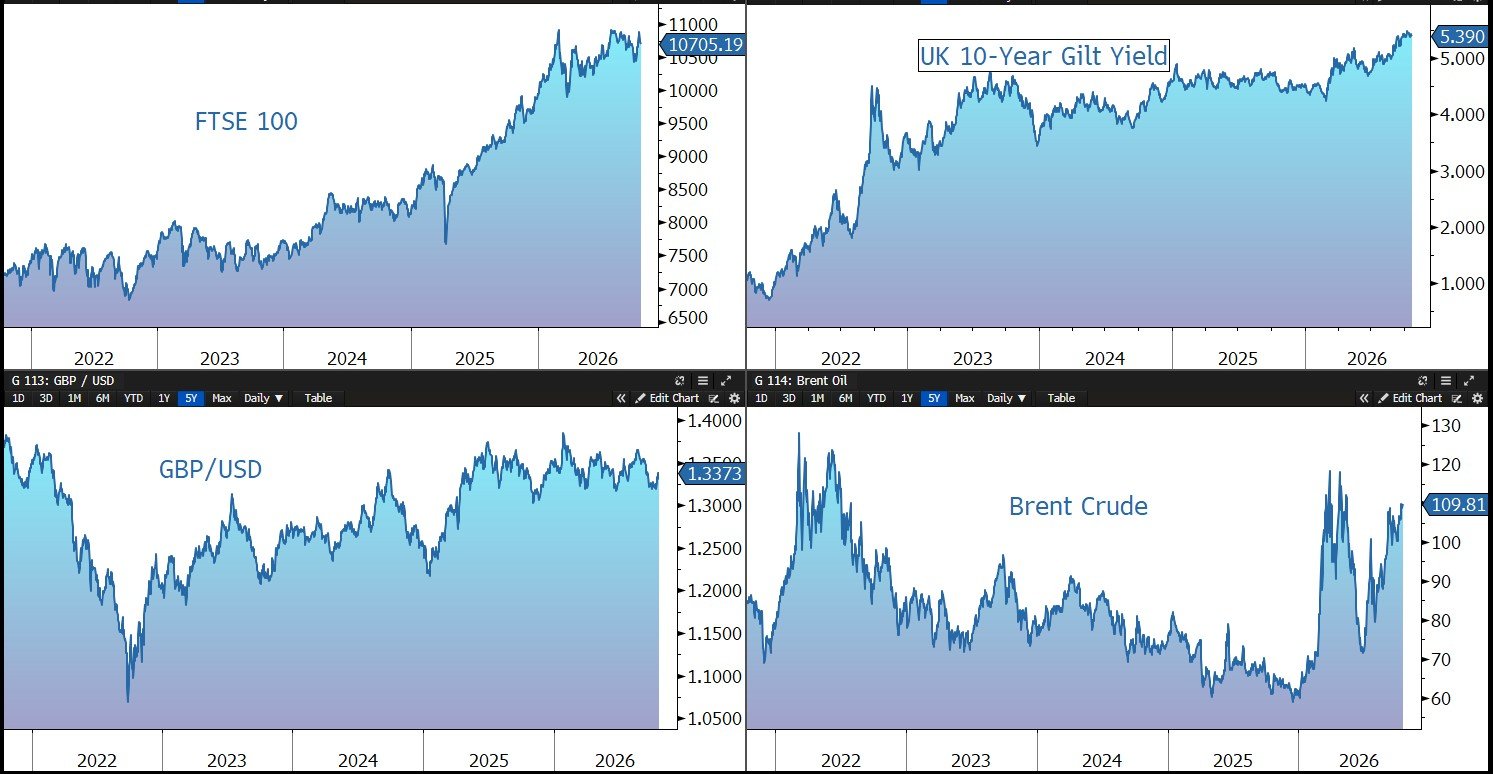
Brent crude rose above $110 a barrel as Iranian attacks on shipping in the Strait of Hormuz continued, with a supertanker reported to have struck a sea mine. Iran’s foreign minister has signalled the strait could reopen if the US fulfils prior commitments, but the situation remains fluid and is the primary geopolitical risk variable for energy markets today. The 10-year US Treasury yields 5.12%, while gold drifted to $4,120 an ounce.
US equities were little changed during market trading hours last night – S&P 500 (+0.3%); Nasdaq (flat) – although they rallied after hours on the back of positive corporate earnings. SpaceX reported Q3 revenue up 161% to $14.6bn and net income of $4.4bn – its first profit as a public company – while Super Micro Computer posted preliminary results that beat expectations, sending both stocks higher in after-hours trading. Elon Musk disclosed that the SpaceX and Tesla boards have formed special committees to explore a potential merger, a development that could rank as the largest corporate combination in history. Asian markets responded positively this morning: Nikkei 225 (+0.9%); Kospi (+3.3%).
The FTSE 100 is currently 0.3% lower at 10,705, while Sterling trades at $1.3385 and €1.1920. UK CPI printed at 3.5% year-on-year in September – an 11-month high, a touch above the 3.4% consensus – reinforcing Bank of England rate hike expectations ahead of next week’s Budget. Meanwhile, UK national debt topped £3 trillion in September for the first time. The deficit widened to £97.8bn – £6bn above the OBR’s March forecast – tightening fiscal headroom ahead of Chancellor Healey's Budget next week. The 10-year Gilt yields 5.39%.
Source: Bloomberg
Company News
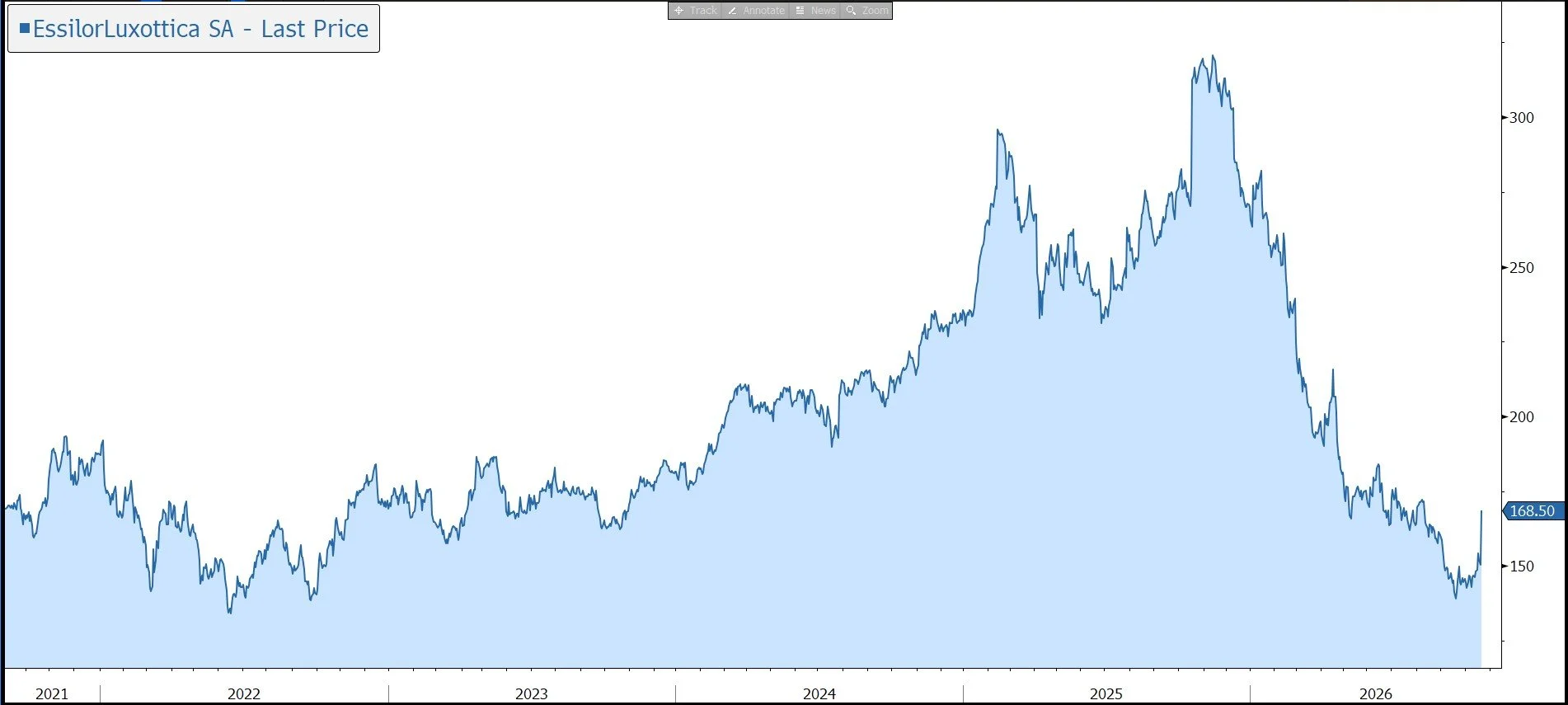
Yesterday evening, EssilorLuxottica released Q3 results which were better than market expectations. Revenue grew by 7.2%, driven by AI smart glasses and myopia management products, but also strong growth from the core eyecare and medtech business, which has seen no signs of consumer ‘trading down’. The final quarter has got off to a good start and medium-term guidance has been reiterated. The shares have derated over the last year due to competition and governance issues, combined with broader weakness in the luxury goods sector. However, in response to a reassuring update, the shares have bounced by 10% this morning.
EssilorLuxottica is the global leader (with a 25% share) in the €130bn eyecare and eyewear industry with exposure to the design, manufacture, and distribution of ophthalmic lenses, prescription frames, and sunglasses. We believe the long-term outlook for the industry is positive, driven by an ageing population, digital eye strain, a growing emerging market middle class, increased education regarding sun protection, and the growth of eyewear as a fashion and technology accessory. By 2050, uncorrected poor vision is predicted to reach epidemic proportions with over 50% of the world’s population expected to suffer from myopia (short-sightedness), many with serious vision-threatening side effects and long-term implications.
The company’s competitive advantage is based on its scale, portfolio of premium brands (such as Ray-Ban and Oakley), product innovation, flexible manufacturing base, quality service, routes to consumer, and partnerships. Essilor owns long-term licences for some of the best-known luxury brands, including Chanel, Prada, Armani, and Jimmy Choo. The group also has a global retail footprint of almost 20k stores, including LensCrafters and Sunglass Hut, and over 300k wholesale partners.
In addition to underlying market trends, growth is being driven by strong innovation across the existing product line and in new markets. The company’s myopia management product Stellest has clinically demonstrated efficacy in slowing down myopia progression in children. Following strong growth in China, the product has now been launched in the US. Given Stellest is a high-value, medically-driven, patented technology, it generates a higher margin than the group average. In addition, a partnership with Applied Materials aims to jointly develop and manufacture the next generation of intelligent optical systems.
In the smart glasses category, the company has a long-term partnership with Meta Platforms (which owns a 3% stake in Essilor) to develop multi-generational smart eyewear products. The collection, which includes Ray-Ban Meta and Oakley Meta, is growing rapidly (up 3x to 7m units in 2025) with demand outpacing supply. Although the company has said that, in time, wearables will be margin accretive given the increased level of quality lenses in the products and the addition of service revenue, for now growth is margin dilutive, something of a concern for the market. That said, the company has said costs have come down, benefiting from productivity and scale, whilst there is also an improvement in average selling price and penetration of transition and polarised lenses. The other concerns are privacy issues and increased competition in the space from major tech firms.
The company has also diversified into the hearing solutions market with a disruptive new technology (i.e., lenses with acoustic technology) to meet the needs of the 1.2bn consumers suffering from mild to moderate hearing loss. The audio component is completely invisible, removing a psychological barrier that has historically stood in the way of consumer adoption of traditional hearing aids. Nuance Audio Plus was launched in mid-September, improving product effectiveness and user experience.
The company has enhanced its presence elsewhere in the MedTech space through several acquisitions: Heidelberg Engineering (diagnostic solutions, digital surgical technologies, and healthcare IT for clinical ophthalmology); Espansione (design and manufacturing of non-invasive medical devices for the diagnosis and treatment of dry-eye, ocular surface and retinal diseases); Optegra (ophthalmology platform for eye hospitals and diagnostic facilities); PUcore (monomers used in the production of high index ophthalmic lenses), and Ikerian AG (operating under the RetinAI brand, specialising in AI and data management in eyecare).
Finally, Essilor also owns streetwear brand Supreme, known for its lifestyle apparel, footwear, and accessories. The company runs a digital-first business and 20 stores in the US, Asia, and Europe. At first glance, the $1.5bn acquisition looks like a diversification from the group’s core business – the rationale is that it will provide a direct channel to an audience that is very difficult to reach and adds a margin accretive business to the group. In particular, the company intends to use Supreme’s model to test exclusive, high-value AI-eyewear releases to a younger, tech-native demographic. We have some reservations and will watch to see if the acquisition ends up being a misallocation of capital.
Back to today’s results. During the third quarter, revenue grew 7.2% at constant exchange rates (CER) to €7.49bn, slightly above the market forecast of €7.36bn. As expected, the rate of revenue growth slowed compared to the 9.7% generated in the first half given the tough year-on-year revenue comparative. However, growth was better than the 6.3% expected, with all regions contributing to growth, and leaves the year-to-date rate at 8.9%.
Growth was boosted by Wearables (AI glasses and Nuance Audio), with revenue up 20% despite the tough year-on-year comparables. The unit has generated €1,261m of revenue in the year to date and is seeing an improvement in price/mix.
The core eyecare/eyewear business grew by 6.5%, at the upper end of the usual mid-single-digit pace. The myopia management portfolio grew by 24%, driven by the supportive clinical evidence on the efficacy of the solutions offered as well as the wide articulation of their range by technology and price-point. Stellest was launched in Japan in July.
EssilorLuxottica is a vertically integrated player with two distribution channels. Professional Solutions (PS) includes the supply of products and services to third-party eyecare professionals (i.e., wholesale).
In Q3, revenue grew by 3.4% at CER to €3.4bn, versus a double-digit comparative from last year.
Direct to Consumer (DTC) includes the sale of products and services directly to end consumers (i.e. retail), comprised of brick-and-mortar stores and e-commerce platforms. In Q3, revenue grew by 10.6% at CER to €4.1bn. Comparable-store sales were up 6.8%, as optical and sun banners both contributed positively.
By geography, North America, the group’s largest region (43% of sales), grew by 4.7% at CER in Q3. Elsewhere, growth was: EMEA (+7.5%); Asia Pacific (+15.7%); Latin America (+7.1%). Note the Middle East only accounts for 1% of revenue.
As expected, there was no commentary on margins or profit in today’s update. As a reminder, in the first half, the company generated a gross margin of 63.5% and an operating margin of 18.9%. Although operating cost efficiencies are providing something of a margin tailwind, for now the mix effect of the AI glasses growth continues to outweigh the accretive impact of Nuance Audio, Stellest, and the MedTech segments. On a positive note, on the call the company said AI glasses margins are improving year-on-year. The business generates strong free cash flow and ended the first half with net debt (including lease liabilities) of €13.4bn, 2.0x net debt to EBITDA.
Looking to the final quarter, the company will continue to face tough prior-year comparatives, although on the call, management highlighted that growth so far in October has been consistent with Q3. There have been no signs of consumer ‘trading down’, with premium categories and higher-tier products continuing to perform strongly, showing consumer resilience in optical and sun categories.
Although the company doesn’t provide annual guidance, it has set out medium-term targets. On average, over the next five years, at constant exchange rates, the company is planning to deliver ‘solid growth’ in total revenue and a ‘broadly aligned growth’ in adjusted operating profit. Although the company hasn’t been specific on what ‘solid’ sales growth means, the consensus is for high single-digit growth, while margins are expected to decline at first before picking up over time.
The company is still not providing specific margin guidance for 2026 but said the result would be driven by a combination of the full-year impact of tariffs, an ongoing currency headwind, mix effect of the growth of AI glasses, growth of Stellest in the US, and the roll-out of the hearing aid business.
Governance uncertainty remains an overhang following the death of founder Leonardo Del Vecchio, whose fortune was split equally among eight heirs. A major turning point emerged in April 2026 when shareholders tentatively backed a proposal allowing Chief Strategy Officer Leonardo Maria Del Vecchio to buy out two siblings for roughly €10bn, potentially raising his Delfin stake to 37.5%. However, the plan hit a standstill amid board pushback, concerns over debt-financing terms, and a boycott of subsequent shareholder sessions. In August 2026, Leonardo Maria stepped down from his executive role as Chief Strategy Officer to focus purely on his shareholder interests via Delfin, establishing a clear separation between family ownership and day-to-day management under Chairman & CEO Francesco Milleri. With Delfin’s €10bn loan structure and internal profit payout rules unresolved, governance of the 32.4% stake in EssilorLuxottica remains uncertain. Reassuringly, in the meantime, the company’s operating management remains very focused on execution.
Source: Bloomberg
