
Morning Note: Market News and an Update from DIY Retailer Kingfisher.
Market News
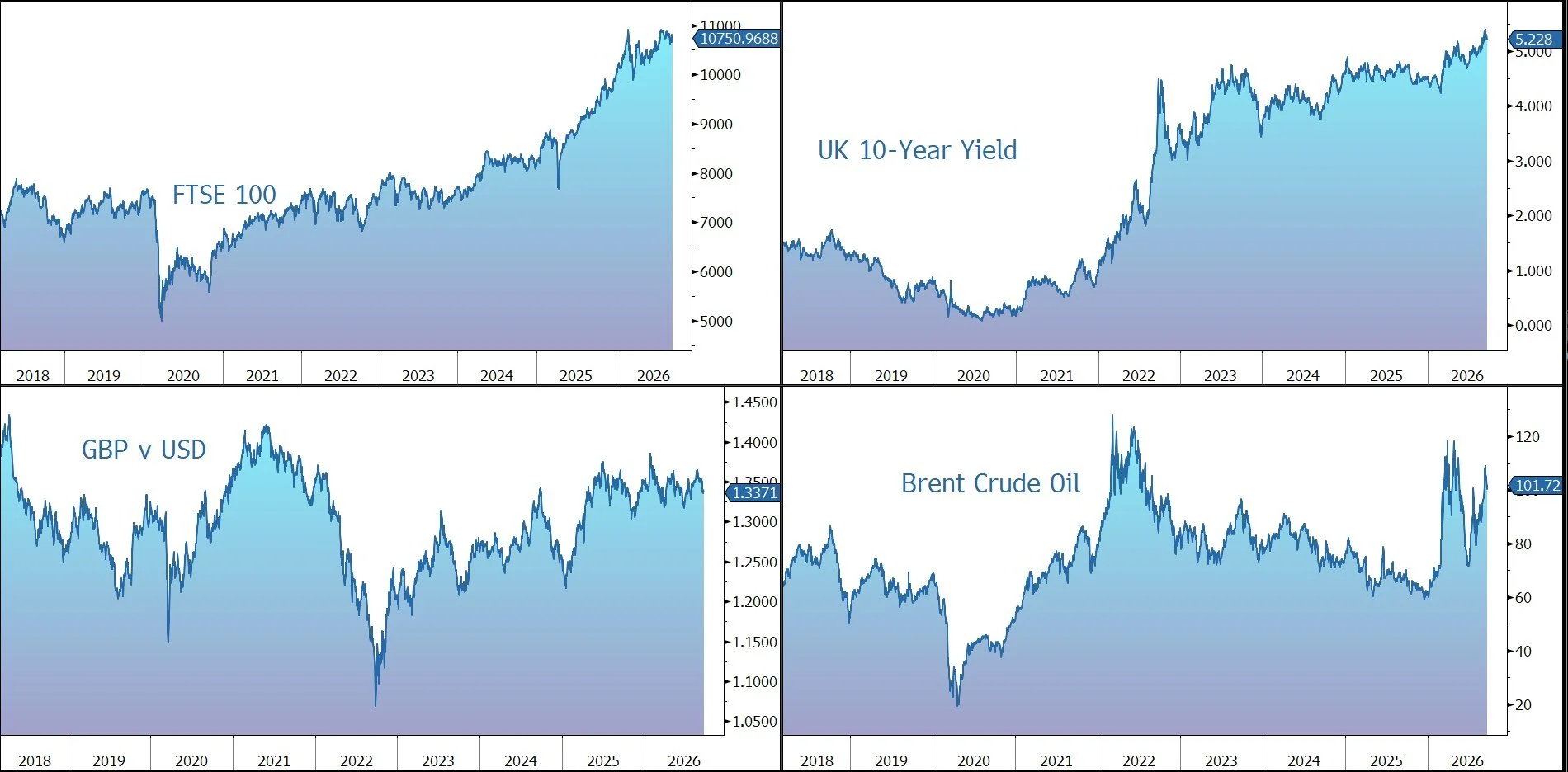
Brent crude rose to $102 a barrel despite growing diplomatic efforts to end the US-Iran war. President Trump is scheduled to address the UN General Assembly in New York later today and could meet with Iranian President Masoud Pezeshkian on the sidelines. Meanwhile, Saudi Arabia moved crude through the Strait of Hormuz at 2.9m barrels per day over the past six days, with the highest tanker count observed since at least June.
Gold has fallen to $4,320 an ounce, adding to losses from the previous session as hawkish comments from Federal Reserve officials strengthened expectations for further US interest rate hikes. Chicago Fed President Austan Goolsbee said the central bank must account for persistent supply shocks, while St. Louis Fed President Alberto Musalem said additional increases may be needed to bring inflation toward the Fed’s target. The yield on the 10-year US Treasury moved up to 4.98%.
Global stocks climbed as the latest developments in artificial intelligence pointed to continued investment in the technology and stronger semiconductor demand. In the US last night, the main indices notched up strong gains – S&P 500 (+1.5%); Nasdaq (+2.3%) – fueled by early signs of success for Meta Platforms’ new AI agent and Alibaba’s Zhenwu V900 chip launch. In Asia this morning, markets also rose, although most of the gains fizzled out: Nikkei 225 (+1.4%); Hang Seng (+0.1%); Shanghai Composite (+0.1%); Kospi (+0.2%).
The FTSE 100 is currently little changed at 10,751, while Sterling trades at $1.3360 and €1.1660. UK public sector borrowing came in at £18.3bn in August, £3.5bn above OBR forecasts, adding fiscal pressure on Chancellor Healey ahead of his debut budget. Asset managers urged the UK government to refrain from “frequent changes to savings, investment and pensions policy”.
Source: Bloomberg
Company News
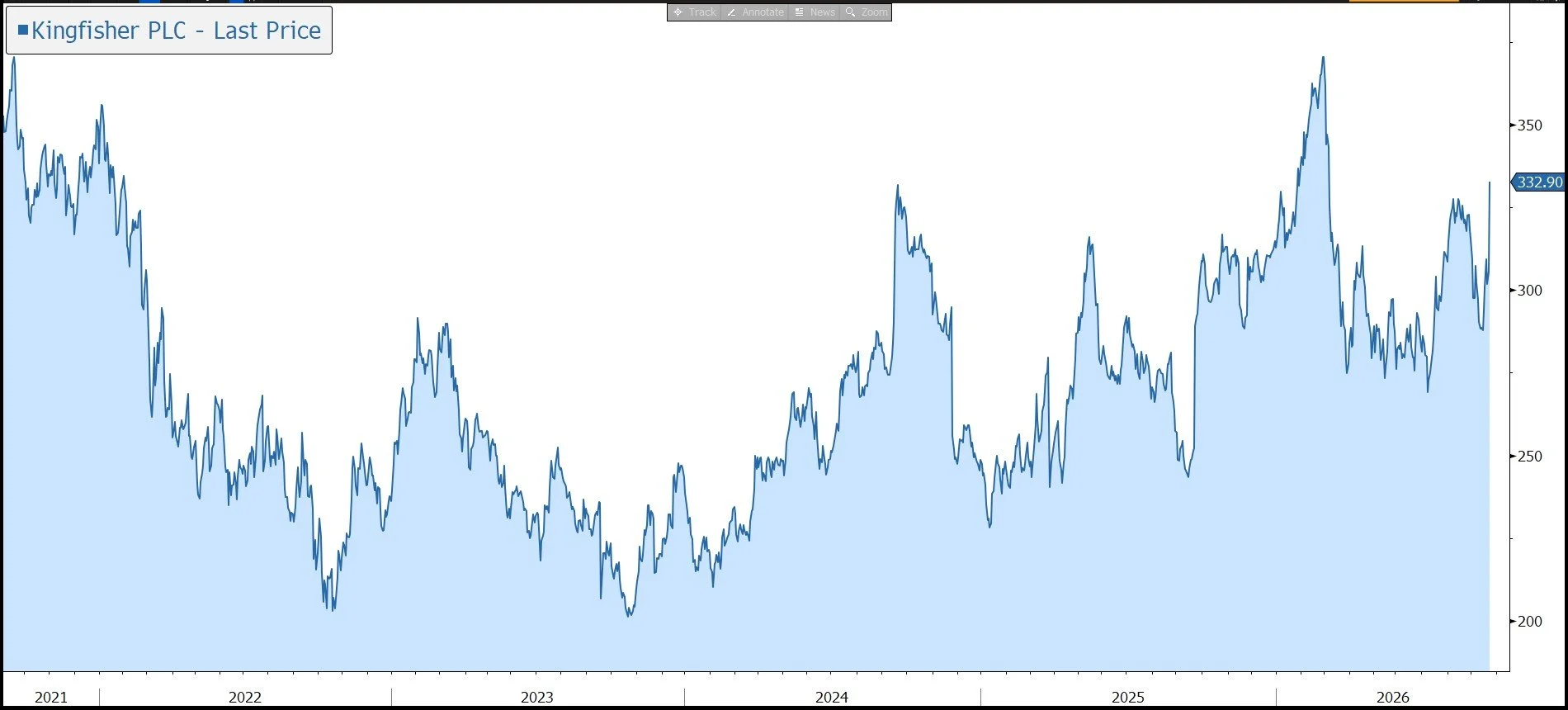
Kingfisher has this morning released results for the financial half-year to 31 July 2026, which were slightly better than expected. While the consumer environment remains mixed, the group’s consistent delivery, strategic progress, and opportunities ahead provide management with the confidence to upgrade its full-year profit and free cash flow guidance. The group maintained its interim dividend and progressed with its share buyback programme. In response, the shares have been marked up 8% in early trading.
Kingfisher is a pan-European DIY chain with around 1,700 stores across brands such as B&Q, TradePoint, Screwfix, and Castorama. The European home improvement market is worth £235bn across a customer base of 320m homes. Growth is expected to be driven by population growth, urbanisation, and the need to repair an ageing housing stock. This is being helped in part by working from home and the focus on energy efficiency.
The company’s sales are made up of Core categories (67% of the total) which include the sales from non-seasonal products across all categories, other than 'big-ticket' sales. Big-ticket sales (15%) include the sales of kitchen, bathroom & storage products. Seasonal category sales (18%) include the sales from certain products within the group’s outdoor, electricals, plumbing, heating & cooling (EPHC), and surfaces & décor categories.
The group’s medium-term financial priorities are focused on growth, cash generation, and higher returns to shareholders. Retail space is expected to grow by 1.5%-2.5% each year. The ambition for trade sales is to reach £5bn in the medium term. The group is targeting sales growth ahead of its markets, adjusted PBT growth faster than sales growth, and free cash flow of more than £500m p.a. from FY26/27. The group intends to maintain an efficient capital structure, with surplus capital to be returned via share buybacks or special dividends.
In the near term, the company highlights that mixed consumer sentiment and political uncertainty remains, as do ongoing cost pressures.
During the half-year to 31 July, total sales grew by 1.6% at constant currency to £7.1bn, driven by continued momentum in strategic growth drivers. This included the transaction value from the sale of products including third-party e-commerce marketplace vendors, known as gross merchandise sales (GMS).
On a like-for-like (LFL) basis (which includes stores that have been open for more than a year and excludes the impact of currency and portfolio changes) sales rose by 0.3% on an underlying basis driven by higher customer transactions. Space growth added 0.8% to growth. Total e-commerce sales rose by 16% and now account for 22% of sales, vs. a 30% ambition.
The company saw growth in core categories (+0.7%) and weather-related seasonal products (+1.3%) offset by a 4.5% decline in big-ticket items.
The trade business continues to strengthen, leveraging the group’s existing store estate. Trade penetration reached 31% of total sales and trade sales now stand at £2.1bn with growth up 16%.
Kingfisher UK & Ireland LFL sales rose by 0.4%, although strong growth at Screwfix (+5.6%) was held back by a 2.9% decline at B&Q. Outside of the UK, Kingfisher France LFL sales fell by 2.3%, with Castorama and Brico Dépôt down 0.5% and 4.2%, respectively. Poland rose by 2.2%, while the Other International division saw LFL sales grow 8.6%.
The company enjoyed market share gains at Screwfix in the UK and in Spain and Poland. B&Q was broadly in line with the market, while Brico Dépôt France performance was impacted by heatwaves due to category mix.
The group faced cost headwinds consisting of wage inflation, higher UK employer national insurance contributions, increased social taxes in France and the new packaging fees in the UK. Against this backdrop, the company remained disciplined on managing costs and cash.
The gross margin rose by 70 basis points to 38.4%, reflecting the company’s buying and sourcing scale, growth from marketplace, and the sale of Romania, partly offset by headwinds from freight and a growing share of trade. The adjusted retail profit margin increased by 50 basis points to 7.1%.
Adjusted pre-tax profit, which excludes the impact of transformation P&L costs and exceptional items, rose by 9.9% to £404m. Although the result was helped by a £14m one-off business rates refund, it was still above the market forecast.
The group generated free cash flow of £339m, down 29%. As a result, net debt rose slightly to £1.9bn, with gearing ticking up to 1.4x net debt to EBITDA, albeit still well below the medium-term target ceiling of 2.0x. The interim dividend was maintained at 3.8p. The company is part-way through a £300m share buyback programme, with £125m completed to date.
The company has raised its guidance for the full financial year to 31 January 2027 – it now expects adjusted PBT of £595m-£635m (versus £565m-£625m previously), while free cash flow is expected to reach £480m-£520m (vs. £450m-£510m previously).
Source: Bloomberg
