
Market News
Global equity markets staged a sharp recovery yesterday after Nvidia’s board reinstated Jensen Huang as president and CEO – less than two weeks after his abrupt exit – following reported pressure from Silicon Valley, Wall Street, and the White House. The S&P 500 surged 4.7%, its best session since April 2025, while the Nasdaq 100 jumped 6.5% and Nvidia soared 31%.
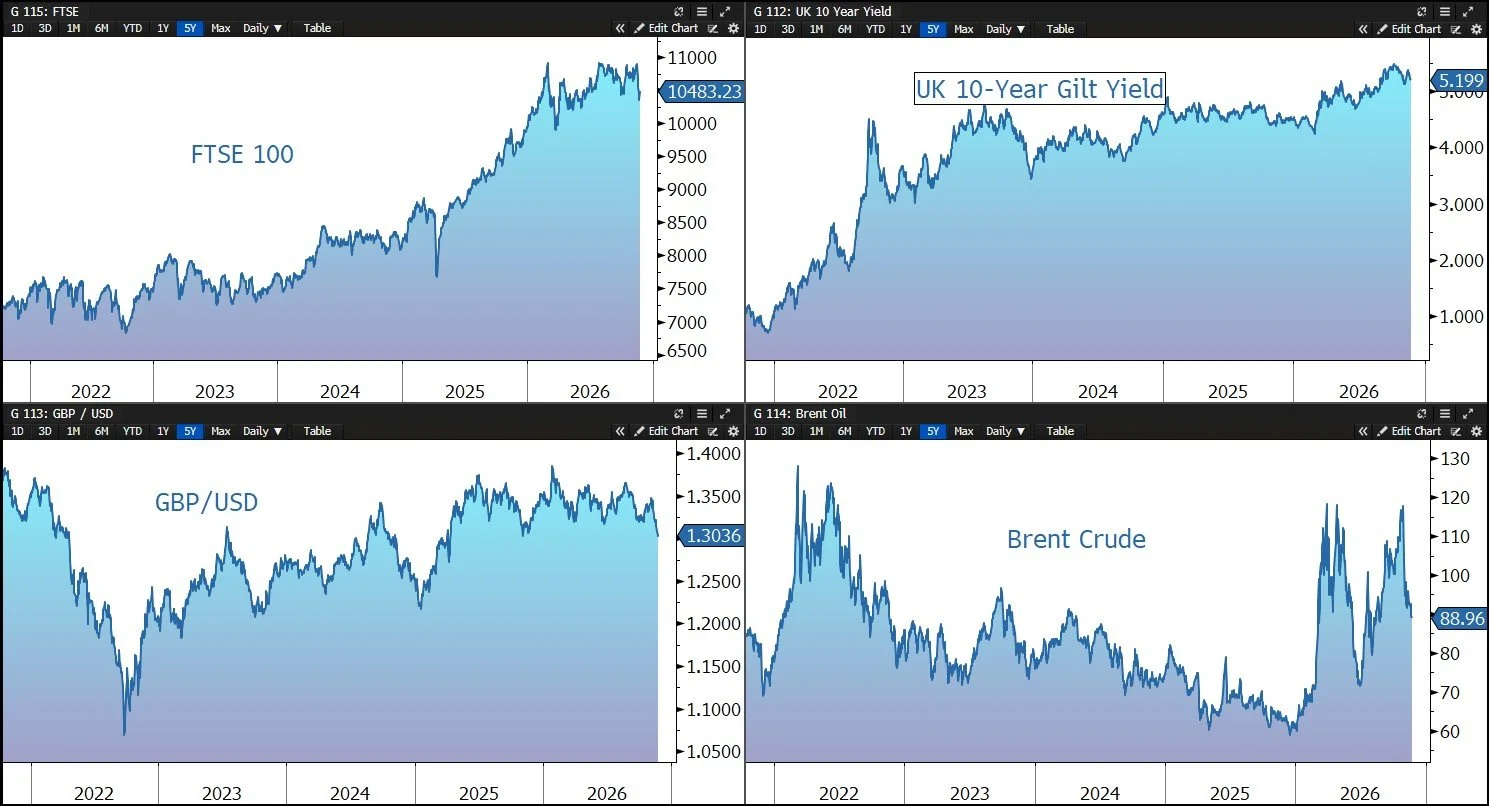
The rally continued in Asia this morning – Nikkei 225 (+3.9%); Shanghai Composite (+0.3%); Kospi (+6.3%) – but is showing signs of fragility heading into the European open, with US equity futures slightly lower and the FTSE 100 little changed at 10,483.
Gold also enjoyed a bounce yesterday and is trading back above $3,600 an ounce. However, copper has erased yesterday’s gains on Chinese demand concerns, and silver is down 2%.
The yield on the 10-year US Treasury drifted down to 4.93%. Data today – Conference Board Consumer Confidence, Case-Shiller home prices, and Richmond Fed – will be scrutinised for signs that the consumer remains resilient despite tightening financial conditions. Meanwhile, New York Fed President Williams has signalled a measured pace of rate hikes, tempering expectations at the margin, while markets continue to fully price a 25bp move in December.
Brent crude has eased back to $88 a barrel on cautious optimism around US-Iran negotiations.
Source: Bloomberg
Company News
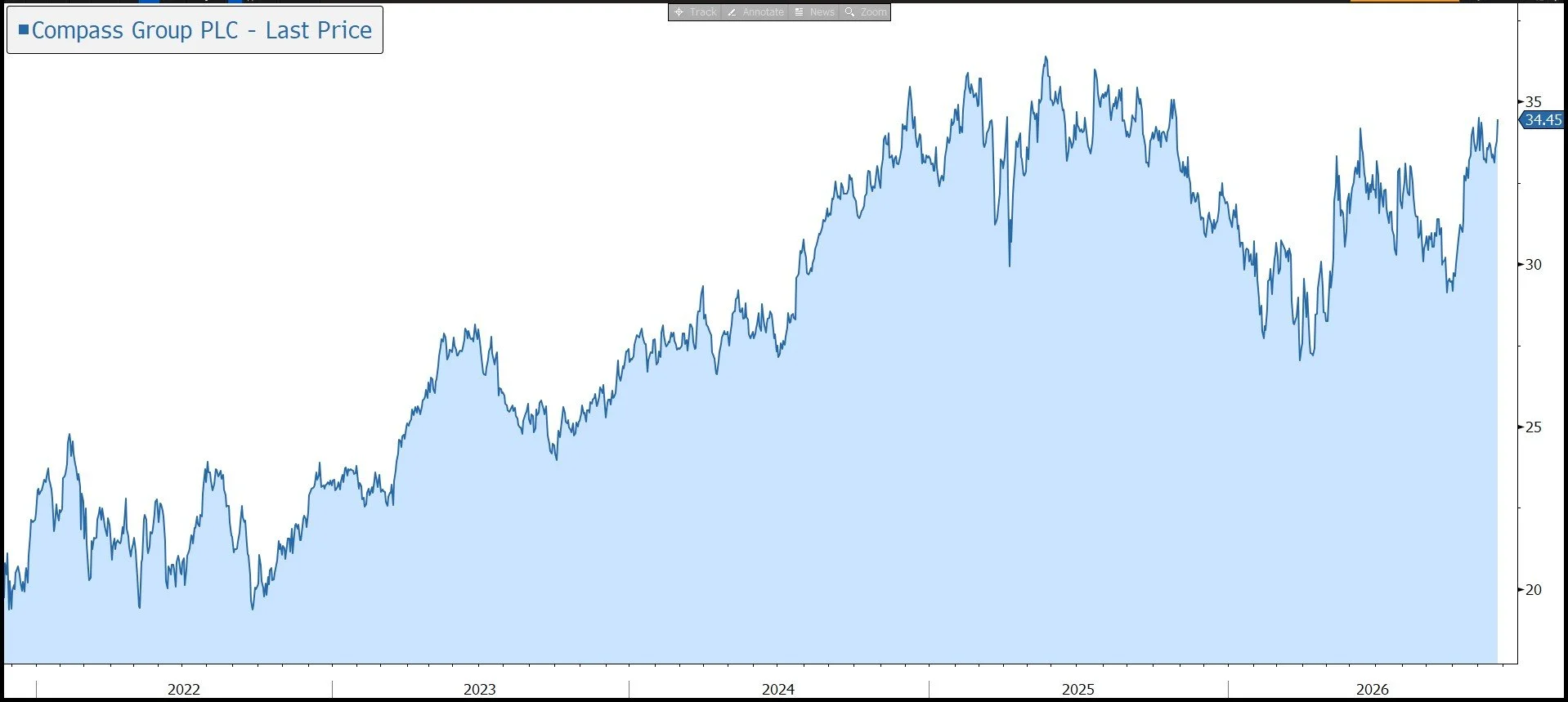
Compass Group has released results for the financial year to 30 September 2026. The business enjoyed a strong end to the year with an acceleration in organic growth in the second half. With financial gearing back in the target range and M&A spend expected to moderate, the company will resume share buybacks with up to $1.5bn over the next two years. In line with recent press rumours, the company will hold a shareholder consultation to move its primary stock market listing to the US, with a secondary listing in the UK. Ahead of this morning's call, the shares are trading up 4%.
Compass is the world’s largest foodservice company, operating in over 25 countries, serving more than 5.5bn meals a year. The group also operates an ancillary support services operation, which accounts for 15% of revenue, and a third-party food purchasing business. Although the company’s shares are listed in the UK, they are priced in US dollars, the company’s reporting currency.
The company operates in a $380bn global food services market, which has expanded by a third in the last five years, despite exits from 15 countries, with the help of acquisitions in segments which increase its captive catering audience. Matching the historical industry growth of 5% p.a., the market could reach $600bn by 2035.
As the largest player (with a 13% share), the company’s scale provides a vital advantage over smaller rivals in terms of buying power. It is the fastest growing major operator, with the highest level of retention and margins in the industry.
The scope for growth from first-time outsourcing and share gains is significant – nearly 75% of in-house catering is still self-operated or managed by small regional players. Companies and other institutions are open to outsourcing as they seek to reduce operating costs, cope with increased complexity, improve health and safety protocols, and ensure resilient food supply chains. As a result, Compass is well placed to consolidate its position as a trusted, financially strong provider, able to offer clients and consumers safe and innovative solutions. This underpins an excellent pipeline of new business.
Management therefore believes net new business growth can be sustained at 4%-5%, above the historical level of 3%. The jury is currently out as to whether this is the case. Either way, this comes on top of like-for-like volume and price growth.
There are threats: permanently increased levels of working from home and online learning, rising unemployment (exacerbated by AI), increased competition from delivery providers, and reduced volume driven by weight-loss drugs. However, we believe Compass is well placed to cope as a result of its diversified and defensive revenue mix, decentralised business model with predominantly local sourcing and supply chain, and a higher level of volume protection in its contracts.
Compass may actually be a ‘physical reality’ beneficiary of the shift to AI. With 90% of its operations in tangible services—like food prep and hospital sanitisation—its core business remains immune to digital replication. As ‘white-collar’ displacement expands the available labour pool, Compass could also benefit from reduced wage inflation and improved margins. Compass is currently using AI to reduce management overhead and cut food waste.
Overall, the company has a significant runway for long-term growth. Management is confident it can sustain mid-to-high single-digit organic revenue growth, ongoing margin progression, and profit growth ahead of revenue growth.
During the latest financial year to 30 September 2026, revenue grew by 10.4% to $50.8bn, in line with the market expectation. Growth on a constant currency basis was 9.3%.
Organic revenue – a combination of like-for-like volume growth, price, new business, and client retention – grew by 7.5% slightly above the market forecast and the company’s guidance of ‘around 7%’. The pace of organic growth accelerated in H2 (+7.8%) versus H1 (+7.2%), despite tough year-on-year comparatives.
The group benefitted from strong outsourcing trends, with net new business growth of 4.3%, within the 4%-5% target range, as expected. New business wins totalled $4.4bn, up 16% year on year, with half generated from first-time outsourcing. Client retention was 96% and the pipeline of opportunities continues to support confidence in future growth.
Compass saw like-for-like volume growth of 0.6% as it continued to benefit from the quality of its offer and the value gap compared to the high street. Pricing growth of 2.6% was in line with inflation.
The company operates across a broad range of sectors: Business & Industry (40% of revenue, 14% growth), Healthcare & Senior Living (22%, 6%), Education (17%, 6%), Sports & Leisure (15%, 15%), and Defence, Offshore, & Remote (6%, 10%).
The group’s largest region, North America (75% of profit), has been the jewel in the crown, having delivered consistent long-term organic growth. In the latest financial year, revenue grew by 7.8% in organic terms. Defence, Offshore, & Remote and Business & Industry were the fastest growing sectors, both increasing organic revenue at a double-digit rate.
The International division has been simplified and adopted North American best practice. As a result, it has been transformed from a volatile, low-growth business into a meaningful contributor to revenue growth and margin progression. In the latest year, organic revenue was up 6.8%. The strongest growth sector was Sports & Leisure, as the group successfully leveraged its expertise from North America and the UK, winning high levels of new business in other markets. We note the company has no direct contract exposure to the Middle East.
The group’s flexible cost base has helped the margin to recover from pandemic lows despite re-opening expenses, the cost of mobilising new contract wins, and inflationary pressures. Looking forward, the group may face higher input and energy costs which could hold back volumes and restrict margins. However, the group has a good track record of coping with increased costs through a combination of efficient procurement, pricing, menu engineering, and overhead cutting.
During the year, the group’s margin grew by 20 basis points to 7.4%, driven by overhead leverage and M&A synergies. Underlying operating profit grew by 11.6% to $3.7bn, versus guidance of ‘above 11%’, and in line with the market forecast. EPS was up 12% to 148c.
The business continued to generate strong free cash flow, up 2% to $2.0bn in the year (80% conversion) and spent $1.9bn (3.8% of revenue) on capex.
As Compass focuses on the significant structural growth opportunities in its core markets, it has stepped up its M&A activity to expand its portfolio of brands, focusing on digital innovation and delivered-in solutions. In the last financial year, the group spent $2.5bn on M&A. The largest deal was Vermaat ($1.6bn), a leading premium food services business in Europe which has created a strong growth platform in a region which has consistently underperformed North America on both organic growth and margin. Following the acquisition of Pro Care Management in Germany ($276m), Compass now operates Group Purchasing Organisations (GPO) in five of its top ten markets.
As a result of its M&A activity, net debt increased by $1.6bn to $8.0bn, with financial leverage of 1.5x net debt to EBITDA, at the upper-end of its medium-term target of 1.0x-1.5x. With the European sectorisation programme largely complete, acquisition spend is now expected to moderate. This provides the financial capacity to resume the share buyback programme, and today the company has announced it will return up to $1.5bn over the next two years. The company also pays an attractive dividend – the FY2026 payout was increased by 12% to 74c (2% yield).
Compass has introduced guidance for FY2027 – high single-digit underlying operating profit growth in constant currency (versus the current consensus of +8.7%), driven by organic revenue growth of around 7% and ongoing margin progression. Financial leverage is expected to be at the top end of the 1.0x-1.5x target range.
Today, the company also announced a shareholder consultation to move its primary stock market listing to the US. As North America now represents 75% of group underlying operating profit, a US listing is a natural evolution for Compass. This move would better align the group’s capital markets presence with its geographic profile, further positioning the business for its next phase of growth. The company will remain strongly committed to the UK and its other International markets. The move is subject to shareholder consultation and approval, with the transition to a US listing expected to complete in 2028. The group will retain a secondary listing in the UK.
Source: Bloomberg
