
Morning Note: Market News and updates from Alphabet (Google) and Shell.
Market News
The yield on the 10-year US Treasury note rose to 4.07% after the Federal Reserve delivered a widely anticipated 25bps rate cut and announced the end of its quantitative tightening. Yields across the curve inched higher as opposing dissents consolidated the view of an FOMC with contrasting opinions, with Kansas City Fed's Schmid opting for a hold while Governor Miran expectedly voted for a 50bps cut. Fed Chair Powell downplayed the likelihood of another rate cut in December, citing the divisions among policymakers and limited federal data amid the government shutdown. Traders now see about a 60% probability for another cut in December, down from more than 90%. The dollar rose and gold fell back below $3,950 post the Fed announcement.
Donald Trump said he had an “amazing” meeting with Xi Jinping in Busan. The US reduced its tariffs on fentanyl to 10% immediately and reached a deal on soybeans and agriculture. The US president said he’d discussed Nvidia chips, but that it’s up to Beijing to continue talking to the company about access to China. He also plans to visit China in April. Xi said China will cooperate with the US.
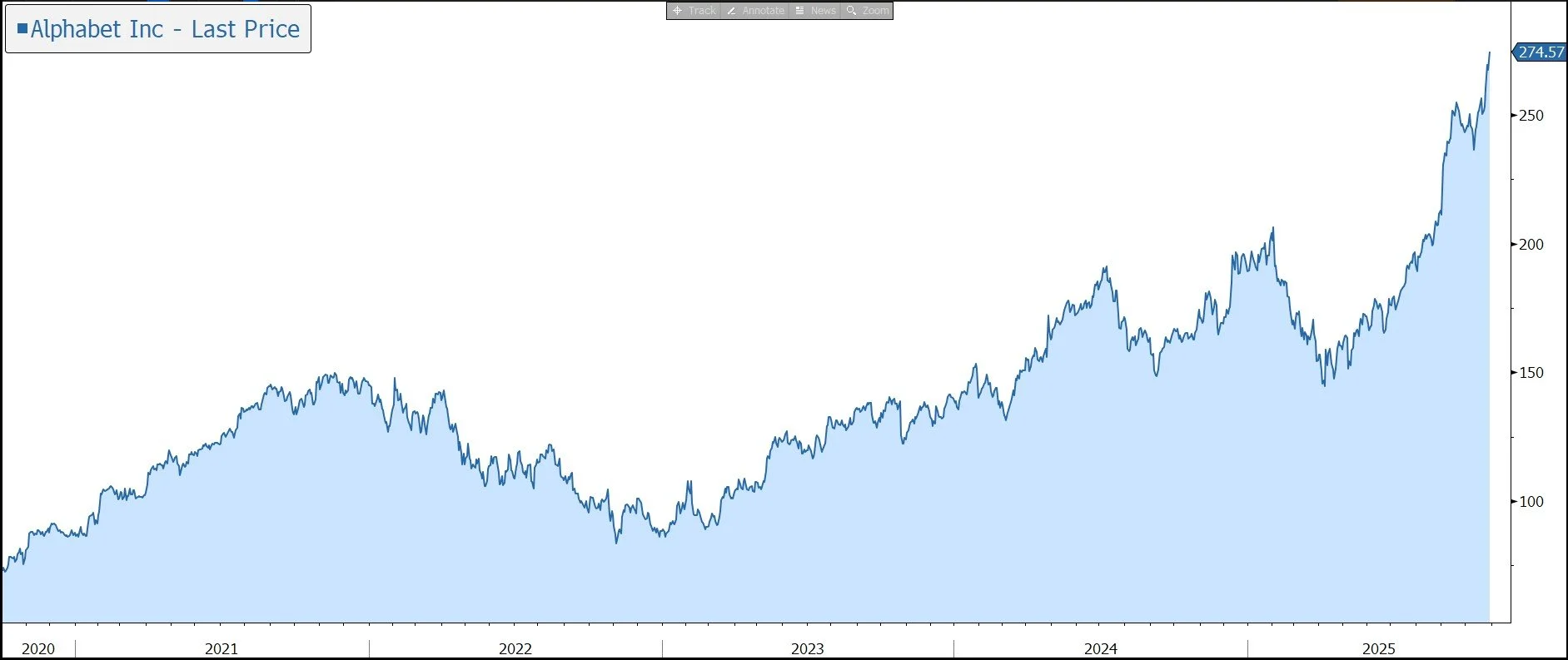
US equities pushed higher last night – S&P 500 (flat); Nasdaq (+0.6%). Results from the three mega-cap stocks to report after hours were mixed, with the market increasingly unsettled by the increased cost of investment in AI. Meta fell 8% after it recorded a $16bn one-time charge related to the Big Beautiful Bill and said its capital expenditure next year would be ‘notably larger’ than in 2025. Microsoft fell 4% despite posting results slightly ahead of market expectations. Google owner Alphabet bucked the trend, rising by 6% (see below), as core advertising and cloud computing pushing earnings ahead of market expectations. Apple and Amazon are due to report post-market this evening.
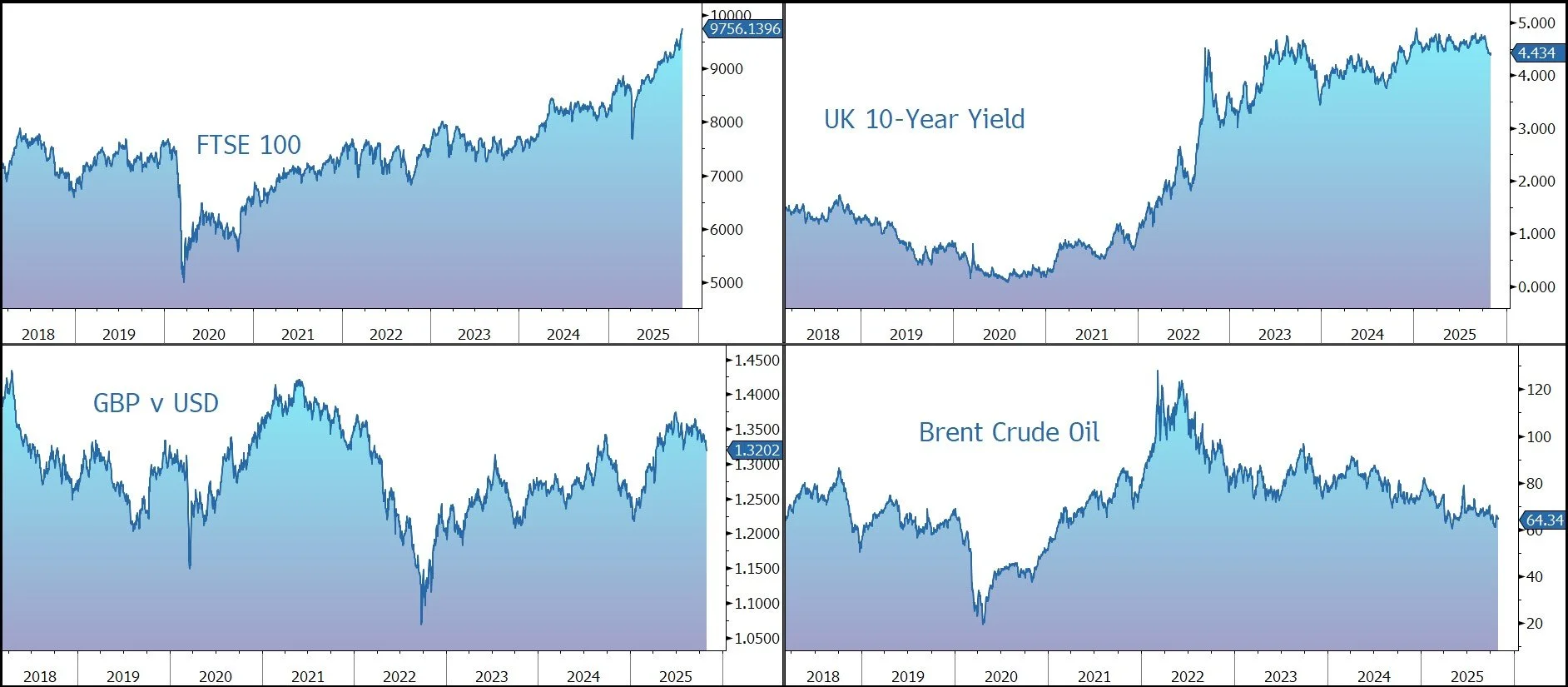
In Asia this morning, equities drifted lower: Nikkei 225 (flat); Hang Seng (-0.2%); Shanghai Composite (-0.7%). The yen weakened to the lowest since February after the Bank of Japan stood pat. The FTSE 100 is currently 0.4% lower at 9,756. Sterling trades at $1.3188 and €1.1360, while 10-year Gilt yields have ticked up to 4.44%.
Source: Bloomberg
Company News
Last night, Alphabet released third-quarter results which were well ahead of market expectations driven by an acceleration in growth in Google Search advertising and Google Cloud. On the back of strong demand from its cloud customers, the company is once again raising its guidance for capital expenditure and expects to do the same in 2026. The shares have been strong in recent months, helped in part by a favourable court ruling and ongoing enthusiasm over AI. In response to last night’s update the stock pushed on a further 6% in after-hours trading.
Alphabet is the public holding company for Google, one of the world’s most recognised and widely used brands. In addition to the core search engine, the group owns digital video platform YouTube, Google Cloud, web browser Chrome, mobile operating system Android, Gmail, Google Maps, AI personal assistant Gemini, Fitbit, autonomous driving company Waymo, drone delivery company Wing, among others.
The group has a strong track record of innovation, leaving it well placed to capitalise on a wide variety of technological themes, such as digital media, e-commerce, video advertising, the cloud, the internet of things, driverless cars, and AI.
The company has seven products with more than two billion users each and another eight with more than 500m users, most of which we believe are far from being fully monetised. The group’s structure allows it to own a portfolio of businesses with different time horizons, while its broad offering provides customer stickiness and a competitive edge. Capital allocation is spread across internal R&D, bolt-on M&A, and massive shareholder returns.
AI remains a hot topic. We believe Alphabet is well placed – the company has been incorporating AI functionality into its search capabilities and other products for years and is expected to launch a steady stream of innovation in the future. Google’s position in cloud services – it is one of the big three public providers, generating more than $50bn in annual revenue – leaves it well placed to provide the infrastructure and computing power needed by AI. A further competitive advantage comes from having the most robust personalised data and user histories from its scaled applications: YouTube, Maps, Gmail, Calendar, and traditional Search. Google is navigating the shift to AI Search and continues to advance its AI driven capabilities, making the experience more intelligent, agentic, and personalised. The integration of Gemini, Google’s answer to ChatGPT, into AI Overviews (which itself has scaled to more than 2bn monthly active users (MAUs) allows users to submit longer and more complex search queries for new use cases. In addition, AI Mode queries doubled over the quarter, Gemini has over 650m MAUs, and AI start-up Anthropic has agreed to use Google’s AI chips in a deal worth tens of billions.
Political and regulatory headwinds remain. However, during the quarter the US District Court for DC issued its remedies order in the Google search monopoly case. The outcome was much less onerous than feared by the market – and removes a significant regulatory overhang. The break-up of the company was avoided (in particular a forced sale of Chrome), the Apple distribution deal was largely untouched, and the scope of data sharing was reduced. The Judge considered the potential impact on consumers and the rise of AI-driven rivals in reaching a decision.
Back to last night’s results. In the three months to 30 September 2025, revenue grew by 15% on a constant currency basis to $102.3bn, above the consensus forecast of $99.9bn. This compares to the 13% growth rate in the previous quarter and expected by the market. The performance was driven by double-digit growth across every major part of the business
The group reports its results across three segments: Google Services, Google Cloud, and Other Bets. Google Services is the largest division (85% of revenue), generating revenue primarily from digital advertising and the sale of apps, digital content products, hardware, and YouTube subscription fees. During Q3, Google Services revenue grew by 14% to $87.1bn, reflecting strong growth across all product areas.
Google Search (which accounts for 76% of ad revenue) increased by 15%, versus 12% last quarter. Advertising from Google Network Members’ websites (10% of ad revenue) fell by 3%. The group separates out YouTube, which accounted for 14% of ad revenue in the quarter and grew by 15%. According to ratings firm Nielsen, YouTube accounts for more than an eighth of all television usage in the US and there are currently more than 200bn daily views on YouTube Shorts.
Other sales within the Services division (known as Google Subscriptions, Platforms, and Devices) include Play, content products, hardware, service, licensing fees, Nest, and YouTube’s non-advertising revenue. They grew by 21% in Q3 to $12.9bn.
Traffic acquisition costs (TAC) are the fees Google pays to other companies (such as Apple) to carry its search service and adverts (i.e., cost of sales). During Q3 they grew by 8% and currently account for 20.1% of advertising revenue.
Google Cloud includes Google’s infrastructure and data analytics platforms, collaboration tools, and other services for enterprise customers. In Q3, the division grew by 34% to $15.2bn. This was better than the market forecast and compares to 32% growth in the previous quarter, led by growth in Google Cloud Platform (GCP) across core products, AI Infrastructure, and Generative AI Solutions. In August, the company signed a six-year cloud computing deal with Meta Platforms worth more than $10bn. The supply-demand balance remains tight – the backlog is $155bn – and the group continues to invest to grow the business. Despite this, Cloud quarterly profit grew from $1.9bn to $3.6bn, with a margin of 23.7%.
The group’s Other Bets division (less than 1% of revenue), which is effectively an incubator fund for new products and technologies, made a quarterly loss of $1,426m, 28% higher than last year. The group continues to wind down non-priority projects.
Alphabet continues to ‘durably engineer’ its cost base to support its investment in long-term growth opportunities, most importantly AI. The number of employees rose by only 5% in the quarter to 190k, while actions are being taken to optimise global office space and use AI to increase business productivity and efficiency. The group has previously highlighted that 25% of new code is being written by AI. The company reiterated its warning that the ramp-up in capital investment (see below) is now feeding through to higher depreciation, which rose by 41% in Q3.
In the latest quarter, efforts to improve efficiency continued, and margins (excluding a $3.5bn charge related to the European Commission fine) rose from 32.3% to 33.9%. EPS grew by 35% in the quarter to $2.87, well above the consensus forecast of $2.27, albeit helped by a net unrealised gain on non-marketable equity securities.
As expected, capital expenditure rose sharply, 83% to $24.0bn in the quarter, as the company continued to pour money into infrastructure for AI products. With the growth across of the business and demand from Cloud customers, the company now expects 2025 capital expenditure to be in a range of $91bn-$93bn, versus guidance of $85bn previously. On the call, the company said capex will step-up significantly again in 2026, with further details at the time of the full-year results.
There is some concern regarding the level of spend on AI and the potential return on investment. However, the company highlighted that demand continues to exceed supply, justifying the ramp-up in investment. We also note the group has a strong track record for generating return on investment – together, Cloud and YouTube exited 2024 at an annual revenue run rate of $110bn.
Free cash flow generation was strong ($24.5bn in the quarter), despite ongoing spend on R&D and capex, while the group’s huge cash pile (including marketable securities and long-term debt) stands at $77bn. This has allowed the company to significantly increase its returns to shareholders. During the latest quarter, the company bought back $11.5bn of its shares, and in April the Board authorised the repurchase of up to an additional $70bn of shares. The company also pays quarterly cash dividends, putting the company on an equal footing with Microsoft and Apple in the minds of investors looking for yield.
The shares continue to trade on a valuation below most of the other tech majors and at a level we believe is very attractive for a company exposed to several areas of long-term secular growth.
Source: Bloomberg
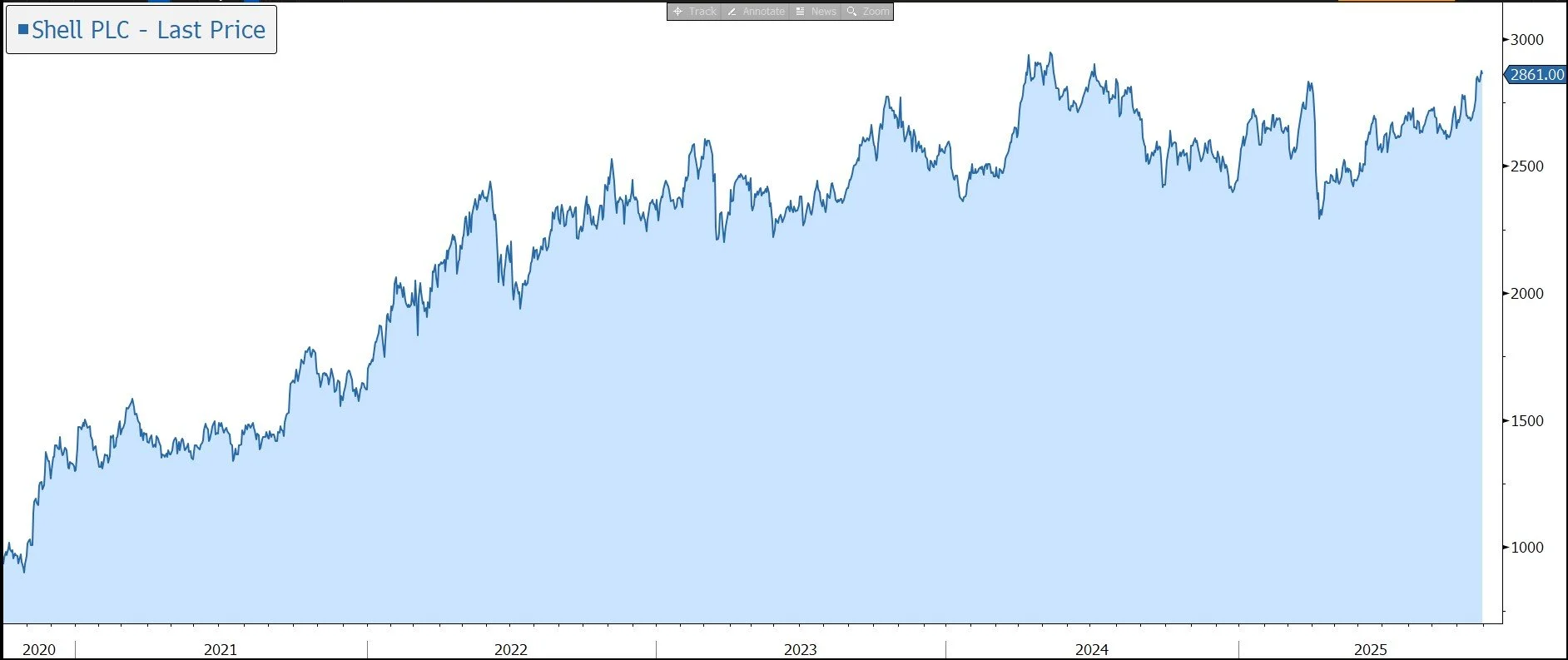
Shell has today released third-quarter results which were above market expectations, driven by higher trading and sales volumes. The group has raised its dividend by 4% and announced another $3.5bn buyback. In response, against a backdrop of a weak oil price and overall stock market, the shares are little changed in early trading.
Shell is a global integrated energy company with expertise in the exploration, production, refining, and marketing of oil and natural gas, and the manufacturing and marketing of chemicals. The group is also allocating capital to low and zero carbon products and services including wind, solar, advanced biofuels, EV charging, hydrogen, and carbon capture & storage. According to Brand Finance Global 500, Shell is the most valuable brand in the industry, valued at around $50bn.
The business is divided into five segments:
· Upstream (i.e. E&P) explores for and extracts crude oil, natural gas and natural gas liquids. Shell has best-in-class deepwater assets complemented by resilient conventional assets in the Gulf of Mexico, Brazil, Nigeria, UK, Kazakhstan, Oman, Brunei, and Malaysia.
· Integrated Gas includes liquefied natural gas (LNG), conversion of natural gas into gas-to-liquids (GTL) fuels, and other products. Shell is the global leader in LNG (achieved through the 2016 acquisition of BG), a critical fuel for the energy transition, with a business that spans upstream, liquefaction, shipping, marketing, optimising, and trading.
· Chemicals & Products is made up of a focused set of assets – there are currently five energy and chemicals parks (i.e. integrated refining and chemicals sites) and seven chemicals-only sites.
· Marketing includes mobility, lubricants, and decarbonisation. In addition to the service stations with their EV charging footprint, Shell is the global number one lubricants supplier and operator of assets is renewable natural gas, sugar cane ethanol, and biofuels.
· Renewables & Energy Solutions includes Shell’s production and marketing of hydrogen, integrated power activities (solar and wind), carbon capture & storage, and nature-based projects. The assets are helping to reduce the carbon intensity of the group’s hydrocarbon product sites. The group is however stepping back from new offshore wind investments and is splitting its power division following an extensive review of the business.
In March, the group hosted an Investor Day at which it set out several operational and financial targets including:
· an increase in the structural cost reduction target from $2bn-$3bn by the end of 2025 (already achieved) to a cumulative $5bn-$7bn by the end of 2028, compared to 2022. In the first half of 2025, the company generated $0.8bn of reductions, with the cumulative total standing at $3.9bn. Around 60% of the saving will come from non-portfolio actions (i.e. not as a result of disposals).
· Invest for growth while maintaining capital discipline, with capital expenditure lowered to $20bn-$22bn p.a. for 2025-2028.
· Grow free cash flow per share by more than 10% p.a. through to 2030 and generate a return of more than 10% across all business segments.
· Shareholder distributions of 40%-50% of cash flow from operations (CFFO) through the cycle (this was 30%-40% previously), continuing to prioritise share buybacks, while maintaining a 4% p.a. progressive dividend policy.
To deliver more value with less emissions Shell will aim to:
Reinforce its leadership position in LNG by growing sales by 4-5% per year through to 2030.
Grow top line production across the combined Upstream and Integrated Gas business by 1% per year to 2030, sustaining 1.4m barrels per day of liquids production to 2030 with increasingly lower carbon intensity.
Drive cash flow resilience and higher returns in the Downstream and Renewables & Energy Solutions businesses where around 20% of the company’s capital employed currently generates a negative return. This will be achieved through focused growth in the high-return Mobility and Lubricants businesses, directing up to 10% of capital employed by 2030 across lower carbon platforms, and through unlocking more value from the portfolio of Chemicals assets by exploring strategic and partnership opportunities in the US, and both high-grading and selective closures in Europe.
Now, back to today’s results. In the three months to 30 September 2025, although adjusted earnings fell by 10% to $5.4bn, they were above the market forecast of $5.1bn. Compared to the previous quarter, earnings rose by 27%, reflecting higher trading and optimisation margins, higher sales volumes and favourable tax movements, partly offset by higher operating expenses.
Oil and gas production rose by 1% to 2.8bn barrels a day. Underlying operating expenses rose by 1.5%. The underlying indicative refining margin rose from $8.9/barrel to $11.6/barrel, while the indicative chemicals margin slipped from $166/tonne to $160/tonne.
By division, adjusted earnings were Upstream (-26%), Integrated Gas (-25%), Marketing (+11%), Chemicals & Products (+19%), while Renewables made a small profit.
The balance sheet is strong, both in absolute terms and relative to the peer group, and the company targets AA credit metrics through the cycle. This provides resilience regardless of the industry or operational backdrop. In Q3, the group spent $4.9bn on capital expenditure, 1% less than last year, leaving it well on target to hit its full-year guidance of $20bn-$22bn. The group generated almost $10bn of free cash flow to leave net debt of $41.2bn, with gearing at a comfortable 18.8%.
As highlighted above, Shell’s current policy is to return 40%-50% of cash flow from operations (CFFO) to shareholders through the cycle through a combination of dividends and share buybacks. The group’s dividend breakeven is around $40 per barrel (vs. Brent currently at $64) and the group is targetting 4% growth annually. At $50 a barrel, share buybacks will be undertaken as a priority to debt reduction and capital investment as management believe the shares are undervalued. In fact, the company made this point again earlier in the year when it denied it was in takeover talks with BP, highlighting that buying back its own shares would create more value than large-scale M&A.
With today’s results, a Q3 dividend of 35.8c a share was declared, 4.1% above the same quarter last year. A similar rate of growth for the full year would generate a yield of 3.7%. With the latest $3.5bn share repurchase programme completed, a new $3.5bn buyback has been announced today to be completed by the end of January 2026. As a result, total shareholder returns in 2025 could amount almost 10% of the current market cap.
We believe decarbonisation can’t happen at the flick of a switch – oil and gas will remain part of the global energy mix for decades, with demand driven by population growth and higher incomes, particularly in developing countries where the desire for energy intensive goods and services like cars, international travel, and air conditioning is rising. We also believe the production of the materials needed to transition to net zero can’t happen without using hydrocarbons. At the same time, reduced investment in new production, partly because of environmental concerns, and natural decline rates, are increasingly leading to constrained supply.
In common with all the oil majors, Shell is looking to reduce emissions in a way that delivers attractive returns for shareholders at a time of macroeconomic and geopolitical uncertainty. The company does this from a position of immense financial strength. The shares remain on an undemanding valuation, both in absolute terms and relative to its US peers, which fails to discount the potential for free cash flow generation and shareholder returns. We believe they also provide something of a hedge against inflation.
Source: Bloomberg
