
Morning Note: Market news and an update on Personal Assets Trust.
Market News
Treasuries came under pressure with curve bear steepening; yields were up 8 basis points at the long end. Gold has drifted this morning to $4,215 an ounce. Bitcoin advanced amid a choppy session after slumping more than 5% on Monday.
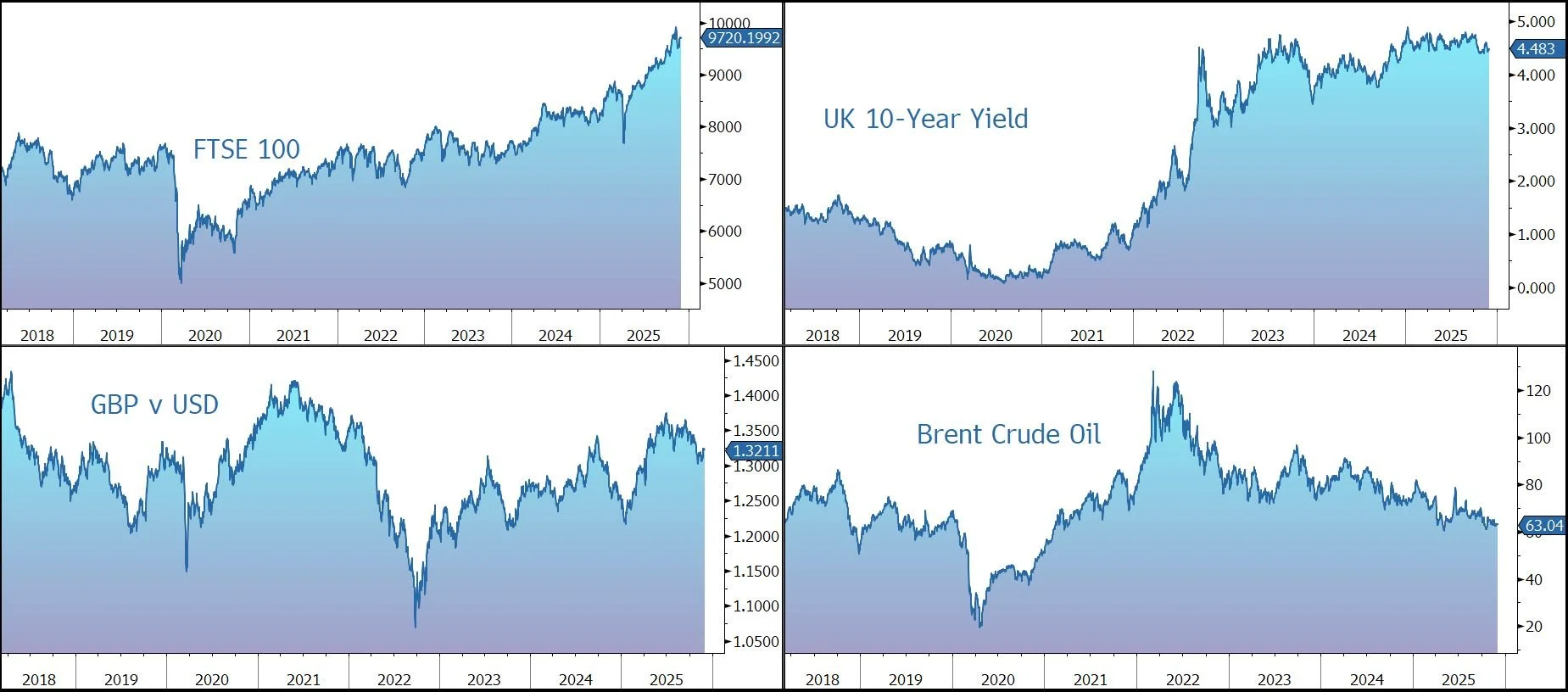
Brent Crude rose above $63 a barrel, building on gains from the previous session, supported by geopolitical risks threatening global supply and the latest OPEC+ decision.
US equities finished lower last night – S&P 500 (-0.5%, breaking a streak of five straight gains); Nasdaq (-0.4%) – ending not far from worst levels. Netflix made a mostly cash offer for Warner Bros Discovery in a second round of bids, people familiar said. The auction may wrap up in the coming days or weeks.
In Asia this morning, equity markets were mixed: Nikkei 225 (flat); Hang Seng (+0.2%); Shanghai Composite (-0.4%). Tech-heavy markets of South Korea and Taiwan outperformed. Japanese government bonds advanced after a keenly watched 10-year auction drew firm demand.
The FTSE 100 is currently little changed at 9,720 while Sterling trades at $1.3210 and €1.1380. The Bank of England cut its estimate of how much capital the UK’s banking industry needs for the first time in a decade. The sector should have Tier 1 capital equal to around 13% of risk-weighted assets, compared with the last estimate for 14%.
Source: Bloomberg
Fund Update – Personal Assets Trust
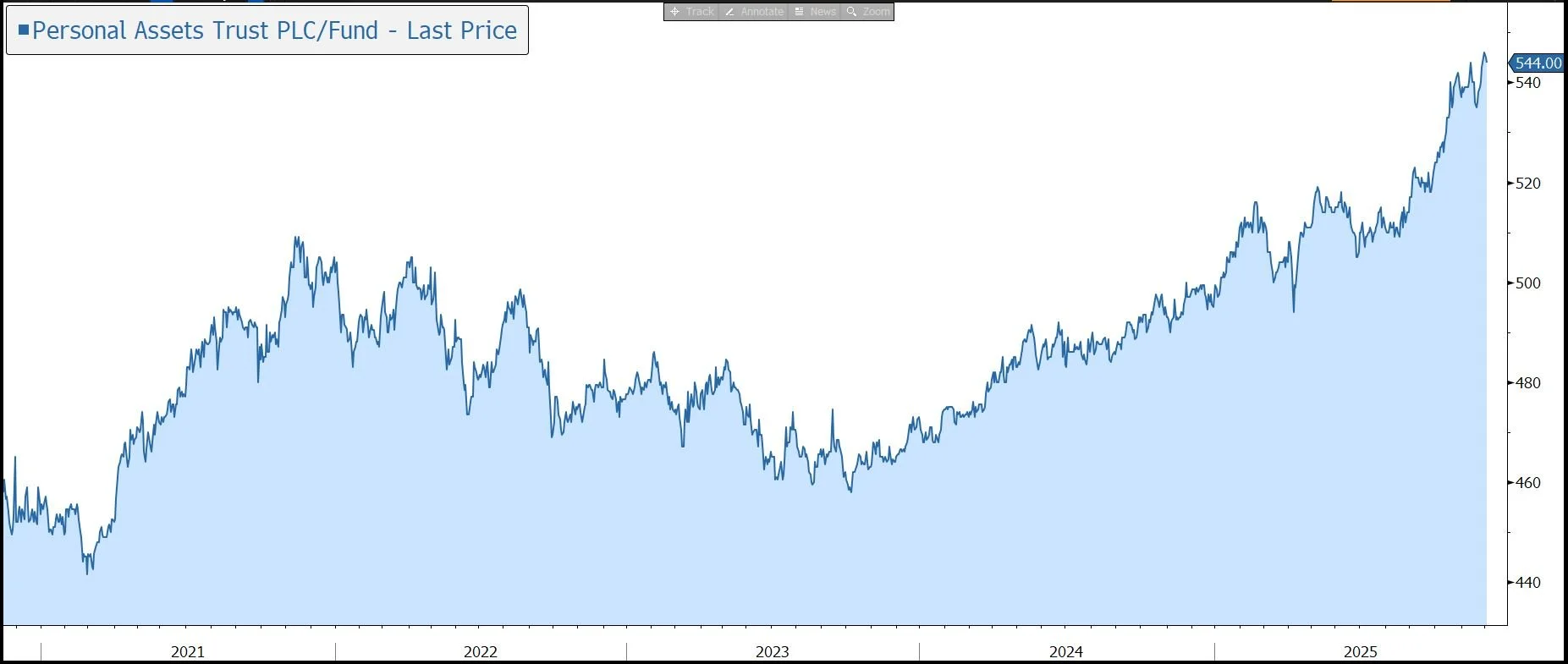
Personal Assets Trust PLC has this morning released its results for the six months to 31 October 2025. The fund has generated robust performance, albeit lagging the overall equity market given its defensive, capital preservation characteristics. The largest contributors to returns were equities and gold. The shares currently trade on a small premium to NAV.
Personal Assets Trust PLC (PAT) is a £1.7bn UK-listed investment trust run by Troy Asset Management. The investment policy to protect and increase (in that order) the value of shareholders’ funds per share over the long term. As a result, the fund can form a defensive cornerstone of an investment portfolio.
Since inception in 2009, the NAV (234.6%) and share price (223.2%) have outpaced the UK RPI (92.2%). In the latest six-month period, the NAV total return was 5.6%, while the share price total return was 6.0%. PAT is not constrained by a traditional benchmark like the FTSE All-Share Index; rather, it aims to achieve returns similar to equities over a market cycle but with significantly lower volatility. However, during the latest period, the fund lagged the FTSE All-Share Index, which rose by 16.0%. Returns rose in real terms, beating inflation of 1.2%.
The managers prioritises the avoidance of permanent capital loss, which they consider the primary definition of risk. The portfolio is structured around a flexible, multi-asset approach, allowing the managers to dynamically shift exposure across different asset classes depending on market conditions and perceived risk. This flexibility means the equity weighting can range drastically, demonstrating a high degree of tactical control.
PAT typically employs four main ‘pillars’ in its allocation, designed to offer both growth potential and resilience:
· High-Quality Equities - The largest component consists of large, well-established companies, often globally recognised brands (e.g., Alphabet, Unilever, Microsoft). These firms are selected for their sustainable growth potential, strong cash generation, and resilience during economic downturns.
· Inflation-Linked Bonds - A significant portion of the trust is dedicated to inflation-linked fixed income, such as UK Index-Linked Gilts and US Treasury Inflation-Protected Securities (TIPS). This provides a substantial hedge against inflation risk and offers stability when nominal bond yields are low.
· Gold Bullion - Physical gold or gold-related investments are held as a defensive measure. Gold serves as a classic portfolio ballast, acting as a non-correlated asset that historically performs well during periods of high geopolitical tension or monetary instability.
· Cash and Cash Equivalents - The trust retains flexibility by holding cash, allowing the managers to deploy capital quickly when attractive valuation opportunities arise, particularly following significant market sell-offs.
In the latest half-year, the largest contributors to returns were equities and gold, adding 3.0% and 2.6% respectively. The only negative contributor was currency, costing 0.1%.
The past six months has seen equity markets rebound strongly from their April lows, with AI-related gains continuing to fuel optimism. The managers believe that Autumn 2025 brought with it several indications that we may be in a stock market bubble. Open AI raised capital, reportedly valuing the company at $500bn at a time when its annual revenue run-rate is around $13bn. The Shiller Price-to-Earnings Ratio on the S&P 500 index reached 40x earnings, a level not seen since the dot-com boom. Finally, the amount of debt being issued across various parts of the market is on the rise.
As a result, the fund remains defensively positioned, with holdings in Japanese yen (8%), gold (12%), liquidity (11%), and short-dated index-linked bonds (28%).
The parts of the equity market favoured by PAT have been shunned, providing an opportunity to pick up quality companies at attractive valuations. This includes companies within sectors like consumer staples and healthcare which often look dullest near the top of strong bull runs. When a reappraisal comes, they are likely to defend and perform well. As a result, somewhat surprisingly, the equity allocation of the fund (41%) has risen this year.
The managers highlight that gold has continued its bull market into 2025, rising 23% in sterling for the six months under review. After such a strong run, the managers accept there are some short-term risks if equity markets fall as gold will be used as a source of liquidity. However, history tells us that across the last six S&P 500 drawdowns of 15% or more, gold typically fell alongside equities at first, but by the trough had outperformed by roughly 40% on average.
To ensure liquidity and investor confidence, the trust operates a robust Discount Control Mechanism. This ensures that the shares trade close to NAV by issuing new shares when demand is high (at a slight premium) and buying back shares when the share price falls below NAV (at a slight discount). In the latest half-year, the company bought back 7.1m shares at a cost of £36.5m and issued 1.5m shares from Treasury for £7.9m. This stability in pricing is a major feature, distinguishing it from many other investment trusts which can often trade at wide discounts.
The trust targets consistent, sustainable dividends, compatible with its primary goal of capital protection. For the current financial year to end-April 2026, the plan is to pay 5.6p per share in four quarterly payments, two of which have already been paid to shareholders. This will amount to a yield of just over 1%.
Source: Bloomberg
