
Morning Note: Market News and an Update from Target Corp.
Market News
Global bond yields retreated from multi-decade highs after the US Treasury Department said it would boost liquidity support for longer-dated securities to at least $4bn per operation from $2bn. US long-dated government yields fell by as much as 10 basis points, dragging European and Asian government bond yields down too. The dollar weakened, while gold rose by 4% to $4,500 an ounce, its highest level since June and close to its key 200-day moving average.
Investors barely reacted to minutes from the US Federal Reserve’s July meeting, which showed deepening concern about inflation with “several” policymakers ready to raise interest rates. Many said a rate hike would be needed if inflation does not decline to the central bank’s 2% target.
The US will begin what Donald Trump called “unprecedented” economic warfare against Iran after faulting the country for failing to make a deal. The US has quietly established a shipping corridor through the Strait of Hormuz, allowing the transport of about 10m barrels of oil a day, Axios reported. Brent crude trades at $92 a barrel.
US equities traded modestly higher last night – S&P 500 (+0.2%); Nasdaq (+0.2%). Moderna soared by 177% after the company said its personalised mRNA cancer therapy developed with Merck cut the risk of melanoma recurrence and spread in a late-stage trial. Merck rose by 13%.
In Asia this morning, equities rose: Nikkei 225 (+1.4%); Hang Seng (+1.3%); Shanghai Composite (+0.2%); Kospi (+5.9%). China is closing the AI gap with the US, raising concerns for firms such as OpenAI and Anthropic, which are chasing trillion-dollar valuations based on their purportedly superior capabilities and prospects. The Japanese government is considering tax incentives for retail JGB investors, the Nikkei reported.
The FTSE 100 is currently 0.2% lower at 10,739. Companies trading ex-dividend this morning include Anglo American (0.42%), Centrica (1.28%), Imperial Brands (1.65%), IHG (0.40%), and Legal & General (2.09%). Sterling trades at $1.3610 and €1.1650, while 10-year Gilts yield 5.04%.
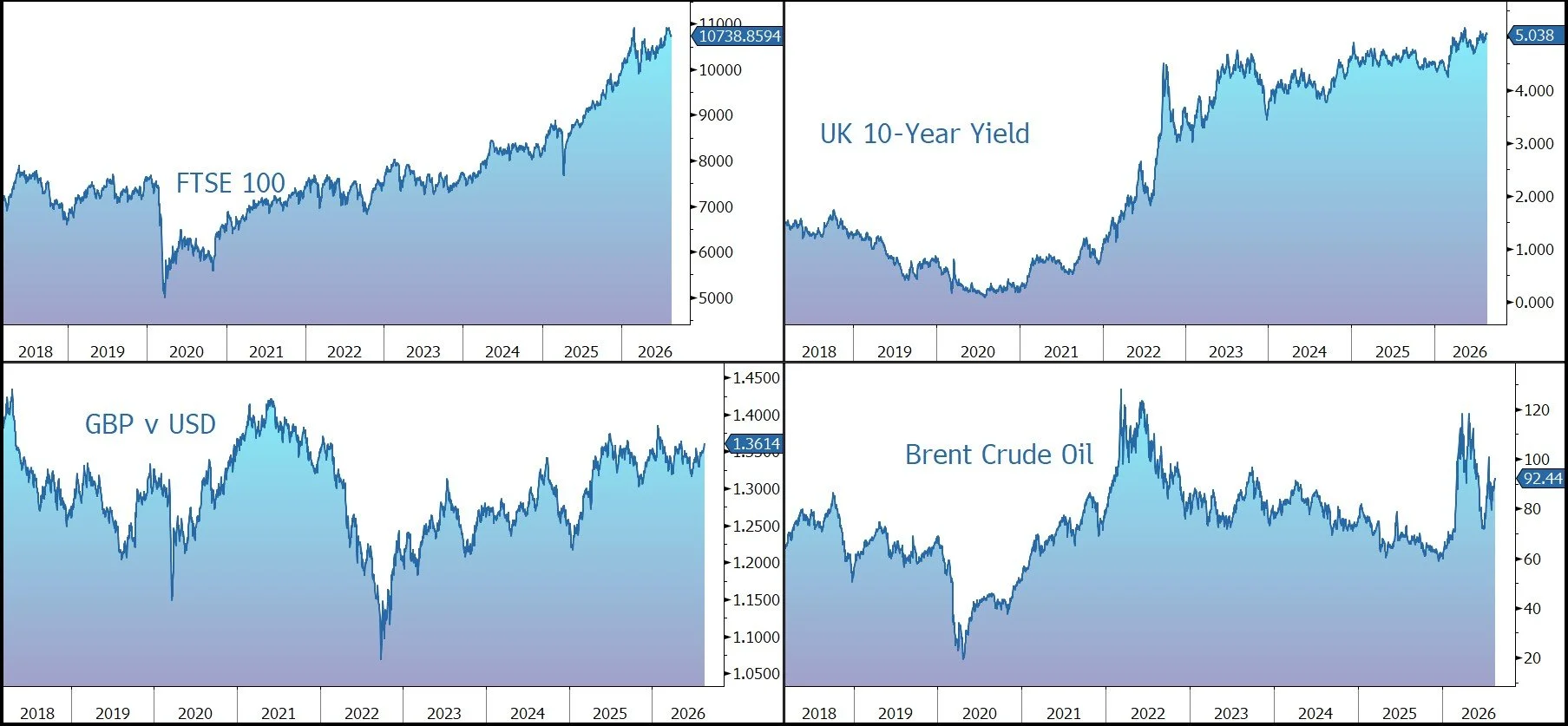
Source: Bloomberg
Company News
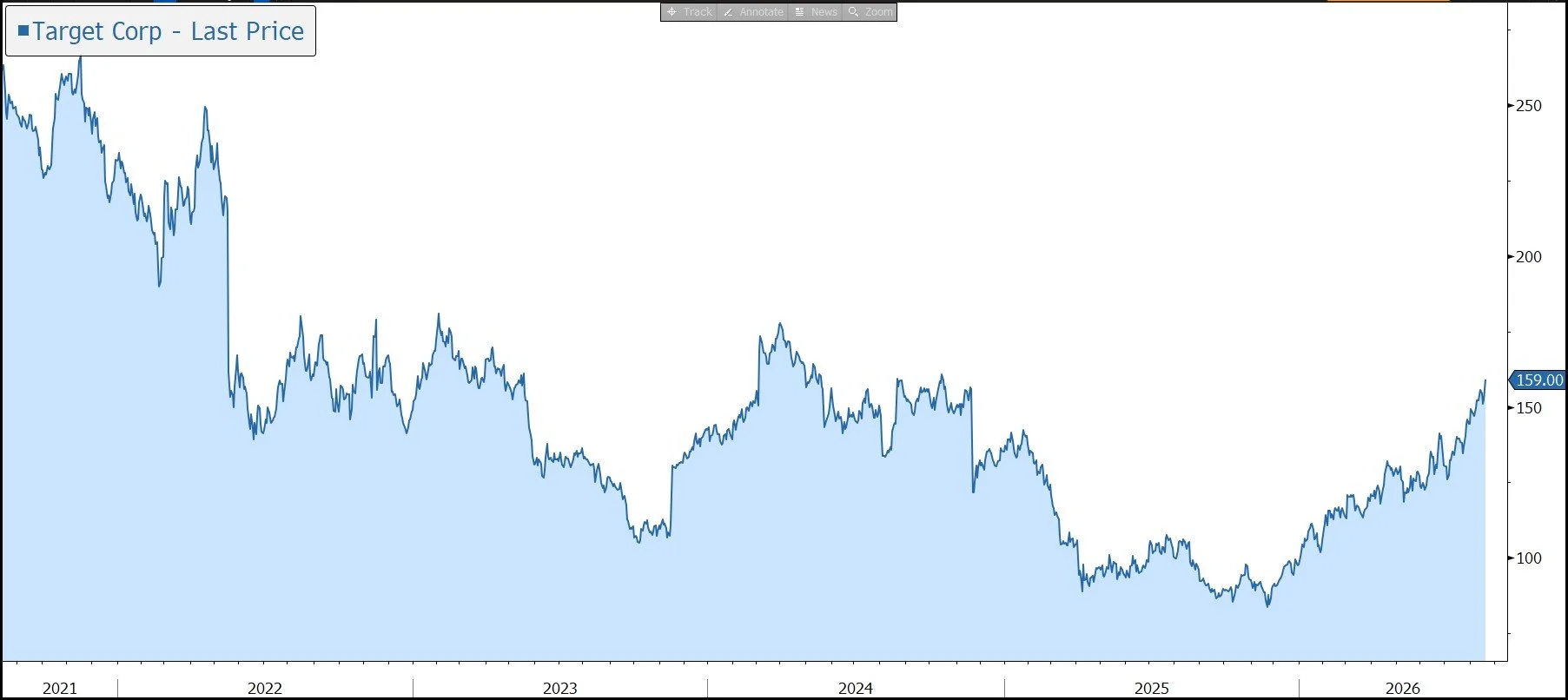
Yesterday afternoon, Target released Q2 results which were better than market expectations and built on the encouraging momentum seen in Q1. The company raised its full-year guidance for sales and EPS. In response, the shares climbed by 4% during yesterday’s session.
Target is a US general merchandise retailer, known for its big-box format. Last year, the group generated sales of $105bn from nearly 2,000 stores and through its digital channels.
However, the chain sells a higher proportion of non-essential merchandise than its competitors, meaning over half of its sales are discretionary, potentially making it more exposed to an economic downturn. The company also imports around half of its merchandise, meaning it would have to raise prices more than others to mitigate the impact of potential tariffs.
The group has undertaken a multi-year strategy to transform itself in the face of fierce competition by appealing to shoppers with a compelling product line – there are 45 brands that are unique to Target – a suite of convenience-driven fulfilment options, and competitive prices.
Back in March, the company announced plans to invest an incremental $2bn in 2026, including more than $1bn in additional capital expenditure and $1bn in additional operating investment. This will include transforming in-store floor plans and displays, increasing payroll and training, strengthening and evolving the assortment in key categories, and accelerating technology — including AI — to make shopping easier and more personalised. The retailer expects to open more than 30 new stores this year as part of its path to 300 new stores by 2035, while investing in over 130 planned full-store remodels.
In the three months to 1 August 2026, despite the challenging retail environment, sales grew by 3.8% in comparable terms to $26.5bn, slightly better than the consensus forecast of $26.1bn. Performance was driven by a 3.6% increase in traffic and 0.2% rise in average transaction amount.
Store comparable sales grew by 2.7%, with an 8.7% increase in digital sales. Growth was broad-based across sales channels, demographics, and merchandise categories. Net sales in all six core merchandising categories grew versus a year ago with double-digit growth in Fun 101 and high single-digit growth in Food & Beverage and Beauty.
Non-merchandise sales grew over 20%, reflecting strong growth in Roundel advertising revenue, Target Circle 360 membership revenue, and the Target+ marketplace.
The company benefitted from $994m of tariff refunds during the quarter. Excluding this, the gross margin rose from 29% to 30%, reflecting the comparison over last year's elevated markdowns and purchase order cancellation costs, as well as continued growth in advertising and non-merchandise sales. Adjusted EPS jumped from $2.05 to $4.11, helped by tariff refund benefits of $1.65. Underlying growth was 20%.
The quarterly dividend was raised by 1.8%, leaving the group on track to increase its annual payout for the 55th consecutive year. The company did not repurchase any of its stock in the quarter and still has $8.3bn of remaining capacity under its repurchase programme.
Given its performance through the first half of the year, the company has increased expectations for the full year. Net sales growth is now expected to be around 5%, one percentage point higher than the prior guidance. Excluding tariff refunds, the operating income margin rate is expected to be 50 basis points higher than last year’s 4.6%. Adjusted EPS guidance has been raised by 75c to $7.50-$8.50.
Source: Bloomberg
