
Morning Note: Market News and an Update from Nvidia.
Market News
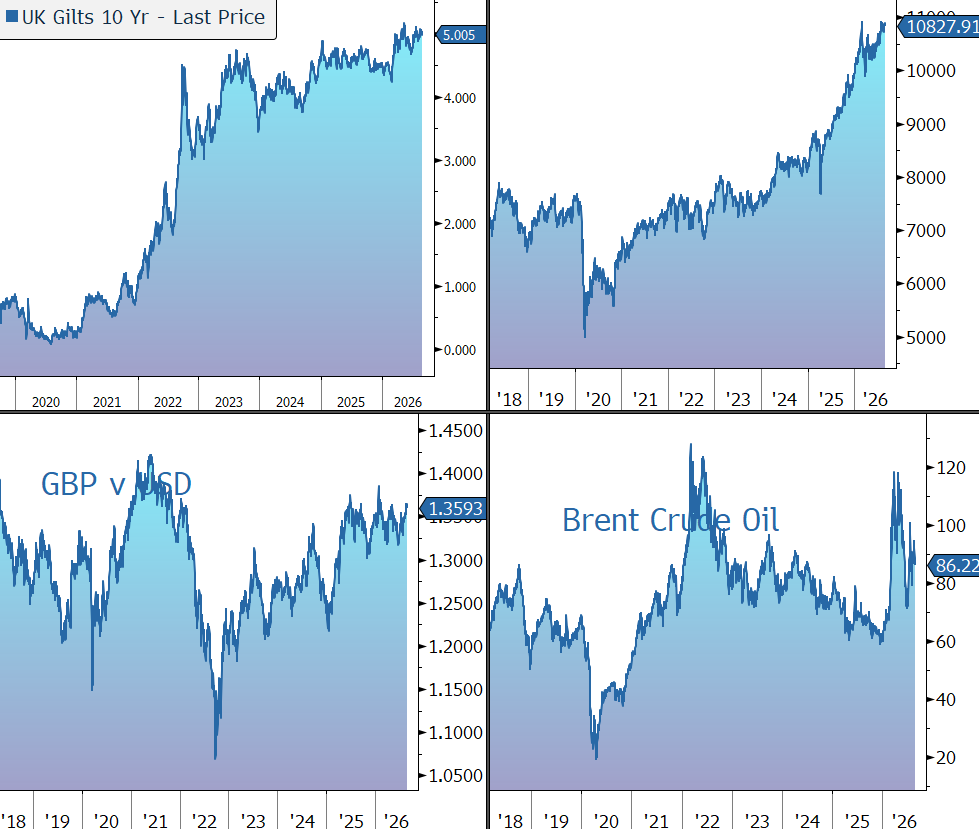
US equity futures advanced as Nvidia’s bullish sales outlook (see below) reinforced optimism that this year’s AI rally has further to run, although any upward move in interest rates could temper enthusiasm for technology stocks. The company’s shares rallied 5% in extended trading, helping lift other AI stocks including Marvell Technology and Sandisk. In Asia this morning, early gains reduced somewhat: Nikkei 225 (-0.3%); Hang Seng (-0.2%), Shanghai Composite (+0.8%); Kospi (+0.9%). The FTSE 100 is currently 0.4% lower at 10,828. Companies trading ex-dividend this morning include Croda (1.39%), Glencore (2.08%), and LondonMetric Property (1.62%).
The dollar firmed as investors assessed economic data and the outlook for rates. The core PCE price index remained elevated at 3.3% year-on-year, slightly above market expectations and ahead of the Fed’s 2% target. Treasuries edged lower as traders slightly increased bets on interest-rate hikes – the yield on the 10-year US note is currently 4.66%. Investors now await Fed Chair Kevin Warsh’s remarks at the Jackson Hole symposium tomorrow, although he is not expected to offer clear guidance on the central bank’s September policy decision.
Brent crude reduced to $81 a barrel, extending its decline to a fourth straight session amid signs of diplomatic progress in the Middle East. Iran and Oman reached an agreement over each country’s share of the Strait of Hormuz’s waters and related revenues, although Tehran cautioned that reopening the crucial waterway would require more than an agreement with Oman. Meanwhile, President Trump said 10m barrels of oil had passed through Hormuz on Tuesday, while reiterating claims that mines in the waterway had been cleared.
Gold moved back above $4,600 an ounce as China’s net imports through Hong Kong rose 11% month-over-month in July, supported by stronger investment demand. Wheat futures climbed to a three-year high as persistentattacks on vessels and infrastructure in the Black Sea region curbed shipments from one of the world’s biggest breadbaskets, reigniting food inflation worries. Uranium futures rose back above $90 per pound, the highest in over six months, as signs of strong demand magnified the impact of setbacks to supply from Kazatomprom, the world's largest producer.
Source: Bloomberg
Company News
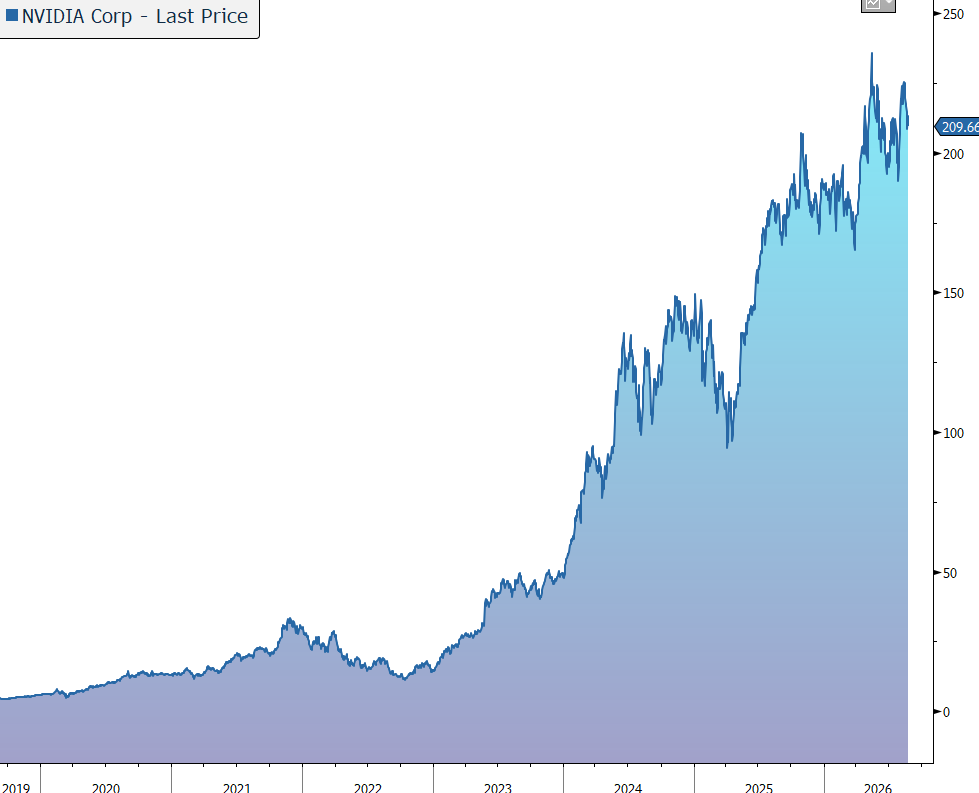
Last night, NVIDIA released results for the three months to 26 July 2026, the second quarter of its financial year to January 2027. The figures came in better than market expectations, underpinned by strong spending on AI infrastructure. The shares rose by 5% in after-hours trading following positive comments on the medium-term revenue outlook, easing concerns over the durability of the investment boom. The update had a positive impact on the rest of the sector given the company’s status as the core bellwether for global AI infrastructure and capital expenditure.
NVIDIA is one of the world’s largest semiconductor companies, with a leading market share in Graphics Processing Units (GPUs). From its original focus on PC graphics, the company has expanded to several other large and important computationally intensive fields, leveraging its GPU architecture to create platforms for scientific computing, AI, data science, autonomous vehicles, robotics, and industrial AI.
NVIDIA’s Blackwell and Vera Rubin architectures are the industry gold standard. According to SemiAnalysis InferenceX benchmark results, NVIDIA Blackwell Ultra delivers up to 50x better performance and 35x lower cost for agentic AI compared with the NVIDIA Hopper platform. Rubin comprises six new chips to deliver up to a 10x reduction in inference token cost, compared with Hopper/Blackwell workloads.
The company is benefitting as data centres make a platform shift from general computing, primarily using central processing units (CPUs), to accelerated computing, primarily using GPUs, which brings significant improvements in performance, energy efficiency, and cost.
Accelerated computing’s ability to significantly speed up machine learning and to deal with large data sets has enabled the development of generative artificial intelligence (AI), which offers human-like computing performance, and Agentic AI, AI systems that can reason and execute multi-step tasks autonomously. This is driving significant investment in new enterprise applications, which is in turn driving new demand for accelerated computing. There has also been an increase in Sovereign AI, where nations build their own domestic AI infrastructure, which generates another source of revenue for NVIDIA.
A concern is Google’s AI ecosystem, which is not reliant on NVIDIA’s GPUs, creating a significant risk to the company’s ability to sustain such high market share and gross margins. To defend its moat, NVIDIA has executed an unprecedented capital deployment strategy, committing capital to investments and partnerships. By funding a vast ecosystem, stretching from foundation model makers to ‘neocloud’ GPU infrastructure providers, NVIDIA is effectively anchoring the next generation of AI development to its proprietary hardware and software stack.
Another risk is that while demand for Rubin is described as unprecedented, the company remains highly dependent on TSMC’s CoWoS advanced packaging capacity, alongside a tight global supply of High Bandwidth Memory.
In the latest quarter, revenue rose by 106% to $96.2bn, above the company guidance of $91bn, plus or minus 2%, and the market forecast of $92bn. The result was 18% higher than the previous quarter.
The company reports across two market platforms: Data Center and Edge Computing.
During the second quarter, Data Center revenue rose by 117% to $89bn. The Vera Rubin platform is ramping into full production with racks running at partners including Google Cloud, Microsoft Azure, and Oracle Cloud Infrastructure. The division is divided into two sub-markets, Hyperscale and ACIE, which incorporates AI Clouds, Industrial & Enterprise. Hyperscale includes revenue from the public clouds and the world’s largest consumer internet companies. In the latest quarter, revenue rose by 102% to $48.7bn, on the strength of Blackwell Ultra.
ACIE addresses NVIDIA’s growth opportunity in diverse AI purpose-built data centers and AI factories across industries and countries. Revenue rose by 138% to $40.3bn, driven by end-demand from AI natives, enterprises, and sovereign customers, as well as hyperscalers utilizing AI clouds.
Edge Computing includes data processing devices for agentic and physical AI including PCs, game consoles, workstations, AI-RAN base stations, robotics and automotive. In the second quarter, revenue rose by 27% to $7.2bn. Growth was driven by strong sales of Blackwell workstations, partially offset by slower consumer PC sales that were tempered by elevated memory and systems prices.
The gross margin is high. In the latest quarter, it rose from 72.5% to 75.0%, in line with the group’s guidance, and driven by improved mix from Blackwell Ultra.
Operating expenses rose by 54% to $8.2bn, slightly below the guidance of $8.3bn, and primarily driven by higher compute infrastructure and compensation and benefits costs. EPS rose by 120% to $2.22, ahead of the market forecast of $2.08.
NVIDIA continues to make strategic commitments across its supply, infrastructure, and partner ecosystems to capitalise on the substantial growth opportunities. The company has partnered with its extensive network of suppliers to secure the critical components needed to meet demand for the next several years. These commitments increased from $119bn last quarter to $279bn, primarily related to the procurement of memory. The company also has equity investments focused on AI model makers, infrastructure financiers, and other private companies.
The business is very cash generative, with free cash flow up 59% to $21.3bn in the three months to end July. The company’s balance sheet is very strong, with cash of more than $56bn at the end of the quarter. This is being used, in part, for shareholder returns, with the company paying out $26.0bn in the form of shares repurchased and cash dividends during the quarter. The company still has $99bn remaining under its share repurchase authorisation.
For the current quarter, the company is guiding to revenue of $108bn, plus or minus 2%. This was above the consensus expectation of $105bn. NVIDIA is not assuming any Data Centre compute revenue from China in its outlook. A gross margin of 74%, plus or minus 50 basis points is forecast. The company has said that rising memory prices could put some pressure on margins. Operating expenses are expected to be $9.0bn.
On the post-results call, the company said it also expects to grow revenue by approximately 70% in FY2028, well above the market projection for growth of 45%.
Source: Bloomberg
