
Morning Note: Market News and an Update from Melrose.
Market News
A global rally in technology stocks gathered momentum as South Korean equities posted a record jump, with investors returning to the AI trade after this week’s rout. The Kospi Index surged as much as 18%, rebounding from a three-day selloff. Heavyweights SK Hynix and Samsung Electronics rose by as much as 30% and 27%, respectively. Elsewhere in Asia, markets were also firm: Nikkei 225 (+3.9%); Shanghai Composite (+0.8%).
US equities rose last night – S&P 500 (+1.7%); Nasdaq (+2.8%) – boosted by technology stocks, particularly Microsoft. Apple fell after hours after component shortages weighed on the company’s sales forecast. Amazon rose after second-quarter AWS net sales beat estimates.
The Japanese yen surged as much as 3.3% to around 158 per dollar before pulling back toward 160 per dollar, with markets suspecting Tokyo intervened once again to support the currency just hours before the Bank of Japan’s policy decision – interest rates were held steady at 1% as expected. Scott Bessent told Fox Business the yen’s “very undervalued.” China’s factory activity unexpectedly contracted for the first time in five months, with the official manufacturing PMI falling to 49.2 in July from 50.3 in June.
Brent crude trades at $85 a barrel as renewed fighting between the US and Iran threatened further disruptions to Middle Eastern energy supplies. Donald Trump said the US-led Board of Peace has reached a deal for the ‘complete disarmament’ of Hamas and other armed groups in Gaza, and the establishment of a new Palestinian government. Gold trades at $4,080 an ounce.
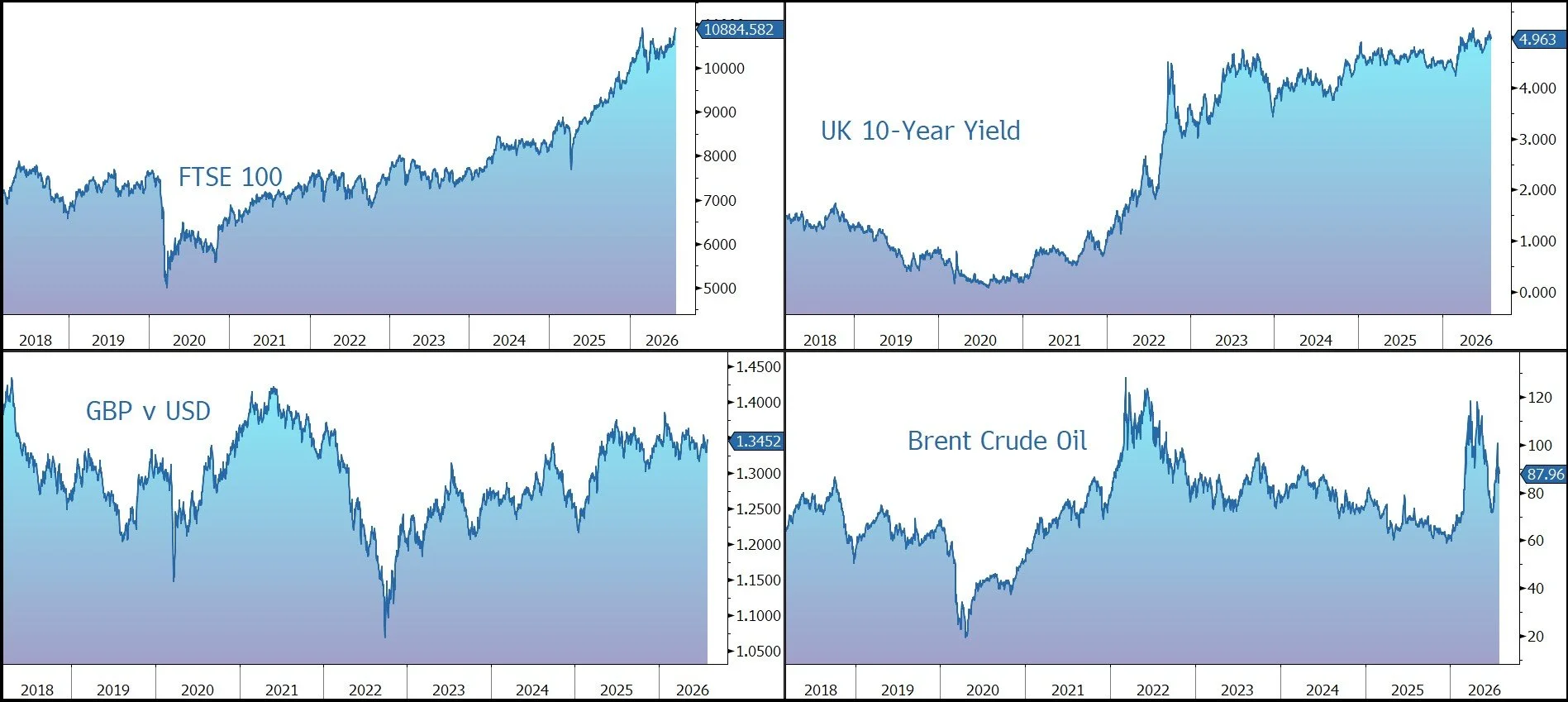
The FTSE 100 is currently 0.8% higher at 10,985. The UK 10-year gilt yield moved below 5.0%, after the Bank of England voted 6-3 to keep the Bank Rate unchanged at 3.75%, compared with market expectations of a 7-2 split. The Bank warned that higher energy prices are likely to push inflation higher later this year, with risks now tilted to the upside. Sterling trades at $1.3450 and €1.1680.
Source: Bloomberg
Company News
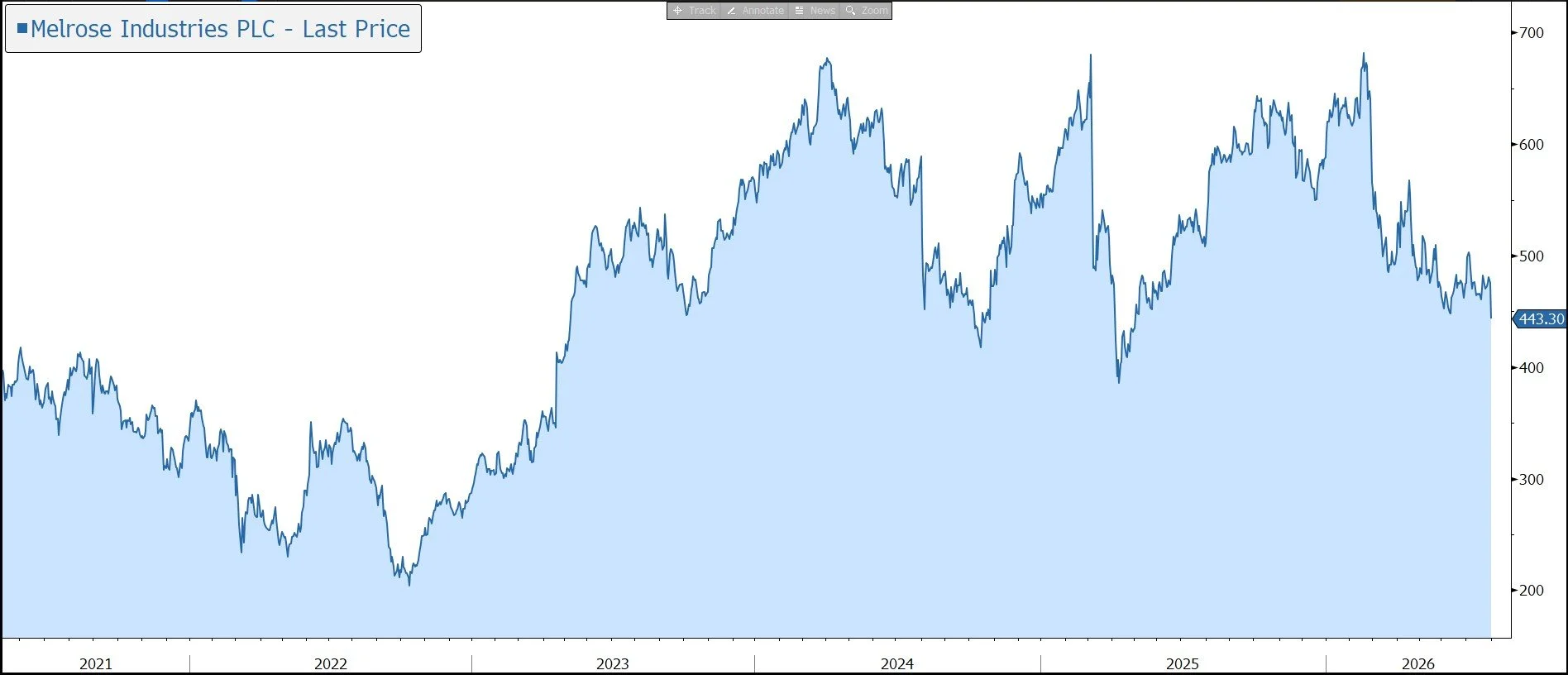
Melrose Industries has released half-year 2026 results which were slightly below market expectations. Underlying performance was underpinned by good commercial and technology progress, combined with operational improvements. The company continues to see a sharp ramp-up in cash flow generation. However, the results have been held back by an incident at a facility in California and the share buyback programme paused until there is more certainty over the financial impact. In response, the shares have been marked down by 5%. Once again, the share price reaction to company results has been volatile – an irritant that probably deters some from investing.
Melrose is a ‘Super-Tier 1’ aerospace technology supplier with established positions on all the world’s high-volume aircraft. Its products are on-board 90% of civil aircraft on the market today (wide and narrow body) and the company generates 95% of its revenue from industry-leading positions (and more than 70% as sole supplier).
Revenue is split 71% civil, 29% defence. The civil industry is expected to enjoy long-term structural growth as airlines upgrade their ageing fleets after years of underinvestment. Backlogs for new aircraft stand at a record level of ~15,000. Air traffic growth and low retirement rates continue to support the aftermarket. Geopolitical uncertainty is driving a step change in defence spending, which is providing a number of new growth opportunities for the group.
R&D excellence and long-standing relationships create high barriers to entry and mean the company is well positioned for the next generation of technology, particularly that enabling zero emission flight – additive fabrication technology, uncrewed Defence air vehicles, and electric flight.
There are two divisions: Engines and Airframes (previously Structures, i.e. bodies and wings of planes).
In 2025, Engines contributed over 75% of Melrose’s profit, with over 85% of this being from the accretive and structurally growing aftermarket. The business has OEM-level capability and responsibility for selected engines which gives more technical and commercial advantages than normal for a Tier 1 supplier. The company is partner to all major engine OEMs (original equipment manufacturers) with its lucrative and diverse Revenue and Risk Sharing Partnerships (RRSP) portfolio providing strong cash flow growth. 17 of the 19 RRSPs are already in the cash generation phase, with a total expected lifetime gross cash inflow of £22bn (£6bn net). In Airframes, Melrose has strong embedded positions with over 70% of its content provided on a sole-sourced basis.
The company recently appointed a new Chief Financial Officer, Ross McCluskey, ex-CFO of Intertek. We are happy with this appointment because Intertek is known for its capital discipline and high margins, something Melrose will need to focus on as it looks to shift from a restructuring play to an operational compounder.
In May, GKN Aerospace suffered a thermal incident at a storage tank at its facility in Garden Grove, California. The local fire authority publicly confirmed that no chemical leak occurred and that there was no risk to the public. The site designs, manufactures and provides aftermarket support for advanced military and commercial transparencies. In 2025, it generated 0.4% of group revenue. In the first half of 2026, the incident reduced revenue by £16m and adjusted operating profit by £9m. Partial production has resumed, and Melrose continues to work closely with customers, regulators, and other authorities to safely restore the site to full production in the second half. For now, the company has paused its share buyback programme (see below) pending clarification of financial impact of the incident, including from ongoing regulatory and legal processes. As well as the financial impact from operating at reduced capacity, Melrose currently anticipates incurring additional exceptional costs of between £25m and £30m in the second half.
In the first six months of 2026, revenue was up 10% to £1,873m. The group’s multi-year transformation programme has been the key driver of margin expansion – up a further 50 basis points in the first half of 2026 to 18.5%. Adjusted operating profit rose by 16% to £347m, while EPS grew by 22% to 17.7p.
In Engines, revenue grew by 19% to £896m, driven by both OE (+23%) and aftermarket (+15%). Margins rose by 40 basis points to 33.8%. There was continued strong OEM order intake for new aircraft supporting multi-year order backlog for engine components
In Airframes, revenue grew by 4% to £977m. The margin slipped by 40 basis points to 6.3%, reflecting lower volumes at Garden Grove. Excluding the incident, the margin was 7.2%. Defence (+14%), reflecting continued demand for lightweight aerostructures and advanced manufacturing capabilities. Civil fell by 1%.
As expected, free cash flow is ramping up sharply as a result of increased RRSP cash flows, operational improvements, and reduced restructuring cash spend. In the first half, the company generated free cash flow of £13m, compared to an outflow of £54m last year.
The company has previously been criticised for using factoring—selling its invoices to third parties for immediate cash—to artificially boost its cash flow and mask its true debt levels. While opponents view factoring as a tactical move to flatter the books and stay below bank leverage thresholds, the company maintains it is a rational, low-cost financing strategy driven by organic revenue growth within long-standing customer contracts. Management has explicitly stated they are not entering into any new factoring programmes in 2026. The arrangements they have are mature and strictly restricted to the specific, long-standing aerospace contracts they already support. In the first half of 2026, the factoring balance fell by £9m to £387m.
Melrose has a strong balance sheet with leverage at 30 June 2026 of 1.8x net debt to EBITDA, in line with the target to be between 1.5x and 2.0x. Financial strength is driving attractive shareholder returns through a progressive dividend – up 20% in 2025 and 13% in the first half of 2026.
There is also potential for a sizeable cash return every year until the end of the decade – the company was undertaking a £175m share buyback programme expected to complete in March 2027. As highlighted above, the programme has been paused.
Overall, the most significant contributor to future Melrose value is profitably capturing the growth from its established positions across civil and defence platforms from record order backlogs, as production ramps and the aftermarket flows through.
Excluding the impact of Garden Grove, our guidance for the full year remains unchanged:
Guidance for revenue is £3.75bn to £3.95bn, up 10% in LFL terms reflecting OE volume ramp-up and the continued strength of the aftermarket. Adjusted operating profit is expected to be between £700m and £750m, reflecting a margin of 19% at the mid-point. The guidance includes variable consideration of between £340m and £380m depending mainly on OE build rates of key engine programmes. Free cash flow is expected to expand to between £150m and £200m driven by the completion of the restructuring programme and growth in operating profit.
The company remains well positioned to deliver its 2029 targets: revenue of £5bn, operating profit (post PLC costs) of £1.2bn+ (i.e. 17% CAGR), margin of 24%+, and free cash flow of £600m and growing beyond. 90% of revenue will come from existing platforms – growth will be driven by maturing engine RRSP portfolio, margin improvement at structures, and ongoing demand for parts – and 10% from new opportunities.
Source: Bloomberg
