
Market News
Global risk appetite staged a sharp recovery overnight, driven by two catalysts: a rare midday statement from China’s State Council pledging expanded “national team” market support, and a continued rebound in AI-linked equities following Wednesday’s near-bear-market low in the Nasdaq 100.
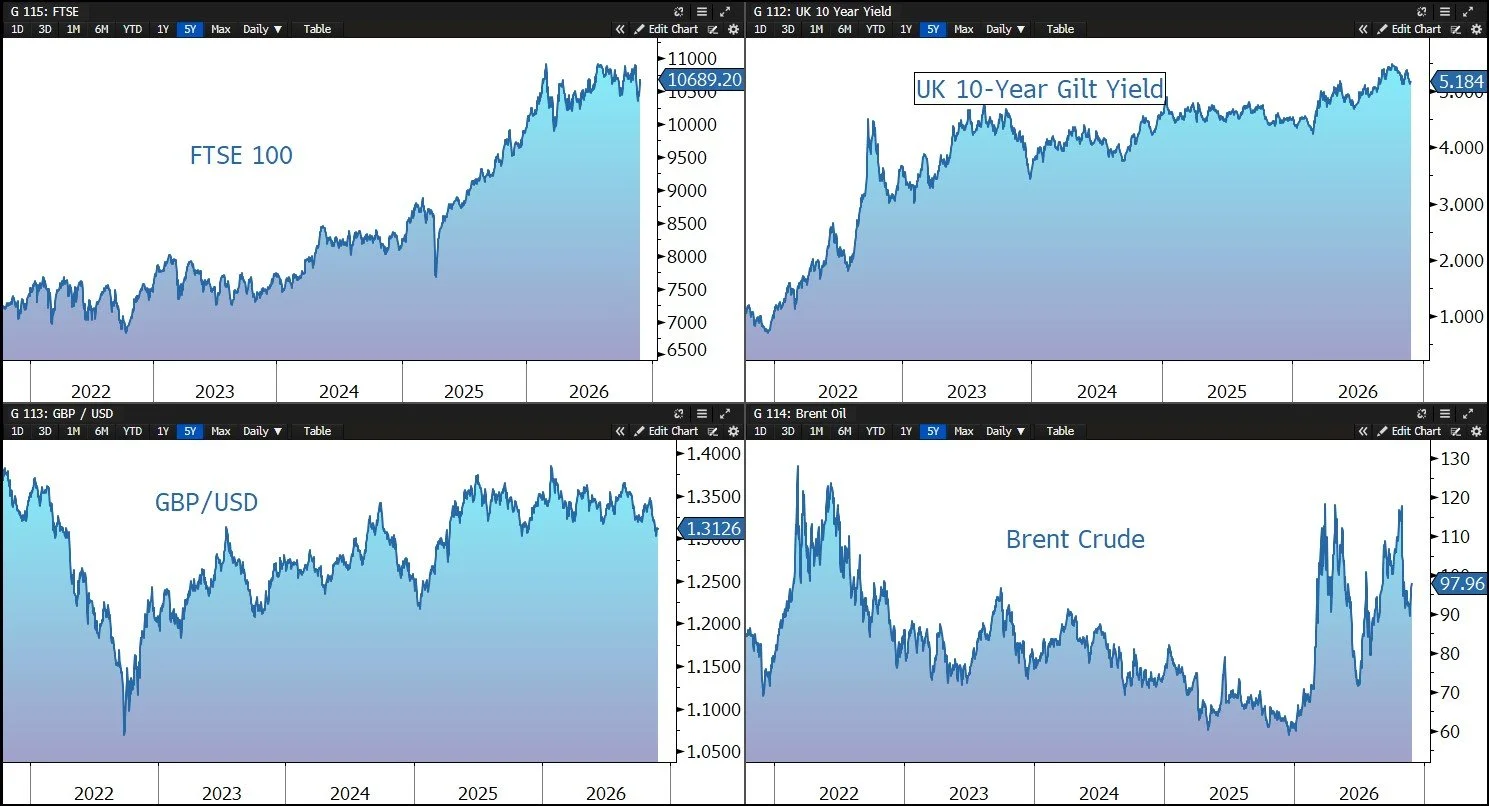
The Shanghai Composite surged by 3.7%, with the ChiNext and Star 50 indexes jumping 9% and 12% respectively. The sustainability of the move depends on whether follow-through policy detail materialises. Gains were also registered elsewhere in Asia this morning: Nikkei 225 (+2.1%); Hang Seng (+2.1%); Kospi (+4.3%). The S&P 500 (+1.2%) and Nasdaq (+2.0%) are both expected to open higher this afternoon on what is a short trading day following yesterday’s holiday. The FTSE 100 is currently 0.7% higher at 10,689. Imperial Brands (see below) remains in focus following yesterday’s news of a potential bid.
Copper surged 6.5%, its biggest intraday gain since January, while gold climbed 3% to $3,675 an ounce as liquidity-driven pressure eased. This helped the mining sector regain its poise. Treasuries retreated in thin post-Thanksgiving trade, with the 10-year yield rising 6bps to 4.91%.
Brent crude climbed above $97 a barrel, putting it on track for its first weekly rise in four weeks, as attacks on Middle Eastern energy facilities and tankers heightened concerns over potential supply disruptions. The OPEC+ meeting on Sunday looms over energy markets, with the cartel reportedly considering rolling over current quotas into January amid internal discord over production audits.
Source: Bloomberg
Company News
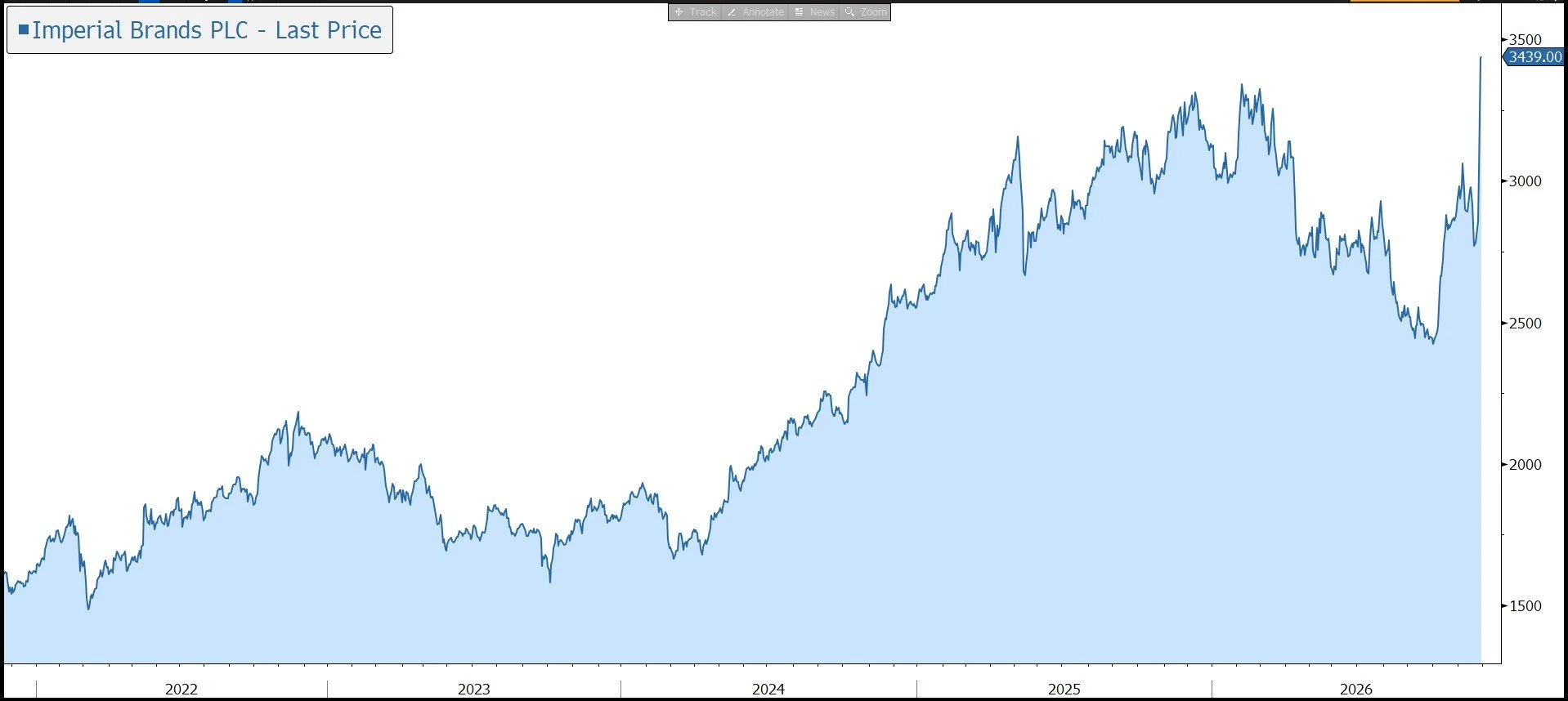
Yesterday afternoon, Imperial shares traded 14% higher at 3,432p following news of a potential bid from US rival Altria.
Imperial Brands manufactures and sells cigarettes, fine cut tobacco, smokeless tobacco, cigars, and next generation products. The main brands include Davidoff, Lambert & Butler, West, Gauloises, JPS, Rizla, and blu.
Altria is a US listed tobacco company that owns Philip Morris USA and with it the US rights to the Marlboro brand. It has a market cap of $127bn, dwarfing Imperial at $34bn (or EV $46bn). Altria has $21bn of net debt.
Yesterday, Altria confirmed it is considering a possible offer for Imperial Brands, with any offer likely to be solely in cash. Altria confirmed it is also in discussions with a third party (rumoured to be Japan Tobacco) regarding its possible acquisition of part of the business of Imperial Brands, however no agreement has yet been reached. There is no certainty an offer will be made nor as to its terms. Under UK takeover rules, Altria has until 24 December to announce a firm intention to bid or walk away. Deutsche Bank and Perella Weinberg have been confirmed as Altria’s financial advisers on the potential bid.
In response, the Board of Imperial released a statement which noted the announcement by Altria that it is considering a possible offer for the company. The Board has not had any discussions with, or received any approach or proposal from, Altria or the third party referenced in the announcement. The statement represents a denial of contact rather than a rejection, leaving Altria at the earliest, least-committed stage under Rule 2.4 of the Takeover Code.
Overall, the timing of the announcement is strange given the US market is closed for Thanksgiving. It looks like Altria’s hand was forced early by media speculation.
Imperial operates in a highly-consolidated market, with resilient revenue driven by strong pricing power. Excluding China – which accounts for more than 40% of global cigarette consumption and is supplied by the state monopoly – the industry is now dominated by five companies that account for more than 80% of the global market (ex-China): Philip Morris International (the owner of Marlboro outside the US, 25% volume share); British American Tobacco (23%); Japan Tobacco (the owner of Gallaher, 17%); Imperial Brands (7%); and Altria (Philip Morris USA, 5%). The remaining 20% or so is largely regional players like ITC (India), KT&G (South Korea), and Gudang Garam/Djarum (Indonesia).
Despite selling only in the US with a 5% global volume share, high US retail prices and margins give Altria roughly 18% of the Big Five’s combined revenue and 20% of combined operating profit.
Given the lack of volume growth in the core tobacco industry, every decade or so there is a round of consolidation which allows the industry to take out another layer of cost to keep profit growing.
Historically, Imperial has been a predator in this process but given its size – the company admits it is a challenger among giants – it has long been the subject of bid speculation.
In this regard, there have been rumours in the past that Imperial Brands could be a target to be broken up by the other players. Japan Tobacco was always seen as a likely suitor, albeit there were anti-trust and ownership issues. In fact, the Japanese state is legally required to maintain a one-third stake in Japan Tobacco, and they might be unwilling to support any rights issue needed to fund a deal. A joint deal with another player helps to solve these issues.
It would be very difficult for Altria to absorb Imperial’s US arm given it already has a 45% market share (as Marlboro owner) and Imperial’s assets would add another 10%.
Altria is likely to offload Imperial’s US assets to a third party to win FTC clearance. Japan Tobacco would fit – it holds 8% of the US cigarette market, making it the fourth-largest player behind Altria, BAT, and Imperial Brands.
A purchase of Imperial’s European/international assets has a number of benefits for Altria. It would help it escape single country risk and diversify its cash flows across multiple mature, high-margin jurisdictions. The company’s stated 2028 strategic vision explicitly calls for exploring new growth opportunities beyond the US and beyond nicotine. Imperial would add a ready-made international distribution for its smoke-free products. Furthermore, when Altria spun off PMI (Philip Morris International) in 2008, the two companies stayed out of each other’s territories. Since then, PMI has re-entered the US aggressively via its $16bn acquisition of Swedish Match and buying back US IQOS commercialisation rights. Acquiring Imperial’s international business lets Altria strike back in PMI’s home turf in Europe with immediate scale.
So, overall, given the small number of players in the global industry a combined bid that split Imperial up is probably the best way to get around anti-trust concerns.
Imperial is the last sizeable player to bid for, making it a fairly scarce asset. It also has a fairly concentrated business: its five largest markets – the US, Germany, the UK, Australia, and Spain – represent 70% of adjusted tobacco operating profit.
Despite that attractive geographic footprint, Imperial’s shares had lagged peers for much of the year prior to yesterday's spike and even now are only trading just above where it was in the spring. There were several reasons for the under-performance. Firstly, market share loss in the US and German combustible market, following the company’s shift to a profit over volume strategy. The concern is that there is more share to be lost. Secondly, increased competition in the US in Next Generation Products which has extended the time to breakeven in the category. Thirdly, Kenneth Dart (via Spring Mountain Investments) reduced his stake from 7% to 3%, and there is still a potential overhang. Fourthly, potential margin pressure due to increased shipping costs as a result of the Middle East conflict. In addition, as a yield stock, higher risk-free government bond yields lower Imperial’s relative attraction to income investors.
All of this came on top of lingering concerns after highly-regarded CEO Stefan Bomhard stepped down just after launching the new strategy. While his successor, former CFO Lukas Paravicini and current CFO Murray McGowan helped draft the 2030 plan, the management transition forced the market to attach a higher ‘execution risk premium’ to the shares until the new leadership team proves it can maintain free cash flow generation.
However, the recent results provided lots of reassurance on a number of issues and the shares bounced 20% in October.
Against the backdrop, I think a bid comes in well above this level.
Imperial is not a distressed business. It is part-way through its second 5-year plan. To support the delivery of its strategy, the company has identified further opportunities to create a simpler, leaner, and more agile organisation. These initiatives are expected to generate annualised savings of at least £320m by 2030, the majority of which will be reinvested to support growth.
The business generates strong cash flow, is buying back shares through an evergreen programme, and yields around 5.5%. Taking dividends and the buyback together, we expect the capital return to shareholders will be around £2.7bn in FY2027, representing more than 12% of the current market capitalisation (before yesterday’s move). Similar returns are expected in the medium term.
Altria trades on a noticeably higher earnings multiple (13x) than Imperial Brands (8x), giving the US company ample financial headroom to make an accretive offer.
Given Imperial’s relative scarcity, there is a chance that BAT could join the party and create a competitive bidding war. The caveat to this is BAT’s own balance sheet leverage (£32bn of net debt) and heavy US market share (30%+), which would make a solo counter-bid for Imperial’s US assets very difficult on antitrust grounds—meaning BAT would also likely need a breakup partner or only be interested in select international assets.
Although a bid would generate an instant uplift in the share price, many shareholders will be pretty ambivalent as to whether it goes ahead given they are already getting total returns (through dividend and buybacks) of 10%+ every year. Over the medium term, that would soon add up to a 30% bid premium. For that reason, I think £40 is the minimum the board would accept.
Even at £40, Imperial would still be valued at roughly 11x FY27 consensus EPS, comfortably below Altria’s rating (13x), leaving room for an all-cash deal to remain immediately earnings-accretive before cost synergies.
Note Altria has net debt of $21bn and gearing of 1.7x net debt to EBITDA, just below its 2.0x target. A cash acquisition at £40, less the proceeds from a third party for the US business, would leave Altria with gearing above 3x, stretched but manageable for a highly cash generative tobacco business.
However, as the Altria statement says there is no certainty an offer will be made nor as to its terms, while the early stage nature of the statement and the presence of a third party increases that risk. As a result, there is clearly a risk of no deal and with it the prospect of a short-term share price fall.
Source: Bloomberg
