
Morning Note: Market news and an update from Glencore.
Market News
The latest batch of US data reinforced expectations that the Federal Reserve will cut interest rates for a third successive time next week. 10-year Treasury yields steadied at 4.08%, while gold trades around $4,200 an ounce.
US equities made small gains last night – S&P 500 (+0.3%); Nasdaq (+0.2%). Microsoft lagged following a report by The Information highlighting that multiple divisions at the company have lowered sales growth targets for certain artificial intelligence products after many sales staff missed goals in the fiscal year that ended in June. The EU is planning a fresh antitrust probe against Meta over the use of AI features within WhatsApp, the FT reported, with an announcement of the investigation possible in coming days.
In Asia this morning, markets were mixed: Nikkei 225 (+2.2%); Hang Seng (+0.7%); Shanghai Composite (-0.1%). The PBOC stepped up its grip on the yuan by setting a significantly weaker reference rate than estimated.
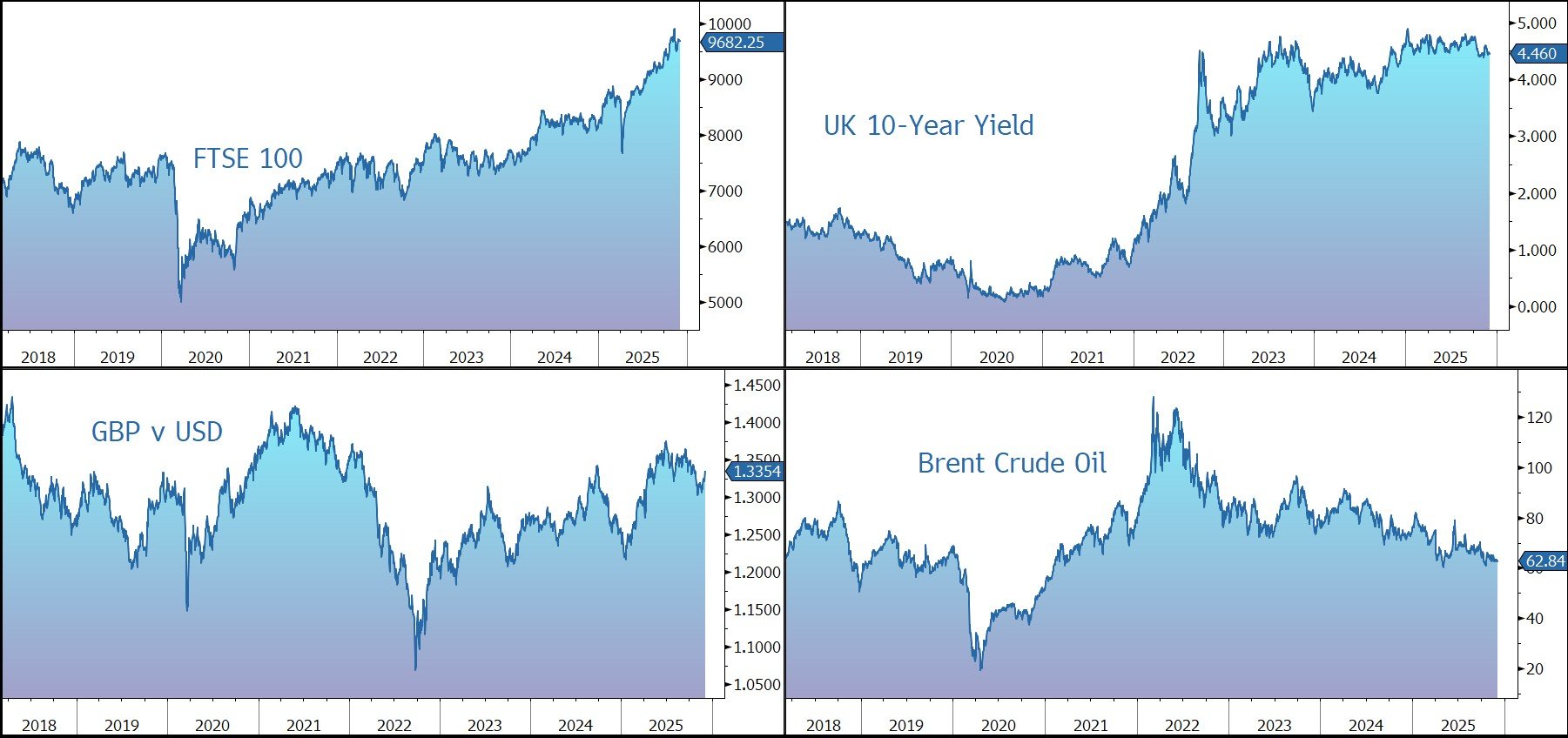
The FTSE 100 is little changed at 9,682. Companies trading ex-dividend today include NEXT (87p) and SSE (21.4p). Sterling extended gains ($1.3345 and €1.1425), reaching its strongest level since late October, as investors welcomed an upward revision to November’s UK services PMI to 51.3 from 50.5, comfortably above the 50 threshold separating expansion from contraction.
France’s social security budget risks failure in next week’s National Assembly vote as centre-right parties reject government’s compromise with Socialists. Philippe’s Horizons party, part of governing coalition, announced it cannot support budget due to pension reform suspension, high deficits, and increased CSG social tax on investment income. Les Républicains also opposes the investment tax hike.
Source: Bloomberg
Company News
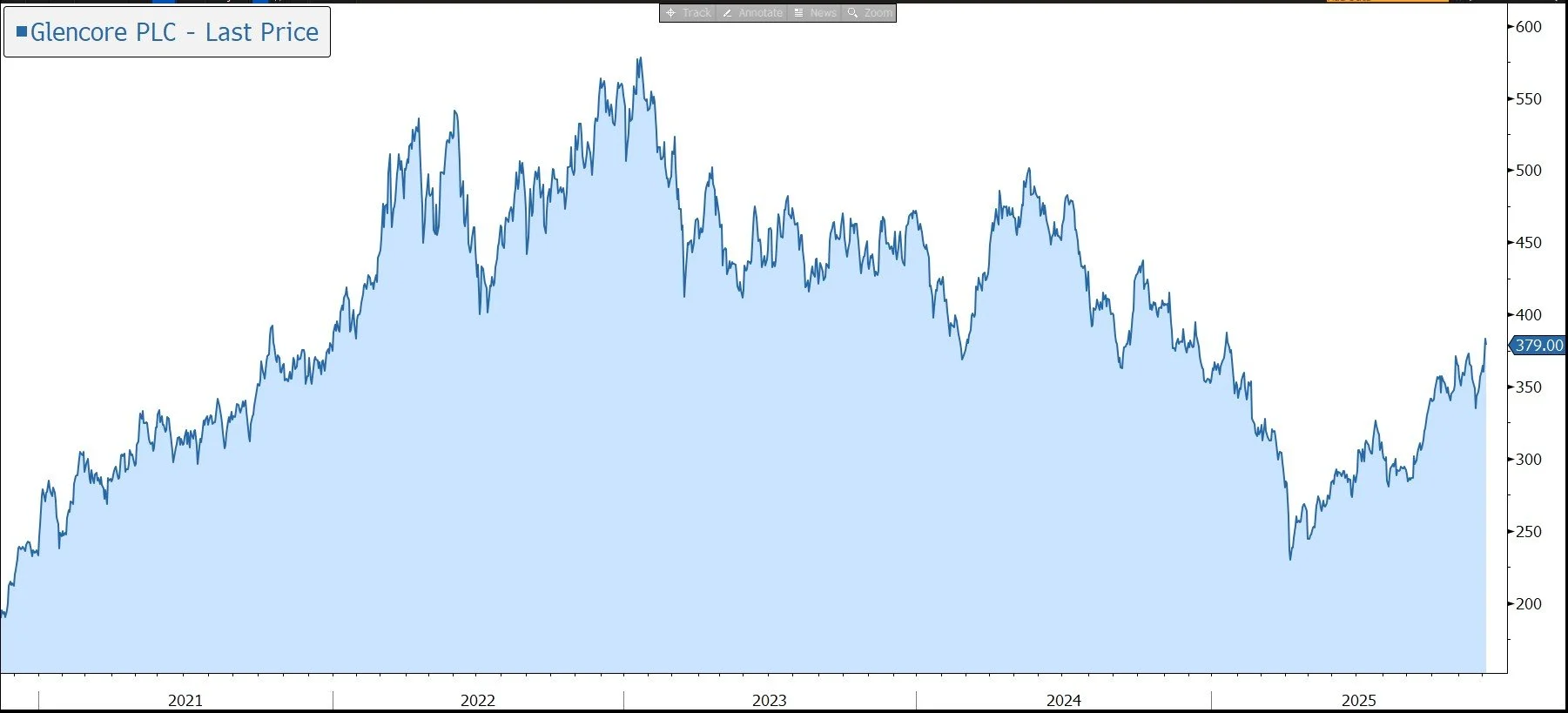
Yesterday afternoon Glencore hosted a Capital Markets Day. In its first such presentation since 2022, the company outlined plans to substantially expand copper production and provided brief updates on its energy and marketing units. Although there are execution risks given the company’s mixed operational track record – we note the downgrade to 2026 copper production – overall we are encouraged by the announcement. The plans are well funded, and surplus capital will continue to be handed back to shareholders. In response to an upbeat presentation, the shares were marked up by 6%.
Glencore is a vertically integrated commodities business, with a strong position in the production of copper, coal, nickel, zinc, cobalt, and precious metals, and a unique marketing business which markets and distributes commodities sourced from internal production and third-party producers to industrial consumers. The group’s strategy is to own large-scale, long-life, low-cost Tier 1 assets.
Following a period of portfolio simplification, the company has sold or shut 35 assets since 2021. In the meantime, it has undertaken selective M&A of high-quality assets in key/core commodities, including copper/alumina/bauxite and high-quality steelmaking coal.
As part of this process, Glencore has uncovered opportunities to streamline its operating structure and identified at least $1bn of cost savings (against a 2024 baseline). These are expected to be fully delivered by the end of 2026, with more than half targeted for the second half of 2025.
Glencore is a leading producer of critical minerals that are used in low-carbon and carbon-neutral technologies, such as electric vehicles and renewable energy, the outlook for which is underpinned by robust demand and persistent long-term supply challenges. This includes copper, which was the main focus of yesterday’s presentation.
The company has always said it will only increase production when the supply/demand dynamics translates into strong pricing, allowing the company to maximise profitability. Following the recent copper price rise, the company now has the confidence to spend and has set out plans to expand production to 1mt by 2028 and 1.6mt by 2035, making the company one of the largest copper producers in the world.
Growth will be driven by the base business, new and restarted mines, and streamlined operations. The company currently has 1.4mt of incremental long-life annual copper production in planning and approval stages. The plans are derisked to some extent as the targets are not dependent on one mine or process and are often a bolt-on to existing infrastructure. The 2035 figure could be a lot higher given the optionality the group has across its asset base.
Argentina will play a key role in the group’s expansion plans. This follows the roll-out of a tax break programme known as the Large Investment Incentive Regime (RIGI) by the new government. The company is planning to restart its Alumbrera Operation in Q4 2026. However, the major greenfield expansion is El Pachón in Argentina, one of the world’s largest undeveloped resources that the company hopes will underpin its long-term growth.
Glencore is also in talks with Brazilian miner Vale's base metals unit to form a copper joint venture in Canada that could yield around 900kt of the metal over 21 years.
On a disappointing note, the company lowered its production guidance for 2026 from 930k tons to 810kt-870kt partly due to lower ore grade and water constraints at its part-owned Chilean mine Collahuasi. The company also outlined lower 2026 production targets for zinc (700kt-740kt) and cobalt (35kt-40kt).
The second strand of the presentation was the energy business. Glencore is the world’s leading seaborne energy (thermal) coal business, a top-tier steelmaking (coking) coal business, and has a rapidly growing LNG, power, gas, and carbon business. As a result, the company will play a strategic role in supporting the world’s energy needs of today and tomorrow. The company believes global population growth, increased urbanisation, and a growing middle class should continue to drive long-term demand for energy.
Glencore owns a 77% interest in Teck’s steelmaking coal business (EVR) – the remaining stake is owned by Nippon Steel (20%) and POSCO (3%). The assets complement Glencore’s existing thermal and steelmaking coal production located in Australia, Colombia, and South Africa. Following consultation with its shareholders, Glencore is retaining its coal and carbon steel materials business. The company believes the cash generative capacity of the business significantly enhances the quality of the overall portfolio, by commodity and geography, and broadens the company’s ability to fund the growth of its copper portfolio as well as accelerate shareholder returns. Management sees potential upside through synergies as the EVR assets are integrated into the portfolio. The company will continue to oversee the responsible decline of its thermal coal operations.
The company presented briefly on its ‘unique’ marketing business. The unit exploits arbitrage opportunities that continuously emerge as a result of different prices for the same commodities in different locations or time periods. It provides a good hedge against commodity price volatility and finances the $1bn base dividend (see below), although clearly there is always a risk of potential losses because of that volatility. Earlier in the year, the company raised its through-the-cycle long-term adjusted EBIT guidance range for the unit by 16% to $2.3bn-$3.5bn p.a. Given the performance year to date, the company currently expects full-year adjusted EBIT around the mid-point of its target range.
The presentation also included financial considerations. Excluding the various copper growth projects, capex will average $6.5bn p.a. from 2026-2028. The level of additional capex will depend on the pace of new project development. If all project progress, additional capex would be $1bn in 2026, $1.7bn in 2027, and $1.5bn in 2028.
Although the plans to expand the copper business can be self-funded, the company will look at opportunities to reduce financial and operational risk. Potential options include a passive minority stake (maybe from a sovereign wealth fund), an active minority stake (maybe a Japanese trading partner), an active investor, or a strategic partner. However, the company was clear that in order to create the most value it will not syndicate a partner until final investment decision (FID) stage.
The company set out its usual illustrative free cash flow assuming current sport prices, production targets, and cost assumptions. For 2026, free cash flow would be $5.5bn.
Glencore will continue to focus on long-term value creation for shareholders. Since 2021, the company has announced shareholder returns of $25.3bn and surplus capital will continue to be returned.
The company reiterated its commitment that once net debt falls below $10bn (after the base distribution), cash will be periodically returned to shareholders via special cash distributions and/or share buybacks. Over time, the company said this debt threshold could increase. The dividend policy is to pay a fixed $1bn base distribution from the Marketing business, reflecting the resilience, predictability, and stability of the unit’s cash flows, plus a minimum payout of 25% of the Industrial free cash flow.
Overall, while there is increased uncertainty around the impact of geopolitics in the shorter-term, Glencore remains of the view that in certain commodities, the scale and pace of global mine project development will struggle to meet demand for the materials needed in the future. Glencore believes it is well placed to participate in bridging this gap, through the flexibility embedded in both its Marketing and Industrial businesses to respond to global needs.
We believe commodities and resource stocks are inexpensive when compared to financial assets and are relatively under-owned in investor portfolios. Furthermore, the mining sector, and in particular Glencore, has a long history of M&A and we expect further industry consolidation in the future. Most recently, we note the merger agreement between Anglo American and Teck Resources, both of which Glencore has weighed a bid for in the past. A bid for Glencore from Rio Tinto has also been rumoured in the past, an outcome that may now be more likely given Rio has a new CEO.
Source: Bloomberg
