
Morning Note: Market News and an Update from Ceres Power.
Market News
Conflicting statements from the US and Iran over potential peace talks continued to unsettle financial markets. Washington has maintained that negotiations are underway, with the Trump administration reportedly sending a 15-point proposal to Iran via Pakistan aimed at resolving the conflict and reopening the Strait of Hormuz. However, Iran said it has no intention of holding talks with the US and would reject a US ceasefire offer, instead setting its own conditions including sovereign control over the strategic waterway. Meanwhile, deployment of thousands of American troops to the Middle East has fanned fears of a risky ground invasion.
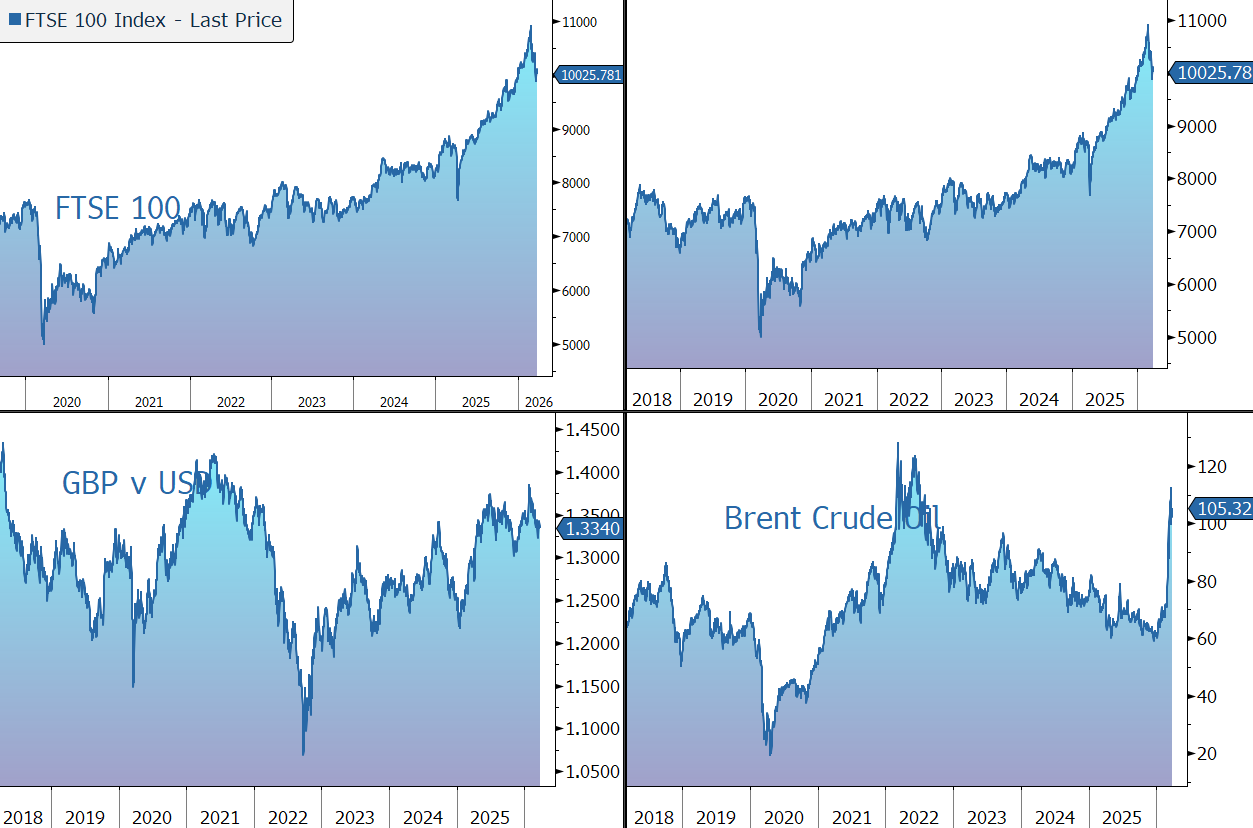
Brent Crude climbed back to $106 a barrel, while the 10-year Treasury yield ticked up to 4.37%. Gold slipped to $4,427 an ounce.
US equities moved higher last night – S&P 500 (+0.5%); Nasdaq (+0.8%). However, the mood turned more negative in Asia this morning: Nikkei 225 (-0.3%); Hang Seng (-2.0%); Shanghai Composite (-1.1%). Technology shares also sold off after a software breakthrough touted by Google researchers called TurboQuant which could make AI models 6x more memory-efficient and 8x faster.
The FTSE 100 is currently 0.4% lower at 10,026. Companies trading ex-dividend this morning include Aviva (4.19%), BAT (1.40%), Prudential (1.29%), and Smith & Nephew (1.49%).
Sterling trades at $1.3390 and €1.1545. UK consumer confidence slumped this month to the weakest reading since the BRC’s tracker began in March 2024.
Lloyd Blankfein warned of a fire risk in private assets, saying a spark may trigger a widespread markdown. An Ares-managed $23 billion private credit fund posted its steepest monthly loss on record in February.
Source: Bloomberg
Company News
Ceres Power has released its 2025 results, with revenue coming in a touch ahead of guidance. During the year, the company’s first partner achieved scaled production, unlocking Ceres’ first royalties, a significant milestone for the business. Revenue guidance for 2026 has been initiated and the company has announced a new strategic partnership with Centrica. In response, the shares have been marked up by 7% in early trading.
Ceres is a world-leading developer of clean energy technology: fuel cells for power generation, electrolysis for the creation of green hydrogen, and energy storage. The company designs and manufactures steel-based Solid Oxide Fuel Cells (SOFC) which, in very simplistic terms, produce electricity when fuel passes through the fuel cell, via a high efficiency electrochemical reaction. The key benefit of the Ceres steel-based version is that it is fuel agnostic – it can use hydrogen, biofuels, and mains fed natural gas. Its power generation efficiency, which is around 60% and can even reach 85% with a heat recovery system, is significantly higher than the efficiency of centralised gas-fired power generation units, which are around 40%-50%. The steel-based structure also means they are more affordable, scalable, extremely robust, and able to operate at lower temperatures. The ‘time to power’ is a further benefit given the long wait times for grid connections or delivery of power units such as gas turbines. The technology can be used in both stationary and transport applications.
The technology is truly reversible – it is also able to generate green hydrogen at high efficiencies and low cost. The solid oxide electrolyser cell (SOEC) technology produces hydrogen up to a third more efficiently than incumbent low temperature technologies particularly when thermally integrated with industrial processes such as chemicals and steel production. Ceres believes its delivers an operating efficiency improvement of around 30%, compared to PEM or alkaline systems.
The company highlights that over the past year or so power and hydrogen markets have experienced opposing trends, with significant changes in both the energy and the political landscapes. There has been a marked increase in near-term demand for fuel cells for power solutions in contrast to challenges in the demand and rate of deployment for hydrogen projects. There is now growing demand for clean power that can be deployed rapidly and the company’s licensees’ first products are targeting this power market which is being driven by increased demand from AI data centres and electrification. The hydrogen market continues to be a significant opportunity for both Ceres technology and its licensees but management believe this will follow the power market, benefiting from the maturity and scale achieved by the company’s partners.
The group’s asset-lite business model remains focused on multi-year development partnerships with global original equipment manufacturers (OEMs) to jointly develop products using the technology. Ceres receives a license fee for the initial use of the system technology, engineering fees during product development, and royalties upon commercialisation. This strategy allows for broader market reach and generates high margins.
The company currently has SOFC licensing agreements and joint development projects with some of the world’s largest engineering and technology companies, such as Weichai Power in China (also a 20% shareholder in Ceres), Miura in Japan, and Doosan in Korea. These cover multiple uses including residential boiler systems, range extenders, data centres, marine transport, and stationary power back-up.
In November, the company signed a new manufacturing licence agreement for the production of Ceres’ proprietary SOFC technology with Weichai Power. Weichai intends to establish a manufacturing facility to produce cells and stacks for the stationary power markets supported by key components supplied from Ceres, targeting power for AI data centres, commercial buildings, and industrial applications. The agreement supersedes existing agreements with Weichai and will generate significant revenue and cash generation from licence fees, milestones, and royalties that are consistent with previous Ceres manufacturing licensing agreements. Licence revenues will begin to be recognised in the first half of 2026.
In July, Doosan Fuel Cell commenced mass market production of fuel cell stacks using Ceres’ solid oxide technology. Doosan is manufacturing the stacks and fuel cell power systems at its dedicated factory in South Korea with the ability to produce a combined generational capacity of 50MW of electrical power each year. This marks a significant milestone for Ceres, as Doosan is the first of its strategic licensing partners to enter mass production using its technology. The products are targetting growth applications including AI-driven data centre power, energy grid stabilisation, power systems for buildings, and auxiliary power for marine. These early shipments have generated the group’s first royalty revenues, marking the beginning of a scalable, high-margin future income stream.
This morning, the company has announced a strategic partnership with Centrica to deploy multi-gigawatt on-site fuel cell power solutions across the UK and Europe, addressing the growing demand and grid connection delays faced by commercial and industrial customers. This collaboration combines Centrica’s energy supply and services expertise with Ceres’ SOFC and SOEC technologies, enabling fast, scalable deployment of high-efficiency, fuel-flexible on-site generation for sectors like data centres and advanced manufacturing.
The main negative for the company was decision in February 2025 by German engineer Bosch to end its partnership with Ceres. This was part of a revised strategy by Bosch and did not reflect its confidence around Ceres or its technology. The financial impact for 2025 will be limited, in the low single-digit millions of euros. Bosch was a 17.4% shareholder in Ceres, which it intends to divest in an orderly manner. Although the stake has since been reduced to 12.9%, it still provides something of an overhang.
On the SOEC side, the group has entered into a number of deals:
- a partnership with Shell to utilise the technology to deliver high-efficiency, low-cost green hydrogen. The company’s first megawatt SOEC demonstrator system, located at Shell’s Technology Centre in Bangalore, India, is now producing an industry-leading electrolyser module efficiency of 37kWh/kg of hydrogen, with performance exceeding expectations.
- a global long-term manufacturing collaboration and licence agreement with Delta Electronics of Taiwan for fuel cell stack production. This agreement also covers SOFCs. Delta has committed £170m on assets for the large-scale manufacturing of hydrogen energy solutions, including on Ceres’ technology, for AI-driven data centre power, microgrid and other energy infrastructure applications.
- an SOEC systems licence with Thermax, a leading provider of energy and environment solutions based in India. The agreement includes (as yet undisclosed) licence fees and product royalties to be received by Ceres. Ground was broken on a SOEC pilot plant earlier this year.
- a long-term licence agreement with Denso of Japan for the manufacture of Ceres’ proprietary SOEC for hydrogen applications. The agreement includes ‘significant’ (as yet undisclosed) revenue for Ceres over multiple years. In September, Denso begun Japan's first demonstration of SOEC hydrogen production at a JERA (Japan’s largest power generation company) thermal power station.
Back to the results, in 2025, revenue fell by 37% to £32.6m, versus guidance of £32m. The reduction primarily reflects the timing of revenues recognised in 2024, when up‑front technology transfer activities were completed for the group’s new manufacturing licence partners, Delta and Denso. Revenue was split between engineering services & licences (68.1%), provision of technology hardware (31.5%), and royalties (0.3%).
The gross margin slipped from 77% to 70%, as a result of the lower revenue. Operating costs decreased by 6% to £70.1m following the cost base rationalisation announced in 2024 and continued financial discipline. However, the operating loss widened from £31.3m to £47.6m as a result of the revenue decline.
The company reduced its cash outflow from £37.5m to £19.2m, driven by substantial partner receipts and continued disciplined cash management. As a result, cash and short-term investments fell from £102.5m to £83.3m as at 31 December 2025.
As a result of the developments by the group’s partners, Ceres has now crossed over from being an R&D company to one that is firmly in a commercial production phase. To drive and support this, Ceres is undertaking a 12-month business transformation programme that will prepare the company for the next phase of growth. Specifically, by the end of 2026, Ceres will have: restructured and realigned the business to the market opportunity; commercially launched its best in class, dual purpose stack platform serving both power and hydrogen markets; and reduced its operating costs, so that operating expenses are expected to fall by around 20%. The cost of the programme will be around £1m.
Ceres has issued new revenue guidance for 2026 of approximately £45m before any new business.
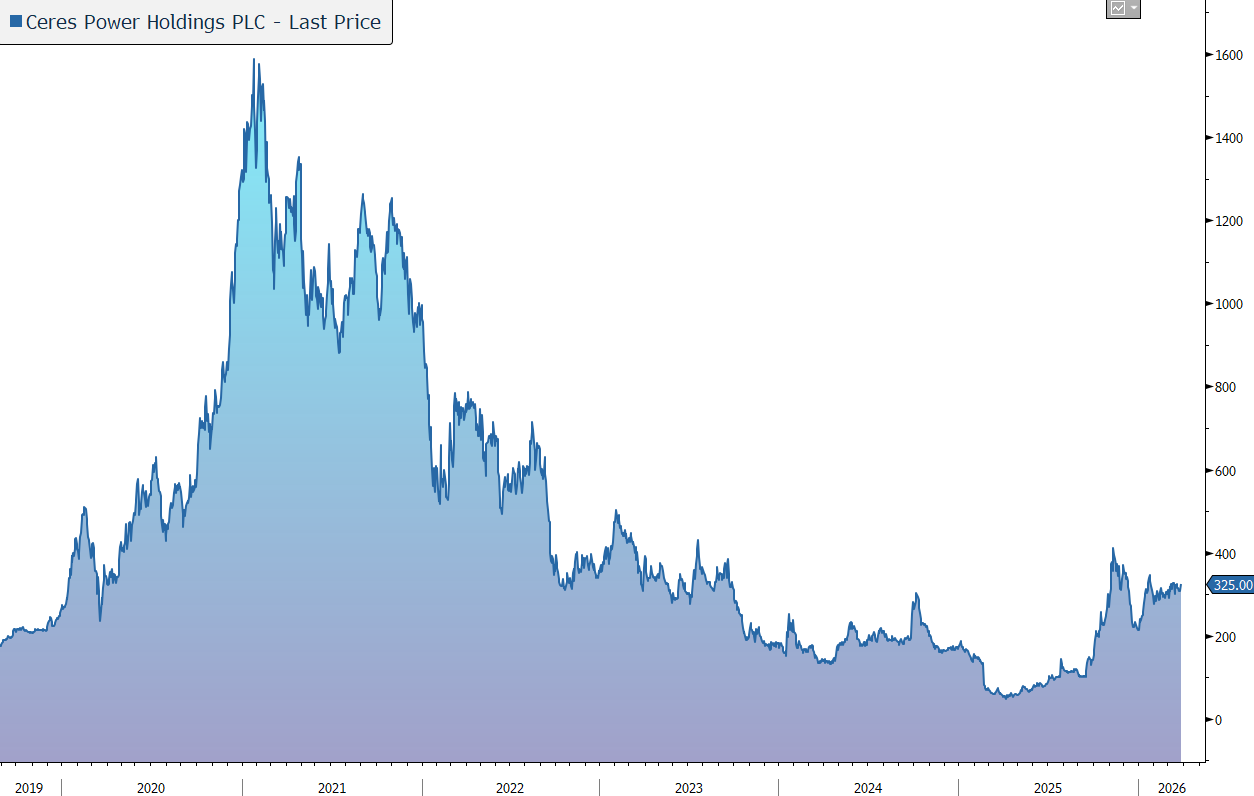
The shares trade on the LSE Main Market. In the three years from the end of 2021, the share price fell heavily driven by rising bond yields and the failure to complete a 3-way joint venture agreement with Weichai and Bosch, and the subsequent decision by Bosch to terminate its contract with Ceres and reduce its stake. More recently, however, the stock has rallied on the back of positive contract developments.
Source: Bloomberg
